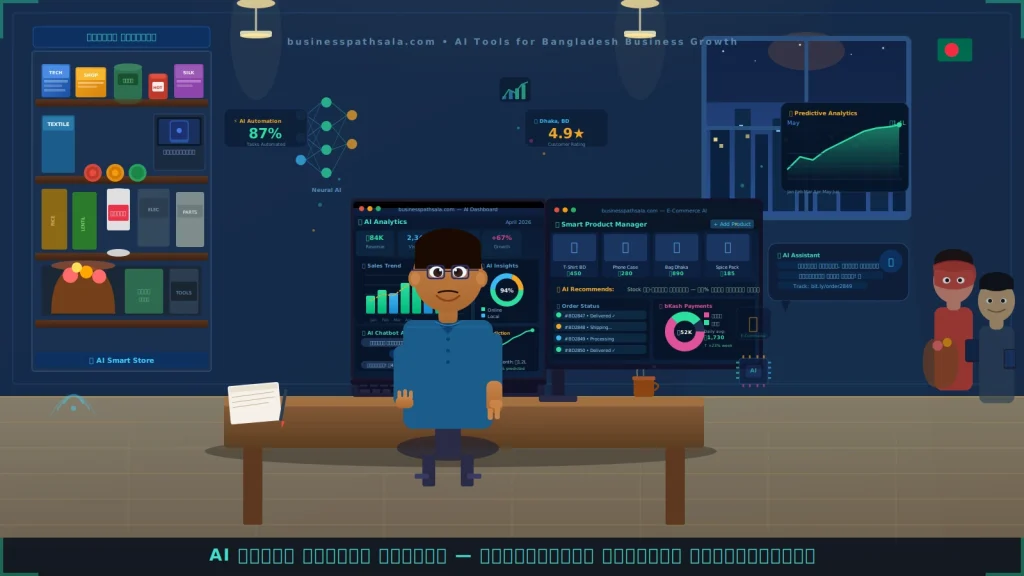
Small and medium enterprises (SMEs) in Bangladesh can grow their business by adopting affordable and scalable AI tools to automate marketing, optimize operations, enhance customer service, and make smarter decisions. Whether running an online store in Dhaka or a manufacturing unit in Chittagong, AI can help SMEs reduce costs, increase sales, and compete more effectively—without needing deep technical expertise or huge budgets.
I personally advise some entrepreneurs to use AI tools to scale their business because without them, their business will fail like Nokia’s mobile phone in the market.
Why AI Adoption Is Crucial for Bangladeshi SMEs
As Bangladesh’s economy digitizes rapidly, many small businesses still rely on manual processes—from handwritten ledgers to manually posting on social media. AI isn’t a futuristic luxury anymore; it’s a practical growth tool.
AI Levels the Playing Field
Unlike expensive software once reserved for big companies, many modern AI tools are cloud‑based and subscription‑friendly. This means even micro‑businesses can use powerful algorithms for content creation, customer insights, and process automation.
Addressing Local Challenges
- High labor costs for repetitive tasks
- Manual inventory and accounting errors
- Limited reach on social media
- Competition from online brands
AI helps solve these by offering automation, accuracy, and speed at a fraction of traditional costs.
Transform Marketing with AI
Marketing is one of the easiest areas where SMEs can see immediate impact from AI.
AI‑Powered Content Creation
Creating content in Bangla that feels natural takes time. AI tools like ChatGPT can assist in generating blog posts, product descriptions, email copy, and social media captions in fluent Bangla and English. Visual AI tools like Canva’s generative features make it possible to produce attractive graphics and short videos without a designer.
Benefits:
- Faster content production
- Consistent brand voice
- Cost savings on agencies
Hyper‑Personalization for Customer Engagement
AI analyzes customer behavior (past purchases, clicks, browsing time) to create personalized recommendations and offers. For example, an online boutique can serve different product suggestions to repeat buyers vs. first‑time visitors.
Results:
- Higher conversion rates
- Increased customer loyalty
- More repeat purchases
Targeted Advertising Optimization
Platforms like Meta and Google now include AI analytics that automatically identify users most likely to convert. This helps reduce “wasted ad spend” and increases the return on investment (ROI) for marketing budgets.
Instead of blasting the same ad to everyone, AI helps tailor ads to users based on preference signals.
Boost Operational Efficiency with AI
Operational efficiency is where SMEs can save the most money and time.
Bangla AI Chatbots for 24/7 Support
AI chatbots that speak Bangla and English can handle customer questions 24/7—whether it’s order tracking, FAQs, or payment queries. On platforms like Facebook Messenger or WhatsApp Business, chatbots can instantly respond to users, allowing human staff to focus on higher‑value tasks.
Impact:
- Faster response times
- Reduced customer support costs
- Better customer experience
Predictive Inventory & Supply Chain Management
Inventory planning is a common pain point for sellers and manufacturers. Predictive AI tools can analyze historical sales trends and external factors (e.g., festivals, seasonality) to forecast demand more accurately.
Benefits include:
- Reduced stockouts
- Lower excess inventory
- Fewer losses due to perishable goods
Automating Administrative Tasks
AI‑powered systems can handle routine tasks like:
- Billing and invoicing
- Data entry
- HR payroll
- Expense tracking
This not only cuts errors but saves hours of managerial time every week.
Improve Decision‑Making with AI Insights
Data without insight is just numbers. AI bridges the gap between data and smart decisions.
Predictive Analytics
AI can forecast future trends—whether predicting sales during peak seasons or understanding when demand will slow. This helps SMEs plan production and marketing more strategically.
Customer Sentiment Analysis
Modern AI tools analyze reviews, comments, and feedback across social platforms to understand customer sentiment. Businesses can react faster to negative trends and reinforce messages that customers love.
Financial Forecasting
Cash flow forecasting helps SMEs avoid crunches. By learning from historical data, AI tools can predict expenses and revenue trends, giving business owners better financial clarity.
Overcoming Challenges for AI Adoption in Bangladesh
AI adoption isn’t automatic. SMEs often face barriers, but all are solvable.
Limited Technical Expertise
Many business owners feel they “don’t understand AI.” Training programs offered by organizations like the SME Foundation and online platforms like Coursera or Udemy can build essential skills. Hiring freelance AI specialists is another cost‑effective option.
Cost Concerns
While some AI enterprise tools are expensive, many small business‑friendly options use subscription pricing that fits modest budgets. Cloud‑based AI also eliminates the need for costly servers and hardware.
Data Privacy & System Integration
Bangladesh is strengthening data protection awareness, and SMEs should adopt best practices—secure customer data, use encrypted tools, and ensure compliance. Most AI tools offer easy integration with existing systems such as CRMs and e‑commerce platforms.
AI Tools & Platforms Recommended for Bangladeshi SMEs
Here are practical AI tools SMEs can start using today:
Marketing & Content
- ChatGPT – AI content in Bangla/English
- Canva AI – Design automation
- Lumen5 – AI video creation
Customer Support
- WhatsApp Business API Chatbots – 24/7 shopping support
- ManyChat / Tidio – AI chat automation
Operations & ERP
- Odoo – AI‑assisted workflow automation
- Zoho ERP – Business process AI tools
- Microsoft Dynamics 365 – AI modules for operations
Analytics
- Google Analytics 4 (GA4) – Predictive metrics
- Power BI / Tableau – AI‑enhanced dashboards
Real‑Life Case Studies in Bangladesh
Practical examples help illustrate AI’s impact.
Case 1: E‑Commerce Boutique in Dhaka
A clothing retailer implemented AI chatbots and personalized product suggestions. Within three months:
- Customer response time dropped by 80%
- Repeat purchase rate rose by 25%
Case 2: Garments Supplier in Chittagong
Using predictive inventory AI reduced excess stock by 20% and lowered waste, improving profit margins during peak seasons.
These examples show that AI doesn’t require mega budgets—just the right tools and strategy.
Step‑by‑Step Roadmap to Implement AI
- Identify Major Pain Points
Marketing? Operations? Support? Start where the impact will be fastest. - Select Appropriate Tools
Match business needs to tools—start with one area before scaling. - Train Your Team
Even basic training helps staff leverage AI responsibly. - Pilot & Measure
Run a pilot project (e.g., chatbot for 30 days), measure outcomes, and adapt. - Scale Gradually
Expand AI tools to more business areas once initial results prove value.
Future AI Opportunities for Bangladeshi SMEs
AI adoption isn’t static. New areas for growth include:
- AI‑powered personalization engines in e‑commerce
- Smart logistics using AI and IoT
- Voice commerce and AI assistants
- Automated translation tools for global reach
Investing in future AI capabilities puts SMEs ahead of competition even as markets evolve.
FAQs
1. Can SMEs in Bangladesh afford AI tools?
Yes. Many tools use affordable subscriptions and cloud delivery, eliminating large upfront costs.
2. Do AI chatbots work well in Bangla?
Yes, modern language models support Bangla, enabling natural conversation and better engagement.
3. How soon do SMEs see results?
Some tools show impact in weeks (e.g., chatbot response times), while deeper adoption (like predictive analytics) may take a few months.
4. Which sectors benefit most from AI?
E‑commerce, retail, supply chain, manufacturing, and services all benefit significantly.
5. Are there local programs supporting SMEs?
Yes—organizations like the SME Foundation and ICT Ministry offer training and incentives for digital transformation.
Conclusion
AI is no longer a luxury for big corporations—it’s a practical growth engine for SMEs in Bangladesh. From automating repetitive tasks to improving customer engagement, AI delivers measurable value when applied strategically. Start small, choose cost‑effective tools, and scale over time. By embracing AI today, Bangladeshi SMEs can increase productivity, improve customer satisfaction, and stay competitive in a rapidly evolving digital economy.
we are working for some automation tools. keep in eyes our Facebook for updates.