A complete, practical guide to building a 100% halal and riba-free business — with startup capital, Islamic finance partners, and real-world strategies for every idea.
Top Shariah-compliant business ideas in Bangladesh for 2026 include halal food manufacturing, modest fashion e-commerce, Islamic financial consulting, eco-friendly farming using Mudarabah, and halal logistics. All ideas follow three core Islamic principles — avoiding Riba (interest), avoiding Gharar (uncertainty), and ensuring asset-backed transactions. Entrepreneurs can access riba-free startup financing through Islami Bank Bangladesh, Al-Arafah Islami Bank, and PKSF Islamic microfinance windows.
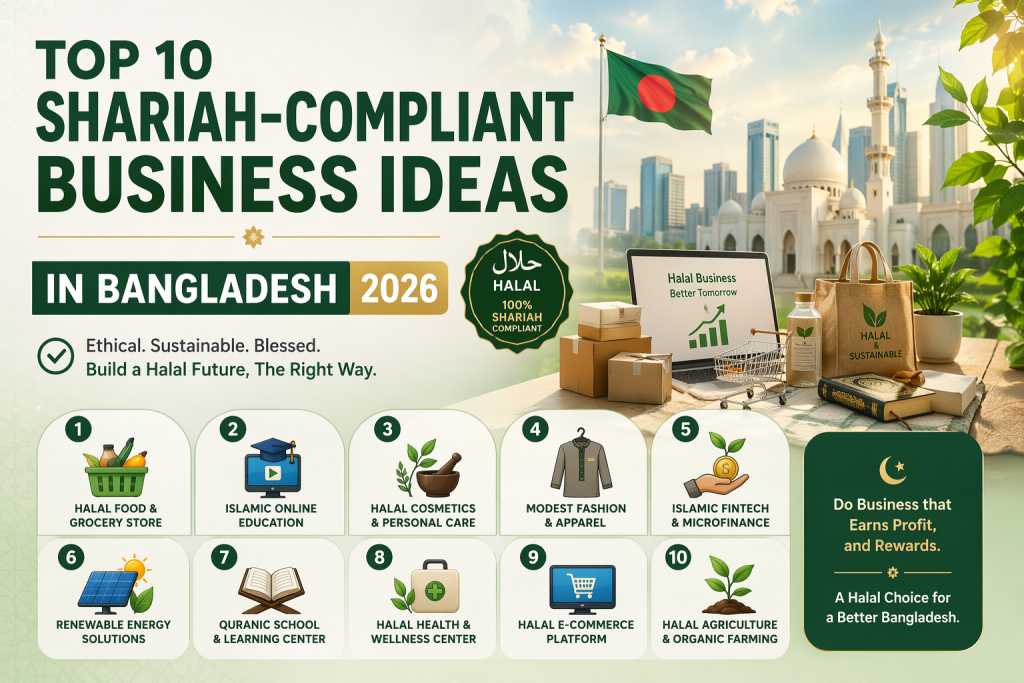
- Halal Food Manufacturing & BSTI Certification
- Modest Fashion E-commerce (Wakalah Model)
- Islamic Financial Consulting & Zakat Advisory
- Halal Organic Skincare (Istisna’a Structure)
- Eco-Friendly Farming (Agri-Mudarabah)
- Halal Real Estate (Ijarah Lease-to-Own)
- Islamic EdTech Platform (Ujrah Model)
- Halal Logistics & Cold Chain Solutions
- Sukuk Investment Advisory & Brokerage
- Halal IT Agency & Ethical Freelance Hub
Is Your Business Truly Halal? Here’s What Most Muslims in Bangladesh Miss
Here is a number that should give every Muslim entrepreneur in Bangladesh pause: according to Bangladesh Bank’s Annual Report, over 78% of small business financing in this country still flows through conventional, interest-bearing bank loans — riba, plain and simple. This is not a small oversight. This is the central contradiction of Muslim entrepreneurship in Bangladesh today.
We obsess over whether the chicken we eat is halal-certified. We check labels. We ask questions. And yet, when it comes to how we fund, structure, and operate our businesses — the economic activity we spend 10 to 14 hours a day doing — most of us have never stopped to ask: Is the way I’m doing this business actually permissible in Islam?
This is the gap this guide is written to close.
Most people think “halal business” means selling food or clothing that has Islamic certification. But Islamic commercial law (fiqh al-mu’amalat) is far broader than that. In Islam, the permissibility of a business is judged across three distinct layers simultaneously:
Layer 1 — The Product
Is what you sell or provide permissible? Food, clothing, digital services, education — the product or service itself must be halal.
Layer 2 — The Financing
Is how you funded it riba-free? Even a 100% halal product becomes tainted when financed with an interest-bearing conventional bank loan.
Layer 3 — The Contract
Is how you transact free from Gharar (uncertainty) and Maysir (speculation)? Vague terms, hidden markups, and gamble-like agreements violate Islamic commercial law.
All three layers must be satisfied simultaneously. A business that passes on Layer 1 but fails on Layer 2 is not a Shariah-compliant business — it is simply a halal product sold through a haram financial structure.
This guide covers 10 business ideas that pass all three layers, with each idea including:
- Startup capital in BDT (realistic, not inflated)
- The specific Islamic finance structure it uses
- Which Islamic bank or institution in Bangladesh to approach
- The most common haram pitfall entrepreneurs fall into — and how to avoid it
- A concrete first step you can take this week
This is not just ideas—every business here can really be started in Bangladesh in 2026 using systems and organizations that already exist.
Why 2026 Is Bangladesh’s Most Important Year for Halal Business Growth
Ten years ago, if you wanted to start a Shariah-compliant business in Bangladesh, you faced a real infrastructure problem. Islamic finance was limited, halal certification was difficult to access, and there were almost no structured platforms for Muslim entrepreneurs to connect with Islamic investment. That has changed substantially — and 2026 represents the first year where all the pieces are genuinely in place.
The Numbers Behind Bangladesh’s Islamic Economy
Bangladesh’s Islamic banking sector is no longer a minor footnote. It is a significant pillar of the financial system, and the numbers reflect that:
| Indicator | Data | Source |
|---|---|---|
| Islamic banking share of total banking assets | ~25% | Bangladesh Bank Annual Report |
| Number of full-fledged Islamic banks | 10 banks | Bangladesh Bank, 2024 |
| First sovereign Sukuk issued | ৳8,000 crore | BSEC, 2020 |
| Halal food export potential by 2030 | $5 billion | FBCCI estimate |
| Muslim population of Bangladesh | 91% | Bangladesh Bureau of Statistics |
| Global halal economy market size (2024) | $7.7 trillion | Dinar Standard Global Islamic Economy Report |
What these numbers tell us is simple: the infrastructure for halal business is now mature enough to support entrepreneurs at every level — from someone starting a modest fashion dropshipping business with BDT 20,000 to someone developing halal cold chain logistics with Islamic bank financing. The question is no longer “Can I build a halal business in Bangladesh?” The question is “Why haven’t I started yet?”
The 3 Core Principles Every Shariah-Compliant Business Must Follow
No Riba — No Interest
All financing must come through profit-sharing, leasing, or fee-based structures — not conventional interest-bearing loans. Bangladesh has 10 full-fledged Islamic banks to serve this need.
No Gharar — No Uncertainty
Contracts must be clear, specific, and based on tangible assets or defined services. Vague deliverables or hidden terms invalidate a transaction under Islamic law.
No Maysir — No Speculation
Business income must come from real economic activity, not speculation, derivatives, or chance-based returns. Real value must be exchanged in every transaction.
Islamic Finance Structures — Quick Reference Table
Throughout this article, you will encounter specific Islamic finance terms. Here is a plain-language reference to use as you read each business idea:
| Islamic Term | Plain English Meaning | Used For |
|---|---|---|
| Mudarabah | Investor funds, entrepreneur works, profits shared by agreed ratio | Farming, investment ventures |
| Ijarah | Islamic leasing — you pay rent, not interest; ownership may transfer at end | Real estate, logistics, equipment |
| Musharakah | Joint venture where all partners contribute capital and share profit/loss | Manufacturing, fintech, partnerships |
| Istisna’a | Commissioned manufacturing — you specify the product, a party produces it | Skincare, food production |
| Wakalah | Agency contract — you act as a representative and earn a disclosed fee | E-commerce, consulting, brokerage |
| Sukuk | Asset-backed Islamic financial certificate (Islam’s version of bonds) | Investment advisory |
| Ujrah | A fee charged for a permissible service or skill | EdTech, IT services, consulting |
| Murabaha | Cost-plus sale — bank buys an asset and sells it to you at a disclosed markup, in installments | Equipment, inventory purchase |
| Bay’ al-Salam | Advance payment for future goods — permitted in hadith for agricultural trade | Food manufacturing, farming |
Top 10 Shariah-Compliant Business Ideas in Bangladesh 2026
Each business idea below follows a consistent format designed to give you everything you need to evaluate whether it suits you — not just an inspiration list, but a decision-making framework. Read the Islamic structure, the local market context, and especially the “haram pitfall” section for each. That last piece is what separates serious halal entrepreneurs from those who accidentally drift into impermissible territory without realising it.
Halal Food Manufacturing & BSTI Certification Consultancy
Bangladesh’s single biggest halal business opportunity in 2026 is not about what you produce — it is about the certification gap that sits between local food producers and global export markets.
Here is the situation: Malaysia, the UAE, Saudi Arabia, and Qatar require official halal certification for virtually all food products they import. Bangladesh exports hundreds of millions of dollars worth of food annually. And yet, fewer than 12% of Bangladeshi food SMEs hold BSTI halal certification — the standard required for most halal-demanding export markets. That gap is your business opportunity.
You can enter this space in two ways. The first is the direct manufacturing path — producing halal-certified packaged food (spices, snacks, dairy-adjacent products, organic produce) under BSTI certification. The second — and significantly more overlooked — is the consultancy model: helping existing small food factories navigate the BSTI halal audit process, prepare their documentation, and achieve certification. Zero inventory, zero production risk, pure knowledge-based service income.
Why It’s Shariah-Compliant
Physical food trade using Bay’ al-Salam — where the buyer pays in advance for a defined quantity of goods to be delivered at a future date — is explicitly mentioned in authentic hadith as a permitted transaction. The Prophet ﷺ said: “Whoever pays in advance for dates (to be delivered later) should pay for a known volume and weight, for a known period.” (Bukhari, Muslim). The consultancy model operates purely on Ujrah — a fee for a permissible professional service.
Unique Sub-Idea: The Halal Certification Consultant
This is the angle that virtually no other article on this topic covers. Rather than manufacturing, you become the bridge between food producers and BSTI’s halal certification process. The process involves ingredient documentation, factory inspection preparation, Shariah board coordination, and follow-up. Food factory owners — especially in areas like Gazipur, Narayanganj, and Narsingdi — understand production but are often completely lost in the certification process. A consultant who speaks their language and understands BSTI’s requirements is worth real money to them.
Modest Fashion E-commerce Using the Islamic Wakalah Dropshipping Model
Modest fashion is one of the most rapidly growing segments of the global Muslim consumer economy. The global modest fashion market was valued at approximately $318 billion in 2023 and is projected to reach $500 billion by 2030 (Dinar Standard). Bangladesh — home to one of the world’s largest garment manufacturing sectors — sits at the centre of this opportunity and has barely touched it.
The Wakalah dropshipping model is what makes this both Shariah-compliant and practically accessible. Here is how it works: instead of buying hijabs, abayas, or modest wear upfront and holding inventory (which carries financial risk and requires capital), you enter into a formal Wakalah (agency) agreement with a supplier. Under this contract, you act as their authorised agent. When a customer places an order with you, you notify the supplier, who fulfils the order. You earn a pre-agreed, disclosed fee or margin — not speculative profit. Crucially, the product is never technically “sold” before it exists, eliminating Gharar.
Why Bangladesh Has a Structural Advantage Here
Dhaka’s garment industry gives Bangladeshi entrepreneurs access to modest wear at prices that sellers in Malaysia, the UK, or the UAE simply cannot match. Mirpur’s fabric markets and the ready-made garment clusters in Gazipur produce high-quality scarves, kaftans, and modest wear at factory pricing. A Bangladeshi seller who sources smartly can offer premium modest wear to Western Muslim consumers at competitive prices while maintaining healthy margins.
Islamic Financial Consulting & Zakat Advisory Services
Of all ten ideas in this article, this one has the most asymmetric opportunity: the demand is enormous, the supply is essentially zero, and the startup cost is among the lowest of any professional service business.
Bangladesh has over one lakh (100,000) registered SMEs in Dhaka Division alone. Every one of these businesses that is owned by a Muslim has a Zakat obligation on its commercial inventory, receivables, and cash holdings. Almost none of them calculate this correctly, because there is no structured private Zakat advisory industry in Bangladesh. The Islamic Foundation handles Zakat education at a national level, but there is no equivalent of an accounting firm that helps businesses calculate and properly distribute their Zakat — the way tax advisory firms handle income tax.
Beyond Zakat, there is growing demand for halal investment screening, Shariah audit services for small businesses wanting to certify their compliance, and Islamic financial planning for individuals who are saving for Hajj, marriage, or retirement without wanting to touch interest-bearing instruments.
Revenue Streams You Can Build
This business has multiple income layers that can grow with your reputation. A one-time Zakat audit for a small business (calculating Zakat on inventory, cash, receivables) can command BDT 5,000–25,000, depending on business complexity. Monthly retainers for ongoing Shariah compliance monitoring can range from BDT 3,000–15,000 per client. An online Zakat calculator tool on your website, monetised through AdSense or as a premium download, can generate passive income. As your reputation grows, speaking engagements at corporate Islamic finance events add another revenue stream entirely.
Halal Organic Skincare Manufacturing — The Istisna’a Model
The halal cosmetics market globally reached $46 billion in 2024 and is projected to exceed $100 billion by 2032, according to the Global Islamic Economy Report. Yet in Bangladesh — a country of 90+ million Muslim women — there is not a single established local halal-certified skincare brand with meaningful market presence. That gap is extraordinary.
Urban Bangladeshi Muslim women, particularly the growing segment who wear hijab, are increasingly careful about what they apply to their skin — not just for health reasons, but for religious ones. Wudu validity is affected by products that form a waterproof layer on the skin (like many commercial foundations). Alcohol-based perfumes and toners are avoided by practising Muslims. And with the Korean beauty wave now reaching Bangladesh, there is active demand for a “halal K-beauty alternative” — products that are gentle, effective, and religiously compliant.
The Istisna’a model makes this business Shariah-compliant from the financing side. Under Istisna’a, you commission a local cosmetic laboratory to produce your formulated product. You define the specifications — ingredients, quantity, packaging — and the lab manufactures to those specs. No conventional loan is involved. The contract is specific, the asset is tangible, the delivery date is defined. This is one of the cleanest Islamic manufacturing contracts available.
Halal Ingredient Checklist — Know What to Avoid and What to Use
- Ethanol / alcohol above 0.5% — Replace with rose water or witch hazel
- Carmine (red dye from cochineal insects) — Replace with beetroot extract or iron oxide
- Placenta extract (often porcine) — Replace with plant stem cell extracts
- Collagen from pork — Replace with marine or plant-based collagen
- Lard or tallow without verified halal source — Replace with shea butter or kokum butter
- Black seed (Nigella sativa) oil — Sunnah ingredient with proven dermatological benefits
- Argan oil, rosehip oil, jojoba oil — 100% plant-based, widely available
- Raw honey and beeswax — Permissible and effective in skincare formulations
- Turmeric, neem, aloe vera — Locally sourced, cost-effective, halal
Certification Path
For the domestic Bangladesh market, pursue BSTI halal mark certification. For export to Malaysia (a premium market), pursue JAKIM certification — Malaysia’s Department of Islamic Development is the gold standard in global halal cosmetics certification and opens doors to a $10 billion+ Malaysian halal cosmetics market. The export premium is significant: products certified under JAKIM can command 30–50% higher pricing in Malaysian and Gulf markets.
Eco-Friendly Halal Farming Using Agri-Mudarabah
Agriculture is where Islamic finance was born. The Prophet ﷺ himself validated Mudarabah-style partnerships in agricultural contexts, and the people of Madinah used this exact structure for date palm farming for centuries before the formal development of Islamic finance theory. In Bangladesh in 2026, this ancient model is being given new institutional life — and the opportunity it creates is real.
The Agri-Mudarabah structure works like this: an investor (the Rabb ul-Maal) provides the capital — seeds, fertiliser, land lease costs, irrigation. A farmer (the Mudarib) provides land, expertise, and labour. At harvest, profits are split by a pre-agreed ratio, written into a formal contract. If the harvest fails due to natural causes (not negligence), the investor bears the financial loss and the farmer bears the loss of their labour time. This is the oldest profit-sharing model in recorded human commerce, and it is completely riba-free by design.
PKSF — the Palli Karma-Sahayak Foundation — has been formalising Islamic microfinance windows across its 208 partner organisations throughout Bangladesh, making structured Agri-Mudarabah financing accessible even in rural areas that have never had contact with formal Islamic banking before.
High-Value Crops With Halal Premium Pricing
Not all crops are equal in terms of profitability for a halal farming enterprise. These four carry premium market potential in Bangladesh in 2026:
- Kalonji (Black Seed / Nigella sativa): A Sunnah food item with documented health benefits. Currently selling at BDT 800–1,200 per kg in Dhaka markets. Urban health-conscious Muslim buyers pay premium prices for organic, farm-certified Kalonji. Export demand from Islamic health supplement companies is growing.
- Organic Turmeric: International export demand for pesticide-free Bangladeshi turmeric is rising. EU and Gulf market buyers pay certification premiums.
- Moringa: Increasingly popular in Islamic health communities for its nutritional density. Moringa leaf powder commands BDT 600–1,000 per kg in urban health shops.
- Strawberries for Urban Dhaka Delivery: High-margin luxury agricultural product for Dhaka’s growing upper-middle-class. Facebook delivery groups have created direct farm-to-consumer models that cut out middlemen entirely.
Halal Real Estate & Property Using Ijarah Muntahia Bittamleek
Real estate is where most aspiring Muslim investors in Bangladesh feel the sharpest conflict between their religious values and economic reality. Property prices in Dhaka are high enough that almost no one can purchase without financing — and most financing means a conventional bank mortgage, which is straightforwardly riba. So Muslim entrepreneurs either compromise their principles and take the riba loan, or they stay out of real estate entirely. Neither outcome is necessary.
Ijarah Muntahia Bittamleek — which translates to “leasing that ends in ownership” — is an Islamic home financing product officially offered by both Islami Bank Bangladesh and Al-Arafah Islami Bank. Here is how it fundamentally differs from a conventional mortgage: in a conventional mortgage, the bank lends you money and you pay it back with interest. In Ijarah, the bank purchases the property itself, owns it outright, and then leases it to you. You pay rent — not interest. Alongside the lease, a separate purchase agreement gradually transfers ownership to you over the financing period. At the end of the term, you own the property. You have never paid a single taka of riba.
The distinction is not semantic. It is structural. The bank’s income is rental income from a property it owns — not interest on a loan. This is a fundamentally different economic transaction.
The Halal Property Broker Model — Start With Zero Capital
You do not have to invest in property yourself to build a real estate business around Islamic financing. The most accessible entry point is as a Halal Property Broker — a specialist who connects Muslim property buyers exclusively with Islamic bank financing options. You earn a standard brokerage commission (Ujrah) for making the introduction and facilitating the transaction. No capital required, no property purchased, no personal financial risk. Your value is knowledge: you understand which banks offer Ijarah products, what the documentation requirements are, and how to navigate the process — knowledge that most buyers desperately lack.
Islamic EdTech Platform — Quranic Education Meets Vocational Skills
Bangladesh has approximately 9,000 registered madrasas, with hundreds of thousands of graduates who emerge with strong Islamic knowledge — Quranic memorisation, Arabic literacy, fiqh understanding — but almost no practical digital income skills. They are educated in one world and expected to earn a living in another. Nobody has seriously built the bridge between these two worlds. That bridge is a significant business opportunity.
The concept here is a dual-purpose EdTech platform: Islamic education (Quran, Arabic, Islamic finance, seerah) combined with vocational digital skills (freelancing fundamentals, digital marketing, graphic design basics, content writing). The target audience is madrasa-educated youth who are deeply uncomfortable with conventional online learning platforms — which often use mixed-gender imagery, background music, and content that conflicts with Islamic values — but who are eager to earn halal income through digital work.
The subscription fee model operates as Ujrah — a permissible fee for a permissible service. This is one of Islam’s most encouraged income sources: the Prophet ﷺ said, “The most rightful income you consume is that which you earn with your hands.” Teaching beneficial knowledge with your hands (or in this case, your mind and voice) is among the most dignified forms of halal income.
The Unique Product: “Halal Freelancing Bootcamp”
The most differentiated product within this EdTech business is a course that teaches not just technical freelancing skills, but the Islamic ethics of professional service: delivering what you promised (Amanah), honest communication with clients (Sidq), timely completion of work, not deceiving clients about your capabilities, and how to refuse projects from haram businesses. This combination of Islamic professionalism and practical skill is completely absent from every other freelancing course in Bangladesh — and it speaks directly to the values of the madrasa-educated demographic who are this platform’s primary market.
Halal Logistics & Cold Chain Solutions — Bangladesh’s Invisible Billion-Taka Opportunity
Bangladesh’s shrimp and fish export industry is worth over $700 million annually and is one of the country’s primary foreign exchange earners. The single largest export market for Bangladeshi frozen seafood is the Middle East. And the Middle East requires halal-certified cold chain logistics — meaning verified separation of halal products from non-halal cargo, maintained throughout the entire supply chain.
Here is the problem: zero logistics companies in Bangladesh specifically market themselves as halal cold chain specialists. No one has claimed this niche. The demand is real, the regulatory requirement is real, and the competitive field is completely open.
Halal logistics goes beyond just transporting food. It means ensuring that the vehicle carrying halal fish was not previously used to transport pork or alcohol without proper cleaning. It means maintaining HACCP-compliant temperature records. It means providing documentation that satisfies importing country halal authorities. For food exporters trying to maintain their halal certification, a trusted halal logistics partner is not a nice-to-have — it is a regulatory requirement.
Starting as a Halal Logistics Broker — The Low-Capital Entry
You do not need to own refrigerated trucks to enter this business. Begin as a Wakalah-based broker: connect shrimp and fish exporters in Chittagong and Cox’s Bazar with existing certified cold chain providers, and ensure halal compliance documentation is in place. You earn a brokerage fee for this introduction and documentation service. Once you have established relationships and cash flow, you can move toward owning your own vehicles through Murabaha transport financing from Al-Arafah Islami Bank, where the bank purchases the vehicle and sells it to you in halal installments.
Sukuk Investment Advisory & Retail Brokerage
In 2020, the Bangladesh Securities and Exchange Commission (BSEC) established a formal Sukuk framework, and Bangladesh Bank subsequently issued the country’s first sovereign Sukuk worth ৳8,000 crore for infrastructure financing. This was a landmark moment for Islamic finance in Bangladesh — and it opened a business opportunity that virtually no entrepreneur in the country has yet recognised or acted on.
Sukuk are asset-backed Islamic financial certificates. Unlike a conventional government bond — where your return is a fixed interest payment — Sukuk returns come from the profits of a real underlying asset (an infrastructure project, a property, a business). The investor owns a proportional share of the asset, and income flows from that ownership. There is no interest. There is no riba.
The problem is that retail access to Bangladesh’s Sukuk market remains extremely limited. Most ordinary Muslim savers in Bangladesh have never heard of Sukuk, do not know how to purchase them, and default to National Savings Certificates (NSC) — which are interest-bearing instruments — as their “safe investment” option. An advisory business that educates and facilitates Sukuk investment for retail clients is addressing a real and urgent need in a market with almost no competition.
Multiple Revenue Streams From One Knowledge Base
The knowledge required to advise on Sukuk investments — understanding Islamic finance structures, BSEC regulations, and investment analysis — is the same knowledge you can monetise across several channels simultaneously. Advisory fees for guiding individual clients through Sukuk purchases. Educational YouTube content monetised through AdSense, where “Sukuk explained in Bengali” remains completely uncovered territory. A blog (on a platform like businesspathsala.com) covering Islamic investment options, drawing organic search traffic from Muslims looking for halal savings alternatives to NSC. Affiliate partnerships with BSEC-registered Islamic brokerage houses who pay referral fees for new clients.
Halal IT Agency & Ethical Freelance Hub — Shariah Client Screening as a Premium Brand
Bangladesh has over 700,000 registered freelancers, making it one of the top five freelancer-producing countries in the world. The vast majority compete on price — racing to the bottom on platforms like Upwork and Fiverr, offering web development, graphic design, and digital marketing at rates that barely cover their time. There is an entirely different market available to Bangladeshi IT professionals who are willing to position themselves differently — and Islamic values provide the most authentic positioning platform available.
The concept is straightforward: an IT agency or freelance practice that exclusively serves Shariah-screened clients. No adult content, no gambling or betting platforms, no alcohol brands, no riba-based financial applications, no deceptive MLM marketing. This ethical positioning is not just a religious obligation — it is a genuine brand differentiator in a global market where Islamic fintech companies in Malaysia, UAE, and the UK are actively seeking developers who understand halal compliance requirements.
These clients — Islamic banks, halal e-commerce platforms, Muslim education organisations, Islamic charity websites — typically pay 30–50% higher rates than generic clients, because they are purchasing not just technical skill but trustworthiness, cultural understanding, and Shariah alignment. That premium is real and documented in Islamic tech procurement conversations happening in Kuala Lumpur, Dubai, and London right now.
Shariah Client Screening Checklist
- Islamic fintech platforms and halal payment systems
- Halal food e-commerce and certification bodies
- Masjid, Islamic school, and Muslim NGO websites
- Modest fashion brands and halal cosmetics companies
- Islamic finance education platforms and Zakat organisations
- Gambling, betting, or online casino platforms
- Alcohol brands and adult entertainment companies
- Riba-based lending apps and conventional insurance marketing
- Deceptive MLM schemes and fraudulent investment promotions
All 10 Ideas Compared at a Glance
Use this table to match the right business to your current situation — considering your capital, risk tolerance, skills, and the Islamic finance structure that suits your goals.
| # | Business Idea | Capital (BDT) | Islamic Structure | Risk Level | Best For |
|---|---|---|---|---|---|
| 1 | Halal Food & BSTI Certification | 50K – 5L | Bay’ al-Salam / Murabaha | Medium | Food entrepreneurs |
| 2 | Modest Fashion E-commerce | 15K – 80K | Wakalah | Low | Young women, creatives |
| 3 | Zakat & Islamic Consulting | 10K – 50K | Wakalah / Ujrah | Very Low | Finance professionals |
| 4 | Halal Skincare Manufacturing | 1L – 5L | Istisna’a | Medium | Beauty entrepreneurs |
| 5 | Eco-Friendly Halal Farming | 50K – 3L | Mudarabah | Medium | Rural entrepreneurs |
| 6 | Halal Real Estate (Brokerage) | 0 – 2L | Ijarah / Ujrah | Low | Property enthusiasts |
| 7 | Islamic EdTech Platform | 30K – 2L | Ujrah | Low | Educators, madrasa grads |
| 8 | Halal Logistics & Cold Chain | 50K – 20L | Ijarah / Wakalah | Medium | Transport, B2B services |
| 9 | Sukuk Investment Advisory | 10K – 50K | Wakalah | Very Low | Finance graduates |
| 10 | Halal IT Agency / Freelancing | 0 – 30K | Ujrah | Very Low | Tech professionals |
Bangladesh’s Top Islamic Finance Institutions
Knowing which Islamic finance structure your business needs is only half the equation. The other half is knowing which institution in Bangladesh can actually provide it. Here are the five key institutions you need to know:
| Institution | Best For | Key Products | Contact |
|---|---|---|---|
| Islami Bank Bangladesh | SME, real estate, manufacturing | Mudarabah, Ijarah, Murabaha, HPSM | islamibankbd.com |
| Al-Arafah Islami Bank | Transport, trade, small business | Musharakah, Murabaha, Istisna’a | al-arafahbank.com |
| EXIM Bank (Islamic Window) | Export-linked halal businesses | Islamic trade finance, export Murabaha | eximbankbd.com |
| Social Islami Bank (SIBL) | Micro and rural ventures | Islamic microfinance, rural SME | siblbd.com |
| PKSF Islamic Partners | Agricultural and rural | Agri-Mudarabah, rural SME Islamic | pksf-bd.org |
5-Step Process to Apply for Islamic SME Financing in Bangladesh
Choose Your Islamic Finance StructureUse the quick reference table in Section 2 to identify which structure matches your business model — Murabaha for equipment, Ijarah for property, Mudarabah for agri-investment, Istisna’a for manufacturing.
Prepare a Shariah-Compliant Business PlanReplace “loan repayment schedule” with “profit-sharing ratio” or “lease installment plan” in your business plan language. Islamic banks evaluate business plans differently from conventional banks — they focus on asset value and profit projection, not creditworthiness alone.
Visit the Full-Fledged Islamic Bank BranchGo to a dedicated Islamic bank branch, not a conventional bank’s “Islamic window.” Full-fledged Islamic banks are more likely to have Shariah officers who can properly structure your financing and answer compliance questions.
Submit Your DocumentationStandard requirements include: National ID card, Trade License, business plan with financial projections, collateral documentation if required, and two guarantors. Some Islamic SME products require an asset valuation report.
Request a Shariah Board Confirmation LetterThis is your right as a customer. Ask the bank’s Shariah officer to provide written confirmation that your specific financing product has been reviewed and approved by the bank’s Shariah supervisory board. This protects you and gives you documented assurance of compliance.
5 Mistakes That Can Make Your “Halal Business” Haram Without You Realising
This section exists because the most dangerous haram elements in business are not the obvious ones — no one builds a business and deliberately chooses to sell pork or operate a casino. The dangerous ones are the subtle structural mistakes that turn an otherwise permissible business into one with haram elements, often without the owner even realising it happened.
Using a Conventional Loan for a Halal Product Business
This is the most widespread error among Muslim entrepreneurs in Bangladesh. The logic goes: “My product is completely halal — I’m selling organic spices / hijabs / Islamic books. The bank loan is just the financing mechanism.” This reasoning is incorrect under Islamic commercial law. The haram is in the transaction structure, not solely in the product. A halal product financed through riba is a business with a riba-contaminated financial foundation. The Prophet ﷺ cursed the one who takes riba, the one who gives it, the one who records it, and the two witnesses to it — the nature of the underlying product was not a variable in that ruling.
Delayed Payment Contracts Without Proper Structure
Selling on credit informally — “pay me when you can” or “pay at the end of the month with a small extra for the delay” — can slide rapidly into Gharar or, if a charge is added for the delay, riba. Any credit sale must be documented in a formal written contract specifying the exact amount owed, the exact payment date, and the consequences of default (without interest charges). The Bay’ al-Dayn or Murabaha structure handles this properly — but an informal arrangement does not, regardless of the seller’s good intentions.
Withholding or Delaying Employee Wages
This is both a business ethics failure and a direct violation of prophetic instruction. The Prophet ﷺ said: “Give the worker his wages before his sweat dries.” (Ibn Majah — authenticated). Employees must be paid on their agreed payday. If cash flow issues cause persistent wage delays, this is a structural business problem that needs to be addressed — not a minor operational inconvenience. Unpaid wages that are withheld beyond the agreed date are a form of injustice (zulm) that Islamic commercial law treats with serious weight.
Mixing Halal and Haram Income Streams
A Muslim entrepreneur might run a beautifully structured halal business — and then open a conventional fixed deposit (FDR) account for their business savings “just to keep the money safe.” The interest income from that FDR contaminates the business’s income stream. Islamic scholars generally advise that if any haram income is received, it should be donated in its entirety to charity without taking any benefit or reward from it — and then the account should be moved to an Islamic savings account. Prevention is simpler: use Islami Bank or Al-Arafah savings accounts exclusively from day one.
Claiming Halal Certification Without Verification
Marketing a product as “halal certified” — using the word on packaging, in advertisements, or on social media — before receiving official BSTI halal mark certification constitutes fraudulent misrepresentation. In Islamic commercial law, this falls under Ghish (deception in trade), which the Prophet ﷺ explicitly condemned. Beyond the Islamic dimension, it also exposes the business to regulatory action from BSTI and the Bangladesh Competition Commission. If you are working toward certification, you may state “halal certification in progress” — but the word “certified” requires the actual certificate.
Frequently Asked Questions
A business is Shariah-compliant when all three layers of Islamic commercial law are satisfied: the product or service is halal, the financing is riba-free (structured through Mudarabah, Ijarah, Murabaha, or similar instruments via Islamic banks), and all contracts are free from Gharar (excessive uncertainty) and Maysir (speculation). In Bangladesh, Islami Bank Bangladesh, Al-Arafah Islami Bank, and Social Islami Bank offer formally Shariah-supervised financing products for SMEs. A business that passes on product but fails on financing is not fully Shariah-compliant, regardless of the permissibility of what it sells.
No. Even if your product is 100% halal, financing it through a conventional interest-bearing bank loan introduces riba into your business structure, which Islamic law prohibits regardless of the product’s nature. In Bangladesh, you have real alternatives: Islami Bank’s Murabaha equipment financing, Al-Arafah’s Musharakah for joint ventures, PKSF’s Islamic microfinance for rural entrepreneurs, and SIBL’s Islamic SME products. These are not theoretical — they are commercially available and used by thousands of Bangladeshi entrepreneurs today.
Yes. Freelancing — providing a skill or service for a fee — is classified as Ujrah in Islamic commercial law, which is one of the most clearly permissible income types in fiqh. The key conditions are: the service itself must be permissible (no helping with haram content), the client’s business must be Shariah-compliant (no working for gambling platforms, adult content, or riba-based financial services), and the payment must be clear and agreed upfront (no vague “pay me what you think is fair”). When these conditions are met, freelancing is not only halal — it is a dignified form of earning described positively in Islamic tradition.
Several of the ideas in this article can genuinely begin with BDT 0 to 30,000 — specifically halal IT freelancing, Zakat advisory consulting, Sukuk investment advisory, and acting as a halal property broker. These are knowledge-based businesses where your most valuable asset is expertise, not capital. Asset-heavy models like halal food manufacturing, skincare production, or cold chain logistics require BDT 1,00,000 to 20,00,000 — but Islamic bank financing options like Murabaha and Istisna’a mean you do not need to have all of that capital personally before starting.
The primary halal certification authority for Bangladesh is the Bangladesh Standards and Testing Institution (BSTI), located in Tejgaon, Dhaka. The certification process involves submitting product ingredient lists for Shariah review, a factory inspection to verify production conditions, and approval by BSTI’s halal committee. For food exporters targeting Malaysia — the world’s most rigorous and respected halal market — you should additionally pursue JAKIM (Jabatan Kemajuan Islam Malaysia) certification, which is a separate process typically conducted in coordination with a JAKIM-approved inspection body. The BSTI halal mark is the legally recognised standard for both domestic sale and most Middle Eastern export markets.
“Verily, the honest and trustworthy merchant will be with the prophets, the truthful, and the martyrs.”
Halal business is not a restriction on your economic ambition. It is a divine protection system — one that removes exploitation from your financing, ambiguity from your contracts, and injustice from your labour relationships, replacing all three with transparency, trust, and the real possibility of barakah in your income.
The Prophet ﷺ described the honest, trustworthy merchant as someone who will stand with the prophets, the truthful, and the martyrs on the Day of Judgment. That is not a small statement. It is a reminder that how you earn — not just what you earn — has eternal weight.
Every one of the 10 ideas in this guide has a zero-to-low-cost entry point. You do not need millions. You need clarity of intention, the right Islamic finance structure, and the discipline to keep all three layers of your business — product, financing, and contract — genuinely halal.
কোন ব্যবসার আইডিয়াটি আপনার জন্য সবচেয়ে উপযুক্ত মনে হচ্ছে? নিচে কমেন্ট করুন — আমরা পরবর্তী আর্টিকেলে আপনার বেছে নেওয়া ব্যবসার জন্য সম্পূর্ণ রোডম্যাপ তৈরি করব।
References & Sources
- Bangladesh Bank Annual Report 2023–24 — bangladeshbank.org.bd
- Bangladesh Securities and Exchange Commission — Sukuk Framework (2020) — sec.gov.bd
- Dinar Standard — Global Islamic Economy Report 2023/24 — dinarstandard.com
- FBCCI — Bangladesh Halal Food Export Potential Report
- Bangladesh Bureau of Statistics (BBS) — Population Census
- PKSF — Islamic Microfinance Program Overview — pksf-bd.org
- BSTI — Halal Certification Standards and Procedures — bsti.gov.bd
- AAOIFI — Shariah Standards for Islamic Finance Institutions — aaoifi.com
- Sahih Bukhari / Sahih Muslim — Bay’ al-Salam hadith (Hadith 2240, Bukhari)
- Sunan Ibn Majah — Worker’s wages hadith (Hadith 2443)
- Sunan al-Tirmidhi — Trustworthy merchant hadith (Hadith 1209)