Imagine this: You have found the perfect piece of land in a growing neighborhood. The numbers work, the demand is there, and you are ready to build. But your bank says it will take 60 days just to review your application — and even then, your approval is not guaranteed because you are self-employed. Meanwhile, another buyer is already circling the same property. This is the exact moment when a hard money construction loan can change everything.
Hard money construction loans give real estate developers and investors a faster, more flexible way to finance new building projects. Unlike traditional bank loans, these loans are approved based on the value of your property and the strength of your project — not just your credit score. By the end of this guide, you will understand exactly how hard money construction loans work, what they cost, how they compare to bank loans, and how to qualify for one — whether you are building in Texas, California, or Pennsylvania.
What Is a Hard Money Construction Loan?
Most people understand that you need money to build a home or commercial property. What surprises many first-time developers is just how difficult it can be to get that money from a traditional bank. Hard money construction loans exist precisely because conventional lenders are slow, paperwork-heavy, and focused on your financial history rather than your project’s potential.
A hard money construction loan is a short-term, asset-based loan used to finance the construction of a new building. Instead of basing approval on your income history, debt-to-income ratio, or credit score, hard money lenders focus primarily on two things: the current value of the land or property being used as collateral, and the projected value of the finished construction — called the After-Repair Value, or ARV.
Hard money lenders for construction projects typically fund 60% to 75% of the ARV. This means if your finished property is expected to be worth $1,000,000, the lender might fund between $600,000 and $750,000 of your total project cost. You would need to cover the remaining amount through your own funds or a co-investor.
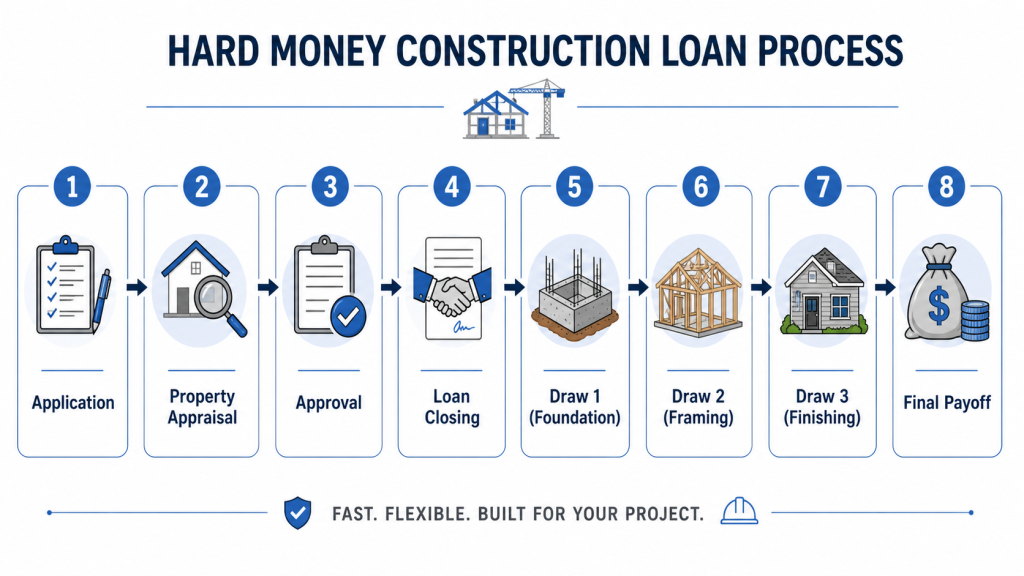
One feature that makes construction-specific hard money loans different from standard bridge loans is the draw schedule. Rather than releasing all the money upfront, the lender distributes funds in stages — called draws — as specific construction milestones are completed. This protects both the lender and the borrower by ensuring money flows in proportion to real, verified progress.
|
This quote captures why hard money construction loans have grown in popularity even among developers who could qualify for conventional financing. Speed is not just a convenience — it is a competitive advantage in fast-moving real estate markets.
How Hard Money Construction Loans Compare to Traditional Loans
Before you decide whether a hard money construction loan is right for you, it helps to understand exactly how it differs from the financing you would get at a bank. The differences go far beyond the interest rate.
|
That gap of 30 to 50 days is not just a number on a page — it represents weeks of carrying costs, holding fees, and opportunity risk. For a developer who has already negotiated a deal, a two-month delay can be financially devastating.
| Feature | Traditional Bank Loan | Hard Money Construction Loan |
| Approval Time | 30–90 days | 7–14 days |
| Credit Requirement | 680+ FICO typically required | Flexible; asset-focused |
| Basis for Approval | Income, DTI, credit history | Property value & project plan |
| Loan Term | 15–30 years | 6 months – 3 years |
| Interest Rate | 6–8% (2024 avg) | 9–15% typical range |
| Best For | Long-term holds, strong credit | Fix-and-flip, new builds, speed |
As the table above shows, hard money construction loans sacrifice cost for speed and access. The interest rates are higher — typically between 9% and 15% annually — but the trade-off is a process that matches the pace of real estate development rather than fighting against it.
It is also worth noting that hard money lenders evaluate deals differently. A bank underwriter looks backward at your financial history. A hard money lender looks forward at the property’s projected value and the feasibility of your construction plan. This forward-looking approach opens the door for self-employed borrowers, first-time developers, and investors with complex tax returns who often struggle to qualify for conventional construction financing.
|
A real estate developer in Dallas, Texas approached several major banks for a $650,000 construction loan to build a 4-unit townhome development in an up-and-coming neighborhood. Every bank declined the application — not because the project lacked merit, but because the developer was self-employed and showed irregular income on tax returns. He then applied to a hard money lender. Within 9 days, the loan was approved and funded based on the ARV of the completed townhomes, which was estimated at $1.1 million. Construction began on schedule, and the developer sold all four units within 60 days of completion. The lesson: a strong project can secure hard money financing even when conventional lenders say no. — Source: BiggerPockets practitioner case documentation |
Interest Rates, Costs, and What to Expect
One of the most common questions about hard money construction loans is also the most important one: how much do they actually cost? Understanding the full picture of fees and rates helps you plan your project budget accurately and avoid surprises during construction.
Beyond interest rates, hard money construction loans often include origination fees, also called points, which typically range from 2% to 5% of the total loan amount. On a $500,000 loan, this means an upfront cost of $10,000 to $25,000. There may also be draw fees charged each time the lender releases a new phase of funding, as well as inspection fees before each draw is approved.
Loan terms for hard money construction loans are typically short — most run from 6 months to 24 months, with some lenders offering up to 36 months for larger or more complex projects. Because these loans are designed to be repaid when the construction is finished and the property is sold or refinanced, the short term is usually not a problem for borrowers with a clear exit strategy.
Hard Money Construction Loans by State
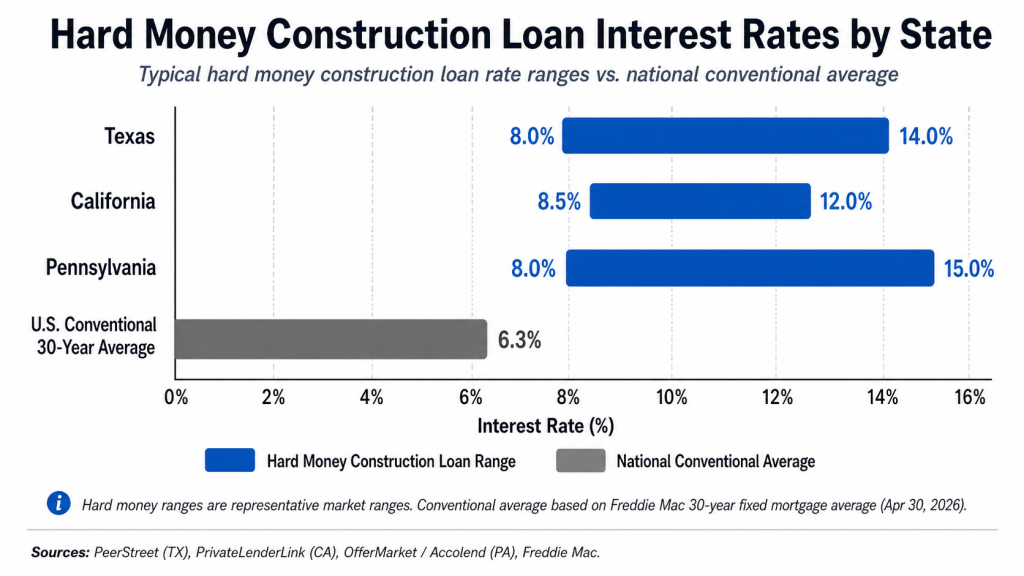
Rates and terms can vary significantly depending on where your project is located. Here is a brief overview of what borrowers typically encounter in three major markets:
| Metric | Detail / Source |
| Hard Money Construction Loans Texas | Rates: 9%–13%. Texas has no state income tax, attracting active real estate investment. Dallas, Houston, and Austin are high-demand construction markets. |
| Hard Money Construction Loans California | Rates: 10%–15%. Higher property values mean larger loan amounts but also stricter environmental and permitting requirements that can affect timelines. |
| Hard Money Construction Loans Pennsylvania | Rates: 9%–13%. The Philadelphia and Pittsburgh markets offer solid ARV potential. Seasonal construction delays are a common contingency consideration. |
|
This structural shift in the lending landscape is not temporary. As conventional banks continue to tighten their underwriting standards in response to regulatory pressure and rising default risk, hard money lenders are stepping into a role that was once occupied entirely by banks. For developers, this means the market for hard money construction financing is more active and competitive than it has ever been — which works in your favor.
How to Qualify for a Hard Money Construction Loan
Here is something many borrowers do not realize until they start the process: qualifying for a hard money construction loan is less about who you are and more about what you are building. That is both the good news and the key to preparing a strong application.
What Lenders Look For
Hard money lenders for construction projects evaluate applications based on a set of project-focused criteria. While each lender has their own process, the following elements appear in virtually every review:
- Property and land value: The lender will order an appraisal or conduct their own valuation of the land or existing structure being used as collateral.
- After-Repair Value (ARV): A detailed estimate of what the completed property will be worth. Your contractor’s scope of work and comparable sold properties in the area are central to this calculation.
- Project plan and timeline: Lenders want to see a realistic construction schedule with clearly defined milestones, as these milestones determine when draws are released.
- Borrower experience: While not always required, having prior construction or development experience can improve your terms and reduce the interest rate a lender offers.
- Exit strategy: How do you plan to repay the loan? Most hard money lenders require a clear exit plan — typically selling the finished property or refinancing into a long-term mortgage.
Notice that this list does not mention a minimum credit score or a specific debt-to-income ratio. That does not mean credit is irrelevant — most hard money lenders will pull your credit report as part of the process. But a credit score below 680 will not automatically disqualify you the way it would at a conventional bank, as long as the project fundamentals are strong.
The Application and Draw Process
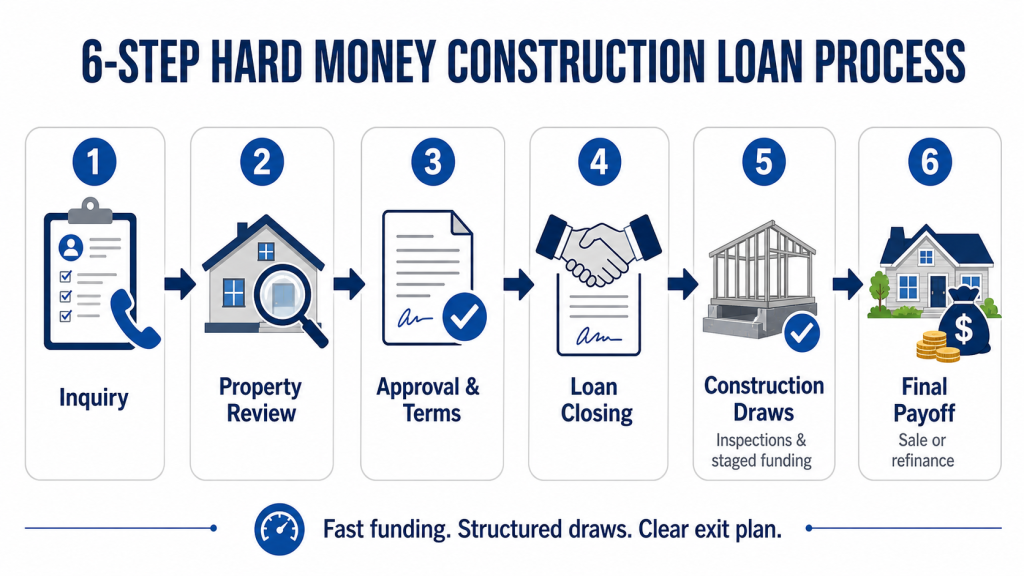
The application process for a hard money construction loan moves much faster than a bank application. Here is what you can expect from start to finish:
- Step 1 – Initial inquiry: Contact the lender with basic project details — location, loan amount needed, projected ARV, and your timeline.
- Step 2 – Submit documentation: Provide a construction plan, contractor quotes, land purchase agreement, and any existing appraisals or surveys.
- Step 3 – Property valuation: The lender arranges an independent appraisal or ARV assessment, often within 48 to 72 hours.
- Step 4 – Approval and term sheet: If approved, you receive a term sheet outlining the loan amount, interest rate, points, draw schedule, and repayment deadline.
- Step 5 – Closing: Most hard money construction loans close within 7 to 14 days of the initial application.
- Step 6 – Draws during construction: As each milestone is completed, you request a draw. The lender may send an inspector to verify progress before releasing funds.
|
An investor in Sacramento, California identified a distressed single-family home slated for demolition and rebuild. The land and structure were purchased for $310,000. The investor applied for a hard money construction loan the same week, presenting a detailed rebuild plan from a licensed general contractor and comparable sales showing finished homes in the area selling for $900,000 to $950,000. The lender approved a $640,000 loan — approximately 70% of the projected $920,000 ARV — within 11 days. Construction began immediately. The finished property sold for $935,000, allowing the investor to repay the loan in full, cover all construction costs, and net a six-figure profit on a project that a conventional lender would have turned away. Source: Lima One Capital published investor case study, 2023. — Source: Lima One Capital Investor Case Studies |
Common Mistakes to Avoid with Hard Money Construction Loans
Even experienced developers make costly errors when working with hard money construction loans. Knowing where things go wrong is just as important as knowing how the process works when it goes right.
|
New residential construction starts reached approximately 1.36 million units in 2023, many of which required bridge or private financing due to tightened conventional credit standards following rising interest rates. — Source: U.S. Census Bureau, New Residential Construction Report, 2024 | Recommend: Feature as an infographic element with a construction-themed icon |
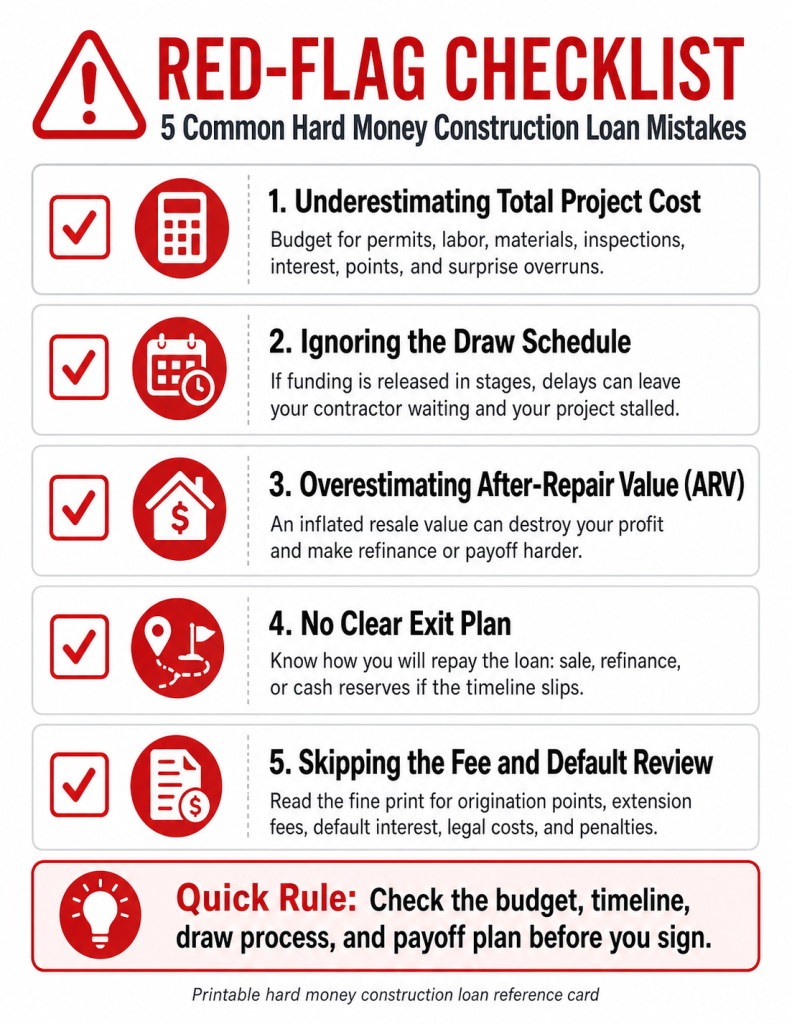
That volume of construction activity represents an enormous pool of projects — and a large number of borrowers who are navigating hard money lending for the first time. Here are the five mistakes that most frequently derail projects:
- Underestimating total project costs: Hard money lenders fund a percentage of the ARV, not the full construction budget. If your cost estimates are too low and you run over budget mid-build, you may not have access to additional funds, and your lender is unlikely to simply increase the loan amount.
- No clear exit strategy before closing: Lenders will ask how you plan to repay the loan. Saying ‘I will figure it out’ is not an exit strategy. Before you apply, know whether you are selling, refinancing, or holding the property — and have data to back up that plan.
- Ignoring extension fees and penalties: Hard money loans are short-term by design. If your construction runs long — due to weather, permitting delays, or contractor issues — you may need to extend the loan. Extension fees can add 1% to 2% of the loan amount per month, significantly increasing your total cost.
- Not vetting the lender: Not all hard money lenders operate with the same standards. Some charge excessive fees, include predatory prepayment penalties, or are slow with draw disbursements — which can stall your construction schedule. Always check the lender’s track record, references, and Better Business Bureau rating before signing.
- Overcounting ARV: An inflated ARV estimate might get your loan approved, but if the finished property does not sell for what you projected, your profit evaporates. Use conservative, data-backed comparable sales when calculating ARV.
How To Get A Hard Money Loan In 2026
Conclusion
Hard money construction loans are not for everyone — but for the right developer or investor, they are one of the most powerful financing tools available. They solve the two biggest problems in development financing: speed and access. If you have a strong project and a clear exit strategy, a hard money construction loan can get you from empty land to completed building faster than any conventional alternative.
Whether you are looking at hard money construction loans in Texas, California, Pennsylvania, or any other state, the fundamentals are the same: lead with a strong project plan, know your ARV, choose a reputable lender, and have your exit strategy mapped out before you sign. The developers who use hard money successfully treat it as a precision tool — targeted, temporary, and part of a larger financial plan.
Your next step is to reach out to two or three reputable hard money lenders in your target market, request a term sheet, and compare the total cost of capital — not just the interest rate — across your options. Armed with the knowledge in this guide, you are ready to have that conversation.
Source Link for visit:
- U.S. Census Bureau — New Residential Construction Report
- Federal Reserve Bank of St. Louis — Commercial Lending Data
- CoreLogic Housing Market Insights