
Bangladesh’s MSME sector is one of the most consequential — and most underserved — business ecosystems in Asia. According to the Bangladesh Bureau of Statistics, the country has over 7.8 million MSMEs contributing approximately 25% to national GDP. That is an enormous economic engine running, in many cases, on handwritten ledgers and gut instinct.
The uncomfortable reality: 53% of SMEs in Bangladesh still rely on manual accounting or basic spreadsheets, leaving them exposed to costly errors, compliance failures, and stunted growth.
The transition from paper-based bookkeeping to digital systems is not simply a technology upgrade — it is a survival decision. Businesses that have adopted inventory and accounting software for small business operations are already outpacing competitors on accuracy, speed, and financial visibility. Meanwhile, those still recording transactions by hand are accumulating invisible risk with every entry.
2026 marks a genuine tipping point. Regulatory pressure is intensifying, digital payment infrastructure is maturing, and banks are increasingly requiring structured financial records before approving credit. A small business that cannot produce clean, auditable accounts is effectively locked out of formal financing — a ceiling that limits expansion, hiring, and investment in ways that compound over time.
There is also a broader structural risk at play. Businesses that remain in the informal economy — operating without documented accounts or verified tax records — face growing exposure as government digitization efforts accelerate. The informal system that once felt protective is increasingly becoming a liability, not a refuge.
Understanding why so many Bangladeshi businesses are making the switch to localized software starts with one critical pressure point: regulatory compliance. And that compliance story begins with the National Board of Revenue.
Why NBR Compliance is the Primary Driver for Software Adoption
NBR compliance — not convenience — is the single biggest reason Bangladeshi small businesses are actively searching for the best accounting software in Bangladesh right now.
The National Board of Revenue (NBR) sets the regulatory framework that every registered business must operate within, covering VAT collection, submission, and audit readiness. For small businesses, this isn’t abstract bureaucracy. If you’re required to register for VAT once your turnover crosses the applicable threshold, you’re also obligated to maintain records in a format that NBR inspectors can verify. Generic global tools built for US or UK tax systems simply don’t map to Bangladesh’s Mushak-based VAT structure — and that gap creates real legal exposure.
The compliance risk is financial, not just administrative. Missed or incorrectly filed VAT returns can trigger penalties, back taxes, and business disruption. Automated tax filing — a core feature of locally adapted software — removes the manual calculation errors that typically cause these issues. As Dhaka Tribune reporting reflects, cloud-based platforms like TallyPrime are preferred specifically because they’re built around NBR’s VAT compliance requirements.
When evaluating software, businesses should look for these must-have VAT features:
- Mushak form generation — automated output of VAT return documents in NBR-approved formats
- Multi-rate VAT support — handles Bangladesh’s tiered tax structure across product categories
- Audit trail logging — timestamped records that satisfy NBR inspection requirements
- E-TIN linkage — connects your tax identification (learn how to [get your e-TIN registered](https://businesspathsala.com/e-tin-certificate/)) directly to financial records
A localized solution handles these requirements natively. Generic platforms require workarounds — and workarounds introduce errors. This compliance foundation matters beyond regulatory survival, too. How a business manages its tax records turns out to be one of the most scrutinized factors when banks evaluate loan applications.
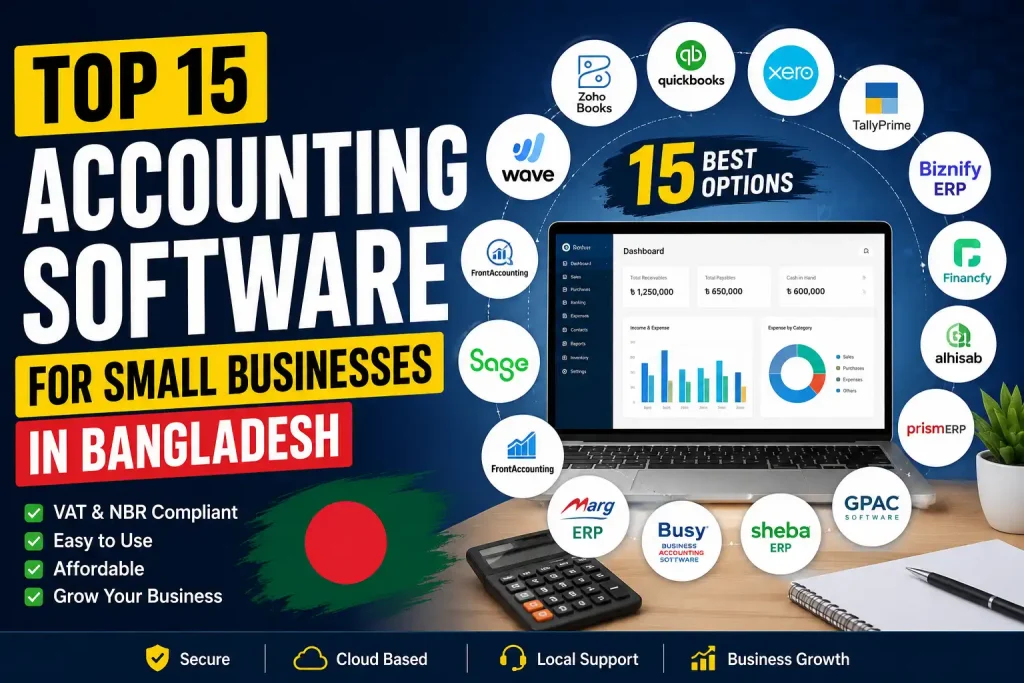
15 Top Accounting Software Options for Small Businesses in Bangladesh
The market for top small business accounting software in 2026 is split between local tools that prioritize NBR compliance and global platforms that offer world-class automation.
Localized Compliance Leaders (Built for BD)
- TallyPrime: The industry standard for double-entry bookkeeping with deep NBR VAT support and local partner networks.
- Biznify: A leading local SaaS platform that automates Mushak 6.3, 9.1, and inventory tracking for retail and wholesale.
- PrismERP: A highly customizable ERP from Divine IT, ideal for growing manufacturers needing local bank reconciliation.
- Nextzen: Known for its clean Bangla interface and strict adherence to Bangladesh Labour Act requirements in its payroll module.
- AmarHishab: A user-friendly local SaaS tool designed specifically for micro-SMEs and traders in the informal sector.
- iBusiness (Softio): Specialized in inventory-heavy businesses, providing robust stock-aging reports and local tax filings.
- Hishab: A unique voice-based accounting solution that lowers the barrier to entry for shopkeepers who aren’t tech-savvy.
Global Cloud Standards (Best for Scaling)
- Zoho Books: The most “local-friendly” global tool, offering affordable BDT pricing and customizable VAT templates for the BD market.
- QuickBooks Online: The gold standard for financial reporting; best for firms with international investors or export-oriented operations.
- Xero: A modern, cloud-native alternative preferred by digital agencies and tech startups for its vast ecosystem of third-party integrations.
- FreshBooks: Specifically designed for service-based businesses needing simple invoicing and expense tracking without complex ERP features.
- Sage Business Cloud: A professional-grade tool favored by accountants for its strong audit trails and multi-currency capabilities.
Open Source & Free Alternatives
- Manager.io: A popular “forever free” desktop version that is highly customizable for local VAT rates and multi-warehouse stock management.
- Wave Accounting: A reliable free cloud option for freelancers and small consulting firms that don’t require localized VAT automation.
- Odoo: An open-source ERP that allows Bangladeshi firms to start with a basic accounting module and scale into a full business suite.
Pricing Comparison: Top 5 Localized Solutions
| Software | Starting Price (Approx.) | Model | Best For |
|---|---|---|---|
| TallyPrime | ৳12,000 – ৳15,000 / year | Subscription or Perpetual | Established SMEs & VAT Compliance |
| Biznify | ৳1,000 / month | Monthly SaaS | Retail & Wholesale Shops |
| AmarHishab | Free – ৳1,000 / month | SaaS / Freemium | Micro-SMEs & Sole Traders |
| Nextzen | ৳1,300 / month ($119/yr) | Annual SaaS | Tech-savvy Teams & Startups |
| PrismERP | ৳115,000+ / year ($1,000) | Enterprise License | Manufacturers & Large Operations |
Note: Prices are estimates based on market rates and may vary based on specific module requirements and vendor support packages.
Digital financial records are now the single most important factor determining whether a Bangladeshi SME secures formal credit — or gets turned away at the bank.
Poor record-keeping is a loan rejection waiting to happen. Banks and NBFIs evaluating SME loan applications need auditable, consistent financial histories. What they typically receive instead are handwritten ledgers, inconsistent cash books, and undocumented receivables. Without structured records, a lender cannot assess repayment capacity, verify revenue trends, or calculate working capital ratios. The result is automatic disqualification — not because the business is unviable, but because it can’t prove it is.
The contrast when digital records exist is striking. Accounting software generates time-stamped transaction histories, reconciled bank statements, and period-over-period profit and loss reports. These aren’t just useful internal documents — they function as a financial passport that a lender can read, audit, and trust. In practice, businesses presenting software-generated financials move through credit evaluations significantly faster and with far fewer clarification requests.
The urgency of this shift has been articulated clearly at the institutional level:
“The adoption of localized accounting software is no longer a luxury but a necessity for Bangladeshi SMEs to access formal credit from banks.” — Selim R.F. Hussain, Chairman, Association of Bankers, Bangladesh (ABB)
That framing matters. The ABB Chairman isn’t talking about convenience or efficiency — he’s identifying software adoption as a prerequisite for financial inclusion. Businesses that invest in the top small business accounting software suited to the local regulatory environment aren’t just organizing their books; they’re building the credibility infrastructure that institutional lenders require.
Looking ahead to 2026, this dynamic extends beyond bank loans. Venture capital and angel investment activity in Bangladesh’s startup ecosystem is growing, and early-stage investors apply the same scrutiny. Clean, software-generated financials signal operational maturity. That’s why understanding which localized tools actually deliver that kind of compliance-ready output is the logical next question — and exactly what the following section addresses.
Top Localized Accounting Solutions for the Bangladesh Market
Bangladeshi SMEs asking “what is the best accounting software for a retail shop in BD?” consistently land on the same shortlist — tools built for local tax codes, local inventory behavior, and local banking workflows.
The right localized software doesn’t just track numbers — it speaks the language of the NBR.
TallyPrime remains the de facto industry standard for small and mid-sized businesses across Bangladesh. According to Biznify, TallyPrime is among the most popular choices for SMEs due to its established presence and strong network of local support partners. Its core strength is double-entry bookkeeping combined with VAT-ready reporting that maps directly onto NBR return formats. For retail shops managing stock across multiple categories, TallyPrime’s inventory module handles reorder levels, batch tracking, and unit conversion without requiring custom development.
Biznify ERP has carved out a strong position by building NBR compliance directly into its architecture rather than bolting it on afterward. Mushrif certificates, VAT challan generation, and sales tax reconciliation are native features — not workarounds. For businesses that experienced the friction of manual compliance described in earlier sections, this matters enormously. The platform also integrates point-of-sale data directly into the ledger, which makes it well-suited for retail and distribution firms operating out of Dhaka or Chittagong.
PrismERP and Nextzen represent a growing tier of locally developed solutions targeting firms that have outgrown spreadsheets but aren’t ready for enterprise-scale deployment. Both platforms offer Bangla-language interfaces, local bank reconciliation templates, and payroll modules calibrated to Bangladesh Labour Act requirements. In practice, growing wholesale or manufacturing firms find these platforms handle multi-warehouse inventory and trade receivables more cleanly than general-purpose global tools.
The pattern across all four platforms is consistent: localized software wins on tax automation and inventory precision because it was designed around Bangladesh’s specific regulatory environment — not retrofitted to it. That distinction becomes even sharper when you compare these tools against global cloud-based alternatives, which bring scalability but carry real trade-offs in local compliance depth.
Global Cloud Software vs. Local On-Premise Solutions
Choosing the right accounting software for small businesses in 2026 means weighing global power against local practicality — and in Bangladesh, that trade-off is sharper than almost anywhere else.
| Software | Best For | Local Compliance Level |
|---|---|---|
| QuickBooks Online | Scalability, international standards | Low — limited VAT automation for BD |
| Tally ERP | Mid-size SMEs, established workflows | Medium — customizable for local tax |
| Local BD SaaS tools | NBR compliance, Bangla interface | High — built for local requirements |
QuickBooks Online is frequently cited as the best choice for scalability among Bangladeshi businesses with international aspirations, particularly those exporting goods or managing foreign-currency invoices. Its multi-currency support, detailed financial reporting, and integration with global payment platforms make it a strong contender for growth-oriented businesses. According to biznify.net, it consistently ranks at the top when Bangladeshi SMEs look beyond domestic markets.
However, the trade-offs are significant. Global platforms typically lack automated compliance with Bangladesh’s specific VAT rules, NBR filing formats, or musharaka-based accounting preferences. Finance teams often end up managing compliance manually — which defeats one of the core purposes of adopting software in the first place.
Connectivity is another real constraint. Cloud-first tools depend on stable broadband, which remains inconsistent outside Dhaka and Chittagong. On-premise solutions like Tally eliminate this dependency but sacrifice real-time collaboration and remote access — a growing need as SME owners manage businesses from mobile devices. A hybrid model — cloud software with offline sync capability — is increasingly the practical middle ground, especially for businesses in semi-urban areas.
For retail shops specifically, this global-vs-local debate gets even more nuanced once inventory and point-of-sale workflows enter the picture — which is exactly where the next comparison picks up.
Best Inventory and Accounting Software for Retail Shops in BD
Retail shop owners in Bangladesh face a distinct set of accounting challenges — high transaction volumes, multi-product stock movement, and the daily pressure of reconciling cash against sales.
The core problem is this: retail accounting fails not from a lack of effort, but from a lack of the right tools.
Retail’s unique demands go beyond basic bookkeeping. A clothing store in Mirpur or a pharmacy in Chattogram needs point-of-sale (POS) recording, real-time stock tracking, supplier payment management, and end-of-day cash reporting — all working together. When these functions are siloed across a paper ledger, a spreadsheet, and a separate POS terminal, errors multiply fast.
Inventory integration is where most retail accounting breaks down. Without a live link between stock levels and financial records, shop owners routinely oversell products, miss shrinkage losses, or fail to account for returned goods. In high-volume environments — think a grocery shop processing hundreds of transactions daily — even a small per-transaction error compounds into significant financial blind spots by month’s end.
Retail-specific tools like Pakka Hishab are built specifically to close this gap. Pakka Hishab focuses on cutting errors and managing high-volume transactions for local shops, combining inventory management with sales tracking in a single platform designed around Bangladeshi retail workflows. Unlike globally-oriented software that requires heavy customization, these localized tools arrive ready for the local context — Bengali-language interfaces, local product category structures, and familiar reporting formats.
Reducing human error in retail isn’t just about software features — it’s about reducing the number of manual touch points. When a sale automatically updates stock, triggers a low-inventory alert, and posts to the daily revenue ledger simultaneously, the margin for data-entry mistakes shrinks dramatically.
As retail operations grow more complex, the features that matter most start shifting — from basic error reduction toward smarter automation, mobile accessibility, and deeper banking integrations. The next section breaks down exactly what to look for in accounting software heading into 2026.
What to Look for in Accounting Software for 2026
The accounting software you choose today should still be working hard for your business three years from now — and in 2026, that means demanding more than basic ledger management.
As competitors increasingly focus on ‘accounting software for 2026’ features, the gap between forward-thinking platforms and outdated tools is widening fast. Bangladeshi small business owners who invest in future-ready features now will avoid costly migrations later. Here are the four capabilities that separate modern platforms from legacy ones:
- AI-driven bookkeeping automation. Modern software should automatically categorize transactions, flag anomalies, and generate draft reports without manual input. Automation removes the human error that silently inflates accounting costs — a critical advantage for lean teams managing dozens of daily transactions. Look for platforms that learn from your transaction history and improve over time.
- Mobile-first accessibility. Business owners in Bangladesh increasingly manage operations from smartphones, often across multiple locations. Your accounting software must offer a fully functional mobile app — not just a dashboard viewer — so you can approve invoices, check cash flow, and reconcile accounts on the go. A platform locked to a desktop is a platform that slows you down.
- Local banking API integration. The ability to pull real-time bank feeds directly from Bangladeshi banks eliminates manual statement reconciliation. This connectivity also strengthens your financial records, which matters enormously when pursuing business financing options or demonstrating creditworthiness to lenders. Prioritize tools actively building partnerships with local financial institutions.
- Cloud backup and data security. A ransomware attack or hardware failure should never mean losing years of financial records. Cloud-based storage with encrypted backups and role-based access controls is now a baseline requirement, not a premium feature. Verify that your provider maintains regional data centers or complies with applicable data residency standards.
Evaluating software against these four benchmarks puts you in a strong position — and sets up the final question every business owner must answer: which specific tool is actually the right fit?
The Bottom Line: Choosing the Right Tool for Your Business
Choosing accounting software in Bangladesh isn’t just a technology decision — it’s a compliance, financing, and growth decision all at once.
NBR/VAT compliance is non-negotiable. Any software you adopt must generate VAT-compliant invoices and support Mushak forms out of the box. Cutting corners here exposes your business to audits, penalties, and reputational damage that no productivity gain can offset. Before evaluating features, verify that the platform is explicitly built for Bangladesh’s tax framework.
- Digital records as a financing lever. According to the Association of Bankers, Bangladesh, localized accounting software is the primary prerequisite for small businesses seeking SME loans in the local market. Clean, auditable financials signal creditworthiness to lenders — something handwritten ledgers simply cannot do. If securing a bank loan or exploring asset-backed financing is on your roadmap, structured digital records aren’t optional.
- Software selection by growth stage. TallyPrime remains the dominant choice for businesses prioritizing local regulatory stability, Bangla-language support, and offline reliability. For businesses eyeing regional or international expansion, cloud-first platforms offer greater scalability — though they require stronger internet infrastructure and typically carry higher subscription costs.
- Integrated inventory and POS for retail. Retail shop owners, in particular, should treat inventory and point-of-sale integration as baseline requirements, not premium add-ons. Disconnected systems create stock discrepancies and reporting gaps that erode the very financial clarity lenders and tax authorities expect to see.
The right software pays for itself — in time saved, risks avoided, and doors opened with banks and investors. That last point matters more than most small business owners initially realize. Understanding how to present your financials to alternative lenders is a skill in itself — and it’s exactly where platforms like BusinessPathsala can bridge the gap between good software and real funding access.
Clean books are the foundation of every successful loan application — and that connection between accounting software and real-world financing is exactly where BusinessPathsala comes in.
Once your localized accounting software is generating accurate, NBR-compliant financial records, the next logical step is putting those records to work. Lenders — particularly alternative lenders offering asset-backed products — evaluate your financial history before everything else. A business with organized, verifiable records moves from “high-risk applicant” to “fundable borrower” faster than almost any other factor. Understanding how that evaluation process works is where financial education becomes critical.
Alternative lending can feel opaque, especially for small business owners who have only ever dealt with traditional bank financing. Products like asset-backed short-term loans carry specific requirements — higher interest rates, collateral thresholds, and tighter timelines — that catch borrowers off guard when they haven’t done their homework. BusinessPathsala specializes in simplifying these complex lending structures through expert-backed guides written for investors and developers at every experience level.
That mission translates directly into actionable resources. Whether you’re trying to understand how collateral is calculated, what documentation lenders expect, or how regional markets affect loan terms, localized lending guides break down the specifics that generic financial content ignores. Moving from software adoption to your first investment deal isn’t a leap — it’s a series of educated steps, and each guide is designed to make the next step clearer.
The path from better bookkeeping to better financing is shorter than most small business owners realize. Explore the resources on BusinessPathsala to close that gap with confidence.


