
The State of Housing Finance in Bangladesh (2026 Update)
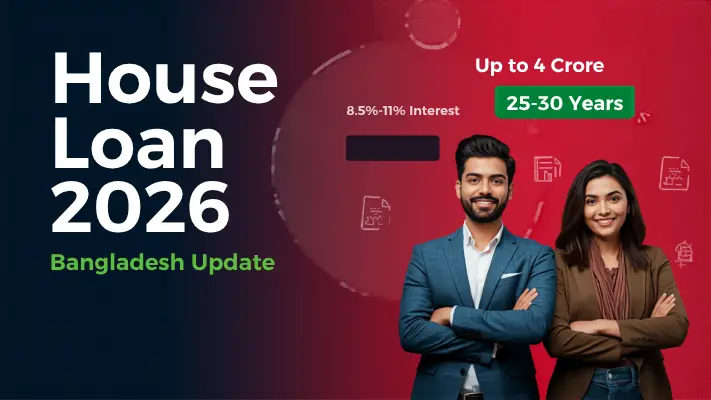
Owning a home in Bangladesh has never felt more within reach — and yet, for many buyers, never more financially demanding. Loan ceilings are rising, new benchmarks are reshaping repayment structures, and the interest rate environment has shifted dramatically from the comfortable lows of just a few years ago.
Current Average Mortgage Rate (Late 2024): 12.92%Source: Bangladesh Bank via TheGlobalEconomy.com
Anyone researching a house loan in Bangladesh today is entering a market in genuine transition. Bangladesh Bank’s move from fixed rates to the SMART (Six-Month Moving Average Rate of Treasury bills) benchmark fundamentally changed how lenders price home finance. Rather than a stable ceiling, borrowers now face rates that float with macroeconomic conditions — and those conditions have pushed costs firmly into the 12–13% range.
The so-called “9% era” — when regulatory caps kept housing loan rates artificially low — is over. For mid-segment buyers, this shift has meaningfully increased monthly payments, squeezing affordability precisely when demand is rising.
The upside? Bangladesh Bank has revised housing finance ceilings upward, with high-performing banks now authorized to lend up to Tk 4 crore for residential purchases — a meaningful increase that expands options for serious buyers.
Higher limits don’t automatically translate into better deals, though. Who qualifies, and on what terms, depends heavily on eligibility criteria — which is exactly where we’ll turn next.
Who Is Eligible for a Home Loan in Bangladesh?

Understanding the eligibility landscape is the first step toward a successful application. Before diving into interest rates or loan limits, lenders evaluate a core set of criteria — and knowing where you stand can dramatically reduce the anxiety of rejection.
The Basic Eligibility Checklist
| Requirement | Detail |
|---|---|
| Minimum Age | 21 years at the time of application |
| Maximum Age | 65 years at loan maturity (not at application) |
| Employment Status | Salaried, self-employed, or business owner |
| Minimum Income (Salaried) | Typically Tk 25,000–30,000/month (varies by bank) |
| Minimum Income (Self-Employed) | Documented net income verified by tax returns or audited financials |
| Credit History | No active default or CIB (Credit Information Bureau) red flags |
| NRB Status | Foreign remittance income accepted; special documentation required |
| Property Type | Residential flat, plot, or under-construction unit with clear title |
In practice, salaried applicants with a permanent government or multinational position face fewer documentation hurdles. Self-employed borrowers, on the other hand, must typically provide two to three years of financial statements to demonstrate income stability.
Special Provisions for NRBs
Non-Resident Bangladeshis (NRBs) can access a house loan in Bangladesh through designated NRB banking windows, provided they demonstrate consistent remittance history and hold a valid work visa or residency permit abroad. Several banks offer preferential processing timelines for NRB applicants, recognizing their significant contribution to Bangladesh’s foreign exchange reserves.
The 30% Down Payment Rule — Non-Negotiable
Perhaps the single most important number to internalize: you must have 30% of the property’s value in cash before you borrow. Per the Bangladesh Bank BRPD Circular, the debt-equity ratio for housing finance is strictly maintained at 70:30 — meaning banks finance a maximum of 70% of the assessed property value. No exceptions exist.
The 30% down payment requirement is the single biggest barrier most first-time buyers underestimate — and the most important number to plan around.
That equity requirement also plays a direct role in how much a lender is willing to extend, which connects naturally to the next critical variable: the bank’s own
The Tk 4 Crore Rule: How Bank Performance Affects Your Loan Limit

Here’s something most borrowers discover too late: the maximum amount you can borrow for a home loan in Bangladesh isn’t just about your income or credit history. It’s also directly tied to the financial health of the bank you choose.
Bangladesh Bank has established a tiered lending ceiling system that links a bank’s non-performing loan (NPL) rate to how much it can disburse to a single housing borrower. The logic is straightforward — cleaner banks carry less systemic risk, so they’re authorized to lend more.
How the Tiered System Works
According to Bangladesh Bank, the rules break down as follows:
| Bank Default Rate | Maximum Loan Ceiling |
|---|---|
| Below 5% NPL | Up to Tk 40 million (Tk 4 crore) |
| Between 5–10% NPL | Capped at Tk 3 crore |
| Above 10% NPL | Further restricted limits apply |
This policy means two borrowers with identical profiles can walk away with very different loan offers — simply because of which institution’s door they knocked on first.
Why This Matters for High-Value Properties
In premium neighborhoods like Gulshan, Banani, or Baridhara, apartment prices routinely exceed Tk 3 crore. If you’re targeting a property in that range and your chosen bank carries a default rate above 5%, you’ve already hit a ceiling before negotiations even begin. Under Bangladesh Bank house loan regulations, the tiered NPL framework isn’t a technicality — it’s a hard limit that directly determines how much financing you can access. Choosing a financially disciplined lender isn’t just a preference — for high-value purchases, it’s a necessity.
In practice, banks with lower NPL rates also tend to offer more competitive interest terms and faster processing, since their internal risk controls are tighter across the board. That means the same Bangladesh Bank house loan policy that caps your borrowing also serves as a useful filter: institutions operating below the 5% NPL threshold are generally better-run lenders in every dimension that matters to a borrower.
One practical approach is to request a bank’s latest published NPL ratio — most institutions disclose this in their annual reports or on their websites — before submitting a formal application.
With the lending landscape shaped so significantly by institutional performance, the logical next step is identifying which specific lenders consistently meet that sub-5% benchmark. That’s exactly where the comparison of Bangladesh’s top home loan providers becomes essential.
Top Banks for Home Loans: Comparing the Market Leaders
Now that you understand how loan limits work, the next question is which lender actually fits your situation. Not every bank offering a bangladesh bank house loan product delivers the same experience, rates, or flexibility. Here’s a practical breakdown of the market leaders worth your attention in 2025.
Standard Chartered Bangladesh
Best for: NRBs and high-net-worth borrowers
Standard Chartered consistently ranks among the top choices for home financing, particularly for Non-Resident Bangladeshis and professionals with documented international income. The bank brings international underwriting standards, multi-currency income recognition, and a streamlined digital application process that local competitors rarely match. In practice, their loan officers are experienced at handling complex income profiles — a real advantage if you’re employed abroad or receive remittances. Expect competitive but not always the lowest rates; you’re paying a premium for service quality and reliability.
IDLC Finance
Best for: Construction and phased disbursements
IDLC is Bangladesh’s leading non-bank financial institution for housing, and it earns that reputation. What sets IDLC apart is its specialized construction loan structure, where funds are released in stages as building milestones are completed. This protects borrowers from interest accumulating on money they haven’t spent yet. For anyone building a home from the ground up rather than purchasing a finished unit, IDLC’s product design is hard to beat.
DBBL (Janala) and BRAC Bank
Best for: Salaried professionals and wide accessibility
Dutch-Bangla Bank’s Janala home loan and BRAC Bank’s housing products target salaried middle-income borrowers across urban and semi-urban areas. Both institutions offer broad branch and agent banking networks, making the application and repayment process genuinely accessible. BRAC Bank in particular has built a strong reputation for transparent processing and responsive customer service — two factors that matter enormously when you’re managing a 20-year commitment.
Rupali Bank and BHBFC
Best for: Government employees and subsidized financing
Rupali Bank and the Bangladesh House Building Finance Corporation (BHBFC) represent the government-backed tier of home lending. BHBFC was specifically created to finance residential construction, and its rates are often more favorable than commercial alternatives. According to BB’s revised housing finance ceilings, BHBFC plays a defined role in expanding homeownership access for lower and middle-income families. Rupali Bank similarly targets civil servants and public-sector employees with structured, affordable packages.
Choosing the right lender is only half the equation. Once you’ve identified a strong match, understanding the full cost of borrowing — beyond the headline rate — becomes critical.
Calculating Your Costs: Beyond the Interest Rate
Finding the best home loan in Bangladesh isn’t just about chasing the lowest interest rate — it’s about understanding the full cost stack before you sign anything. The headline rate is only one piece of the puzzle.
Fees You’ll Pay Before the First EMI
Most borrowers are caught off guard by the upfront costs. Here’s what to expect:
- Processing fee: Typically 0.5% to 1% of the loan amount, charged by most major lenders at disbursement
- Legal charges: Standard across institutions — banks like Rupali Bank and IDLC include these as non-negotiable line items for title verification and documentation
- Valuation fee: A licensed surveyor assesses the property; costs vary but usually run between Tk 5,000–15,000 depending on property size and location
- Stamp duty and registration: Government-mandated costs that add meaningfully to your total outlay
The true cost of a home loan is rarely the number advertised — fees, charges, and tenure choices can add tens of lakhs to what you actually pay.
The Tenure Trap: 10 Years vs. 25 Years
Tenure has an enormous impact on total interest paid. On a Tk 50 lakh loan at 9%, a 10-year tenure means roughly Tk 26 lakh in total interest. Stretch that to 25 years and the figure nearly triples. A longer tenure lowers your monthly EMI but dramatically increases your lifetime cost. Using an EMI estimation tool to model different scenarios side-by-side before committing is a smart first step.
Pro Tip — Negotiating Processing Fee Waivers: Processing fees are more flexible than banks let on. If you have a strong credit profile, an existing relationship with the bank, or are applying during a promotional period, ask directly for a waiver or reduction. Some lenders will quietly discount this fee for salaried applicants with clean repayment histories.
Of course, even a perfectly structured loan can hit unexpected turbulence — which is where understanding rescheduling options becomes critical.
Loan Rescheduling and Tenure Extensions
Life doesn’t always go according to plan, and Bangladesh Bank’s updated guidelines acknowledge that reality. Under new rescheduling rules, lenders — including major players offering products comparable to the Standard Chartered Bangladesh home loan lineup — can now extend a borrower’s remaining loan term by up to 30% during a formal rescheduling. In practice, that means if you have 10 years left on your mortgage and hit a financial rough patch, your bank could stretch that out by an additional three years, lowering your monthly installment and giving you breathing room to recover. This is a meaningful safety net that didn’t exist in the same structured form before.
However, rescheduling isn’t a free pass. Every extra month you add to your tenure translates directly into more interest paid over the life of the loan — sometimes tens of thousands of taka in additional cost. The relief is real, but the long-term burden grows. One practical approach is to treat rescheduling as a last resort rather than a routine adjustment, and to resume original payment amounts as soon as your cash flow stabilizes.
Hard limit to remember: Regardless of rescheduling arrangements, all home loans in Bangladesh must be fully settled before the borrower turns 65. If you’re applying at 50 with a 20-year term, your bank will likely restructure the product around that cutoff — so factor your current age into every tenure decision you make.
Understanding these guardrails puts you in a stronger position when you’re ready to negotiate terms, which leads naturally into the strategic moves that can make or break your application in 2025.
Strategic Advice for 2026 Borrowers
Securing the best home loan in Bangladesh in 2026 demands preparation, not luck. Here’s how to position yourself before you sign anything.
Next Steps:
- Fix your credit score first. Lenders scrutinize repayment history closely. Clear outstanding dues, reduce credit card utilization, and resolve any defaults before approaching a bank. A stronger profile unlocks better rates and higher limits.
- Compare at least three lenders. Pit one foreign bank, one private local bank, and one NBFI against each other. Fee structures, processing timelines, and prepayment penalties vary widely — what looks cheaper upfront can cost more over a 20-year tenure.
- Understand the full cost picture. As covered earlier, rising borrowing costs are already suppressing mid-segment demand — don’t let hidden charges catch you off guard.
The smartest borrowers treat a home loan like a business decision. If you want to sharpen that mindset across all major financial choices, exploring structured financial guidance can help you evaluate loan products more confidently — whether for property, vehicles, or beyond.
The 2025 market rewards preparation. Do the homework now, and your future self will thank you.
Key Takeaways
- Processing fee: Typically 0.5% to 1% of the loan amount, charged by most major lenders at disbursement
- Valuation fee: A licensed surveyor assesses the property; costs vary but usually run between Tk 5,000–15,000 depending on property size and location
- Stamp duty and registration: Government-mandated costs that add meaningfully to your total outlay
- SMART (Six-Month Moving Average Rate of Treasury bills)
- you must have 30% of the property’s value in cash before you borrow