
Quick answer: An agriculture business loan in Bangladesh is a specialized credit facility offered by state-owned specialized banks (Bangladesh Krishi Bank and Rajshahi Krishi Unnayan Bank), commercial banks, and licensed finance companies under Bangladesh Bank’s Agricultural and Rural Credit Policy. Eligible ventures span commercial crop farming, dairy and cattle fattening, poultry farms, fisheries and hatcheries, cold storage, and agro-processing units. Concessional loans for priority import-substitute crops (such as pulses, oilseeds, spices, and maize) carry a subsidized 4% interest rate, while specialized refinance windows and standard agricultural or agro-SME loans typically range from 8% to 14% depending on the bank, loan size, and whether central bank refinance applies. Small farmers can access collateral-free crop loans up to BDT 2.5 lakh against simple crop hypothecation, whereas larger commercial agribusinesses apply through bank SME or corporate agro desks.
Updated 20 November 2026. Agricultural credit targets, concessional refinance allocations, and commercial bank interest schedules change periodically. Confirm current interest rates, collateral thresholds, and sector permits with your chosen bank branch before submitting formal documents.
Farming in Bangladesh looks very different today than it did twenty years ago. Across Bogura, Jashore, Mymensingh, Cumilla, and Pabna, thousands of educated entrepreneurs are running commercial dairy barns, biofloc and pond fisheries, automated poultry sheds, seed nurseries, and modern rice or spice processing mills. Yet when these agribusiness owners walk into a bank branch asking for financing, many get confused by a basic split in the banking system. Traditional crop loans follow one set of rules, while commercial agro-processing, feed trading, and large livestock farms often fall under SME banking rules. Knowing which track fits your farm or agro-enterprise saves months of delays and can cut your annual interest bill dramatically.
How Agriculture Business Loans Work in Bangladesh
Every fiscal year, Bangladesh Bank publishes its Agricultural and Rural Credit Policy and Programme, assigning mandatory agricultural lending targets to every state-owned, private, and foreign scheduled bank operating in the country. If a commercial bank fails to disburse its annual agricultural quota directly or through approved microfinance linkages, Bangladesh Bank deducts the shortfall and deposits it into a non-interest-bearing central bank account. Because of that regulatory pressure, banks actively look for genuine, well-documented farms and agro-enterprises to finance.
In practice, agricultural financing in Bangladesh splits into two distinct tracks:
- Direct Agricultural and Rural Credit Track: Aimed at crop cultivation, seasonal vegetables, fruit orchards, small dairy farms, pond aquaculture, and farm machinery purchases (such as power tillers, combine harvesters, and irrigation pumps). Specialized state banks like Bangladesh Krishi Bank (BKB) and Rajshahi Krishi Unnayan Bank (RAKUB) handle the largest share of these loans, alongside state-owned commercial banks.
- Commercial Agribusiness and Agro-SME Track: Aimed at larger commercial poultry farms, dairy processing plants, cold storages, automatic rice mills, animal feed dealers, and export-oriented agro-processors. Private commercial banks and NBFIs process these files through their SME or Agribusiness divisions, often blending Bangladesh Bank CMSME refinance windows with standard commercial credit. You can see how central bank small-business windows operate in our CMSME loan guide for Bangladesh.
Five Main Agribusiness Sectors Eligible for Bank Loans
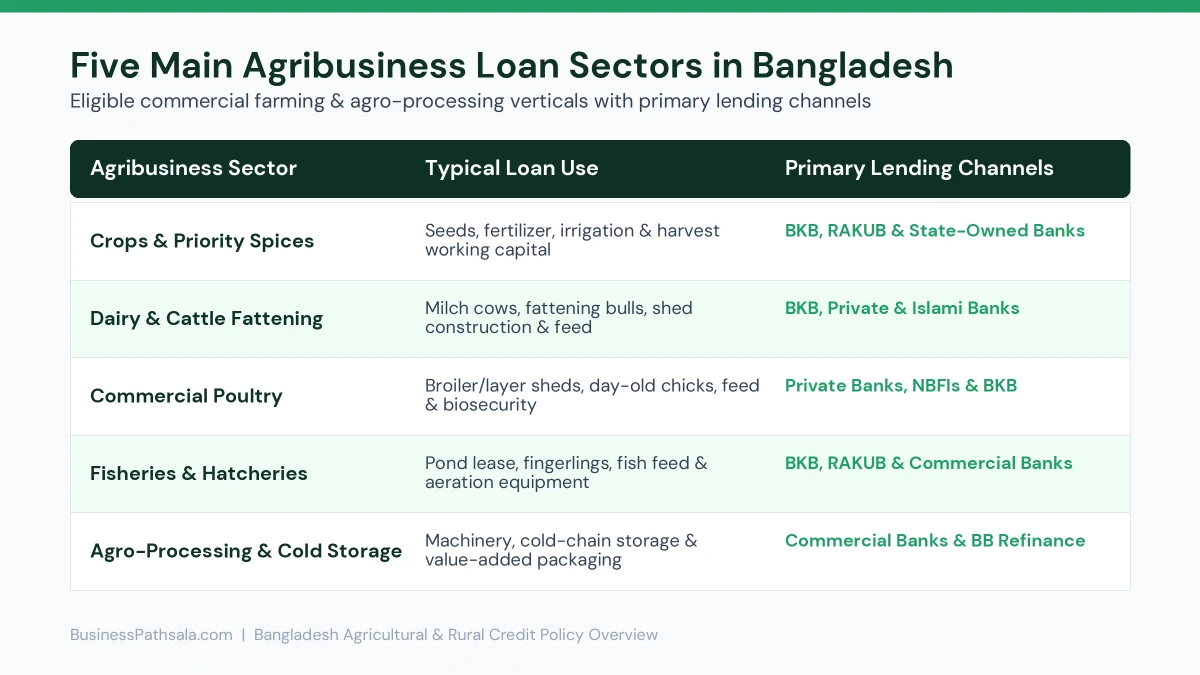
Bangladeshi lenders evaluate farming risk by sub-sector because cash-flow cycles vary wildly between a 35-day broiler batch, a 9-month pond fish harvest, and a multi-year dairy shed. Below are the five primary sectors banks actively finance and the specific costs they typically cover.
1. Commercial Crops, Horticulture, and Import-Substitute Spices
Beyond traditional Boro and Aman paddy, banks prioritize high-value commercial crops such as onion, garlic, ginger, turmeric, pulses, mustard, maize, potatoes, and commercial fruit orchards (mango, dragon fruit, guava, and malta). Under Bangladesh Bank’s long-standing concessional policy for import-substitute crops, eligible farmers cultivating specified pulses, oilseeds, spices, and maize can access loans at a subsidized 4% annual interest rate, with the government subsidizing the remaining interest margin directly to the lending bank.
2. Dairy Farming and Beef Fattening
Dairy and livestock enterprises receive strong backing from both specialized agricultural banks and private SME desks. Term loans cover shed construction, milking equipment, biogas or waste setups, and purchasing crossbred dairy cows, while working capital covers Napier grass cultivation, concentrated feed, and veterinary care. Seasonal cattle fattening loans timed ahead of Eid-ul-Adha are also widely available, typically structured for 6 to 12 months with bullet or harvest-linked repayment. Commercial livestock farms should coordinate registration and veterinary compliance with the Department of Livestock Services (DLS).
3. Commercial Poultry (Broiler, Sonali, and Layer Farms)
Poultry financing is divided between working capital for day-old chicks, feed, and vaccines, and medium-term loans for environmentally controlled sheds and cage systems. Because feed accounts for roughly two-thirds of operating costs and disease outbreaks can wipe out a batch overnight, banks inspect biosecurity buffers, shed floor space, and DLS online farm registration closely before approving working-capital limits.
4. Fisheries, Pond Aquaculture, and Hatcheries
Bangladesh’s commercial fisheries sector (covering pangas, tilapia, rui, katla, koi, shrimp, and crab farming across Mymensingh, Khulna, Satkhira, and Jashore) relies heavily on working capital for pond preparation, fingerlings, floating feed, and aerators. Banks require clear pond ownership or a registered multi-year lease agreement (usually at least 3 to 5 years remaining on the lease) and prefer farmers who maintain water-quality and feed-conversion logs. Technical guidelines and licensing details are maintained by the Department of Fisheries (DoF).
5. Agro-Processing, Cold Storage, and Farm Machinery
Entrepreneurs setting up automatic or semi-automatic rice mills, spice grinding units, mustard oil expellers, fruit pulp processors, potato cold storages, or commercial agro-machinery rental services qualify for larger term finance facilities. These projects usually sit under the Bangladesh Bank Agro-Based Product Processing Refinance Scheme or the broader CMSME manufacturing window, allowing multi-year repayment tenures of 3 to 7 years with a short installation grace period.
Best Banks for Agriculture Business Loans in Bangladesh
Choosing the right bank depends on your loan ticket size, location, and how quickly you need disbursement. Specialized agricultural banks reach remote upazilas and offer low-cost crop loans, whereas private banks process larger commercial agribusiness files faster if you have strong bank statements and clean tax papers.
| Bank / Institution | Primary Agro Focus | Typical Loan Structure | Best Fit For |
|---|---|---|---|
| Bangladesh Krishi Bank (BKB) | Nationwide crop, livestock, fisheries, farm machinery, and agro-processing | Short-term seasonal crop loans, medium-term farm loans, and agro-industrial term finance | Farmers and rural agribusinesses outside Rajshahi and Rangpur divisions seeking subsidized rates |
| Rajshahi Krishi Unnayan Bank (RAKUB) | Dedicated specialized agro bank for Rajshahi and Rangpur divisions | Crop cultivation, cold storage, dairy, poultry, fisheries, and rural SME credit | Commercial farmers, potato growers, and agro-mills in northern Bangladesh |
| Sonali, Janata, Agrani & Rupali Bank | State-owned commercial banks with mandatory annual agro credit targets | 4% concessional spice/pulse loans, livestock/fisheries loans, and CMSME agro-processing | District-level commercial farms and rural borrowers with clean land documents |
| BRAC Bank PLC | Dedicated Agribusiness and SME Banking network across Bangladesh | Unsecured and secured agro-SME working capital, dairy/poultry expansion, and input dealerships | Established agro-dealers, feed distributors, commercial farms, and agro-processors |
| City Bank, Islami Bank & Dutch-Bangla Bank | Commercial agro-SME, Shariah-compliant agro investment (Bai-Muajjal/HPSM), and value-chain finance | Working capital limits, machinery financing, and contract-farming credit | Formalized agribusinesses with 1 to 2 years of bank turnover and clean financial records |
| PKSF Partner NGOs / MFIs | Micro-agribusiness and small livestock/vegetable value chains | Quick small-ticket loans (BDT 50,000 to BDT 5 lakh+) with minimal collateral | Smallholder and peri-urban farms that lack formal bank statements or land mortgages |
Note: Interest rates, maximum unsecured caps, and refinance availability vary across branches and funding quarters. Always request the bank’s current Schedule of Charges and written sanction terms before signing.
Interest Rates and Real Repayment Math (BDT 10 Lakh Example)
Agricultural loan pricing in Bangladesh is not one flat number. Your exact rate depends on whether your project qualifies for a 4% government-subsidized import-substitute crop window, a Bangladesh Bank refinance facility (often capped around 7% to 8% at the customer level when active), standard agricultural credit pricing, or a commercial agro-SME rate (often 12% to 14.5%). You can compare commercial lending ranges in our guide to SME loan interest rates in Bangladesh.
To see how strongly the interest track affects farm profitability, consider an illustrative BDT 10,00,000 (10 lakh) term loan repaid over 36 months (3 years) on a standard monthly reducing-balance schedule:
| Financing Track (BDT 10 Lakh, 36 Months) | Approx. Monthly EMI | Total Interest (3 Years) | Total Repayment |
|---|---|---|---|
| 4.0% Annual Rate (Concessional Priority Crops) | BDT 29,524 | BDT 62,863 | BDT 10,62,863 |
| 8.0% Annual Rate (Subsidized Agro / Refinance Window) | BDT 31,336 | BDT 1,28,109 | BDT 11,28,109 |
| 10.0% Annual Rate (Standard Agricultural Credit) | BDT 32,267 | BDT 1,61,619 | BDT 11,61,619 |
| 13.5% Annual Rate (Commercial Agro-SME Bank Loan) | BDT 33,935 | BDT 2,21,670 | BDT 12,21,670 |
Illustrative calculation only: Figures assume equal monthly installments (EMI) and exclude processing fees, legal and valuation charges, stamp duties, and VAT. Note that seasonal crop and cattle-fattening loans are often structured with harvest-linked or bullet repayments rather than monthly EMIs.
Securing an 8% refinance-backed agro loan instead of a 13.5% commercial SME loan on BDT 10 lakh saves roughly BDT 2,599 per month and BDT 93,561 in total interest over three years. For a priority spice or pulse producer qualifying for the 4% concessional window, the three-year interest savings jump to BDT 1,58,807 compared to a commercial rate.
Eligibility Criteria and Collateral Rules
Bank credit officers check both your personal credit standing and the physical viability of your farm before approving funds. Most Bangladeshi lenders apply these baseline eligibility criteria:
- Citizenship and Age: Bangladeshi citizen with a valid National ID (NID), typically aged between 21 and 65 years at loan maturity.
- Actual Farming or Agribusiness Activity: You must directly cultivate the land, manage the livestock or fish farm, or operate the agro-processing or input-trading enterprise. Absentee investors with no operational control face strict scrutiny.
- Land Ownership or Registered Lease: For crop, fishery, and livestock projects, you need proof of land or pond ownership (updated Khatian/Porcha and land tax receipt) or a legally valid lease agreement covering at least the full loan tenure. Sharecroppers (Barga Chashi) can access small crop loans through Krishi Card verification and local agriculture officer certification.
- Operating History (For Commercial Agro-SMEs): While small seasonal crop loans are available to active farmers immediately, private banks generally require 1 to 2 years of operating history for commercial dairy, poultry, fisheries, or agro-processing loans above BDT 5 lakh.
- Clean CIB Status: Neither the applicant nor any business partner, director, or guarantor may have an overdue or classified default in the Bangladesh Bank Credit Information Bureau (CIB) database.
- Collateral Rules: Under Bangladesh Bank agricultural credit directives, banks provide small crop loans (typically up to BDT 2.5 lakh per farmer for general crops) without requiring registered land mortgages, relying instead on crop hypothecation and personal guarantees. For commercial farm or machinery loans above BDT 5 lakh to BDT 10 lakh, state banks almost always require registered land collateral, while select private banks offer unsecured agro-SME limits based on strong bank turnover and personal guarantors.
Required Documents Checklist for an Agriculture Business Loan
Incomplete land papers or missing sector registrations are the top reasons agricultural loan files stall at rural and district branches. Organize these six document sets before submitting your application.
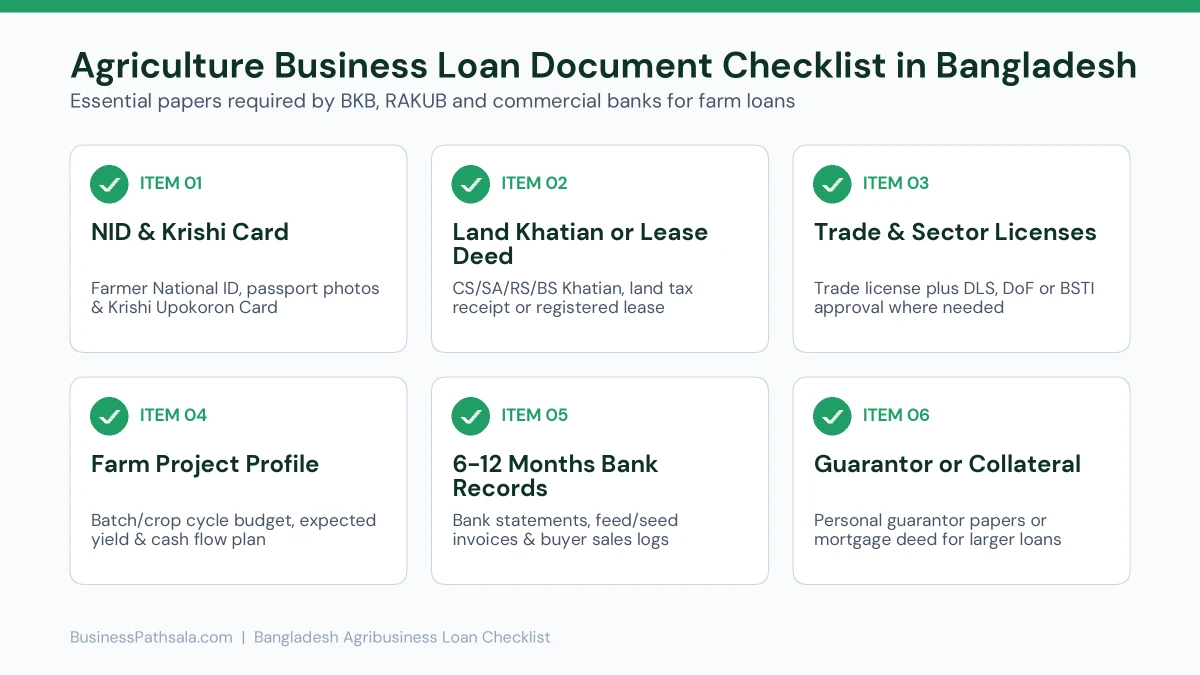
- Identity and Farmer Verification: Valid NID copy, 2 to 4 recent passport-size photos, and your Krishi Upokoron Sahayata Card (Agriculture Input Assistance Card) if applying for direct crop financing. Verification from the local Upazila Agriculture Office under the Department of Agricultural Extension (DAE) helps speed up crop files.
- Land and Premises Papers: Updated land ownership deeds, CS/SA/RS/BS Khatian (Porcha), current land development tax receipt (Khajna), or a stamped multi-year pond/farm lease agreement.
- Business and Sector Permits: Updated Trade License (mandatory for commercial farms, hatcheries, dealers, and mills), e-TIN certificate, and latest income tax return acknowledgement (PSR). Depending on your sub-sector, attach DLS farm registration (poultry/dairy), DoF hatchery registration (fisheries), Department of Environment clearance, or BSTI certification (packaged food processing).
- Farm Project Profile and Cost Breakdown: A clear production-cycle budget detailing shed or pond capacity, seed/chick/fingerling costs, feed expenses, mortality buffer, expected harvest yield, and conservative selling prices. Use our templates for preparing a business plan for a bank loan in Bangladesh and an SME loan project profile.
- Banking and Sales Proof: Last 6 to 12 months of business bank statements, along with wholesale market (arat/mandi) receipts, feed supplier invoices, or buyer contracts proving actual farm turnover.
- Guarantor and Security File: NID, photos, and income or land proof of your personal guarantors, plus original title deeds if applying for a secured term loan.
Step-by-Step: How to Apply for an Agriculture Business Loan
- Match your project to the right bank track. For seasonal crops, spices, or small rural livestock under BDT 5 lakh, start with your nearest Bangladesh Krishi Bank, RAKUB, or state-owned bank branch. For commercial dairy, poultry, fisheries, or agro-processing above BDT 5 lakh with active bank transactions, compare at least one state bank and two private SME banks side by side.
- Complete required sector registrations before approaching the bank. Renew your Trade License and secure DLS, DoF, or DAE verification early. Banks rarely process commercial livestock or food-processing loans without valid regulatory clearances.
- Open a bank account and deposit farm sales regularly. Even if you sell fish, milk, or vegetables for cash at local wholesale markets, deposit those proceeds into your business bank account for 3 to 6 months before applying. Verifiable account inflows dramatically increase your approved loan limit.
- Submit a formal application directly at the branch. Fill out the bank’s official agricultural or SME loan form, attach your project profile and supporting folder, and collect an application receipt. Avoid paying unofficial middlemen or brokers who promise faster approval at rural branches.
- Prepare for physical farm and land inspection. The branch credit officer (and a third-party land valuer, if collateral is pledged) will visit your farm site to verify land boundaries, shed condition, livestock or pond stock, and local reputation. Keep your batch registers and purchase receipts ready on site.
- Verify repayment timing on the written sanction letter. Before signing, check that the repayment schedule matches your biological harvest cycle. A monthly EMI works well for daily-income dairy farms or agro-dealers, whereas seasonal crop, fish, or cattle-fattening projects should request harvest-linked or grace-period repayment terms.
Common Mistakes That Cause Agribusiness Loan Rejections
- Requesting monthly EMIs on a 9-month harvest crop: Committing to monthly installments when your pond fish or orchard only generates revenue twice a year leads straight to overdue status and CIB damage. Always align the repayment frequency with real harvest cash inflows.
- Ignoring biological and weather risk buffers: Presenting a project profile that assumes 0% poultry mortality, peak market prices all year, and zero flood or disease disruption tells a banker you have not stress-tested your farm. Include a realistic 5% to 10% mortality or yield buffer in your cash-flow sheet.
- Unclear or jointly disputed land papers: In rural Bangladesh, ancestral land held jointly among several heirs (Ejmali property) without formal mutation (Namjari) or partition deeds cannot be accepted as bank mortgage collateral. Clear mutation and tax receipts before applying.
- Diverting farm funds to non-farm expenses: Using working capital meant for fish feed or fertilizer to build a residential house or buy personal vehicles causes immediate cash-flow failure during harvest and permanently blocks future refinance eligibility.
If your agribusiness is still in its initial pilot stage and does not yet meet commercial bank requirements, you can also review alternative Uddokta loan options in Bangladesh, including SME Foundation cluster programs and micro-enterprise financing, to build a verifiable credit record first.
Frequently Asked Questions
Which bank is best for an agriculture business loan in Bangladesh?
For small to medium crop cultivation, priority spices, and rural livestock loans, Bangladesh Krishi Bank (BKB) and Rajshahi Krishi Unnayan Bank (RAKUB, for Rajshahi and Rangpur divisions) offer the widest upazila reach and access to subsidized agricultural credit. For larger commercial dairy, poultry, fisheries, agro-dealerships, and agro-processing units needing faster turnaround, private banks with dedicated agro-SME teams (such as BRAC Bank, City Bank, and Islami Bank) are often more flexible.
What is the interest rate on an agriculture business loan in Bangladesh?
Eligible farmers cultivating government-designated import-substitute crops (such as pulses, oilseeds, spices, and maize) can receive concessional loans at 4% per year. Active Bangladesh Bank agricultural or agro-processing refinance windows typically cap customer rates around 7% to 8%, while standard agricultural credit and commercial agro-SME bank loans generally range between 9% and 14.5% depending on the lender and market conditions.
Can I get an agriculture business loan without land collateral in Bangladesh?
Yes, for smaller loan amounts. Under Bangladesh Bank agricultural credit rules, banks can disburse small crop loans (commonly up to BDT 2.5 lakh) without land mortgages by taking crop hypothecation and personal guarantees. For commercial agribusinesses, some private banks also offer unsecured agro-SME loans if the business has 1 to 2 years of verifiable bank turnover and two solvent personal guarantors.
Can a tenant farmer or leased-pond operator get an agriculture loan?
Yes. Sharecroppers and tenant farmers can access small crop loans through verified Krishi Cards and local agriculture office recommendations, while commercial fish, poultry, or dairy operators working on leased land can apply by submitting a properly stamped multi-year lease agreement covering the loan duration along with personal guarantors or alternative security.
How long does it take to get an agriculture business loan approved?
Small seasonal crop loans with complete land and Krishi Card papers at Krishi Bank or state banks typically take 1 to 3 weeks. Larger commercial agribusiness and agro-processing loans requiring site inspection, CIB clearance, and legal land valuation usually take 3 to 6 weeks from full document submission.
Official Sources and Further Reading
- Bangladesh Bank Official Portal (bb.org.bd): Annual Agricultural and Rural Credit Policy and Programme, 4% concessional crop credit directives, and agro-processing refinance circulars.
- Bangladesh Krishi Bank (BKB): Official loan products, crop norms, livestock, fisheries, and agro-industrial credit schemes outside Rajshahi and Rangpur divisions.
- Rajshahi Krishi Unnayan Bank (RAKUB): Official agricultural and rural agribusiness financing programs for northern Bangladesh.
- Department of Agricultural Extension (DAE): Krishi Card information, crop advisory, and farmer registration support.
- Department of Livestock Services (DLS) & Department of Fisheries (DoF): Commercial dairy, poultry, and hatchery registration portals required for formal agribusiness lending.
Preparing for Your Bank Visit
Getting approved for an agriculture business loan in Bangladesh starts with matching your farm’s actual cash cycle to the right lending track. Verify your land mutation or lease papers, complete your Trade License and DLS or DoF registrations, and write a realistic production-cycle budget that accounts for feed, seasonal price shifts, and biological buffers. Speaking with both a specialized agricultural bank and an active private agro-SME branch in your district lets you compare real interest rates, grace periods, and collateral terms before committing.
Financial information notice: This article is provided for general educational purposes only and does not constitute a loan offer, legal advice, or a guarantee of financing approval. Agricultural credit policies, concessional interest ceilings, refinance allocations, and bank collateral rules can change at any time. Always confirm current terms directly with Bangladesh Bank and your chosen bank branch.


