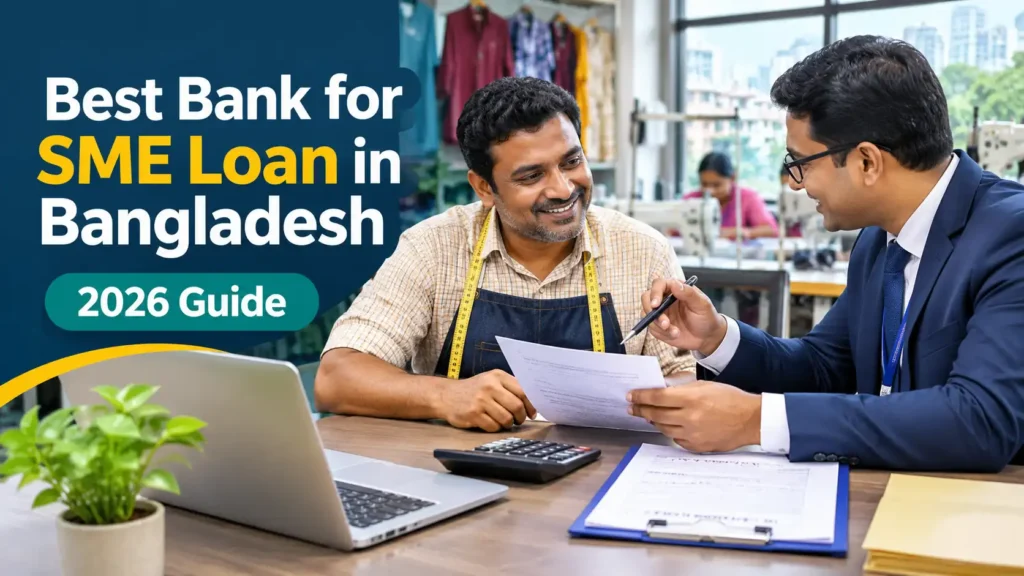
CMSME Loan Bangladesh refers to financing for cottage, micro, small and medium enterprises through scheduled banks and finance companies. Bangladesh Bank sets the regulatory framework and operates refinance programmes through participating lenders. A business may qualify for a particular facility only when it meets the enterprise classification, purpose, documentation and credit-assessment rules for that programme.
This guide explains the CMSME financing system, current policy routes, how to prepare an application, what costs to compare and where to verify terms. Figures below refer to named programmes and should not be treated as offers available to every borrower.
Quick answer: What is a CMSME loan in Bangladesh?
A CMSME loan is business financing intended for a qualifying cottage, micro, small or medium enterprise. It can fund working capital, machinery, inventory, business expansion or another approved business purpose. The lender decides whether to approve the borrower, while Bangladesh Bank circulars govern the relevant refinance and policy schemes. Interest or profit rates, loan limits, collateral, tenure and documents vary by product.
What does CMSME stand for?
CMSME means Cottage, Micro, Small and Medium Enterprise. The term covers different sizes and types of businesses rather than one single loan product. A small manufacturing workshop, a neighbourhood trading business, a cottage producer and a medium-sized service company may all fall within the wider CMSME framework, but they will not necessarily qualify for the same financing scheme.
Bangladesh Bank’s SMESPD Circular No. 01 dated 17 March 2025 is the current master circular listed for CMSME financing. It describes CMSME enterprises and CMSME loans or investments and provides the policy framework used by scheduled banks and finance companies. Enterprise classification depends on the applicable criteria and business activity. Applicants should ask the lender to confirm the category under the current circular rather than rely on an old chart copied from an online article.
Which businesses can apply for CMSME financing?
Depending on the product and scheme, eligible business activities can include manufacturing, trading and services. Examples include small garment and tailoring units, food processing, grocery and wholesale shops, repair workshops, furniture makers, printing businesses, transport-related services, technology services and other qualifying enterprises.
Eligibility is not decided by the business name alone. A bank may examine the enterprise’s activity, legal form, fixed assets, workforce, turnover where relevant, operating history, ownership, existing borrowing and repayment capacity. Some schemes are designed for particular groups or purposes, such as women entrepreneurs, new entrepreneurs, agro-processing businesses, recognised clusters or operating firms that need working capital.
Enterprise category and evidence
Keep records that help the bank understand the size and activity of the enterprise. These may include trade licence, ownership papers, employee information, asset records, sales documents and financial statements. If the business has several activities or related units, disclose them accurately. The bank determines the applicable category using the current regulatory criteria and its own due diligence.
Current Bangladesh Bank CMSME financing programmes
Bangladesh Bank’s circular portal lists several CMSME-related measures issued during 2026. The schemes have different objectives, fund sizes and borrower conditions. A fund’s total allocation is not the same as an individual borrower’s loan entitlement, and the availability of a programme depends on participating institutions and the scheme’s operating rules.
| Programme or route | What it is designed for | Published borrower rate ceiling |
|---|---|---|
| CMSME working-capital refinance fund (June 2026) | Operating CMSMEs that need working capital to run at full capacity | Up to 9% per annum, subject to scheme rules |
| General CMSME refinance scheme (February 2026) | Financing eligible cottage, micro, small and medium enterprises through participating lenders | Up to 7% per annum, as reported for the scheme |
| Cluster financing scheme (February 2026) | Eligible businesses operating in recognised CMSME clusters | Up to 7% per annum, as reported |
| Financial Sector Fund for the Development of MSMEs | Eligible micro, small and medium enterprise finance | Up to 7% per annum, as reported |
| Women entrepreneur and other targeted refinance routes | Borrowers meeting the specific ownership, business and programme criteria | Scheme-specific; confirm the current circular |
Important: These rates are programme-level ceilings reported in Bangladesh Bank material, not a promise that every applicant will receive finance at that rate. The lender must confirm its participation, available allocation, eligible purpose, borrower conditions and final sanction terms. Islamic banks may describe the charge as a profit rate rather than interest.
Tk 5,000 crore working-capital refinance fund
Bangladesh Bank introduced a Tk 5,000 crore revolving refinance fund in June 2026 to support active CMSMEs facing working-capital shortages. The central bank’s refinance rate to participating banks was reported at 4%, while the maximum customer-level interest or profit rate was reported at 9%. The fund is intended for businesses that are operating but cannot use their full production or service capacity because they lack sufficient working capital.
This is different from a general-purpose loan for a brand-new business or a long-term machinery purchase. A borrower should be ready to show current business operations, the working-capital gap, stock or purchase requirements and the way the facility will support the operating cycle. Participating lenders may apply additional eligibility checks. For example, a bank’s public announcement may identify exclusions or conditions that apply under its own participation agreement.
General refinance and cluster finance
Bangladesh Bank’s 5 February 2026 circular list includes a general CMSME refinance scheme and a cluster financing scheme. The January–March 2026 quarterly report describes a restructured Tk 18,000 crore refinance scheme, a Tk 3,000 crore cluster financing scheme and a Tk 1,500 crore Financial Sector Fund. The report gives a maximum borrower rate of 7% for several of these routes. These programmes have separate operating rules, so a business should not assume that the same limit or documents apply to all of them.
Cluster finance may suit businesses that operate in a recognised industrial or commercial cluster and share supply-chain, production or market links. Ask the lender what evidence is required to establish that the enterprise belongs to the eligible cluster. Do not assume that simply operating near other businesses makes a firm eligible.
Women entrepreneurs and new businesses
Bangladesh Bank has also listed refinance support for women entrepreneurs and new entrepreneurs. These routes may have special ownership, management, business-age or sector conditions. A woman applicant should be prepared to show her ownership and actual role in the enterprise if the scheme requires it. A new entrepreneur should ask whether the programme accepts a pre-revenue business or requires an operating enterprise and transaction history.
CMSME loan types: choose finance for the right purpose
Working-capital loan
Working capital can help pay for stock, raw materials, supplier bills, wages and other short-term operating needs. It is generally linked to the business’s operating cycle. Before applying, estimate how long cash remains tied up in inventory and receivables, and explain how the loan will be repaid from normal business collections.
Term loan for machinery or expansion
A term loan may finance machinery, equipment, renovation or a planned expansion. Match the repayment period to the useful life of the asset and the time needed for the investment to generate cash. Obtain supplier quotations and prepare a realistic forecast that includes installation, maintenance, utilities and other costs.
Overdraft or revolving credit
An overdraft or revolving facility can provide short-term flexibility when cash receipts and payments do not arrive on the same day. The lender sets a limit and reviews the account under its product terms. Ask how interest or profit is calculated, what happens when the facility expires and whether the bank can reduce or cancel the limit.
Islamic business finance
Islamic banks and Islamic banking windows may offer Shariah-compliant investment structures for trading, assets or working capital. The contract structure and terminology can differ from a conventional loan. Compare the total payment obligation, fees, repayment dates, security and default provisions in the written offer, and ask the bank to explain the underlying contract.
Who is eligible for a CMSME loan?
There is no single eligibility checklist for every CMSME facility. Banks and finance companies normally assess the business category, legal ownership, purpose of finance, operating performance and ability to repay. Scheme-specific conditions may add further requirements.
- The enterprise must fit the relevant CMSME category under the current Bangladesh Bank framework.
- The business activity and proposed use of funds must be allowed by the selected product or refinance scheme.
- The applicant must provide valid ownership and business information.
- The lender will review financial capacity, cash flow, existing liabilities and credit history, including CIB information where applicable.
- Security, guarantors or other risk controls may be required depending on the product and borrower.
- Special schemes may impose extra conditions for women-owned firms, startups, clusters, sectors or business location.
Meeting a scheme’s basic conditions does not guarantee approval. A bank must complete its credit assessment and may decline or change the requested amount if repayment capacity, documentation or risk does not meet its policy.
Documents to prepare before visiting a bank
Ask the chosen bank for its current checklist before submitting an application. The following documents are commonly useful, but not every lender asks for every item.
- Applicant’s NID, photographs and contact details.
- Current trade licence and business address evidence, where applicable.
- Partnership deed, company incorporation papers, board resolution or other ownership documents, as relevant.
- e-TIN and tax return acknowledgement or other tax papers when required.
- Business bank statements and transaction records.
- Sales, purchase, stock and supplier records.
- Financial statements, income-expense summary and a monthly cash-flow forecast.
- Supplier quotations or invoices for machinery, equipment or inventory purchases.
- Property papers, valuation documents or guarantor details if the lender requires security.
- Existing loan statements and repayment information.
Keep the information consistent across the trade licence, bank account, tax records and application. Explain any differences in business address, ownership or trading name. Never submit altered invoices, inflated sales figures or another person’s documents. Do not hand over original property deeds or pay an unofficial agent without a written instruction that you have verified with the bank.
How to apply for a CMSME loan in Bangladesh
- Define the funding need. Write down the exact amount and separate working capital, machinery, stock and expansion costs. Avoid requesting an arbitrary round figure.
- Identify the right facility. Decide whether a working-capital limit, term loan, overdraft or specialised refinance route matches the purpose.
- Check the programme rules. Use Bangladesh Bank’s latest circulars and ask whether the lender is participating in the scheme and has an allocation available.
- Prepare the business file. Organise ownership papers, bank statements, sales records, tax documents, quotations and a cash-flow forecast.
- Compare lenders. Speak with the SME desks of two or more banks or finance companies where practical. Request written terms, not only verbal estimates.
- Submit through an official channel. Apply at the bank branch or official digital channel. Keep an acknowledgement and a copy of the submitted documents.
- Respond to due diligence. The lender may inspect the business, verify suppliers, review bank transactions or ask for additional records.
- Read the sanction letter. Check the approved amount, pricing, tenure, instalment schedule, fees, collateral, covenants and disbursement conditions before signing.
- Use the money as approved. Keep invoices and transaction records that show the funds were used for the stated business purpose.
How much CMSME loan can you get?
The amount depends on the specific product, enterprise category, business cash flow, security and lender assessment. A Bangladesh Bank refinance fund’s total size is not the maximum amount that one business can borrow. Likewise, a product’s advertised maximum is not a guaranteed approval amount.
For a practical estimate, list the cost of the intended purchase or operating need, subtract the cash the business can contribute and check whether the remaining amount can be repaid from forecast cash flow. The bank may set a lower limit after reviewing stock turnover, receivables, existing debt and business performance.
How to compare CMSME loan interest rates and total costs
Compare the full cost of finance, not just the headline rate. Ask each lender to provide a written quotation with these details:
- Annual interest or profit rate and whether it can change.
- Calculation method and whether payments reduce the outstanding principal.
- Processing, documentation, legal, valuation, insurance and other fees.
- Instalment amount, payment frequency and total repayment.
- Grace period, if any, and the date the first instalment is due.
- Collateral, guarantor and personal guarantee requirements.
- Late-payment charges, default conditions and early-settlement rules.
- Disbursement conditions and any required borrower contribution.
Illustrative comparison only: If a business borrows BDT 10 lakh, the total cost will depend on the rate, repayment method, tenure, fees and timing of instalments. A lower stated rate may still be more expensive if the facility has higher fees or a shorter repayment period. Ask the bank for a repayment schedule and compare the total amount payable under the same loan amount and tenure.
For a broader explanation of market pricing and current bank offers, read our SME loan interest rate in Bangladesh guide. The rate information in that article should also be checked against the bank’s latest quotation.
How to improve your application
Present a clear business story supported by records. Explain what the enterprise sells, who its customers are, how it receives payment, what the main costs are and why the requested finance is needed now. A simple monthly cash-flow forecast is often more useful than a long generic business plan.
Separate business and personal transactions where possible. Deposit business sales into the business account, keep supplier invoices and record cash sales. If the business has seasonal demand, show the high and low months. If a new machine is expected to increase output, support the estimate with supplier information and a reasonable sales plan.
Review existing loans before applying. Calculate monthly obligations and show how the proposed instalment fits after wages, rent, supplier payments, taxes and essential operating costs. Do not hide overdue debt or provide inaccurate CIB information.
Common reasons CMSME applications face difficulty
- Unclear loan purpose: The application does not explain how the money will be spent or repaid.
- Weak transaction records: Sales and purchases cannot be reconciled with bank statements or invoices.
- Inconsistent documents: Names, addresses, ownership or licence details do not match.
- Over-borrowing: The requested instalment is too high for the business’s cash flow.
- Wrong scheme selection: The business applies for a programme that does not match its activity or eligibility.
- Undisclosed liabilities: Existing loans or overdue payments are not fully explained.
- Unverified intermediaries: An agent asks for money or promises guaranteed approval.
Where to verify CMSME loan information
Start with Bangladesh Bank’s SME & Special Programmes Department. Its circular portal lists current circulars and letters, while its quarterly CMSME report summarises financing developments. For a scheme, check the circular itself because a news summary may omit eligibility details or later amendments.
- Bangladesh Bank: SMESPD circulars and letters — use this for current policy circulars, amendments and programme notices.
- Bangladesh Bank: Quarterly Report on CMSME Financing, January–March 2026 — background on the refinance funds and CMSME financing developments reported in that quarter.
- SME Foundation — check official support, training and enterprise-development information.
- Mutual Trust Bank: participation in the Tk 5,000 crore working-capital fund — a participating bank’s announcement describing the fund and customer-level ceiling.
- Community Bank: CMSME working-capital refinance participation — another bank announcement about the scheme.
Related BusinessPathsala guides
- Compare banks offering SME loans in Bangladesh to shortlist lenders and review product differences.
- Understand SME loan interest rates in Bangladesh before comparing written quotations.
- Explore entrepreneur loan options in Bangladesh if you are a new or early-stage business owner.
- Read the steps to start a small business in Bangladesh if you are still planning your business.
Frequently asked questions about CMSME loans in Bangladesh
1. What is a CMSME loan in Bangladesh?
It is financing for an eligible cottage, micro, small or medium enterprise through a scheduled bank or finance company. The product may support working capital, machinery, inventory or another approved business purpose.
2. What is the maximum interest rate for a CMSME loan?
There is no single rate for every CMSME loan. Bangladesh Bank’s 2026 refinance programmes report different borrower-level ceilings, including 7% for several schemes and up to 9% for the Tk 5,000 crore working-capital fund. Standard bank products may have different pricing. Confirm the current rate and eligibility with the lender.
3. Can a small business get a CMSME loan without collateral?
Some products or guarantee-backed schemes may allow unsecured or partially secured finance. Other products require property, a guarantor or another form of security. The answer depends on the loan amount, business profile, scheme and bank policy.
4. Can a new business apply for CMSME financing?
Some targeted programmes may support new entrepreneurs, but many ordinary bank products prefer an operating business with sales and transaction records. Ask the lender whether it accepts pre-revenue applicants and what evidence is required.
5. Can a trading business apply?
Trading businesses may be considered under products and schemes that permit trading activity. The lender will check the applicable CMSME category, stock cycle, sales records and repayment capacity. Some specialised schemes may focus on manufacturing or services instead.
6. Are women entrepreneurs eligible for CMSME loans?
Women entrepreneurs can apply for general CMSME products and may also qualify for women-focused refinance programmes. The special route may require proof of ownership, management role and other scheme-specific conditions.
7. Which documents are required?
Common documents include NID, trade licence, ownership papers, bank statements, tax documents where required, sales and purchase records, financial information and a cash-flow forecast. The bank provides the final checklist for its product.
8. How long does CMSME loan approval take?
There is no universal processing time. It depends on the lender, loan size, document completeness, site verification, collateral valuation and any refinance approval process. Ask the branch for an estimated timeline after it reviews your file.
9. Can I use a CMSME loan to repay a personal loan?
Do not assume that personal debt repayment is an eligible business purpose. Use the facility only for the purpose permitted in the sanction letter and scheme rules. Ask the lender before applying if you need to refinance an existing business facility.
10. Where can I check the latest CMSME refinance circular?
Use the Bangladesh Bank SMESPD circular portal and open the latest circular or circular letter for the specific programme. Confirm any amendments and ask the participating bank to explain the current borrower conditions.
Conclusion
A CMSME loan can help a qualifying Bangladeshi business finance inventory, operating expenses, machinery or expansion. The right route depends on the business category and the purpose of the funds. Bangladesh Bank’s refinance programmes can offer defined pricing ceilings, but the conditions differ and approval remains with the participating lender.
Before applying, identify the exact scheme, prepare reliable business records, compare written offers and check whether repayments fit your cash flow. Confirm every rate, limit, fee and eligibility rule against the latest circular and the lender’s sanction terms.
Financial information notice: This article is for general educational purposes. It is not a credit offer or personal financial advice and does not guarantee loan approval. Programme rules, rates, fees and lender products may change. Verify current terms directly with Bangladesh Bank and the relevant bank or finance company.