
Quick answer: A manufacturing business loan in Bangladesh is a structured mix of industrial term finance, machinery lease funding, and revolving working capital (such as Cash Credit, Overdraft, and Import L/C) offered by commercial banks and non-bank financial institutions (NBFIs). Under Bangladesh Bank’s CMSME Master Circular (SMESPD Circular No. 01, 17 March 2025), manufacturing enterprises receive top policy priority, including access to subsidized central bank refinance windows such as the Tk 25,000 crore CMSME Refinance Scheme (capped at 7% annual interest at the customer level when active) and dedicated technology or green transformation funds. Standard commercial manufacturing loans without refinance typically range between 11.5% and 14.5%, with repayment tenures of 3 to 7 years for factory setups and capital machinery.
Updated 20 November 2026. Central bank refinance allocations, commercial lending rates, L/C margin rules, and regulatory permit fees change periodically. Confirm active refinance availability and written sanction terms with your chosen bank or NBFI before signing vendor contracts.
Running a factory in Bangladesh requires a completely different capital structure than running a retail shop or wholesale trading business. Whether you manufacture plastic household goods in Keraniganj, light engineering spare parts in Bogura, packaging cartons in Gazipur, or processed food in Narayanganj, your cash gets locked up in two separate places at once: heavy upfront machinery that takes years to pay back, and continuous raw material purchases needed to keep production lines running. When factory owners borrow short-term working capital to buy permanent machines, cash flow breaks within twelve months. Matching each industrial expense to the right bank facility is the foundation of sustainable manufacturing finance.
Why Bangladeshi Banks Prioritize Manufacturing Over Trading
If you own a production unit, national banking policy works in your favor. Under Bangladesh Bank’s CMSME Master Circular, scheduled banks and finance companies must allocate a major share of their total CMSME loan portfolio to the manufacturing and service sectors rather than pure trading. Specifically, central bank targets push lenders to direct at least 40% to 50% of their CMSME disbursements toward manufacturing, with combined manufacturing and service targets reaching 70% or higher over multi-year policy roadmaps.
This policy tilt has two direct benefits for factory owners. First, banks actively seek compliant factories to meet their central bank manufacturing ratios. Second, manufacturing enterprises enjoy broader access to concessional refinance funds managed by Bangladesh Bank’s SME & Special Programmes Department (SMESPD) and SME Foundation. You can review how small, medium, and cottage thresholds work in our CMSME loan guide for Bangladesh.
Five Core Bank Loan Facilities for Manufacturing Businesses
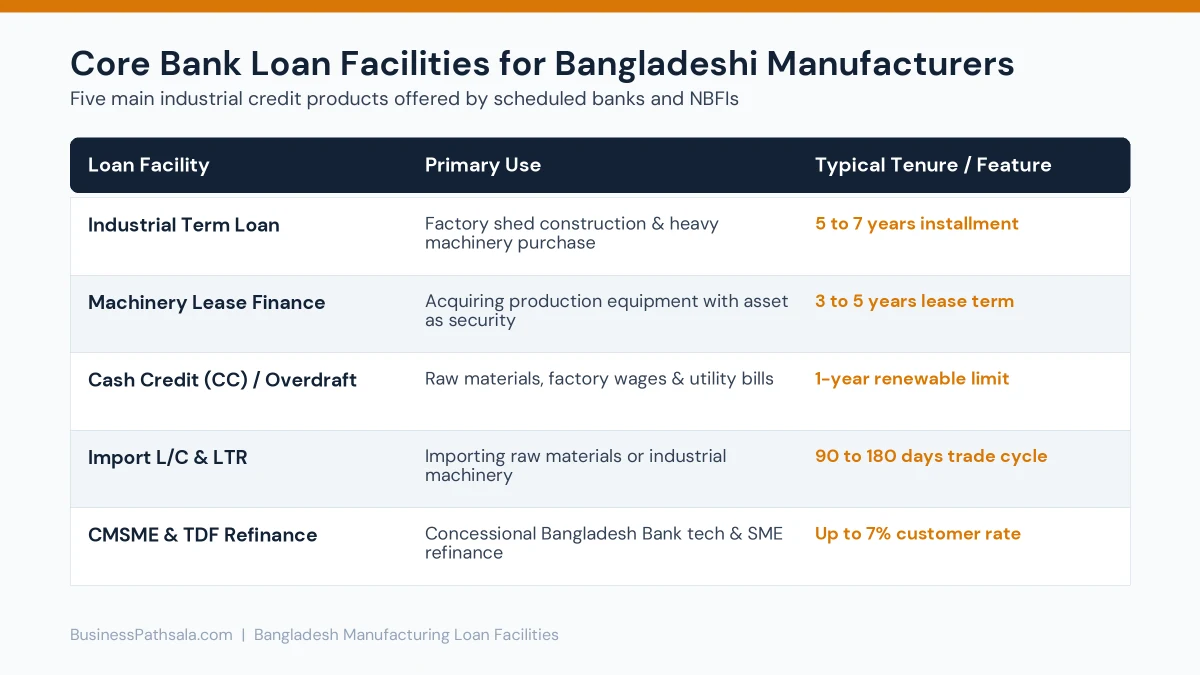
Rarely does a growing factory rely on a single loan product. Banks split manufacturing credit into fixed-asset facilities (for land, sheds, and machines) and working-capital facilities (for raw materials, power bills, and buyer credit cycles). Understanding these five core products helps you ask for the right package at the bank desk.
1. Industrial Term Loan (Project Finance)
An industrial term loan finances long-lived capital expenditure: constructing a factory shed, installing a sub-station or industrial gas connection, or buying local and imported production machinery. Tenures normally run from 3 to 7 years, often with a 3-to-12-month grace period while the factory is built and machines are installed. Banks usually finance 60% to 75% of the verified project cost, expecting the sponsor to contribute the remaining 25% to 40% as equity.
2. Lease Finance and Capital Machinery Loans
If you want to add specific machines to an existing factory (such as an injection molding unit, CNC lathe, automated pouch-packing line, or backup diesel generator) without mortgaging additional real estate, machinery lease finance is often faster than full project finance. Licensed NBFIs like IDLC Finance, IPDC Finance, and LankaBangla Finance—as well as private commercial banks—finance up to 70% to 80% of the machine’s invoice value over 3 to 5 years, keeping the machinery itself as primary security.
3. Cash Credit (CC Hypothecation) and Overdraft (OD)
Once machines are running, factories need continuous working capital to buy local raw materials, pay factory workers, cover utility bills, and bridge 30-to-90-day credit periods demanded by institutional buyers or distributors. Under a Cash Credit (CC Hypo) or Overdraft limit, the bank approves a revolving ceiling (renewed annually) backed by hypothecation of your raw material stock, finished goods inventory, and receivables. You pay interest only on the exact Taka you draw each day.
4. Import L/C, Loan Against Trust Receipt (LTR), and Back-to-Back L/C
Manufacturers importing raw polymers, steel coils, chemicals, or foreign capital machinery from China, India, or Europe rely on trade finance limits. Your bank opens an Import Letter of Credit (L/C) in favor of the foreign supplier. When the shipment arrives at Chattogram Port or Benapole, the bank retires the shipping documents and converts the payment into a short-term Loan Against Trust Receipt (LTR), typically for 90 to 180 days, giving your factory time to process the raw materials and sell finished goods. Export-oriented factories (such as RMG, leather, or jute goods) use Back-to-Back L/Cs and Packing Credit (PC) tied to export sales contracts.
5. Bangladesh Bank Subsidized Refinance Windows
Before accepting a standard commercial rate, ask your bank whether your factory qualifies for an active central bank refinance facility:
- Tk 25,000 Crore CMSME Refinance Scheme: Caps customer interest at 7% per year for eligible cottage, micro, small, and medium manufacturers (banks borrow from Bangladesh Bank at 2%), with priority for import-substitute manufacturing and rural enterprises.
- Technology Development / Upgradation Fund (TDF): Supports export-oriented and local manufacturing units upgrading to modern, energy-efficient machinery at concessional single-digit rates through participating banks.
- Green Transformation Fund (GTF) and Green Refinance: Offers low-cost financing for factories installing Effluent Treatment Plants (ETPs), solar rooftop power, energy-efficient boilers, or water-recycling systems.
- SME Foundation Credit Wholesaling Program: Provides single-digit, collateral-free small loans (typically BDT 1 lakh to BDT 25 lakh) to cottage and small manufacturers, especially inside Bangladesh’s 177 mapped SME clusters.
Interest Rates and Real Repayment Math (BDT 50 Lakh Factory Loan)
Manufacturing loan rates in Bangladesh vary sharply depending on whether your facility sits inside a central bank refinance window or standard commercial bank pricing. To compare broader lending rates across banks, check our guide to SME loan interest rates in Bangladesh.
Below is an illustrative repayment comparison for a BDT 50,00,000 (50 lakh) machinery term loan repaid over 60 months (5 years) on a standard monthly reducing-balance schedule:
| Loan Rate Scenario (BDT 50 Lakh, 60 Months) | Approx. Monthly EMI | Total Interest (5 Years) | Total Repayment |
|---|---|---|---|
| 7.0% Annual Rate (CMSME Refinance Window) | BDT 99,006 | BDT 9,40,360 | BDT 59,40,360 |
| 9.0% Annual Rate (Concessional / Special Window) | BDT 1,03,792 | BDT 12,27,507 | BDT 62,27,507 |
| 11.5% Annual Rate (Prime Corporate / Low SME Tier) | BDT 1,09,963 | BDT 15,97,782 | BDT 65,97,782 |
| 13.5% Annual Rate (Standard Commercial SME Rate) | BDT 1,15,049 | BDT 19,02,954 | BDT 69,02,954 |
Illustrative math only: These calculations assume equal monthly installments (EMI) without a grace period and exclude bank processing fees, L/C opening commissions, land valuation charges, insurance, and 15% VAT. Actual repayment terms appear in your bank’s written sanction letter.
Securing a 7% CMSME refinance rate instead of a 13.5% commercial rate on a BDT 50 lakh machinery loan lowers monthly debt service by roughly BDT 16,043 per month and saves BDT 9,62,594 in total interest over five years. That difference alone can cover the cost of an extra production shift or a major raw material buffer.
Top Banks and NBFIs for Manufacturing Loans in Bangladesh
Not every bank handles industrial finance equally well. Small workshops need fast SME desks with flexible collateral options, while mid-sized factories importing raw materials need banks with strong international correspondent networks for smooth L/C opening.
| Lender Category | Notable Active Institutions | Core Manufacturing Strengths | Best Fit For |
|---|---|---|---|
| Leading Private SME Banks | BRAC Bank, City Bank, Eastern Bank (EBL), Prime Bank, Mutual Trust Bank (MTB), Dhaka Bank | Fast credit appraisal, active Bangladesh Bank refinance access, strong import L/C and trade finance desks | Growing small and medium factories with 2+ years of bank turnover and clean accounts |
| Shariah-Compliant Banks | Islami Bank Bangladesh, Al-Arafah Islami Bank, Shahjalal Islami Bank, EXIM Bank | HPSM (Hire Purchase under Shirkatul Melk) for machinery and Bai-Muajjal / MPI for raw material imports | Manufacturers seeking Islamic asset-backed machinery and working-capital structures |
| State-Owned Commercial Banks | Sonali Bank, Janata Bank, Agrani Bank, Rupali Bank, BASIC Bank | Longer project-finance tenures, wide industrial estate reach, access to government industrial funds | Larger collateral-backed factory setups in BSCIC estates and district industrial zones |
| Specialized NBFIs | IDLC Finance, IPDC Finance, LankaBangla Finance, United Finance | Flexible machinery lease finance, supply-chain factoring, and quick turnaround on equipment upgrades | Established factories adding specific machines without opening new L/C relationships |
Eligibility Criteria: What Banks Check Before Funding a Factory
Credit committees evaluate factories more deeply than retail shops because machinery has lower resale value if a plant shuts down. Expect your relationship manager to verify these six areas:
- Business Track Record: For expansion loans or working-capital limits, most private banks require at least 2 years of profitable manufacturing operations. Greenfield (brand-new) factories are funded selectively and usually require higher sponsor equity (35% to 50%), strong prior industry experience from the founders, and solid land collateral.
- Debt-to-Equity Ratio: Banks want sponsors to keep meaningful skin in the game. Most industrial term loans cap bank debt at 60:40 or 70:30 (meaning 60% to 70% bank loan and 30% to 40% owner equity).
- Debt Service Coverage Ratio (DSCR): Your projected monthly net operating cash flow should comfortably cover scheduled loan installments—most Bangladeshi banks look for a DSCR of at least 1.25x to 1.50x after factoring in raw material price swings and utility downtime.
- Utility and Location Readiness: A factory project cannot start without reliable three-phase industrial electricity (or captive power), water supply, road access for trucks, and proper zoning (such as a BSCIC Industrial Estate or designated commercial-industrial belt).
- Clean CIB Record: All proprietors, partners, or private limited company directors must hold clean Credit Information Bureau (CIB) reports with zero classified defaults.
- Collateral and Security Coverage: Small manufacturing loans (up to BDT 25 lakh to BDT 50 lakh depending on the bank and turnover) may qualify for partial or full collateral-free SME facilities with personal guarantees. Larger factory loans almost always require registered mortgage of factory land and building (or alternative residential/commercial property), plus hypothecation of all plant machinery and inventory and comprehensive fire and industrial all-risk (IAR) insurance.
Required Documents and Regulatory Permits Checklist
Regulatory compliance is where many Bangladeshi manufacturing loan applications get stuck. Unlike a trading shop that only needs a Trade License, factories must show safety, labor, and environmental clearances before disbursement. Gather these six document categories early.
- Entity and Tax Registrations: Updated Trade License specifying manufacturing activity; for private limited companies, RJSC Certificate of Incorporation, MOA, AOA, and Form XII; plus company and directors’ e-TIN, latest tax return receipts (PSR), VAT/BIN registration, and Import Registration Certificate (IRC) if importing raw materials or machines.
- Industrial Registration: Registration with BSCIC (for cottage, micro, and small industries) or the Bangladesh Investment Development Authority (BIDA) for larger local and joint-venture industrial units.
- Safety and Environmental Permits: Factory License from the Department of Inspection for Factories and Establishments (DIFE), Fire Service and Civil Defence License, Environmental Clearance Certificate (ECC) from the Department of Environment (DoE), and BSTI product certification if you manufacture food, beverages, cosmetics, cables, or other regulated items.
- Technical and Cost Evidence: Dated Pro-Forma Invoices (PI) from foreign machinery suppliers or local vendor quotations, factory layout plan, utility load sanction letters, and raw material supplier price lists.
- Financial and Banking File: Last 2 to 3 years of audited financial statements (or management accounts for smaller proprietorships), 12 months of business bank statements, sales VAT returns (Mushak-9.1), and a detailed project profile. For structured templates, see our guides on preparing a SME loan project profile in Bangladesh and writing a business plan for a bank loan.
- Collateral and Legal Papers: Original land deeds, complete chain of title (Bia deeds), updated CS/SA/RS/BS Khatian, mutation (Namjari), current land tax receipt (Khajna), non-encumbrance certificate (NEC), and board resolution authorizing the borrowing.
Step-by-Step: How to Apply for a Manufacturing Business Loan
- Separate your CapEx and working-capital needs clearly. Never lump factory construction, machinery, and daily raw material purchases into one term loan. Draft two clean budgets: one for fixed assets (term loan or lease) and one for your monthly operating cycle (CC Hypo / OD / Import L/C).
- Secure core factory permits before formal submission. At minimum, initiate your Fire License, DIFE registration, and DoE site clearance early. Banks can start credit appraisal while final certificates are in progress, yet they will not release funds until mandatory safety and environmental conditions are satisfied.
- Collect fresh machinery quotations and verify supplier credibility. Obtain dated pro-forma invoices (typically valid 30 to 60 days) from reputable local or overseas machinery manufacturers, including installation, warranty, and spare-parts terms.
- Shortlist 2 to 3 banks with strong SME or industrial desks. Compare their active Bangladesh Bank refinance access (especially the 7% CMSME window), L/C opening margins, collateral valuation policies, and processing timelines.
- Prepare for factory inspection and independent land valuation. Once you submit your bound project profile and financial folder, the bank’s relationship manager and risk analyst will inspect your factory floor, inventory, production capacity, and customer invoices, while an enlisted surveyor values any mortgaged property.
- Negotiate grace periods and L/C terms before signing the sanction letter. If you are importing machines that take 4 months to ship, clear customs, and install, make sure your sanction letter includes an appropriate 6-to-9-month principal grace period so installments begin only after commercial production starts.
Common Mistakes That Delay or Derail Factory Financing
- Underestimating working capital after buying machines: Many first-time factory owners spend all their equity and bank loan on sheds and machinery, leaving zero working capital to buy raw materials or survive 60-day wholesale buyer credit. Always reserve at least 3 months of operating expenses and raw material inventory in your financing plan.
- Ignoring Mushak (VAT) and bank statement alignment: If your actual factory turnover is BDT 5 crore per year but your bank statements and VAT returns only show BDT 1 crore because most sales happen in unrecorded cash, the bank will size your loan against the BDT 1 crore figure. Formalize sales deposits at least 6 to 12 months before applying.
- Buying unverified secondhand machinery without valuation: Banks rarely finance old or unbranded secondhand machines unless an independent technical surveyor certifies their remaining useful life and fair market value.
- Skipping environmental and fire compliance until the last minute: Applying for a DoE clearance or Fire License only after receiving a conditional sanction letter can delay disbursement by 2 to 4 months and cause vendor machinery quotes to expire.
If your manufacturing venture is still a small workshop or home-based unit that does not yet require large industrial project finance, you can start with smaller Uddokta loan options in Bangladesh or SME Foundation cluster financing to build your first two years of formal credit history.
Frequently Asked Questions
What is the interest rate on a manufacturing business loan in Bangladesh?
If your factory qualifies under Bangladesh Bank’s Tk 25,000 crore CMSME Refinance Scheme, the customer-level interest rate is capped at 7% per year (subject to active refinance allocation). Dedicated technology upgradation or green transformation windows also offer subsidized single-digit rates. Standard commercial manufacturing term loans and working-capital facilities typically carry rates between 11.5% and 14.5% depending on the bank, risk rating, and market liquidity.
Can I get a bank loan to start a brand-new factory in Bangladesh?
Yes, though greenfield factory loans face stricter underwriting than expansion loans for existing units. Banks generally require the sponsors to have relevant prior industry experience, contribute 35% to 50% of the total project cost as equity, hold clean land and utility clearances, and submit a thorough feasibility study backed by machinery quotations and realistic buyer demand.
How much of my machinery cost will a Bangladeshi bank finance?
For established manufacturing businesses with healthy bank turnover, banks and NBFIs commonly finance 65% to 80% of the verified cost of new capital machinery through term loans or lease finance, with the factory owner contributing the remaining 20% to 35% as down payment or equity margin.
Is land collateral always mandatory for a manufacturing loan?
For small cottage and micro workshops borrowing under BDT 25 lakh (or up to BDT 50 lakh at select private SME banks with strong turnover), unsecured or partially secured facilities backed by personal guarantees and machinery hypothecation are possible. For larger industrial term loans and high-value import L/C limits, registered land and factory building mortgages remain standard across Bangladeshi banks.
How long does manufacturing loan approval take in Bangladesh?
An existing factory applying for a machinery lease or working-capital top-up with complete financial statements and permits typically receives approval in 3 to 5 weeks. Full industrial project finance involving land mortgage valuation, legal vetting, and import L/C setup usually takes 6 to 10 weeks.
Official Sources and Further Reading
- Bangladesh Bank SMESPD Circular No. 01 — CMSME Financing Master Circular (17 March 2025): Official definitions of cottage, micro, small, and medium manufacturing enterprises and sectoral lending targets.
- Bangladesh Bank SME & Special Programmes Department (SMESPD): Central bank refinance schemes supporting manufacturing, import substitution, and green transformation.
- Bangladesh Small and Cottage Industries Corporation (BSCIC): Industrial estate plots, small-industry registration, and technical support.
- Bangladesh Investment Development Authority (BIDA): One-stop industrial registration and investment facilitation for larger manufacturing units.
- Department of Environment (DoE) & SME Foundation: Environmental Clearance Certificate guidelines and SME cluster credit programs.
Moving Forward With Your Factory Financing Plan
Successful manufacturing finance in Bangladesh comes down to matching the right facility to each part of your factory’s balance sheet. Finance sheds and machines with multi-year term loans or lease facilities, fund raw materials and buyer credit with revolving working capital or import L/Cs, and clear your Fire, DIFE, and DoE permits early so disbursement never stalls. Compare at least two private SME banks and one specialized NBFI or state bank to verify active 7% CMSME refinance availability before locking in your final sanction letter.
Financial information notice: This article is provided for general educational purposes only and does not constitute a loan offer, financial advice, or a guarantee of loan approval. Central bank refinance pools, interest rates, L/C margin directives, and regulatory permit rules change over time. Always verify current terms directly with Bangladesh Bank and your chosen bank or financial institution.


