
Last updated: · By Humayun Ahmed
Businesses in Bangladesh often need two different forms of protection and compliance when launching a product: trademark registration to protect the brand name or logo, and BSTI certification to show that a product meets an applicable Bangladesh Standard (BDS). These are separate legal processes handled by separate government bodies.
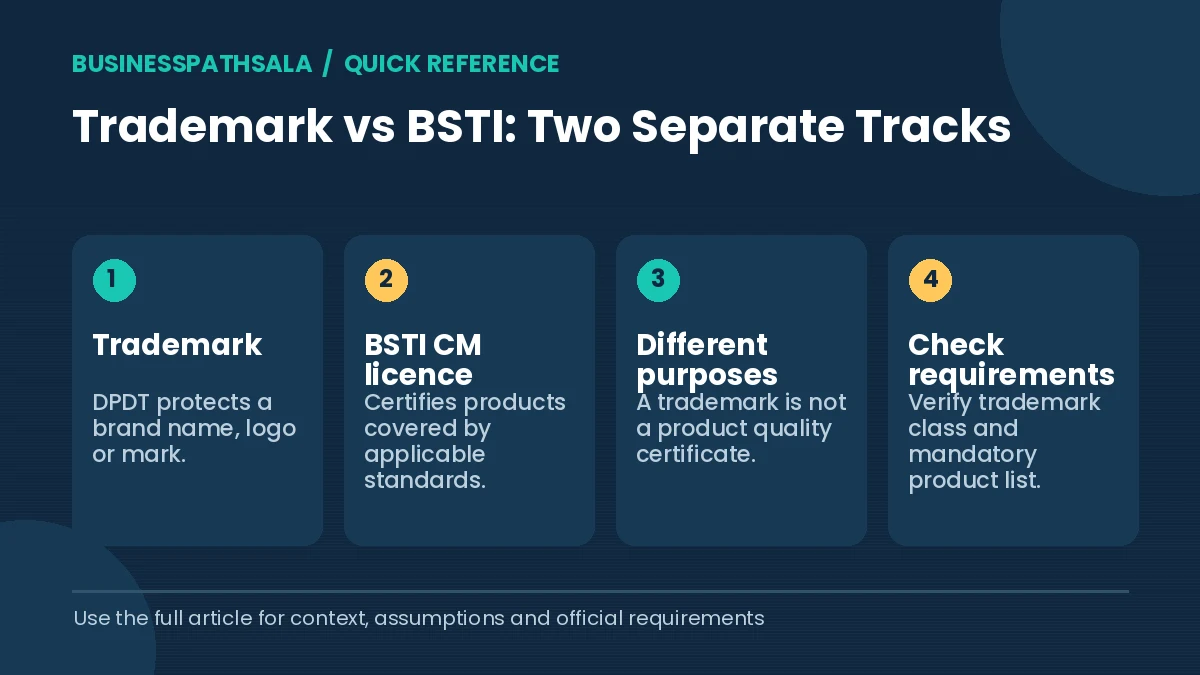
The Department of Patents, Designs and Trademarks (DPDT) handles trademark registration. The Bangladesh Standards and Testing Institution (BSTI) issues Certification Marks (CM) licences for products covered by its certification schemes. A trademark certificate does not prove that a product meets a safety or quality standard. A BSTI CM licence does not give the business exclusive ownership of its brand name.
This guide explains the 2026 application process, official fees that can be verified, documents, timelines, online portals, and the common mistakes that cause delays. Requirements can vary by product and application type, so confirm the current fee and checklist with DPDT or BSTI before paying.
Before filing, make sure your business structure and basic registrations are in order. See our guides to starting a business in Bangladesh, RJSC company registration fees, and online BIN registration for related setup steps.
nTrademark vs BSTI licence: what is the difference?
| Point | Trademark registration | BSTI CM licence |
|---|---|---|
| Purpose | Protects a brand identifier such as a name, logo or label mark | Certifies that a product conforms to a relevant Bangladesh Standard under the applicable scheme |
| Government authority | DPDT, Ministry of Industries | BSTI |
| What is covered? | A mark for specified goods or services in one or more classes | A defined product, product type, manufacturing site and applicable standard |
| Who may need it? | Businesses that want legal protection for their brand | Manufacturers/importers of products covered by mandatory certification, and businesses seeking voluntary certification |
| Result | Registration certificate and rights under trademark law | CM licence/standard mark permission or import clearance, depending on the product and scheme |
| Does one replace the other? | No | No |
Part 1: Trademark registration in Bangladesh
What can be registered as a trademark?
A trademark is a sign that distinguishes the goods or services of one business from those of another. It may include a brand name, word, logo, device, label, combination of words and designs, or another registrable mark under the law. A business should decide whether it needs to protect its word mark, logo, or both. A word mark and a stylised logo can require separate applications because the protection sought is different.
Bangladesh’s principal legislation is the Trademarks Act, 2009, as amended. DPDT is the government office responsible for trademark registration. Bangladesh is not a member of the Madrid System for international trademark registration, so a foreign applicant seeking protection in Bangladesh generally needs a national filing through the applicable local process.
Who can apply for trademark registration?
A person or legal entity claiming to be the proprietor of a mark that is already used or proposed to be used may apply in the prescribed manner. The applicant should be the person or company that will actually own and control the brand. If a company is intended to own the brand, consider filing in the company’s name rather than an employee’s or founder’s personal name without a clear ownership plan.
Before filing, confirm the applicant’s exact legal name, address, entity status, and the mark’s ownership. A mismatch between the trade licence, company documents, application and supporting papers can create avoidable objections or later transfer work.
Trademark classes: how to choose the right one
Goods and services are grouped under the Nice Classification, which has 45 classes: Classes 1–34 cover goods and Classes 35–45 cover services. A trademark application is made separately for each class. The correct class depends on the goods or services the mark will identify, not simply the industry name used by the business.
For example, a clothing brand may need Class 25 for clothing, while a retail or online marketplace service may need Class 35. A food producer may need a goods class that matches the actual product. These are examples only; the exact description and class must be checked against the current classification and DPDT practice.
Do not select extra classes just because they sound relevant. Every additional class generally means another application and another set of official fees. On the other hand, filing only in the wrong class may leave the main commercial activity without the intended protection.
Step-by-step trademark registration process
- Search for similar marks. Search the DPDT trademark register and relevant journals for identical and confusingly similar marks. Search spelling variations, Bangla and English versions, phonetic equivalents, logos and related goods/services. A quick Google search is not a substitute for a registry search.
- Choose the owner and mark. Decide whether to file the word mark, logo, label or more than one version. Make sure the applicant is the intended legal owner.
- Select the class and goods/services description. Identify the appropriate Nice class and draft a precise description. Overly broad or vague descriptions can create examination problems.
- Prepare the application. DPDT’s online system lists TM-1 for registration, TM-4 for search, TM-9 for publication, TM-11 for registration/certificate, TM-12 for renewal and other forms for changes and proceedings.
- Submit and pay through the official process. DPDT’s online filing instructions direct applicants to its e-filing platform. The department has also published instructions for A-Challan fee payment. Follow the payment steps shown in the portal and confirm the fee before final submission.
- Respond to examination objections. The Registrar may raise objections about distinctiveness, similarity, classification, documents or other legal grounds. Reply within the deadline in the notice and provide evidence or legal submissions where appropriate.
- Publication in the Trade Marks Journal. If accepted, the mark is advertised. A third party may oppose the application within the statutory period.
- Complete registration. If the application is not opposed, or an opposition is decided in the applicant’s favour, pay the applicable registration fee and complete the certificate stage.
Trademark registration fees in Bangladesh (2026)
Trademark fees are charged by application and class. A specialist Bangladesh filing guide updated in October 2026 reports the following official fee structure, consistent with the fee schedule described in the DPDT service information. Because the amount payable is confirmed in the government’s payment system, verify the current amount and any tax before submitting.
| Stage / form | Reported official fee | When payable |
|---|---|---|
| TM-1 application | BDT 5,000 per class | At filing |
| TM-9 journal publication | BDT 3,000 per class | After acceptance, before publication |
| TM-11 registration/certificate | BDT 20,000 per class | After the opposition stage, when registration proceeds |
| Estimated total for one class | BDT 28,000 | Across the three stages, excluding professional fees and any additional charges |
| TM-4 official search | BDT 2,000 | If a formal search report is requested |
| TM-12 renewal | BDT 20,000 | At renewal, subject to current schedule |
Example: If a business files the same brand in two classes, the reported three-stage official fees would be BDT 56,000 (BDT 28,000 × 2), before any legal or agent fees and any applicable tax. A logo application filed separately may add another set of class-based fees.
These are not legal-agent fees. If you use a trademark lawyer or agent, ask for a written quotation that separates official government fees, professional fees, VAT/tax if applicable, search work, objection replies and opposition work. The DPDT portal’s A-Challan instructions and the amount shown at payment should prevail if they differ from an older online article.
How long does trademark registration take?
Section 20(3) of the Trademarks Act provides for the registration certificate to be issued within 150 working days from filing where the application has no defects, objection or opposition and the applicant has complied with the requirements. This is a statutory timeframe for a clean case, not a promise that every application will finish within that period.
Examination objections, missing documents, journal publication schedules, opposition proceedings, payment delays and applicant-side defaults can extend the process substantially. A specialist guide reports that real-world cases may take considerably longer, including two to three years in some situations. Plan product launches and packaging changes with this uncertainty in mind.
How long is a trademark valid?
Under the Trademarks Act, the initial registration term is seven years, with renewal for successive ten-year periods. Keep a renewal calendar and maintain evidence of genuine commercial use, such as invoices, packaging, advertisements and sales records. A mark that is not genuinely used for a continuous period of five years may be vulnerable to a removal action under the law.
Documents commonly needed for trademark filing
- Applicant’s full legal name, address and nationality or place of incorporation;
- Trade licence or company incorporation documents, as relevant to the applicant;
- Clear representation of the word mark, logo or label;
- Goods/services description and proposed Nice class;
- Date of first use, if already used, or proposed-to-be-used status;
- Bangla or foreign-language transliteration/translation where required;
- Power of attorney or agent authorisation if filed through a representative;
- Priority documents if a valid priority claim is being made.
The precise document list depends on the applicant and filing. Follow the current DPDT portal checklist rather than relying on a generic agent checklist.
Part 2: BSTI certification and CM licence in Bangladesh
What is a BSTI CM licence?
BSTI’s Certification Marks (CM) scheme certifies that a product meets the relevant Bangladesh Standard (BDS) under the applicable certification procedure. A licensed product may use the BSTI standard mark in the manner permitted by the licence. BSTI conducts document review, factory inspection, sampling and product testing before a CM licence is granted or renewed.
BSTI certification is not a general business registration. The requirement is product-specific. A company may need a CM licence for one product and not another, depending on the current mandatory list and the applicable standard. Some products may also seek voluntary certification where a relevant standard and scheme are available.
Which products require BSTI certification?
BSTI’s official mandatory-products page lists 328 mandatory products following the addition of 13 products in January 2026 to the earlier list of 315. The list spans food and agricultural products, chemicals, engineering goods, electrical and electronic products, textiles and other product groups. The list can change through government notifications, so check the latest list before manufacturing, importing or marketing a product.
In June 2026, BSTI-related reporting noted seven additional products for which the BSTI label or logo was made mandatory: fortified maize oil, saris, woven dress fabrics for women and girls made of man-made fibres and blends, LED luminaires, plastic feeding bottles, toys and autoclaved aerated concrete blocks. This is a useful reminder that a product that was outside the mandatory list last year may be covered after a new notification.
Do not rely on a broad product category alone. Check the exact product name, composition, grade, intended use, relevant BDS number, SRO/notification and whether the rule applies to local production, imports or both. For imported goods, the applicable route may be a BSTI clearance certificate rather than the same CM licence process used for a local factory.
Who needs a BSTI licence?
- Local manufacturers: A factory producing a product covered by mandatory CM certification generally needs the relevant licence before marketing it with the BSTI mark.
- Importers: An importer of a product covered by mandatory import certification may need a BSTI clearance certificate or the relevant conformity evidence for customs release.
- Brand owners using contract manufacturers: The manufacturer, production site, product specification and brand arrangement must be disclosed and accepted under BSTI’s applicable process. Do not assume a licence held by another factory automatically covers your product or brand.
- Voluntary applicants: A business may seek certification for a product covered by an available voluntary scheme, subject to BSTI’s rules.
BSTI CM licence application process for local manufacturers
- Check the mandatory list and BDS. Confirm whether the exact product is mandatory and identify the relevant Bangladesh Standard, test parameters and labelling rules.
- Prepare the factory and quality system. Ensure production equipment, raw-material controls, process records, testing arrangements, storage, hygiene and environmental conditions are suitable for the product and standard.
- Register on the BSTI e-Application portal. Create and verify an applicant profile, then choose the correct service, such as CM licence for a scope product or another applicable service.
- Submit the application and documents. Upload the required trade, tax, trademark, premises, environmental and product information. The portal provides a tracking number after submission for applicable services.
- Pay the application fee. The portal or BSTI will show the applicable payment instructions. Keep the payment receipt and application tracking number.
- Factory inspection. A BSTI officer may inspect the manufacturing site, production process, quality controls, hygiene and relevant facilities.
- Sample collection and testing. BSTI collects product samples and tests them against the relevant BDS at its own or an approved laboratory.
- Evaluation and decision. BSTI reviews the inspection and test reports. If the product and facility meet the requirements and the required fees are paid, the CM licence may be issued.
- Maintain compliance after approval. Continue production controls, correct labelling, record keeping, renewals and cooperation with surveillance inspections and market sampling.
BSTI CM licence fees in Bangladesh
BSTI publishes a CM fee schedule. The official schedule page updated in July 2025 states a new CM licence application fee of BDT 1,000 and a renewal application fee of BDT 1,000. The annual CM fee is calculated on annual ex-factory production value: 0.07% for fruit-based products, subject to a BDT 3,000 minimum and BDT 30 lakh maximum; and 0.10% for other products, subject to a BDT 3,500 minimum and BDT 35 lakh maximum.
| Fee item | Published amount / method |
|---|---|
| New CM licence application | BDT 1,000 |
| CM licence renewal application | BDT 1,000 |
| Fruit-based product annual CM fee | 0.07% of annual ex-factory production value; minimum BDT 3,000; maximum BDT 30,00,000 |
| Other product annual CM fee | 0.10% of annual ex-factory production value; minimum BDT 3,500; maximum BDT 35,00,000 |
| Product testing / inspection | Varies by product, test method, sample and service |
These figures are from BSTI’s published CM fee schedule and should be reconfirmed before payment. The total cost is not necessarily BDT 1,000: marking fees, laboratory testing, inspection, sample transport, retesting and other product-specific charges may apply. Do not use an old fee table from a third-party page without checking BSTI’s current schedule.
Documents for a BSTI CM licence
BSTI’s mandatory-product service profile lists the following common documents. Requirements differ by product and facility, and some documents apply only where relevant.
- Prescribed CM licence application form or online application;
- Updated trade licence;
- TIN certificate and relevant tax/business identity documents;
- Trademark registration certificate, where required by the applicable service checklist;
- Premises licence for food products, where applicable;
- Environmental clearance certificate, where applicable;
- Process flow diagram and manufacturing process details;
- Product label showing the required information and complying with the relevant BDS;
- Factory, machinery, laboratory and quality-control information;
- Product specification, raw-material details and test records where requested;
- Other product-specific approvals, certificates or declarations.
BSTI’s e-service portal lists additional optional documents for some non-scope product applications, such as NID/passport, BIN, fire licence, BIDA/SME/BSCIC registration, laboratory equipment list, calibration certificates and contract papers. These should not be assumed mandatory for every CM application. Select the correct service and follow its live document checklist.
How long does BSTI certification take?
BSTI’s published mandatory-product service profile gives a broad service range of 19–94 working days. Many applications may be completed in a shorter period, while products requiring complex chemical, engineering, electrical or other laboratory testing can take longer. The timeline also depends on whether the applicant submits complete documents, provides samples and pays the required fees on time, and whether the factory passes inspection.
Do not print the BSTI mark on packaging or market a product as certified before the licence is issued and the exact scope, product and site are confirmed. A pending application is not a licence.
BSTI licence for imported products
Importers should identify the product’s mandatory status before placing an order or shipping the goods. For covered products, the customs process may require a BSTI clearance certificate or acceptable conformity evidence. Requirements can differ depending on whether the product is covered by an overseas accredited test certificate, whether BSTI sampling is required, and the current import policy and notification.
Before shipment, send the product specification, brand, manufacturer details, country of origin, BDS reference and available test certificates to BSTI or your customs clearing agent for a written determination. Do not assume a local factory CM licence is the correct document for an imported consignment.
How trademark registration and BSTI certification work together
For a manufacturer launching a packaged consumer product, the two processes can be linked in the business setup sequence:
- Choose the brand and search for conflicting marks.
- File the trademark application in the intended owner’s name and the correct goods class.
- Identify the product’s BDS and check whether it is on the current BSTI mandatory list.
- Prepare the factory, process controls, label and product tests against the applicable standard.
- Apply for the relevant BSTI CM licence or import clearance route.
- Use the BSTI standard mark only after the correct licence is issued, and use the registered trademark in a way consistent with the scope of the registration.
BSTI’s service profile for mandatory products lists a trademark registration certificate among the required documents. That makes early brand clearance and trademark filing especially important for manufacturers who will need CM certification. However, the precise requirement should be checked against the live BSTI service and product category.
Common mistakes that delay approval or increase cost
- Choosing a brand before searching: A similar earlier mark may lead to objection or opposition. Search before printing packaging or spending on marketing.
- Filing in the wrong owner’s name: Fixing ownership after filing may require extra paperwork and fees.
- Selecting the wrong class: A registration in an unrelated class may not protect the goods or services actually sold.
- Assuming one trademark covers every product: Goods and services are classified; separate classes may be needed.
- Assuming every product needs a BSTI licence: Check the current mandatory list and exact BDS instead of relying on hearsay.
- Assuming no BSTI approval is needed because a competitor sells without a mark: Competitor behaviour is not proof of legal compliance.
- Using a label that does not meet BDS rules: Missing Bangla information, incorrect net quantity, grade, manufacturer or other mandatory declarations can create problems.
- Confusing CM licence with import clearance: Ask BSTI which service applies to local manufacture versus imported products.
- Budgeting only for the application fee: Testing, marking fees, inspection and professional services can make the total higher.
- Using the BSTI logo before approval: A pending application does not authorise use of the standard mark.
- Ignoring renewal and surveillance: Certification requires continued conformity, not just a one-time application.
Practical compliance checklist for a new product business
- Confirm the legal entity that will own the brand and product.
- Search the DPDT trademark register for identical and similar marks.
- Choose the correct Nice class and goods/services description.
- Check DPDT’s current online filing forms and A-Challan payment instructions.
- Check BSTI’s current mandatory-product list and relevant BDS number.
- Determine whether the product is locally manufactured, imported or contract-manufactured.
- Collect trade licence, TIN, trademark, premises and environmental documents as applicable.
- Prepare product labels, process flow, machinery and laboratory records.
- Obtain written clarification on product-specific tests, fees and inspection requirements.
- Do not use the registered trademark symbol or BSTI standard mark in a way that overstates the legal status of the mark or product.
- Maintain renewal dates, test records, invoices, packaging samples and compliance documents.
Frequently asked questions
Is trademark registration mandatory for every business in Bangladesh?
A business is not required to register every brand as a condition of simply existing. Registration is the formal route to protect a mark under trademark law and is strongly advisable when a business is investing in a brand. Specific sectoral or product licensing processes may separately ask for trademark documents.
Can I apply for a trademark online in Bangladesh?
Yes. DPDT’s official online application information lists TM-1 registration, TM-4 search, TM-9 publication, TM-11 registration/certificate and TM-12 renewal among the available services. The department directs applicants to its e-filing platform and provides A-Challan payment instructions.
How much does trademark registration cost in Bangladesh?
A current specialist guide reports BDT 5,000 for filing, BDT 3,000 for journal publication and BDT 20,000 for registration, or BDT 28,000 for one class across the three stages. Verify the payable amount in the DPDT/A-Challan process because taxes and later fee updates may affect the amount.
How many years is a trademark valid?
The initial term is seven years under the Trademarks Act, with renewal for successive ten-year periods.
Does every product need a BSTI licence?
No. Mandatory certification applies to products included in the current mandatory list and relevant notifications. Other products may fall under a voluntary certification scheme. Check the exact product and BDS standard with BSTI.
How many products are on BSTI’s mandatory list?
BSTI’s official page updated on 2 April 2026 lists 328 mandatory products, including a 13-product addition published in January 2026. Check the live page for subsequent notifications.
How much is the BSTI CM licence fee?
BSTI’s published schedule states a BDT 1,000 new application fee and BDT 1,000 renewal application fee. The annual CM fee is based on ex-factory production value, and testing/inspection charges vary by product.
Can I use the BSTI logo while my application is pending?
No. Do not represent a product as BSTI-certified or use the standard mark before the correct licence has been issued and its scope confirmed.
Is BSTI certification the same as trademark registration?
No. Trademark registration protects a brand identifier. BSTI certification confirms product conformity with a relevant Bangladesh Standard under the applicable scheme. One does not replace the other.
Official portals and sources
- DPDT official website — government trademark services, notices, forms and journals.
- DPDT / WIPO e-filing platform — online trademark applications and related services.
- DPDT online application instructions — available TM forms and portal guidance.
- Trademarks Act, 2009 — WIPO Lex — legal provisions on filing, registration, term and procedure.
- BSTI official website — mandatory products, CM fee schedules and certification information.
- BSTI mandatory-products list — official product list and notifications.
- BSTI CM licence fee schedule — published application and annual CM fees.
- BSTI e-Application portal — online service applications, payments and tracking.
Disclaimer: This article is general business and compliance information, not legal advice or a product-specific conformity decision. Laws, mandatory product lists, fees and portal procedures may change. Confirm the latest requirements with DPDT, BSTI or a qualified trademark professional before filing or selling a regulated product.
