Last updated: · By Sumon Mahmud
The Export Development Fund (EDF) of Bangladesh Bank is a foreign-currency refinancing facility that helps eligible manufacturer-exporters finance imported raw materials and production inputs. It is designed for export-linked procurement, usually through back-to-back (BTB) import letters of credit, and repayment is tied to export proceeds.
The rules changed in 2026. Bangladesh Bank issued FEPD-1 Circular No. 24 on 23 July 2026, replacing the earlier 2017 master instructions and subsequent amendments. Under the revised circular, the exporter-level rate is 6-month SOFR plus 1.5% per year, and the normal tenor is 180 days, extendable to a maximum of 270 days with Bangladesh Bank approval. A further circular dated 16 September 2026 clarified overdue checks for certain local deliveries against inland BTB LCs.
This guide explains who may qualify, how the limits work, what the financing costs, which documents to prepare, and how to approach an Authorized Dealer (AD) bank. Always ask your bank to confirm the latest circulars and its own credit requirements before opening an LC.
What is the Export Development Fund (EDF)?
Bangladesh Bank established the EDF in 1989 to support manufacturer-exporters that need foreign currency to import inputs for export production. The central bank provides US-dollar refinancing to eligible AD banks against qualifying foreign-currency loans those banks have given to manufacturer-exporters.
The exporter normally deals with an AD bank, not directly with Bangladesh Bank. The bank assesses the transaction, provides the foreign-currency financing, and submits the relevant refinancing application to Bangladesh Bank. The fund is a loan facility, not a grant, cash subsidy, or general-purpose import loan.
How does an EDF loan work?
- The manufacturer receives an export letter of credit, firm export contract, or another eligible export commitment.
- The manufacturer arranges an eligible back-to-back import LC or inland BTB LC in foreign currency for the required production inputs.
- The AD bank checks the export and import documents, value-addition requirements, borrower status, and its own credit conditions.
- The bank makes the qualifying foreign-currency payment and applies to Bangladesh Bank for EDF refinancing under the prescribed process.
- The manufacturer repays the bank from the proceeds of the related export, within the permitted tenor.
For eligible bulk-import arrangements, the circular also recognises financing based on past export performance. The detailed ceiling and conditions differ from ordinary BTB-LC financing.
Who is eligible for EDF financing in Bangladesh?
The 2026 master circular covers qualifying manufacturer-exporters producing goods for direct export and producers of intermediate goods that make local deliveries to manufacturers of final export products. The latter are commonly described as deemed exporters when the transactions meet the applicable rules.
EDF may be considered for eligible input procurement against:
- Back-to-back import LCs in foreign currency;
- Inland back-to-back LCs in foreign currency; and
- Eligible bulk imports by qualifying manufacturers or member mills, subject to the specific limits and conditions in the circular.
Eligible Type-B and Type-C units in EPZs/EZs are also covered in the circumstances described by the circular. A business being involved in exports does not automatically make it eligible. The transaction, imported inputs, export commitment, value addition, borrower status, and bank assessment all matter.
Who may not qualify?
- A trading company that only imports and resells goods, without qualifying manufacturing-export activity.
- A service exporter whose activity does not involve eligible manufacturing input procurement.
- A manufacturer whose relevant input imports do not comply with the current Import Policy Order, value-addition criteria, customs-bond rules where applicable, or foreign-exchange instructions.
- An exporter that has failed to repatriate export proceeds within the statutory 120-day period after shipment, unless an extension or permission applies.
- A manufacturer whose EDF liabilities have been settled through funded facilities, until the eligibility issue is regularised under the circular.
- A borrower whose financing would exceed the applicable EDF ceiling or Bangladesh Bank’s single-borrower exposure limit.
The circular allows an exporter to regain eligibility in specified cases after overdue export proceeds are repatriated or an exemption is granted by the Discount Committee. Your AD bank must verify the relevant overdue position before applying.
EDF interest rate in 2026
Under FEPD-1 Circular No. 24 dated 23 July 2026, Bangladesh Bank charges the AD bank 6-month SOFR + 0.5% per year. The AD bank charges the manufacturer-exporter 6-month SOFR + 1.5% per year.
SOFR means the Secured Overnight Financing Rate. The applicable reference in the 2026 circular is 6-month SOFR; do not use an old fixed rate or assume that a historical SOFR quotation is today’s rate. Because the benchmark changes, the final annualised cost must be calculated using the reference rate and fixing convention applied by the bank for the relevant transaction.
| Cost element | Rule under the 2026 circular |
|---|---|
| Bangladesh Bank refinancing rate to AD bank | 6-month SOFR + 0.5% p.a. |
| Exporter/customer rate charged by AD bank | 6-month SOFR + 1.5% p.a. |
| Possible gap-period interest | AD bank may charge up to an additional 1.0% p.a. for the period between paying the import bill from its own funds and receiving EDF refinancing |
| Extended tenor | The rate prevailing when the extension is granted applies to the extended period |
Illustrative calculation: If the relevant 6-month SOFR fixing used by the bank were 4.00%, the exporter-level annual rate under the formula would be 5.50% (4.00% + 1.50%). This is only an example, not a statement of the current SOFR or a bank quotation. For a short-term facility, ask the bank to show the actual day-count method, benchmark fixing date, interest period, and any permitted gap-period charge in writing.
EDF loan tenure and repayment
The normal EDF loan tenor is up to 180 days from the date of disbursement. Bangladesh Bank may extend it up to 270 days after receiving an application that explains why more time is needed to repatriate export proceeds.
The AD bank should submit an extension request at least 10 days before the maturity date. The application must explain the reason and include supporting documents, including the relevant Bill of Entry. The circular specifies senior-level bank sign-off. If sufficient export proceeds have already been received to repay the EDF loan, the bank should arrange repayment rather than seek an extension.
EDF is normally retired from the proceeds of the related export. It should not be treated as a revolving working-capital loan with an assumed automatic renewal.
EDF loan limits by exporter category
The 2026 circular sets maximum outstanding exposure by category. For ordinary BTB-LC input procurement, the amount is limited to the lower of the eligible input-import value under the relevant export LC or contract (after applying the current value-addition rules) and the applicable association ceiling.
| Association / category for BTB-LC financing | Maximum limit |
|---|---|
| BGMEA member mills | USD 20 million |
| BKMEA member mills | USD 15 million |
| FLAXA member mills | USD 15 million |
| BBPMEA member mills | USD 10 million |
| BFEA member mills | USD 10 million |
| BFFEA member mills | USD 5 million |
| Other sectors | USD 10 million |
For qualifying member mills that bulk-import raw materials to make intermediate goods for local delivery to manufacturers against foreign-currency inland BTB LCs, the ceilings are different:
| Association | Eligible items | Maximum limit |
|---|---|---|
| BTMA | Cotton and other fibres | USD 20 million |
| BDYEA | Unprocessed yarn and chemicals | USD 10 million |
| BPAMEA | Raw materials | USD 2 million |
| BPGMEA | Raw materials | USD 1 million |
| BCMEA | Raw materials | USD 1 million |
For the bulk-import category above, the eligible amount is also restricted by the foreign-currency amount realised against inland BTB LCs during the preceding 12 months. The applicable amount is the lower of that figure and the association ceiling.
The circular also provides an additional bulk-import support facility for manufacturer-exporters irrespective of sector, based on export performance over the preceding 12 months or USD 500,000, whichever is lower. This support and the member-mill bulk-import entitlement are mutually exclusive and remain within the admissible limit under the circular. An exporter importing both in bulk and under BTB arrangements, or operating under multiple associations, cannot simply add all association ceilings together; the circular restricts the exporter to the maximum limit applicable to one association.
How to apply for an EDF loan through a bank
There is no ordinary direct-to-public EDF application counter at Bangladesh Bank. Start with the foreign-exchange or trade-finance team of a scheduled bank that is an Authorized Dealer in foreign exchange.
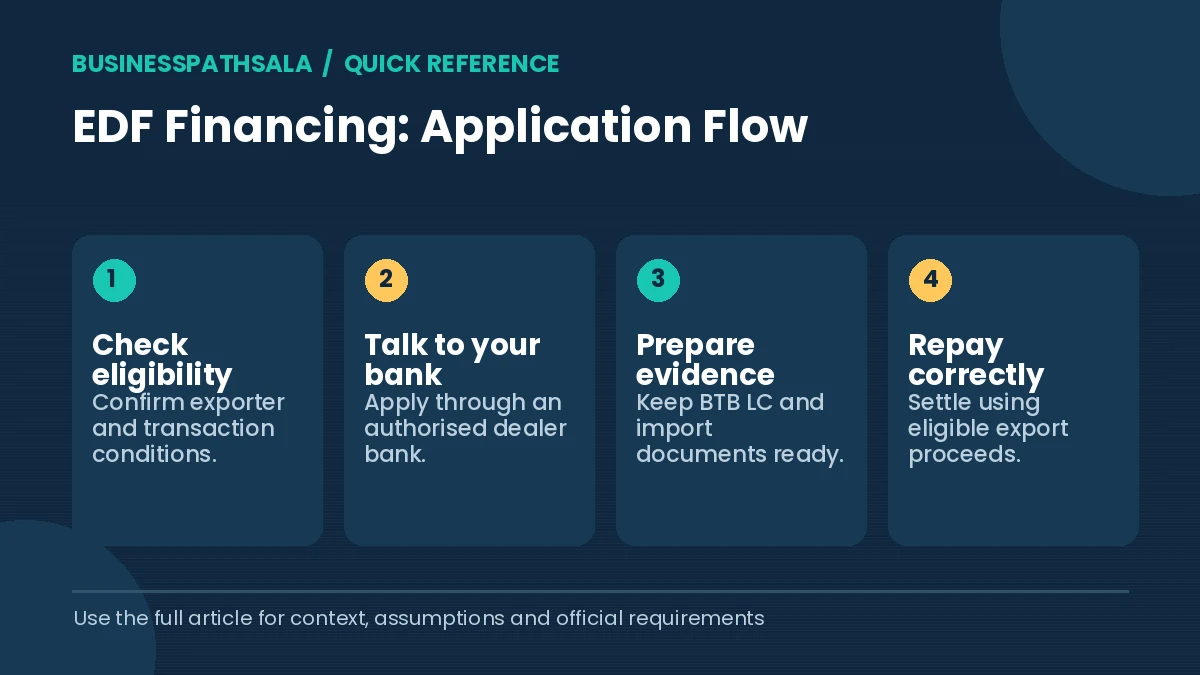
- Confirm the transaction type. Explain whether the requirement is for a BTB import LC, inland BTB LC, or eligible bulk import.
- Check the export linkage. Provide the master export LC, firm contract, inland BTB LC, or other relevant evidence requested by the bank.
- Ask for a preliminary eligibility review. The bank should check the product, value-addition rules, association category and ceiling, export-proceeds history, CIB/credit position, and single-borrower exposure.
- Submit the bank’s credit and trade documents. The bank may require a credit proposal, facility application, financial statements, security documents, and transaction-specific papers.
- Obtain written pricing and tenor terms. Ask for the benchmark, margin, gap-period rate if any, maturity date, repayment source, and charges before accepting the facility.
- Let the AD bank submit the EDF application. Under the master circular, the head office or principal office of the AD bank submits Form-A to Bangladesh Bank’s FRTMD-1, listing the input procurements financed in foreign currency.
- Track export proceeds and maturity. Keep the bank informed about shipment, export-document negotiation, proceeds realisation, and any delay well before maturity.
Documents to prepare
The exact checklist varies by bank and transaction. The following is a practical preparation list, not a claim that every item is mandatory in every case.
- Trade licence, incorporation or partnership documents, and current company profile;
- Export Registration Certificate (ERC) and relevant association membership certificate, where applicable;
- Master export LC, firm export contract, or relevant buyer order;
- Back-to-back import LC or inland BTB LC details;
- Proforma invoice, supplier details, commercial invoice, and shipping documents when available;
- Bill of Entry and customs/bond documents relevant to the imported inputs;
- Input-output or value-addition calculation required under the applicable Import Policy Order;
- Export shipment records and evidence of export-proceeds realisation;
- Financial statements, bank statements, existing borrowing details, and security papers requested by the AD bank;
- Explanation and supporting records for any delayed export proceeds or requested tenor extension.
Bangladesh Bank’s Form-A is submitted by the AD bank, not normally by the exporter directly. It records the direct or deemed exporter, ERC, import or inland BTB LC, amount in USD, import-payment date, and related master LC or contract information.
Important 2026 update for deemed exporters and inland BTB deliveries
FEPD-1 Circular No. 36 dated 16 September 2026 clarified the overdue-status test for bulk imports by eligible producers. AD banks may consider EDF finance where local delivery bills against back-to-back LCs do not remain outstanding beyond 270 days. The clarification was issued to align the overdue-status test with the permitted deferred-payment period for certain back-to-back LCs. Other EDF instructions in Circular No. 24 remain unchanged.
This does not mean every local delivery automatically qualifies for 270 days. The underlying transaction must still satisfy the applicable LC, EDF, foreign-exchange, and bank requirements.
Common mistakes exporters should avoid
- Using an old interest rate: Ask the bank to apply the 6-month SOFR formula in the 2026 master circular, not a copied historical fixed rate.
- Assuming the association ceiling is the approved amount: The eligible input value, value-addition rules, exposure limit, and other conditions can reduce the amount.
- Applying after export proceeds become overdue: Monitor the 120-day statutory repatriation period and any permitted extension.
- Confusing an EDF loan with a general import facility: EDF is tied to eligible manufacturing inputs and export transactions.
- Waiting until maturity to request an extension: The AD bank should submit the request at least 10 days before maturity, with supporting evidence.
- Ignoring the gap period: Ask whether the bank will charge the permitted additional interest for the period before it receives EDF refinancing.
- Combining multiple association limits: The circular does not allow an exporter to stack ceilings across multiple associations or bulk and BTB routes.
EDF vs. a regular export or import loan
| Point | EDF | Regular bank facility |
|---|---|---|
| Purpose | Eligible foreign-currency input procurement linked to manufacturing exports | Depends on the bank product and sanction |
| Access | Through an AD bank under Bangladesh Bank EDF rules | Directly from the bank under its credit policy |
| Pricing | Formula linked to 6-month SOFR plus prescribed margin | Set by bank product, currency, borrower risk, and applicable rules |
| Tenor | Normally 180 days; may be extended to 270 days with Bangladesh Bank approval | Depends on the facility |
| Repayment | Normally from related export proceeds | As stated in the sanction |
Frequently asked questions about EDF in Bangladesh
Can a small exporter apply for an EDF loan?
Possibly, if it is a qualifying manufacturer-exporter or eligible deemed exporter and the transaction meets the circular. Business size alone does not establish eligibility. The AD bank must check the export transaction, input procurement, applicable ceiling, and credit conditions.
Can I apply directly to Bangladesh Bank?
The exporter normally applies through an Authorized Dealer bank. The AD bank’s head office or principal office submits the prescribed Form-A to Bangladesh Bank.
What is the EDF interest rate in 2026?
The exporter-level rate under FEPD-1 Circular No. 24 is 6-month SOFR plus 1.5% per year. The actual rate depends on the relevant benchmark fixing and the bank’s calculation for the transaction.
What is the maximum EDF loan period?
The normal tenor is 180 days. Bangladesh Bank may approve an extension up to 270 days on a properly supported application. An extension is not automatic.
Can a trading company use EDF?
EDF is intended for eligible manufacturer-exporters and qualifying producers of intermediate goods for export manufacturing. A company that only trades or resells imported goods should not assume it qualifies.
Can a service exporter or freelancer use EDF?
The facility is for eligible input procurement by manufacturer-exporters. A service exporter or freelancer should not assume that ordinary service-export receipts qualify for EDF.
What happens if export proceeds are not received on time?
Failure to repatriate export proceeds within the statutory period, unless an extension or permission applies, can make the related input imports ineligible for EDF and may trigger other regulatory consequences. Contact the AD bank before the deadline if a delay is likely.
Final checklist before approaching your AD bank
- Confirm that your business and the specific input-import transaction meet the 2026 EDF circular.
- Check the applicable association ceiling and the value of eligible inputs.
- Review export-proceeds realisation and overdue status.
- Ask for the 6-month SOFR fixing, bank margin, possible gap-period charge, and total estimated cost in writing.
- Confirm the 180-day maturity and the evidence required for any extension request.
- Keep the export LC, BTB LC, Bill of Entry, shipment, and proceeds records organised.
Official references: Read Bangladesh Bank’s FEPD-1 Circular No. 24 dated 23 July 2026 (Master Circular on EDF) and FEPD-1 Circular No. 36 dated 16 September 2026. The Bangladesh Bank EDF page may still display older reference details, so use the later circulars where they supersede earlier instructions.