Last updated: · By Afra Monira
Break-even point (BEP) is the sales level at which a business’s total revenue equals its total costs. At this point, the business makes neither a profit nor a loss. A small business in Bangladesh can calculate its break-even point by dividing monthly fixed costs by the contribution earned from each unit sold.
Break-even units = Monthly fixed costs ÷ (Selling price per unit − Variable cost per unit)
For example, if a shop has monthly fixed costs of Tk 60,000, sells a product for Tk 500 and spends Tk 300 on each unit, its contribution is Tk 200. It must sell 300 units in a month to break even. This guide explains the calculation, Bangladesh-specific costs, examples, limitations and a practical monthly review method.
What Is a Break-Even Point?
The break-even point is the level of sales where total sales revenue covers all fixed and variable costs for a chosen period. If sales are below this point, the business makes an operating loss under the assumptions used. If sales are above it, the business earns an operating profit before any costs excluded from the model.
Break-even analysis is part of cost-volume-profit analysis. Bangladesh Open University’s management accounting material explains how selling price, sales volume and cost behaviour affect profit, and how contribution first covers fixed expenses. The method is useful when setting prices, preparing budgets and deciding whether a product or business idea is financially feasible.
Break-Even Point Formula
1. Break-even point in units
BEP (units) = Fixed costs ÷ Contribution margin per unit
Contribution margin per unit = Selling price per unit − Variable cost per unit
Round the result up to the next whole unit because a business cannot sell a fraction of a product in most cases.
2. Break-even point in sales taka
Contribution margin ratio = Contribution margin per unit ÷ Selling price per unit
BEP sales (Tk) = Fixed costs ÷ Contribution margin ratio
For example, if the contribution margin ratio is 40% and fixed costs are Tk 60,000, monthly break-even sales are Tk 150,000.
3. Profit at a planned sales volume
Estimated operating profit = (Units sold × Contribution margin per unit) − Fixed costs
This formula helps you test whether a sales target is likely to cover costs. It is a planning estimate, not a substitute for an income statement or cash-flow report.
Fixed Costs vs Variable Costs in Bangladesh
Correct cost classification matters more than complicated arithmetic. Use one consistent period, such as one month. If you use monthly rent, monthly sales and monthly salaries, do not mix them with annual costs without converting them to monthly amounts.
| Cost type | Common examples | How to treat it |
|---|---|---|
| Fixed costs | Shop or office rent, fixed salaries, internet package, software subscription, insurance, equipment depreciation | Include the amount payable for the month even if sales are low |
| Variable costs | Product purchase or raw materials, packaging, per-order delivery subsidy, sales commission, payment transaction fees | Calculate the cost for each unit or order |
| Mixed costs | Electricity, phone bills, generator fuel, maintenance, staff overtime | Separate the fixed minimum from the usage-related portion where practical |
For a retail shop, the purchase cost of goods is usually variable. For a small food producer, ingredients and packaging vary with output. For an online seller, packaging, courier charges paid by the seller, return losses and payment fees may vary with orders. Do not classify a cost only by its name: classify it by how it behaves as sales volume changes.
Step-by-Step: How to Calculate Break-Even Point
Step 1: Choose the period
Start with a monthly calculation if your rent, wages and sales are tracked monthly. A seasonal business may also need a weekly or seasonal model. Keep the period consistent throughout the calculation.
Step 2: Add all fixed costs
List rent, fixed payroll, internet, software, accounting support, insurance, equipment depreciation and other regular overhead. Include the market value of work you perform yourself if you want to understand the true economic cost of running the business. If you pay a loan instalment, separate principal and interest: interest is a financing expense, while principal repayment is a cash-flow obligation rather than an operating expense. For cash break-even planning, show both views separately.
Step 3: Calculate variable cost per unit
Add the costs that arise from selling one additional unit. For a product, include purchase or manufacturing cost, packaging, seller-paid delivery, sales commission and payment charges. For a service, include direct labour hours, materials, subcontracting and other costs directly tied to delivering that service.
Step 4: Set a realistic selling price
Use the average net selling price after routine discounts, not just the printed price. If VAT is collected from customers, do not automatically treat the VAT amount as revenue available to cover costs. Record sales and VAT according to the applicable tax treatment and confirm the current rules with the National Board of Revenue or a qualified tax professional.
Step 5: Calculate contribution per unit
Subtract variable cost per unit from net selling price. If the result is zero or negative, the product cannot cover fixed costs at that price and cost structure. Revisit pricing, sourcing, fulfilment or the product itself.
Step 6: Divide fixed costs by contribution
Divide total fixed costs by contribution per unit. Round up to a whole unit and convert the units into sales revenue if needed.
Step 7: Compare the result with realistic demand
Ask whether your location, production capacity, customer base and sales channels can support the required monthly volume. A break-even figure is useful only when it is compared with achievable demand.
Bangladesh Small Business Example: A Clothing Shop
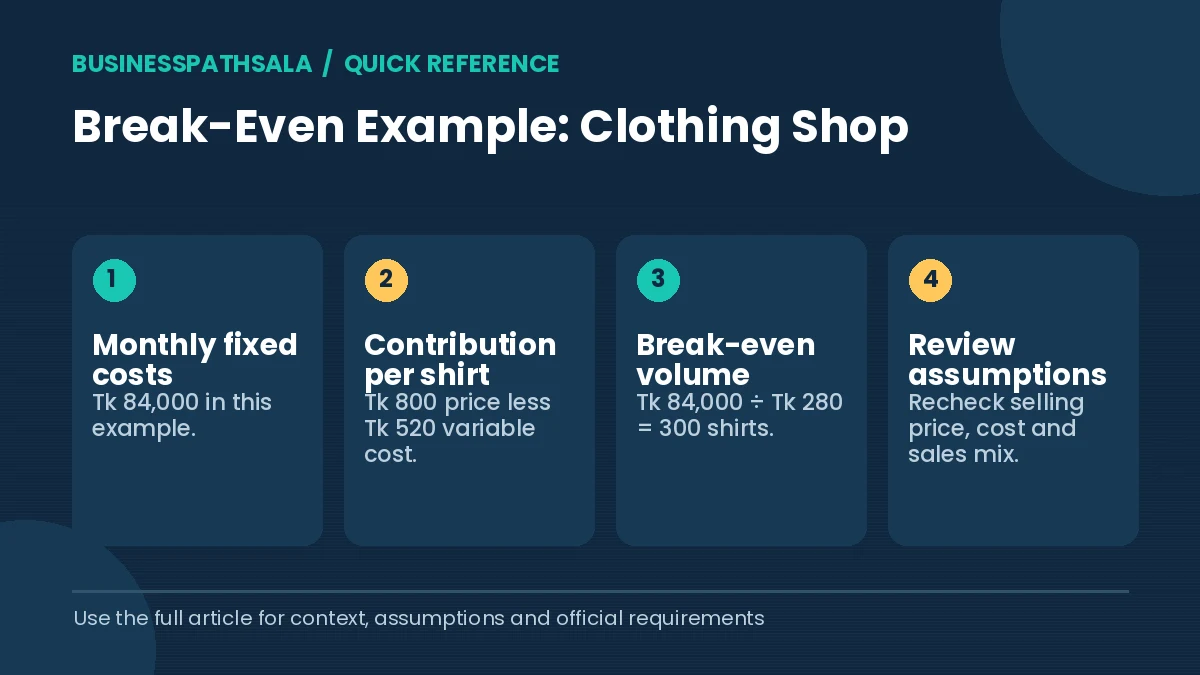
Suppose a small clothing shop in Bangladesh sells a shirt for an average net price of Tk 800. The purchase cost, packaging and seller-paid delivery average Tk 520 per shirt. Monthly fixed costs are Tk 84,000.
| Item | Amount |
|---|---|
| Average selling price | Tk 800 |
| Variable cost per shirt | Tk 520 |
| Contribution per shirt | Tk 280 |
| Monthly fixed costs | Tk 84,000 |
| Break-even units | 84,000 ÷ 280 = 300 shirts |
| Break-even sales | 300 × Tk 800 = Tk 240,000 |
The shop needs to sell 300 shirts in the month to cover the costs included in this model. At 350 shirts, the estimated operating profit is (350 × Tk 280) − Tk 84,000 = Tk 14,000. At 250 shirts, the estimated loss is Tk 14,000. These figures assume the average price and cost remain stable and that all 350 or 250 units are sold in the same period.
Example for an Online Business
Consider a Facebook-based online store selling a household product. Its average net selling price is Tk 1,200. Product purchase cost is Tk 700, packaging is Tk 35, seller-paid delivery subsidy is Tk 40, and payment or order-processing cost averages Tk 25. Variable cost is therefore Tk 800 and contribution is Tk 400 per completed order.
If monthly fixed costs are Tk 48,000 for content production, internet, staff retainer and other overhead, the break-even point is 48,000 ÷ 400 = 120 completed orders. This is not necessarily 120 orders received: cancellations, failed deliveries and returns can reduce completed sales. Use completed, paid orders when calculating actual contribution.
Track return-to-origin costs, discounts and cash-on-delivery collection charges. If the seller absorbs these expenses, they belong in the relevant order economics. A courier comparison and inventory process can help you measure these costs more accurately. See our guides to courier services for e-commerce in Bangladesh and POS and inventory software for retail shops.
How to Calculate Break-Even for Multiple Products
A shop selling several products usually cannot use one product’s contribution margin for the whole business. Calculate the contribution margin ratio for each product, then use a weighted average based on the expected sales mix.
For a simple illustration, suppose a shop expects 60% of revenue from Product A with a 30% contribution margin ratio and 40% from Product B with a 50% ratio. The weighted contribution margin ratio is (60% × 30%) + (40% × 50%) = 38%. If fixed costs are Tk 76,000, estimated break-even revenue is Tk 76,000 ÷ 38% = Tk 200,000.
This answer depends on maintaining the assumed sales mix. If customers begin buying more of the lower-margin product, the overall break-even revenue rises. Review the mix whenever product demand changes.
How to Calculate Break-Even with a Target Profit
Many owners need to know how much to sell to earn a specific profit, not merely avoid a loss.
Required units = (Fixed costs + Target operating profit) ÷ Contribution per unit
If fixed costs are Tk 84,000, contribution is Tk 280 per shirt and the target monthly operating profit is Tk 28,000, required sales are (84,000 + 28,000) ÷ 280 = 400 shirts.
Use operating profit consistently. If your target is after-tax net profit, interest and tax need to be modelled separately. Tax rules and rates can change, and the applicable treatment depends on the business and transaction.
Margin of Safety: How Far Are You from a Loss?
The margin of safety shows how much actual or planned sales can fall before the business reaches break-even.
Margin of safety (Tk) = Actual or budgeted sales − Break-even sales
Margin of safety (%) = (Margin of safety ÷ Actual or budgeted sales) × 100
If planned monthly sales are Tk 300,000 and break-even sales are Tk 240,000, the margin of safety is Tk 60,000 or 20%. A low margin means a modest fall in sales may push the business into a loss. A high margin gives more room, although it does not remove cash-flow or market risks.
How to Lower Your Break-Even Point
- Review purchase prices: Compare suppliers and negotiate based on quality, delivery reliability and total landed cost.
- Reduce avoidable fixed overhead: Review unused subscriptions, excess space and recurring services before cutting costs that support sales.
- Improve contribution per order: Reduce waste, packaging errors, failed deliveries and unnecessary discounts.
- Revisit pricing carefully: A price increase can reduce the number of units required, but test customer demand and competitor pricing first.
- Focus on profitable products: Promote products with stronger contribution, while considering customer demand and repeat purchases.
- Improve stock control: Avoid dead stock, expiry and emergency purchases. Use a reliable stock and sales record.
Do not assume that cutting every cost is helpful. A lower-cost supplier may increase defects or returns. Reducing staff may weaken customer service. Evaluate the effect on contribution and demand before making a change.
Common Break-Even Calculation Mistakes
- Leaving out the owner’s labour: A business can appear profitable only because the owner works without a salary.
- Using list price instead of realised price: Discounts, bundles and refunds reduce the actual amount earned.
- Ignoring delivery and returns: These costs can materially change online order contribution.
- Mixing monthly and annual figures: Convert all costs to the same period.
- Treating every expense as fixed: Electricity, fuel and payroll may have variable components.
- Assuming every product has the same margin: Use a weighted sales mix for a multi-product business.
- Confusing profit with cash: Credit sales, inventory purchases, loan principal and delayed collections affect cash flow differently.
- Ignoring tax treatment: VAT and other tax obligations should be accounted for correctly. Check current NBR guidance rather than assuming every business has the same tax rate or threshold.
Break-Even Analysis: What It Cannot Tell You
Break-even analysis is a simplified model. It commonly assumes a stable selling price, stable variable cost per unit, fixed costs within a relevant operating range and a reasonably stable product mix. It may also assume that units produced are sold during the period. Real businesses face changing supplier prices, seasonal demand, discounts, damaged stock, staff capacity limits and customer credit.
The calculation does not show whether the business has enough cash to pay suppliers tomorrow. It does not measure loan affordability, tax compliance, working-capital needs or the time required to collect receivables. Use it alongside a cash-flow forecast, stock records and a profit-and-loss statement.
Bangladesh VAT and Record-Keeping Considerations
Tax treatment affects the amount of revenue available to cover business costs. The National Board of Revenue publishes VAT FAQs and compliance guidance, including information on registration and turnover-tax arrangements. The applicable requirements can depend on the law in force, annual turnover, business activity and exemptions. Do not hard-code a tax threshold or VAT rate into a long-term break-even sheet without checking the latest NBR notice or consulting a tax practitioner.
Keep purchase invoices, sales records, expense vouchers, payroll records, delivery statements and payment-provider statements. Separate business and personal transactions. If your business is required to maintain VAT records or issue tax documents, follow the relevant NBR rules. See the official NBR VAT registration and enlistment guidance and NBR VAT FAQ.
A Monthly Break-Even Review Checklist
- Update actual rent, salaries and recurring overhead.
- Update purchase prices, packaging, delivery and transaction costs.
- Calculate the realised average selling price after discounts and refunds.
- Recalculate contribution per unit or contribution margin ratio.
- Calculate break-even units and break-even sales for the month.
- Compare actual completed sales with the break-even target.
- Calculate the margin of safety and estimated operating profit or loss.
- Review the next month’s sales forecast, stock needs and cash collection timing.
Accounting software or a properly maintained spreadsheet can make this review easier. Business owners comparing bookkeeping tools can read our guide to accounting software for small businesses in Bangladesh. For broader planning, see how to start a business in Bangladesh.
Frequently Asked Questions
What is the easiest way to calculate break-even point?
Add monthly fixed costs, subtract variable cost per unit from selling price, then divide fixed costs by that contribution. Round the result up to a whole unit.
What is the break-even formula in taka?
Break-even sales in taka equal fixed costs divided by the contribution margin ratio. The ratio is contribution per unit divided by selling price per unit.
Can a small business break even without making a profit?
Yes. At break-even, revenue exactly covers the costs included in the calculation. Profit is zero before any excluded costs or adjustments.
Should I include loan instalments in break-even?
For accounting break-even, loan principal is not an operating expense; interest is generally treated separately as a financing cost. For cash break-even, include the full instalment as a cash outflow in a separate cash requirement calculation.
How often should I calculate break-even?
Review it monthly and whenever selling prices, supplier costs, rent, wages, delivery charges or product mix change materially.
Is break-even analysis suitable for a service business?
Yes. Replace product units with billable hours, projects, customers or service packages. Variable costs should include the direct cost of delivering each service.
What if the contribution margin is negative?
The selling price is below the variable cost per unit. Increasing volume will generally increase the loss. Review price, cost and the product or service before scaling sales.
Final Takeaway
Break-even analysis gives a small business owner a clear monthly sales target for covering costs. Start with accurate fixed costs, calculate the variable cost of each sale, and use the contribution margin to find the required units or revenue. Recheck the assumptions every month and compare the result with actual cash flow, stock movement and customer demand. A break-even figure is a planning tool; it is not a guarantee of profit.
Disclaimer: This article is for general educational purposes and is not individual accounting, tax or investment advice. Confirm applicable tax and VAT obligations with the National Board of Revenue or a qualified professional.