
Last updated: · By Afra Monira
For the 2026–27 tax year, Bangladesh has added freelancing and content creation to the income categories listed for income-tax exemption under the Finance Act 2026. This is relevant to eligible individual YouTubers and Facebook creators, but the exemption should not be treated as a blanket exemption for every kind of income, every business structure or every tax obligation. Creators should keep platform statements, payment records and bank remittance evidence, and confirm their own eligibility under the amended law.
Bangladesh Bank’s foreign-exchange circular also explains how individual service exporters can receive foreign earnings through authorised banks and payment channels. This guide covers the current legal position, YouTube and Facebook payout setup, bank documentation, tax-return records and common mistakes.
Are YouTube and Facebook Earnings Tax-Free in Bangladesh?
The Finance Act 2026 amended the Sixth Schedule of the Income Tax Act 2023 to include “freelancing” and “content creation” in the relevant income-exclusion list. The amendment is reflected in the official Bangladesh Laws text. The Institute of Chartered Accountants of Bangladesh (ICAB) explains that the exemption for freelancing and content-creation income runs up to 30 June 2027, subject to the statutory conditions, including receipt through banking channels.
This means eligible income from content creation may qualify for the exemption during the specified period. It does not mean that all money entering a creator’s bank account is automatically tax-free. The source and nature of income, who earns it, the applicable assessment year, the statutory conditions and the evidence of receipt all matter.
For example, revenue earned personally from monetised videos may be treated differently from salary, sponsorship income earned through a company, sales of merchandise, consulting fees, or income from a separate business. Do not assume that every revenue stream associated with a social-media page falls into the same tax category.
What Changed Under the Finance Act 2026?
The Finance Act 2026 added freelancing and content creation to the relevant Sixth Schedule provision. The official amendment is the controlling legal source. ICAB’s tax summary describes the exemption as applying through 30 June 2027 and notes the importance of banking-channel receipt. The budget speech had announced the policy direction, but creators should rely on the enacted Finance Act rather than a budget proposal or a social-media post.
There has also been public confusion about a reported 7.5% deduction from certain inward remittances. In June 2026, NBR publicly stated that there was no provision for deducting that amount from freelancers’ or expatriates’ income in the way described in the reports. A bank statement showing a deduction should still be investigated with the bank and NBR; do not assume that a deduction is an income tax payment or that every inward remittance is covered by the same rule.
YouTube Monetization and Payout Rules for Bangladesh
YouTube monetisation is available through the YouTube Partner Programme (YPP), subject to channel and feature-specific eligibility, policy compliance and review. YouTube lists advertising revenue, Shorts Feed ads, YouTube Premium revenue, memberships, Super Chat, Super Stickers and Super Thanks among its monetisation features. The exact thresholds vary by feature and can change, so check the current YouTube Studio Earn tab and official eligibility page before applying.
For advertising revenue, YouTube’s published baseline includes 1,000 subscribers and either 4,000 valid public watch hours in the previous 12 months or 10 million valid public Shorts views in the previous 90 days, alongside other requirements. Lower entry thresholds for certain fan-funding features are separate and do not automatically unlock advertising revenue.
How YouTube pays creators in Bangladesh
Bangladesh is listed by Google as a country where YouTube payment accounts can receive payments by cheque or wire transfer. Electronic Funds Transfer (EFT) is not listed for Bangladesh in Google’s country table. Creators should use the payment options displayed inside their own AdSense for YouTube account, because availability and account-specific verification can differ.
- Open the Payments section in AdSense for YouTube.
- Complete identity, address and tax-related verification requested by Google.
- When the payment-method threshold is reached, add an eligible bank account for wire transfer or another option shown in the account.
- Enter the account-holder name and bank details exactly as held by the bank. Ask the bank for its incoming-wire instructions and SWIFT/BIC details.
- Keep the payment statement and the bank’s inward-remittance advice or credit advice.
Google says it does not charge a fee for receiving a wire transfer, but the recipient’s bank may charge fees or apply its exchange rate. Confirm the receiving bank’s charges and conversion method before relying on a payout estimate.
Facebook Monetization and Payout Rules for Bangladesh
Meta’s Facebook Content Monetization programme brings eligible formats such as Reels, longer videos, photos and text posts into a unified monetisation programme. Access is subject to Meta’s invitation or availability process, account and content eligibility, Partner Monetization Policies and Content Monetization Policies. Availability can differ by account and country, so check the Monetization section in the Professional Dashboard or Meta Business Suite rather than relying on old follower-count claims.
Meta’s payout setup is account-specific. Creators should enter accurate legal and payment details, complete any identity or tax onboarding requested by Meta, and select a payment method actually offered in their dashboard. Do not use another person’s bank account or false country details to bypass restrictions. A mismatch between the legal payee, platform account and bank beneficiary can delay or block payment.
What to save for each Facebook payout
- Monthly monetisation or earnings statement from Meta.
- Payout notification and transaction reference.
- Payment processor statement, if one is involved.
- Bank credit advice showing the foreign remittance and credited taka amount.
- Records of platform fees, refunds or adjustments.
Bangladesh Bank Rules for Receiving Creator Income
Bangladesh Bank’s FEPD-1 Circular No. 26, dated 30 July 2026, consolidates foreign-exchange rules for export transactions and includes a section on freelancers and individual service exporters. It recognises electronic evidence such as platform statements, emails, contracts, invoices and digital communications for verifying service-export receipts. The bank may check whether the beneficiary’s profile and capability are consistent with the stated activity.
The circular says inward remittances up to USD 20,000 or equivalent against service exports may be credited without Form-C, subject to the bank’s verification. It also describes authorised payment channels and the possibility of receiving eligible proceeds through bank accounts or supported digital wallets. This is a foreign-exchange documentation rule, not an income-tax exemption by itself.
For service exporters, the circular permits retention of up to 50% of net export earnings in an Exporters’ Retention Quota (ERQ) account for software, data processing and other ICT-related services, and up to 30% for other legitimate services, subject to the detailed rules. The remaining amount is converted into taka and credited locally. Whether a particular creator’s activity falls into a category eligible for ERQ treatment should be confirmed with the authorised dealer bank.
Bangladesh Bank also states that banks must ensure deduction and payment of taxes where applicable and that transactions remain subject to KYC, AML/CFT and foreign-exchange rules. A creator should not confuse permission to receive foreign currency with permission to keep all proceeds abroad.
Documents You Should Keep
| Record | Why it matters |
|---|---|
| YouTube or Meta monthly earnings statement | Shows the platform, earning period and gross or net amount |
| Payout confirmation | Links the platform balance to a payment reference |
| Bank credit advice or remittance certificate | Shows the amount received, currency and conversion |
| Bank statement | Supports the date and amount credited to your account |
| Platform fee or adjustment record | Explains differences between gross earnings and net payout |
| Identity and account ownership records | Helps resolve payee-name or KYC questions |
| Invoices or sponsorship agreements | Separates platform advertising income from direct brand deals |
How to Show Creator Income in Your Tax Records
Even where a category of income qualifies for exemption, keep a clear record of the income and the legal basis for claiming the exemption. Do not simply omit every platform payment from your books. Maintain a separate ledger for YouTube, Facebook, sponsorships, affiliate commissions, merchandise and other revenue streams.
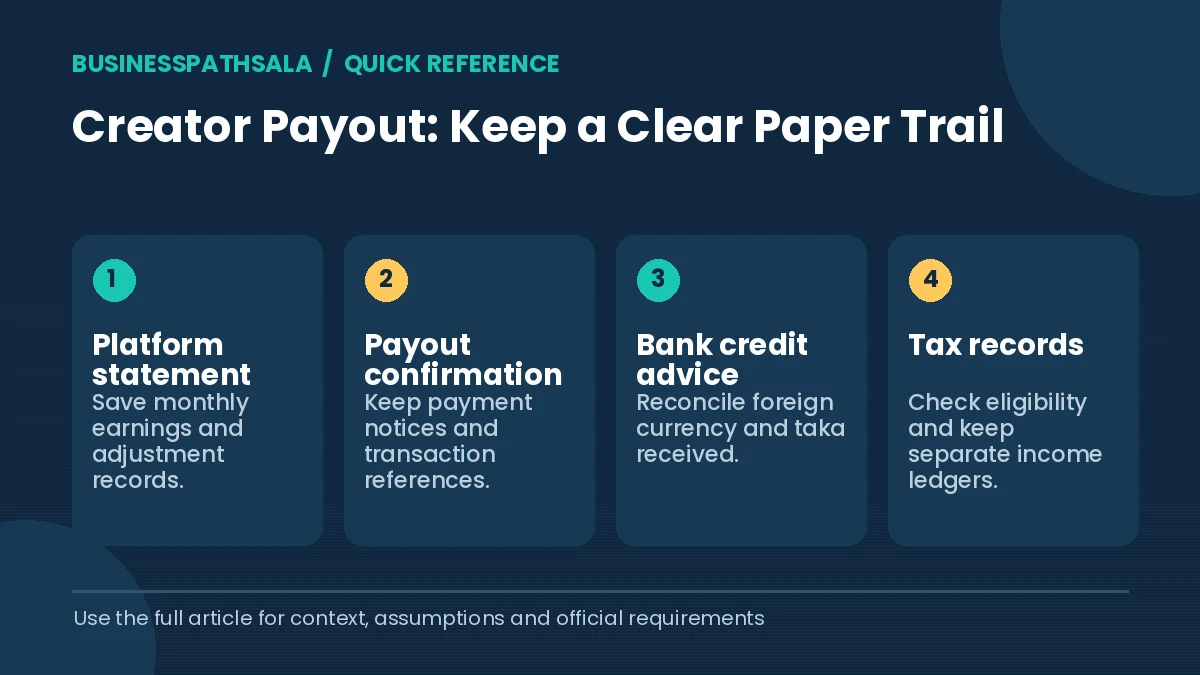
For each payment, record the platform or customer, earning period, gross amount, platform deductions, payout date, foreign currency, bank exchange rate where available, taka amount credited and supporting document references. Reconcile the platform statement with the bank credit. If a platform pays several months together, preserve the month-by-month earnings breakdown.
Whether a person must file an income-tax return depends on the Income Tax Act and the person’s circumstances, including applicable mandatory-filing conditions. An income exemption does not automatically remove every return-filing or record-keeping obligation. Check the current NBR e-Return guidance and consult a tax practitioner if you also earn salary, rent, business income, interest, sponsorship or other taxable income.
Platform Income vs Sponsorship and Other Creator Revenue
Creators often receive money from several sources. A YouTube AdSense payout, a Facebook monetisation payout, a direct sponsorship from a local company, affiliate commission, paid event appearance and sale of branded products are not necessarily the same legal category.
Keep each stream separate. For a sponsorship, retain the agreement, invoice, campaign deliverables and payment proof. For affiliate income, keep the network statement and remittance evidence. For merchandise, maintain sales, purchase and inventory records. Ask a tax professional to classify each stream under the current law rather than applying the content-creation exemption to every receipt without analysis.
Common Mistakes Bangladeshi Creators Should Avoid
- Assuming all foreign money is tax-free: The source and legal nature of the income matter.
- Using a relative’s bank account: A payee and beneficiary mismatch can trigger platform or bank verification problems.
- Keeping no payout evidence: Save statements and remittance records every month.
- Mixing business and personal income: Separate platform income from sponsorships, merchandise and other work.
- Relying on outdated Facebook eligibility posts: Check the current Professional Dashboard and Meta policies.
- Confusing foreign-exchange rules with tax law: A bank’s permission to credit a remittance does not itself decide its income-tax treatment.
- Assuming exemption means no tax return: Filing requirements must be checked separately.
Frequently Asked Questions
Is YouTube income tax-free in Bangladesh in 2026?
The Finance Act 2026 added content creation to the relevant income-exclusion provision, and ICAB describes the exemption as running to 30 June 2027 subject to statutory conditions. Confirm that your particular income and receipt method qualify.
Is Facebook monetization income tax-free in Bangladesh?
Eligible income from content creation may qualify under the Finance Act 2026 amendment. Keep platform and bank records, and distinguish creator income from sponsorship, sales and other business receipts.
Can Bangladeshi YouTubers receive AdSense payments by bank transfer?
Yes. Google’s payment-method table lists wire transfer for Bangladesh YouTube payment accounts. The account should show the payment methods available to the individual creator.
Does Google charge a wire-transfer fee?
Google says it does not charge a wire-transfer fee, but the receiving bank may charge fees or apply its own exchange rate.
Do I need to submit Form-C for every YouTube or Facebook payout?
No. Bangladesh Bank’s July 2026 circular says service-export inward remittances up to USD 20,000 or equivalent may be credited without Form-C, subject to bank verification. Ask your authorised dealer bank how it classifies and documents the platform payment.
Should I keep my YouTube or Facebook earnings statement?
Yes. Keep monthly statements, payout confirmations, bank credit advice, exchange-rate details and any fee or adjustment records. These documents help reconcile platform earnings with the amount credited in Bangladesh.
Does tax exemption mean I do not need an e-TIN or tax return?
Not automatically. Tax identification and return-filing requirements are separate questions. Check the current NBR rules that apply to your circumstances.
Final Checklist for YouTube and Facebook Creators
- Confirm the legal payee name on your platform account.
- Complete platform identity, address and tax onboarding accurately.
- Use a bank or payment method officially supported by the platform.
- Ask your bank for incoming foreign-payment instructions.
- Download monthly earnings and payout statements.
- Keep bank credit advice and remittance records.
- Separate platform monetisation from sponsorship and business income.
- Check the current Finance Act and NBR return-filing requirements before claiming an exemption.
Bottom line: Bangladesh’s Finance Act 2026 provides a specific income-tax exemption route for eligible freelancing and content-creation income through 30 June 2027, while Bangladesh Bank sets out how foreign service-export proceeds can be documented and received. Creators should keep a complete payment trail and verify that their exact income stream meets the legal conditions.
Disclaimer: This article is general information, not personal tax, legal or banking advice. Tax law, platform eligibility and payment arrangements can change. Confirm the current position with NBR, your authorised dealer bank and a qualified tax professional.
Official Sources and Further Reading
- Finance Act 2026 amendment to the Sixth Schedule
- ICAB Journal: Finance Act 2026 tax amendments
- Bangladesh Bank FEPD-1 Circular No. 26 (30 July 2026)
- YouTube Partner Programme and monetisation eligibility
- Google AdSense payment methods by country
- Meta: Facebook Content Monetization programme
- NBR Income Tax Acts
