Last updated: · By Abrar Hossain
To export goods commercially from Bangladesh, a business generally needs an Export Registration Certificate (ERC) issued by the Office of the Chief Controller of Imports and Exports (CCI&E). The application is handled through the CCI&E Online Licensing Module (OLM). Applicants should prepare a valid trade licence, e-TIN, chamber or trade association membership, bank solvency certificate, identity documents and business-structure papers before submitting the form.
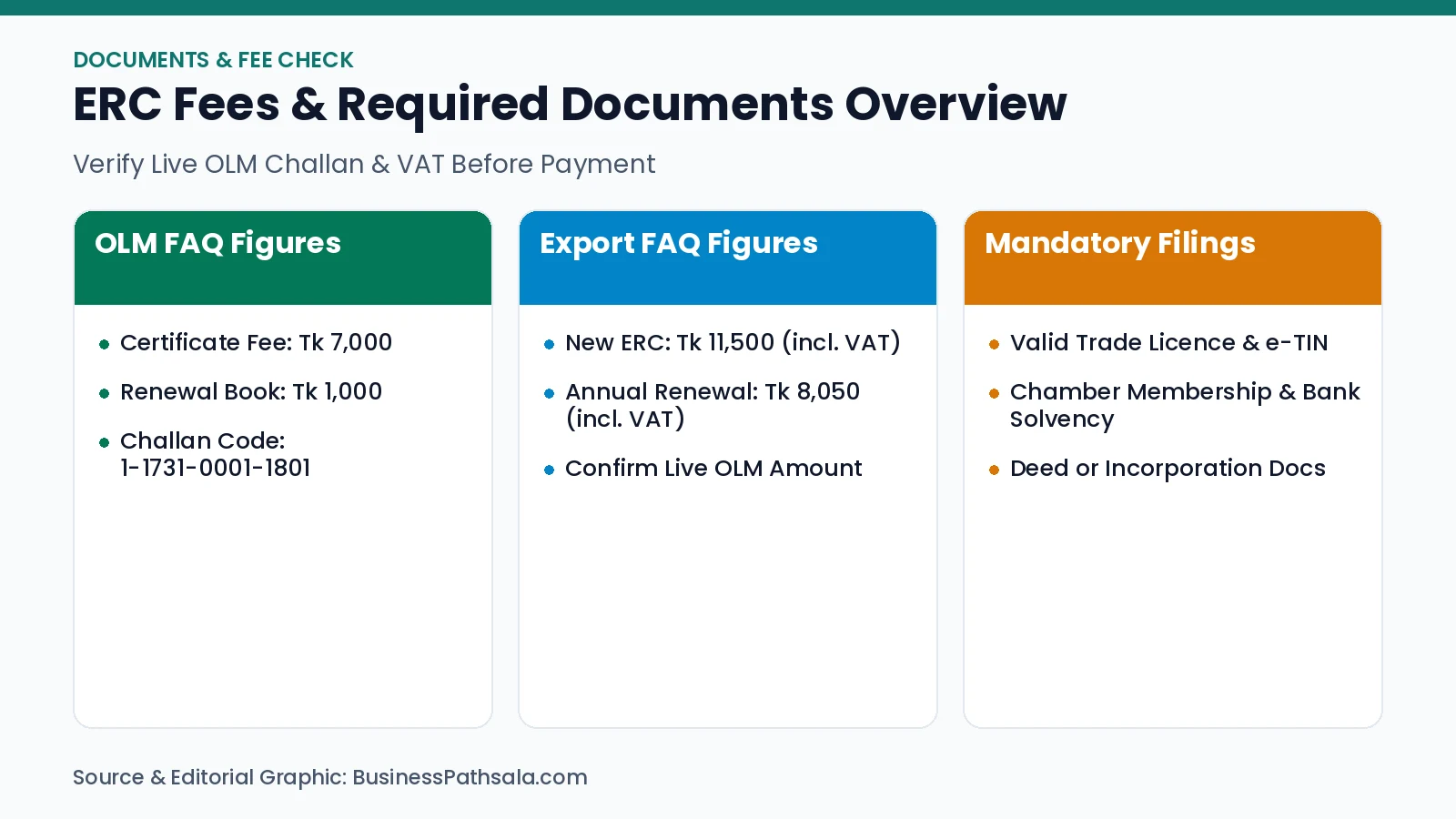
Important fee note (checked 28 November 2026): CCI&E’s live OLM FAQ still displays an ERC certificate fee of Tk 7,000 plus a Tk 1,000 renewal-book fee, while a government-hosted export FAQ gives Tk 11,500 for a new ERC and Tk 8,050 for annual renewal, including VAT. The CCI&E website also lists a revised-fee office order effective from 1 September 2022. Because the official pages are not fully aligned, do not rely on an old blog or a fixed estimate. Check the fee and VAT generated in your OLM application and confirm the applicable treasury-challan instructions with CCI&E before payment.
What is an Export Registration Certificate (ERC)?
An Export Registration Certificate is a registration issued by CCI&E to an eligible exporter in Bangladesh. It identifies the registered exporter for export-related regulatory and banking procedures. It is different from a trade licence, e-TIN, VAT/BIN registration, product-specific permit or an export permit for a particular transaction.
Bangladesh Customs’ Import Export Gateway lists ERC as a CCI&E document to be obtained online before opening an export letter of credit (LC). The same gateway lists other documents that may be required for a shipment, including an export contract or LC, EXP form, commercial invoice, packing list and transport document. The exact requirements depend on the product, destination and payment arrangement.
Who needs an ERC in Bangladesh?
Businesses that export goods from Bangladesh should confirm their ERC requirement with CCI&E before entering an export transaction. This can include manufacturers, trading companies, agro-processors, garment and textile businesses, leather-product exporters, handicraft producers and other commercial exporters.
Having an ERC does not automatically approve every product for export. Prohibited and restricted goods, product standards, sanitary or phytosanitary controls, destination-country rules and other sector permissions still apply. A business should check the rules for its specific HS code and product before accepting an overseas order.
ERC fees in Bangladesh (2026): what should you budget?
Fee information on online sources is inconsistent. The CCI&E OLM FAQ’s ERC answer states Tk 7,000 for the certificate and Tk 1,000 for the renewal book, deposited through a treasury challan under code 1-1731-0001-1801. A government-hosted FAQ for export-import of plant and plant-based products states Tk 11,500 for initial ERC issuance and Tk 8,050 for annual renewal, including VAT. These published figures should not be combined or treated as interchangeable.
| Fee item | Published figure | How to treat it |
|---|---|---|
| CCI&E OLM FAQ: ERC certificate | Tk 7,000 | Displayed on the OLM FAQ page; verify the live payable amount. |
| CCI&E OLM FAQ: renewal-book fee | Tk 1,000 | Displayed separately; confirm whether it applies to your application. |
| Government-hosted export FAQ: initial ERC | Tk 11,500 including VAT | Different government-hosted published figure; reconfirm with CCI&E. |
| Government-hosted export FAQ: annual renewal | Tk 8,050 including VAT | Different government-hosted published figure; reconfirm with CCI&E. |
CCI&E’s official website has a page titled “Registration and Renewal General Information” that lists an office order on new fees for IRC, ERC and indenting services, stated to be effective from 1 September 2022. The fee order and the payment instructions shown inside the OLM application should be checked together. The OLM system may separate the registration fee and VAT into different entries or challans. Do not pay using a bank account number or personal mobile wallet supplied by an unofficial agent.
For a reliable budget, include the government fee and VAT shown by the portal, any chamber membership charge, bank certificate charge and document-attestation costs. Chamber fees vary by chamber and membership class. Professional service charges are separate from government fees and are not required simply because an agent offers to prepare the application.
Documents required for ERC registration
Prepare clear, current scans of the documents below. The OLM application will show mandatory fields and upload requirements for the selected business type. CCI&E may ask for additional documents or clarification during scrutiny.
- Prescribed ERC application: Complete the relevant application form in the CCI&E OLM portal.
- Trade licence: A valid trade licence showing the business name and address.
- Chamber or trade association membership: A valid membership certificate from a recognised chamber of commerce or relevant trade association.
- e-TIN: The business or proprietor’s electronic Taxpayer Identification Number, as applicable.
- Bank solvency certificate: Obtain it from the bank nominated for the export business. Confirm the wording and validity period with the bank.
- Applicant’s identity: NID or passport copy and a recent passport-size photograph, in the format requested by the portal.
- Partnership firm: Registered partnership deed or the certified/attested copy requested by CCI&E.
- Private limited company: Certificate of Incorporation, Memorandum of Association and Articles of Association.
- Treasury challan/payment evidence: Keep the original or digital payment evidence required by the current application workflow.
- Other papers, where applicable: Joint venture agreement, sponsoring-authority recommendation, product-specific approvals or additional documents requested by CCI&E.
These requirements are consistent with the document list on the Bangladesh Trade Portal and the CCI&E OLM FAQ. A sole proprietorship, partnership and limited company do not submit identical entity documents, so select the correct organisation type before filling in the form.
How to apply for an ERC online through CCI&E OLM
The official application portal is olm.ccie.gov.bd. Use the portal reached from the CCI&E website. Avoid look-alike websites and unofficial payment links.
Step 1: Prepare your business information
Check that the trade licence, e-TIN, bank information and chamber membership show consistent business details. Resolve spelling differences in the business name, owner’s name and address before applying. Make colour scans of the documents in a readable format and keep the original papers available.
Step 2: Create an OLM account
Open the CCI&E OLM portal and register a user account if you do not already have one. Enter the applicant’s details, email address, mobile number and other requested information. Keep access to the registered email and mobile number because application updates may be sent through the portal or SMS.
Step 3: Select the ERC service
Sign in and choose the new General ERC or the relevant ERC service shown in the dashboard. Do not choose an IRC, Export Permit or re-registration option when you are applying for a fresh ERC. If the portal offers more than one ERC category, check the description and select the one that matches your business activity.
Step 4: Complete the application form
Enter the business name, address, ownership details, nominated bank and other required information exactly as they appear in supporting records. Complete every mandatory field marked with an asterisk. Select the correct regional office if the application asks you to do so.
Step 5: Upload supporting documents
Upload each document in the correct field. Check that the scan is complete, readable and not password-protected. Make sure the partnership deed or company papers match the organisation type selected in the form. Keep a copy of every uploaded file.
Step 6: Check the fee and VAT shown in OLM
Use the fee calculation and payment instructions generated by the current portal. CCI&E’s OLM FAQ refers to treasury challan code 1-1731-0001-1801, while other service instructions may require specific fee and VAT entries. Confirm the applicable code, amount and payment channel on the live application before depositing money. Save the challan or electronic receipt.
Step 7: Review and submit
Review every field, uploaded file and payment detail. Submit the application and save the application or tracking number. A draft saved in the portal is not a submitted application. Check the dashboard and registered contact details for scrutiny messages, correction requests or approval updates.
Step 8: Respond to queries and collect the certificate
If CCI&E asks for a correction or additional paper, respond through the channel specified in the notice. After approval, follow the portal’s instruction to download or print the ERC. Check the certificate carefully for the business name, address, registration details and nominated bank before using it for an export transaction.
How long does ERC approval take?
Published service documents do not provide one consistent current processing-time guarantee. An older CCI&E service procedure lists three working days, while current third-party guidance gives longer estimates. Actual time can depend on document quality, application volume, verification and whether CCI&E asks for corrections. Treat any stated timeline as an estimate unless the portal or issuing office confirms it for your case.
How long is an ERC valid? Does it need renewal?
Bangladesh Customs’ Import Export Gateway currently lists ERC validity as five years for the product entry reviewed for this guide. CCI&E’s OLM FAQ also lists annual renewal and renewal of certificates that have remained unrenewed for more than three years. These pages may describe different certificate conditions or reflect changes in the system. Check the validity and renewal date printed on your own ERC and follow the latest CCI&E order shown in OLM. Do not assume an older annual-renewal statement applies to every newly issued certificate.
ERC vs trade licence, e-TIN and BIN
| Registration/document | What it does | Issuing authority |
|---|---|---|
| Trade licence | Authorises the business to operate within the issuing local authority’s rules. | City corporation, municipality or union parishad, as applicable. |
| e-TIN | Identifies the taxpayer for income-tax purposes. | National Board of Revenue (NBR). |
| BIN / VAT registration | Identifies the business for VAT-related purposes where registration is required. | NBR VAT authority. |
| ERC | Registers the business as an exporter with CCI&E. | Office of the Chief Controller of Imports and Exports. |
These documents serve different purposes. An ERC does not replace the trade licence, e-TIN or BIN. Check whether your business must hold BIN and any product-specific licence before exporting.
Common ERC application mistakes to avoid
- Applying with an expired trade licence or chamber membership.
- Entering a business name or address that does not match the supporting papers.
- Selecting the wrong organisation type or ERC service.
- Uploading blurred, cropped or incomplete scans.
- Using a bank certificate that does not identify the correct business or nominated bank.
- Paying an outdated fee or using an unverified treasury code.
- Assuming ERC approval also clears product-specific export restrictions.
- Failing to check the certificate details and validity after issuance.
What to do after receiving an ERC
After receiving the ERC, confirm the exporter’s bank arrangements and the transaction documents with an authorised dealer bank. Prepare the proforma invoice or sales contract, export LC where applicable, EXP form, commercial invoice, packing list and transport documents. Confirm whether the product needs a certificate of origin, health or phytosanitary certificate, inspection certificate, or approval from another regulator.
Bangladesh Trade Portal’s exporter procedure also describes market research, buyer communication, price negotiation, export finance, production, shipment and repatriation of export proceeds. The exporter should plan these steps before accepting an order, because the buyer’s destination-country rules can affect packaging, labelling, quality tests and required certificates.
Frequently asked questions about ERC in Bangladesh
1. Where can I apply for an ERC in Bangladesh?
Apply through the CCI&E Online Licensing Module at olm.ccie.gov.bd. The issuing authority is the Office of the Chief Controller of Imports and Exports.
2. What is the ERC fee in Bangladesh in 2026?
Published official sources are inconsistent: the CCI&E OLM FAQ displays Tk 7,000 plus a Tk 1,000 renewal-book fee, while a government-hosted export FAQ reports Tk 11,500 including VAT for initial issuance. Check the amount calculated in your live OLM application and confirm it with CCI&E before payment.
3. Is a chamber membership certificate required?
CCI&E’s OLM FAQ and Bangladesh Trade Portal list membership from a recognised chamber of commerce or relevant trade association among the ERC documents. Confirm that your membership is valid and relevant to your business.
4. Is an e-TIN required for ERC?
Yes. The CCI&E OLM FAQ includes TIN in the document list for ERC applications. Keep the current e-TIN information ready and make sure the business details are consistent.
5. Do I need a bank solvency certificate?
Yes. CCI&E’s published requirements include a bank solvency certificate. Ask the nominated bank to issue it with the correct applicant and business details.
6. Can a sole proprietorship apply for ERC?
A business owner should select the sole-proprietorship or individual business option available in OLM and submit the trade licence, identity, tax, bank and membership documents requested. Do not upload company incorporation papers for a sole proprietorship.
7. Does an ERC replace a trade licence or BIN?
No. A trade licence, tax identification, VAT/BIN registration and ERC have separate legal and administrative purposes. Check which are required for your business and product.
8. How long does it take to get an ERC?
Processing depends on CCI&E scrutiny and document completeness. Older official service information lists three working days, but applicants should confirm the current expected timeline with OLM rather than treating that older figure as a guarantee.
9. Is ERC valid for five years?
Bangladesh Customs’ Import Export Gateway lists a five-year validity entry for ERC. Check the validity date printed on your certificate and the current CCI&E instructions, as renewal conditions can depend on the certificate and applicable order.
10. Can I export any product after getting an ERC?
No. An ERC does not remove restrictions on prohibited or controlled products. Product-specific permits, tests, certificates and destination-market rules may still apply.
Official sources and useful resources
- CCI&E OLM FAQ — ERC services, documents, fees and OLM guidance.
- CCI&E registration and renewal information — office orders and revised fee notices.
- Bangladesh Trade Portal: How to become an exporter — required documents and export steps.
- Bangladesh Customs Import Export Gateway — ERC and other export documents for a sample HS-code entry.
- National Board of Revenue — tax and VAT information.
Final checklist before submitting your ERC application
- Trade licence is valid and business details match.
- e-TIN information is ready.
- Chamber or trade association membership is current.
- Bank solvency certificate is available.
- NID/passport and photograph are prepared.
- Partnership deed or company documents are ready, where applicable.
- OLM displays the correct ERC service and current fee/VAT.
- Payment evidence is saved and the application is successfully submitted.
- The issued certificate’s details and validity have been checked.
Disclaimer: This guide is for general business information. Fees, document requirements, validity and processing procedures can change. Confirm the latest instructions with CCI&E and the OLM portal before making payment or shipping goods.