An Uddokta loan in BD is business financing that helps a new or existing entrepreneur start, operate, or expand a business in Bangladesh. Depending on the applicant and business, funding may be available through bank CMSME loans, finance companies, SME Foundation-linked programmes, sector-based refinance facilities, or special initiatives such as Bangladesh Bank’s UDYOG programme. The right option depends on the business stage, purpose of funds, repayment capacity, eligibility and the lender’s current terms.
This guide explains the main entrepreneur loan options in Bangladesh, who may qualify, which documents to prepare, how to approach a bank, and what to check before signing a loan agreement. It also explains an important time-sensitive point: the first application window for the 2026 UDYOG programme closed on 15 October 2026. Do not assume that applications are currently open.
Quick answer: Start by defining how much money your business needs and what it will pay for. Then compare suitable CMSME or specialised financing products from scheduled banks and finance companies. Prepare a business plan, cash-flow estimate, identity and business documents, and ask each lender for a written repayment schedule and total borrowing cost.
What Is an Uddokta Loan in Bangladesh?
An entrepreneur loan, commonly called an uddokta loan in Bangladesh, is financing provided for a productive business activity. A borrower may use it for working capital, equipment, inventory, business expansion, production, or another approved business purpose. The exact facility may be called an SME loan, CMSME loan, micro-enterprise loan, small-business loan, start-up loan, or business term finance.
In Bangladesh, CMSME means cottage, micro, small and medium enterprises. Bangladesh Bank issues policy and refinancing instructions to support this sector, while scheduled banks and eligible finance companies assess individual applications and provide financing under their own approved products and lending rules. A Bangladesh Bank refinance scheme does not mean every applicant can apply directly to the central bank for a loan.
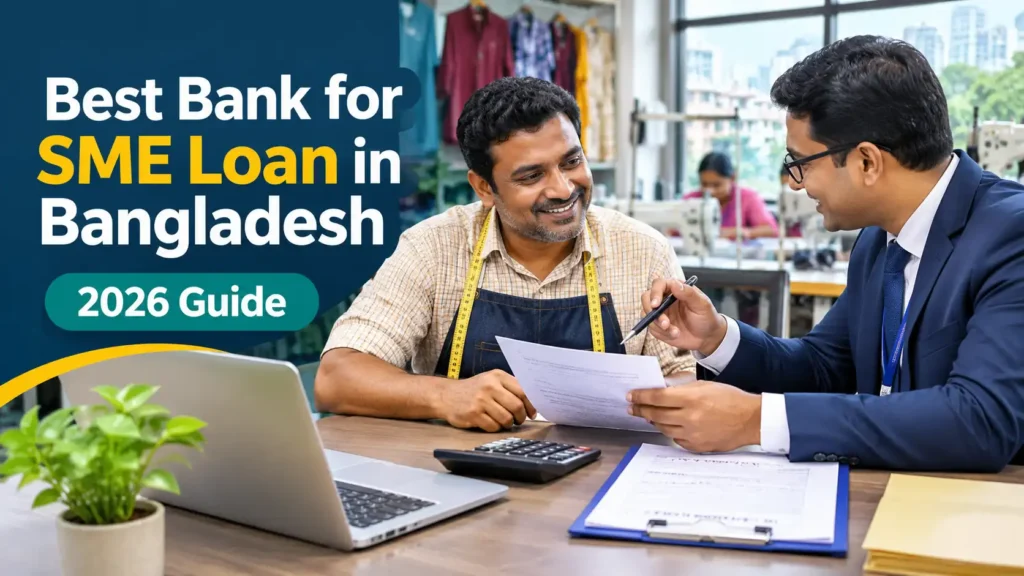
For example, a small grocery wholesaler may need working capital to purchase stock before a busy season. A tailoring workshop may need sewing machines. A food processor may need packaging equipment and raw materials. These businesses have different financing needs, so they should not automatically choose the same type of loan.
If you are still choosing what to start, browse our list of small business ideas in Bangladesh and assess each idea against local demand, costs and your experience.
Latest Entrepreneur Financing Update: Bangladesh Bank’s UDYOG Programme
One of the most relevant recent initiatives for young entrepreneurs is UDYOG: Upazila-Driven Youth Opportunity for Growth. Bangladesh Bank issued its policy through SMESPD Circular No. 05 on 13 September 2026. The programme was designed to identify promising young entrepreneurs at upazila level and support viable business ideas through a combination of bank financing and a grant.
Current status as of 16 November 2026: The first phase, held from 16 September to 15 October, covered eight districts and has closed. Bangladesh Bank has since opened the second phase in the remaining 56 districts. Applications are being accepted from 1 November to 30 November 2026 in all upazilas of those districts. Applicants must submit the prescribed form at a scheduled bank branch in their own upazila. The second phase does not cover the eight first-phase districts: Manikganj, Feni, Naogaon, Jhenaidah, Bhola, Habiganj, Rangpur and Netrokona. Confirm the latest instructions and form with Bangladesh Bank or a participating bank before applying.
| UDYOG feature | Policy information |
|---|---|
| Programme name | UDYOG: Upazila-Driven Youth Opportunity for Growth |
| Policy circular | Bangladesh Bank SMESPD Circular No. 05, dated 13 September 2026 |
| Maximum combined financing | Up to BDT 20 lakh, subject to assessment |
| Financing structure | 50% bank loan and 50% grant |
| Maximum bank-loan component | Up to BDT 10 lakh |
| Maximum grant component | Up to BDT 10 lakh |
| Age limit | Not more than 28 years on the application closing date |
| First-phase application period | 16 September–15 October 2026; closed in eight districts |
| Second-phase application period | 1–30 November 2026; open in the remaining 56 districts as of 16 November 2026 |
| Second-phase submission point | Any scheduled bank branch in the applicant’s own upazila |
| Where applications were submitted | A scheduled bank branch in the relevant upazila |

Who Was Eligible for the UDYOG Programme?
Under the circular, applicants had to meet the programme’s specific eligibility conditions. These included:
- Be a citizen and not older than 28 on the application deadline.
- Be a permanent resident of the upazila where the application was submitted.
- Have an existing business initiative or a realistic plan to establish a new business.
- Explain the business model and the actual financing requirement.
- Not have previously borrowed from a bank or financial institution for business activities, as specified by the programme.
- Not be classified as a loan defaulter. A negative CIB finding could disqualify the applicant.
- Not be employed by a government, semi-government or autonomous institution.
The programme considered lawful businesses across areas such as agriculture, food processing, handicrafts, fisheries, livestock, tourism, services, renewable energy, light engineering and technology-based start-ups. A business idea alone was not enough: the applicant had to explain the business need, proposed spending and ability to implement the plan.
How Did the UDYOG Loan and Grant Work?
The combined amount could be up to BDT 20 lakh, but the full ceiling was not an automatic entitlement. The bank and selection process were to consider the applicant’s real business need, proposed expenses and assessment. The ratio was 50:50: half as a bank loan and an equal amount as a grant. Therefore, a business assessed as needing BDT 12 lakh could receive up to BDT 6 lakh as a loan and BDT 6 lakh as a grant, subject to approval.
The circular stated that the loan and grant would be disbursed together through the bank into the entrepreneur’s account, not in cash. It also provided for a post-dated cheque for the grant-equivalent amount. The grant could be converted into a recoverable loan in specified circumstances, including failure to meet the programme’s repayment or utilisation conditions. Applicants should read the full circular and bank documents carefully before accepting this facility.
UDYOG selection did not guarantee loan approval. The bank still had to complete its own credit and regulatory checks. The programme also included financial literacy, business development training, mentoring and support with matters such as trade licensing, TIN, business planning and market connections.
Other Uddokta Loan Options in BD
UDYOG was a specific programme for eligible young applicants. Entrepreneurs outside its age or other eligibility rules can still investigate ordinary CMSME financing and other suitable facilities. The following are broad financing categories. The availability, amount, pricing, collateral and documents depend on the specific lender and current circulars.
1. CMSME and SME Business Loans
CMSME financing is generally relevant to cottage, micro, small and medium businesses. It may support manufacturing, trading and service activities. A bank may offer working-capital finance, a term loan, equipment finance or another product according to the business’s needs and its own lending policy.
Examples include a small manufacturer buying raw materials, a retailer replenishing inventory, or a service provider purchasing equipment. Ask the lender whether the product is intended for a new business, an established business, or both. Some products require a period of operating history and regular business transactions.
2. Working-Capital Finance
Working capital is the money a business uses for its day-to-day operating cycle. It can cover inventory, raw materials, supplier payments, wages and other approved operating expenses. It is usually more suitable for a business that already has sales or a credible operating plan than for someone who has not yet tested a business idea.
Estimate how quickly the stock or raw materials will turn into sales and when customers will pay. A loan repayment schedule should fit that cash-conversion cycle. Borrowing for inventory that may take a long time to sell can create repayment pressure.
3. Term Loans for Equipment and Expansion
A term loan provides financing over an agreed period. It may be suitable for machinery, shop renovation, production equipment, delivery vehicles or expansion. The lender may ask for supplier quotations, cost estimates, proof of the business location, and evidence that the proposed investment can generate enough cash to repay the loan.
4. SME Foundation-Linked Credit Wholesaling
SME Foundation has described a Credit Wholesaling (CWS) programme intended to improve access to finance for underserved micro and small entrepreneurs. Under this model, financing is channelled through partner banks and non-bank financial institutions rather than being treated as a direct retail loan from the Foundation to every applicant. The Foundation’s published information gives priority to selected clusters, sectors and groups, including small and women entrepreneurs.
Because programme pages and fund availability can change, contact SME Foundation or a participating financial institution to confirm whether a current application round is available, which sectors are covered, and what terms apply. Do not rely on an old interest-rate statement without written confirmation.
5. Sector-Based and Cluster Financing
Bangladesh Bank’s SME and Special Programmes Department publishes circulars on CMSME finance, refinance funds and cluster financing. A cluster-based approach may be relevant to businesses operating in a recognised industry concentration or production area. A business should ask its bank whether its sector or cluster is covered by a current facility and whether the bank is participating.
Do not assume that a refinance facility sets the same customer rate at every bank. The product terms, lender participation, borrower assessment and applicable circular determine the actual offer. Bangladesh Bank’s circular list should be checked for the latest instructions, including 2026 updates.
6. Start-up Financing
Innovative, scalable and technology-enabled ventures may be assessed under start-up financing arrangements. Bangladesh Bank’s 9 July 2025 start-up financing master circular describes the characteristics and eligibility framework for start-ups, including registration in Bangladesh and requirements relating to the venture and its promoters. The circular also distinguishes between bank equity funds and loanable or investable funds. A bank’s internal start-up equity fund should not be assumed to be a conventional loan facility.
Founders should explain the product, target customer, business model, revenue assumptions, technology or innovation, operating costs and route to sustainability. A technology label by itself does not make a business eligible for a particular funding product.

How Much Uddokta Loan Can You Get?
There is no single loan amount available to every entrepreneur in Bangladesh. The amount depends on the lender’s product, the business category, the purpose of borrowing, repayment capacity, credit history, documents, security and the current funding programme. A maximum limit published for one scheme does not automatically apply to another bank or product.
For UDYOG, the first-round policy ceiling was BDT 20 lakh in combined financing, split between a maximum BDT 10 lakh bank loan and BDT 10 lakh grant. For a regular CMSME loan, the lender will apply the limit and conditions of the product and any relevant policy. Ask for the current product sheet rather than relying on a social media post or an old article.
As context, Bangladesh Bank’s Quarterly Report on CMSME Financing for January–March 2026 reported BDT 52,107.72 crore in CMSME financing disbursed to 386,453 enterprises during that quarter. This is sector-wide financing activity, not a promise that an individual applicant can obtain a particular amount.
Who Can Apply for an Entrepreneur Loan?
For ordinary business finance, the lender assesses the borrower and business under the specific loan product. Commonly relevant factors include:
- Business activity: The business should be lawful and within the lender’s accepted sectors.
- Business stage: Some products are intended for existing businesses, while special programmes may accept new business plans.
- Repayment capacity: The lender needs to understand how the business will generate cash to pay instalments.
- Credit record: Existing borrowing, repayment history and CIB information may affect the decision.
- Business records: Sales, purchases, bank transactions, invoices and accounts help demonstrate activity.
- Owner contribution: The bank may consider how much capital the owner is investing.
- Security or guarantee: Requirements depend on the product and relevant policy; collateral-free does not mean automatic approval.
A new entrepreneur with no operating history should not present projected sales as if they were actual revenue. Instead, explain how the estimate was prepared, show evidence of demand, and make conservative assumptions. A realistic plan is more useful than an inflated forecast.
A practical business plan helps you explain the purpose of the loan and show how the business will repay it. You can also read our guide on how to prepare a new business plan.
Documents Commonly Required for an Uddokta Loan
Document requirements vary by bank, loan type and business structure. The following checklist is a preparation guide, not a universal official list for every product.
| Document | Why the lender may request it |
|---|---|
| National ID and photographs | Identity and customer verification |
| Trade licence | Evidence of business permission and activity, where applicable |
| e-TIN or tax documents | Tax identification and compliance review, as applicable |
| Business bank statements | Evidence of transactions, turnover and cash flow |
| Business plan | Purpose of borrowing, market, operations and financial projections |
| Sales and purchase records | Evidence of business activity and working-capital needs |
| Financial statements or accounts | Assessment of revenue, costs, assets and liabilities |
| Supplier quotations or invoices | Verification of equipment or inventory costs |
| Business address or rental documents | Verification of operating location, where required |
| Collateral or guarantor documents | Only when required by the selected product |
For UDYOG’s first round, Bangladesh Bank specified a completed application form, National ID, citizenship certificate from the relevant ward commissioner or councillor, latest educational certificate if available, and a passport-size photograph. The specific programme also used upazila residency and age conditions. These requirements should not be copied as the document list for every ordinary SME loan.

How to Apply for an Uddokta Loan in BD: Step-by-Step
Step 1: Define the Exact Purpose
Write down what the money will pay for. Separate working capital from long-term investment. For example, list raw materials, stock, machinery, delivery equipment, renovation and other costs separately. Avoid asking for a round figure without a cost breakdown.
Step 2: Prepare a Practical Business Plan
A useful plan explains what you sell, who buys it, how you reach customers, who your competitors are, what it costs to operate and how the business earns revenue. Include a monthly cash-flow estimate. If you are starting a business, show evidence of demand such as customer enquiries, pre-orders, supplier quotations, market visits or a small pilot.
Step 3: Choose the Correct Loan Type
Match the loan to the spending. Working capital may suit stock and operating expenses. Equipment finance or a term loan may suit machinery and expansion. A specialised programme may be relevant for a qualifying young entrepreneur, women-owned business, sector or cluster. Do not apply for a facility simply because its advertised maximum amount looks attractive.
Step 4: Shortlist Banks and Finance Companies
Contact more than one scheduled bank or licensed finance company where practical. Ask whether it currently offers a product for your type of business and whether the branch is participating in the specific refinance or special programme. Start with the bank that handles your regular business transactions, but compare written terms from other lenders too.
Step 5: Prepare and Submit Documents
Prepare clear copies and keep the originals available for verification. Make sure the names, business address, licence details and bank records are consistent. Ask the branch for a written checklist before submitting. For special programmes, use only the prescribed application form and the official submission channel.
Step 6: Answer the Bank’s Questions Honestly
The bank may ask about sales, suppliers, customers, existing liabilities, loan purpose, collateral, business experience and repayment plans. Give accurate figures. Never alter invoices, exaggerate revenue or use another person’s business documents. False information can lead to rejection and may create legal or credit problems.
Step 7: Review the Offer Before Signing
Ask for the approved amount, rate, calculation method, total repayment, instalment schedule, fees, collateral conditions and default provisions in writing. Do not sign blank forms or give an unexplained payment to an agent who promises approval. Keep copies of the application and every document the bank gives you.
How to Compare Interest Rates and Total Loan Costs
The lowest advertised rate does not always mean the cheapest loan. Two lenders may calculate interest differently or charge different fees. Compare the total amount you will pay, not just the headline percentage or monthly instalment.
- Is the rate fixed or variable?
- Is interest calculated on a flat basis or on the outstanding balance?
- What is the total repayment over the full tenure?
- Are there processing, documentation, legal, valuation or insurance fees?
- What are the late-payment and default charges?
- Can you repay early, and is there an early-settlement fee?
- Is collateral, a guarantor or a post-dated cheque required?
- When will instalments start, and is any grace period available?
For a separate explanation of pricing, see BusinessPathsala’s guide to SME loan interest rates in Bangladesh. Remember that any published rate is product-specific and may change. Confirm the current quotation directly with the lender.
Where to Find Official Information and Apply Safely
Use official sources to confirm current policies and application windows. Bangladesh Bank publishes SME and Special Programmes Department circulars, policy updates and CMSME financing reports. SME Foundation publishes information on its support programmes. Individual banks publish their own product terms and application channels.
- Bangladesh Bank – SME & Special Programmes Department circulars
- Bangladesh Bank – UDYOG programme launch press release
- BSS – UDYOG applications open in the remaining 56 districts until 30 November 2026
- UDYOG national-phase application form (hosted by Dhaka Bank)
- Bangladesh Bank – Quarterly Report on CMSME Financing, January–March 2026
- SME Foundation Bangladesh
- SBAC Bank – UDYOG programme information
For a current special scheme, confirm the circular number, participating bank, application deadline, location coverage, age or business conditions, required documents and whether funds are still available. Do not pay an unofficial person to obtain a form, influence selection or guarantee approval. Bangladesh Bank’s press release for the first UDYOG round stated that applicants did not need an existing account at the bank where they submitted the application and that no application fee was payable.
Frequently Asked Questions About Uddokta Loan in BD
1. What is the easiest way to get an Uddokta loan in BD?
There is no guaranteed easy route. Identify a suitable bank product, prepare a realistic business plan and cash-flow estimate, keep your documents ready, and apply through the lender’s official channel. Eligibility and approval depend on the product and assessment.
2. Can I get an entrepreneur loan to start a new business?
Some special programmes and start-up financing arrangements may consider new business ideas, while many ordinary SME products prefer applicants with an operating business and transaction records. Ask the bank whether its current product accepts pre-revenue businesses.
3. Is the Bangladesh Bank UDYOG programme still accepting applications?
Yes. As of 16 November 2026, the second phase is accepting applications from 1 to 30 November in the remaining 56 districts. The first phase in eight districts has closed. Submit the prescribed form at a scheduled bank branch in your own upazila, if your district is in the second phase.
4. How much financing is available under UDYOG?
The programme allows up to BDT 20 lakh in combined financing, split equally between a bank loan and a grant. The maximum components are BDT 10 lakh each. Actual financing depends on assessed business need and approval; applicants are not automatically entitled to the maximum.
5. Can women entrepreneurs apply for business loans in Bangladesh?
Women entrepreneurs can ask scheduled banks and finance companies about CMSME products and relevant women-focused facilities. Eligibility, rates, limits and documentation vary.
6. Is collateral required for every entrepreneur loan?
No single rule applies to every product. Some schemes may permit financing without additional collateral, while other products require security, a guarantor or other risk mitigation. Confirm the exact terms in writing with the lender.
7. What documents should I prepare before visiting a bank?
Prepare your NID, photographs, trade licence where applicable, TIN or tax papers where relevant, business bank statements, business plan, sales and purchase records, and supplier quotations for planned purchases. The bank may request additional documents based on the business and loan type.
8. Does selection under a special programme guarantee a loan?
No. Selection is not itself a guarantee of financing. The bank must complete its credit assessment and comply with applicable lending rules before approving and disbursing a loan.
9. Can I apply if I already have a business loan?
For an ordinary CMSME product, existing borrowing is assessed under that lender’s policy and repayment-capacity review. The UDYOG circular has a specific restriction on previous business borrowing; check the circular and ask the participating bank whether you meet the programme conditions.
10. How can I check whether a loan offer is genuine?
Verify the product on the official bank or finance-company website and contact the branch using its published contact details. Request written terms. Avoid anyone who guarantees approval, asks for unexplained advance payments or refuses to identify the lender and product.
Final Thoughts
Finding the right Uddokta loan in BD begins with understanding the business need. A young founder may look for a special programme such as UDYOG when a new application round is officially announced. An established shop, manufacturer or service business may be better suited to a regular CMSME working-capital or term-loan product. A technology venture may need to investigate start-up financing rules.
Before borrowing, prepare a realistic business plan, compare written offers, calculate the total repayment and verify current eligibility with the lender. Use official Bangladesh Bank and SME Foundation information for programme updates. A suitable loan can support a business, but only when the amount, purpose and repayment schedule fit the business’s actual cash flow.
Editorial note: This article is for general educational purposes and is not an offer of credit or personal financial advice. Loan schemes, rates, eligibility and deadlines may change. Confirm current terms directly with the relevant bank, finance company or government institution before applying.