
A strong business plan for a bank loan in Bangladesh explains what the business does, why it needs financing, exactly how the money will be used, and how operating cash can support repayment. It should pair a clear business case with realistic figures, supporting records, and the lender’s current application checklist. A business plan can help a bank assess a proposal, but it cannot guarantee approval.
For a business owner, the useful question is not “How many pages should I write?” It is “Can a loan officer trace every amount I request to a business need and a credible source of repayment?” This guide shows how to build that case for a shop, service business, trading firm, manufacturer, or startup seeking bank finance in Bangladesh.
Quick answer: Prepare a concise business profile, market and operating plan, itemised funding request, monthly cash-flow forecast, repayment explanation, risk notes, and verified business documents. Ask the bank for its current format and checklist before finalising the file because requirements differ by institution, product, business type, and borrower.
What does a bank look for in a business plan?
A bank uses a business plan as one part of its credit assessment. The document should help the lender understand the business, check the use of funds, assess the owner’s preparation, and compare projected cash generation with the proposed repayment. The bank may also review credit history, existing liabilities, account activity, business records, guarantees, collateral, and other factors under its own policy.
Bangladesh Bank’s CMSME Financing Master Circular, issued on 17 March 2025, sets out the current central-bank framework for cottage, micro, small, and medium enterprise financing. It does not create one universal business-plan template or promise that every applicant qualifies. The bank or finance company still assesses the application under the relevant rules and its own product terms. Read the Bangladesh Bank CMSME Master Circular (PDF) and confirm current requirements directly with the bank.
The SME Foundation has published a general bank-loan checklist, but it is a starting point rather than a universal current requirement. Ask your selected branch for its latest checklist and confirm which documents apply to your business and loan product.
Before writing: identify the loan and the reader
First, clarify what kind of finance the business needs. A term loan for equipment has a different purpose and repayment shape from short-term working capital, an overdraft or cash-credit facility, seasonal finance, or a startup facility. Describe the intended use in terms the bank can verify: machinery with a supplier quotation, stock tied to a sales cycle, renovation with a cost estimate, or working capital connected to orders and customer payment timing.
Write down the product name, branch or channel, requested amount, indicative tenor, repayment type, security or guarantor requirements, application format, and required financial period. Do not assume a term or rate from a friend’s previous loan applies to your application. For example, Dutch-Bangla Bank’s published SME FAQ distinguishes between cash-credit and term-loan purposes and provides a bank-specific document list; SBAC Bank also lists its own eligibility and supporting papers. These are examples of how requirements vary, not universal rules. Check the bank’s own current SME loan information and SBAC SME product details.
Keep the plan aligned to the application form. If the bank has a prescribed template, use it and attach extra explanation only where it improves clarity. You can also review our general guide to writing a business plan for broader planning steps, then use this article for the bank-finance parts.
What to include in a business plan for a bank loan in Bangladesh
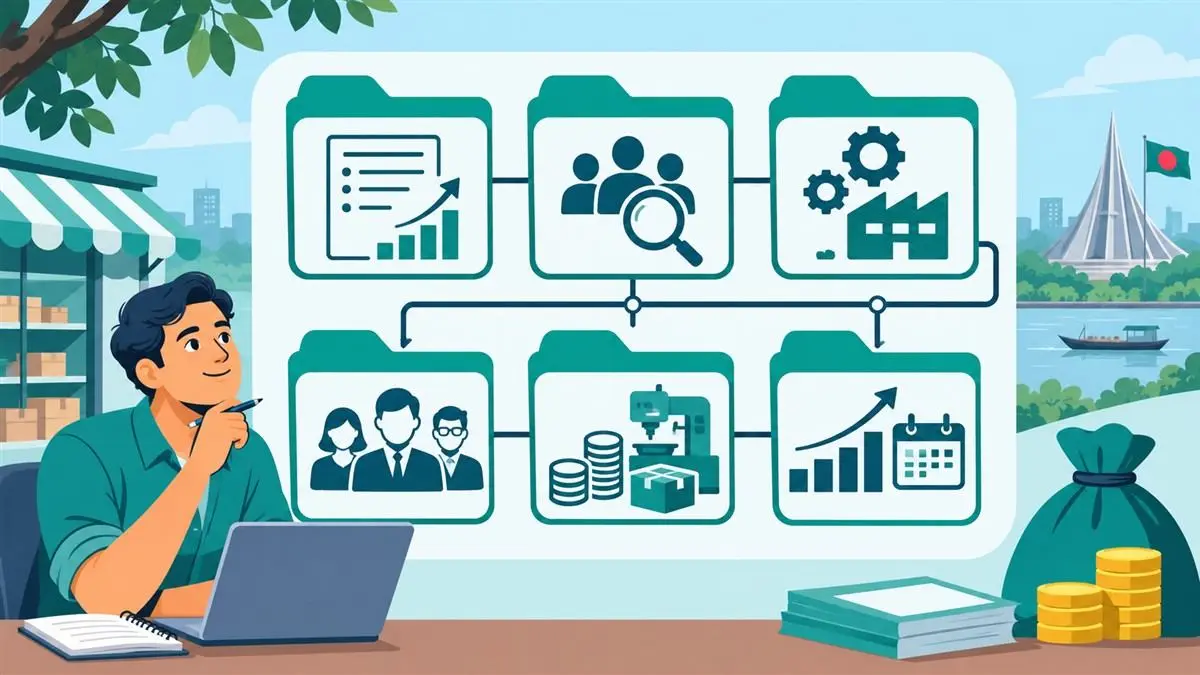
1. Cover page and one-page summary
State the business name, location, legal structure, owner or authorised contact, date, and version of the document. In the summary, explain in plain language what you sell, who buys it, how long the business has operated, what it needs financing for, the amount requested, the owner’s contribution if applicable, and the expected repayment source.
Write the summary after completing the detailed sections. It should match the figures in the request letter, application form, projections, and attached statements. If you change the requested amount, update every document that refers to it.
2. Business and management profile
Describe the business location, legal structure, ownership, operating history, products or services, current capacity, and key suppliers. Explain who handles operations, sales, purchasing, record-keeping, and finance. Mention relevant experience factually. If a role is not yet filled, say so instead of implying the person is already on the team.
Include registration or permission details that apply to your activity and structure, such as a trade licence or company papers where relevant. Requirements differ by business and location, so verify them with the responsible authority and the lender. A business already operating should give a short, evidence-based account of its trading history rather than rely on a broad claim such as “sales are growing fast.”
3. Customers, market, and competitors
Define your target customers by practical traits: area, type of buyer, need, buying pattern, and price range. Explain how you know there is demand. Useful evidence may include sales records, repeat orders, purchase orders, customer enquiries, supplier data, a pilot launch, or documented interviews. Label small samples honestly; a handful of conversations is useful learning, not proof of nationwide demand.
Identify direct and indirect competitors. Compare what they sell, approximate price bands you have observed, service, location, and the reason a customer may choose your offer. Avoid saying there is no competition. Customers can choose another business, an online seller, an informal provider, or no purchase at all.
4. Operations and sales plan
Explain how an order moves from customer enquiry to delivery and payment. Describe the location, opening or production capacity, equipment, inventory, suppliers, staffing, delivery process, and quality checks. Mention the records you keep, such as invoices, stock registers, purchase orders, sales ledgers, or digital payment statements.
Make sales assumptions visible. For a retailer, show how many transactions and what average sale you expect. For a manufacturer, state the planned output and utilisation assumptions. For a service firm, explain billable work, project timing, and collection periods. Tie each projection to available evidence and identify seasonal changes or customer credit periods.
5. Funding request and use of funds
List the requested amount and break it into specific uses. Use supplier quotations or cost estimates where available. Separate assets that can be checked, such as equipment or renovation, from recurring needs such as inventory and working capital. Explain whether the owner will contribute funds and when those funds will be available.
| Use of funds | What to show |
|---|---|
| Machinery or equipment | Item, supplier quotation, installation or delivery cost, and expected business use |
| Inventory or raw materials | Items, quantities, purchase cycle, supplier basis, and link to expected sales |
| Working capital | Cash-flow gap, operating expenses covered, customer collection timing, and period needed |
| Renovation or setup | Work description, cost estimate, premises status, and any approvals that apply |
| Other purpose | Specific explanation and documents that support the amount |
Do not inflate the request to create a cash cushion without explaining it. A clear request lets the lender compare the amount to the project cost, the business’s contribution, and the likely repayment capacity. If the total project cost is larger than the proposed bank loan, show how the remainder will be funded.
6. Financial statements and forecasts
For an operating business, include the historical financial information requested by the bank, with dates and source records. Depending on the business and product, that may mean account statements, sales and expense records, tax documents, existing loan schedules, or prepared financial statements. Do not assume every bank asks for the same period or format.
For future projections, prepare a monthly cash-flow forecast for at least the period requested by the lender. A simple forecast should show opening cash, cash received, cash paid, loan instalment assumptions, and closing cash. Separate cash sales from credit sales: a sale recorded today may not put money into the account today. Identify your assumptions for sales volume, prices, collection delays, supplier payment timing, wages, rent, utilities, transport, tax and other costs that apply.
Show a cautious scenario as well as your base forecast. Ask what happens if sales start later, input prices rise, or a major customer pays late. A forecast that remains viable under a reasonable setback is more useful than one that works only if every assumption goes perfectly.
7. Repayment explanation
Explain where each repayment will come from and when that cash is expected to arrive. Repayment should be tied to operating cash flow or another clear source, not simply to “future growth.” Include existing debt and regular owner withdrawals in the cash-flow view. Do not count the same cash twice as both the owner’s living money and the amount available for instalments.
Use the lender’s proposed repayment schedule for any final calculation. If terms have not been offered, label the repayment figure as an assumption and avoid presenting it as a bank quote. Discuss what you would do if cash flow falls short, such as reducing discretionary spending, adjusting stock purchases, or using a documented backup source. Do not assume that collateral removes the need to show a repayment plan.
How to test whether the business can afford repayments
Compare the cash left after ordinary business expenses with the expected instalment. This is a planning check, not the bank’s complete credit model and not an approval formula.
Illustrative example only: Suppose a business estimates that it can generate BDT 120,000 a month after its normal operating costs, before loan repayment. If a bank’s proposed instalment were BDT 65,000, the simplified remaining amount would be BDT 55,000. The owner would still need to check whether that remainder can cover taxes or other obligations, household withdrawals, irregular maintenance, slow months, and any existing debt. These figures are invented solely to explain the calculation; they are not typical bank terms or a recommendation.
Repeat the check with lower sales and later collections. If the forecast leaves little room, consider whether the requested amount, timing, stock level, or project plan should change before applying. Use the actual terms in the bank’s offer when they become available.

Documents to prepare for a bank loan application
There is no single document list for all businesses or banks in Bangladesh. Ask your selected bank for a current written checklist and confirm whether originals, copies, signatures, seals, audited accounts, or particular statement periods are required. A preparation folder may include the following where applicable:
- Completed and signed bank application form.
- Owner or authorised signatory identity and photographs, as requested.
- Current trade licence and business registration or incorporation documents relevant to the legal structure.
- Tax identification and tax-return documents where required by the lender or applicable rules.
- Bank statements and business transaction records for the period the bank requests.
- Sales records, invoices, purchase records, inventory information, and financial statements where applicable.
- Details of existing loans, repayment schedules, guarantees, or other liabilities.
- Supplier quotations, project estimates, purchase orders, or contracts that support the requested use of funds.
- Collateral, guarantor, or property papers if the product requires them.
- Business plan, cash-flow forecast, and supporting assumptions.
Keep a copy of the exact file submitted. Make sure the business name, address, requested amount, account numbers, and dates are consistent across the plan and supporting records. If a document is not available, ask the bank what alternative evidence it accepts rather than creating a replacement yourself.
Step-by-step: prepare and submit the application
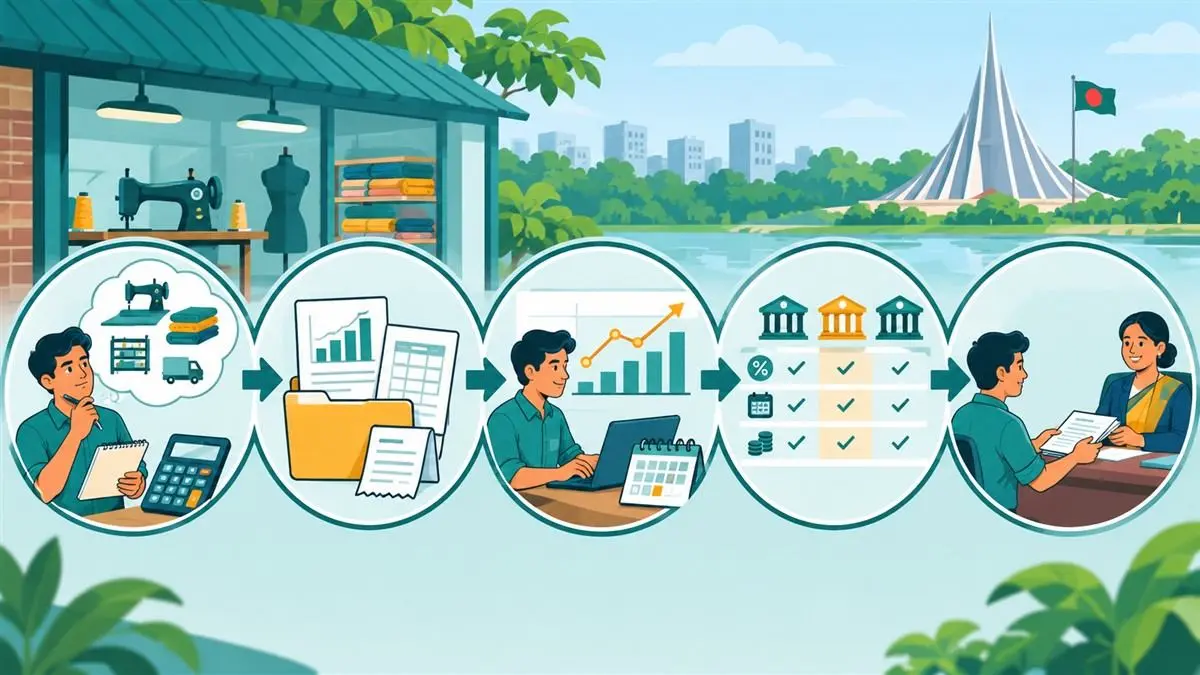
- Choose the purpose. Decide whether the business needs working capital, equipment finance, or another facility, and estimate the amount from documented needs.
- Ask the bank for current requirements. Request the application form, checklist, required financial period, and any plan format from the branch or official channel.
- Gather evidence. Collect records and quotations, reconcile amounts, and identify gaps that need a bank-approved alternative.
- Build the forecast. Prepare monthly cash flow and explain the assumptions behind sales, costs, collection, and payment timing.
- Write and cross-check the plan. Ensure that the request, use of funds, projections, and supporting papers agree.
- Submit through the stated channel. Keep acknowledgement details, submitted copies, and a record of follow-up requests.
- Respond accurately to questions. Provide requested clarifications and updated documents. Do not alter records to make results look stronger.
The bank may ask for additional information, site visits, clarification, or security documents. Processing time and the outcome depend on the lender, the file, the product, and its credit decision process. A complete application can reduce avoidable back-and-forth, but it does not guarantee approval or a particular amount.
Common business-plan mistakes that weaken a loan file
- Requesting a round number without a cost breakdown. Connect the amount to items, quantities, quotations, and the project total.
- Using sales targets without evidence. Show how customers, capacity, or existing sales support the forecast.
- Confusing profit with cash. Include when customers pay and when suppliers, staff, rent, and lenders must be paid.
- Leaving out existing borrowing. Disclose liabilities and repayment obligations consistently with the bank’s forms.
- Using different figures in different documents. Reconcile totals across the plan, application, quotations, and statements.
- Copying a generic plan. Remove assumptions that do not fit your location, sector, business age, or product.
- Promising guaranteed growth or repayment. Present assumptions, evidence, and risks honestly.
- Ignoring the bank’s format. A polished document may still be incomplete if it misses a required form or attachment.
How this article fits with other Bangladesh business-loan guides
This guide is about preparing the plan and supporting file. For product selection and eligibility, compare our CMSME loan guide for Bangladesh and guide to banks offering SME loans. If the business is not yet operating, our Bangladesh business-starting guide covers the broader setup decisions. Check all product details with the lender because offerings and terms can change.
Frequently asked questions
Is a business plan compulsory for every bank loan in Bangladesh?
Not necessarily in the same form for every product. A lender may require a business profile, project profile, cash-flow forecast, or a particular application format. Ask the bank which documents apply to your loan type and business.
How long should a business plan for a bank loan be?
There is no universal page count. Make it long enough to explain the business, funding need, repayment source, risks, and requested supporting evidence. Follow the bank’s template if it provides one and keep the summary concise.
Can a new business apply for a bank loan?
Some financing products may consider newer businesses, while others require operating history or other conditions. Check the current eligibility criteria for the specific product and be especially clear about owner contribution, market evidence, project costs, and how repayment could begin.
Do banks in Bangladesh always require collateral?
No single answer applies to every bank or facility. Security requirements can vary by loan purpose, amount, product, applicant, and applicable scheme. Ask the bank what collateral, guarantees, or alternative security it requires for your case.
Should I include a financial forecast if the business already has accounts?
Yes, when the lender requests it or when it helps explain repayment. Historical records show what has happened; a cash-flow forecast explains how the business expects to meet future costs and instalments. Keep both consistent and label assumptions clearly.
Will a well-written plan guarantee loan approval?
No. A plan is supporting evidence, not a promise of approval. The bank makes its own decision after reviewing the application, records, credit information, repayment capacity, security, product rules, and other relevant factors.
Final checklist before you submit
- The requested loan matches a clearly described business purpose.
- Each major cost has supporting evidence or a stated basis.
- Sales, expenses, and collection timing are explained.
- The cash-flow forecast includes a repayment view and a cautious scenario.
- Existing debt and owner withdrawals are reflected honestly.
- Names, dates, amounts, and business details match across the file.
- You used the lender’s current forms and document checklist.
- You retained a copy and understand that final terms depend on the bank.
Financial information notice: This article is general educational information, not a loan offer, legal or tax advice, or a guarantee of financing. Loan eligibility, documents, security, pricing, and repayment terms vary by lender and may change. Verify current requirements with the bank and consult a qualified professional where needed.