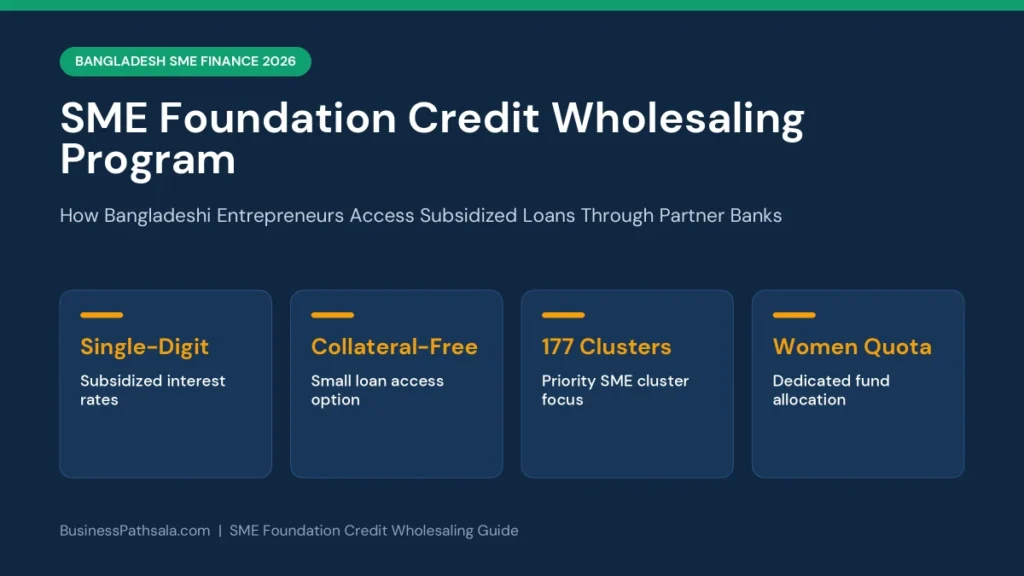
Quick answer: The SME Foundation Credit Wholesaling Program is a government-backed financing scheme in Bangladesh that channels low-interest, single-digit loans to cottage, micro, and small enterprises through Partner Financial Institutions (PFIs) such as commercial banks and licensed finance companies. You do not apply for money directly at the SME Foundation office in Dhaka. Instead, you apply at a participating partner bank or NBFI branch that has signed an active Memorandum of Understanding (MoU) with SME Foundation. Depending on the active funding round, eligible entrepreneurs can access collateral-free loans (commonly BDT 1 lakh to BDT 25 lakh, with higher caps for capital machinery in specific windows) at subsidized single-digit rates, with priority given to the 177 recognized SME clusters and women entrepreneurs.
Updated 20 November 2026. Active loan caps, customer interest rates, and participating partner banks vary across each Credit Wholesaling funding round. Always verify the current circular on the official SME Foundation portal and confirm active fund availability at your chosen bank branch before submitting documents.
Small factory owners in Bogura, footwear makers in Bhairab, handloom weavers in Sirajganj, and boutique operators in Dhaka often hit the same wall when they ask a bank for a loan. Commercial banks either quote double-digit interest rates that squeeze thin operating margins or demand registered land papers worth more than the loan itself. The Small and Medium Enterprise Foundation (SME Foundation), operating under the Ministry of Industries of Bangladesh, designed its Credit Wholesaling Program specifically to solve that gap for underserved cottage, micro, and small businesses outside major corporate circles.
What Is the SME Foundation Credit Wholesaling Program?
Credit wholesaling is a two-tier lending structure. Rather than building hundreds of retail branches across Bangladesh, the SME Foundation provides wholesale revolving funds at a very low concessional rate to selected scheduled banks and non-bank financial institutions (NBFIs), known as Partner Financial Institutions (PFIs). Those partner lenders then retail the money out to eligible small businesses at a capped single-digit interest rate set by SME Foundation for that funding cycle.
The program started as a pilot in 2009 to test whether targeted wholesale funds could push formal banks to lend to small, regional manufacturing clusters without demanding heavy immovable collateral. Over the years, it grew into one of the most recognized public-sector credit channels for small enterprises in Bangladesh, expanding significantly during the post-pandemic government stimulus rounds and continuing through revolving fund disbursements.
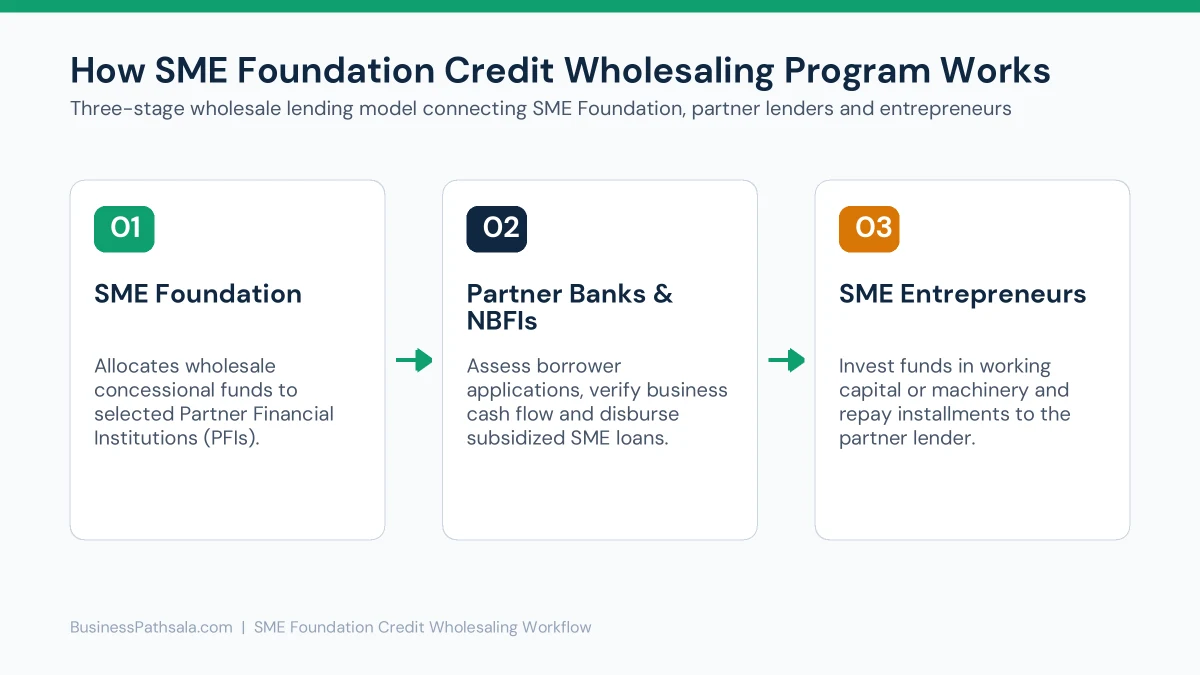
Understanding this two-tier model saves a lot of wasted trips. SME Foundation sets the policy rules, selects priority clusters, monitors lender compliance, and releases wholesale tranches. The partner bank or finance company handles every step of your actual loan: accepting the application, visiting your workshop or shop, checking your Credit Information Bureau (CIB) status, disbursing the Taka into your account, and collecting your monthly installments.
Key Features: Interest Rates, Loan Limits, and Repayment Terms
Because SME Foundation runs Credit Wholesaling in revolving rounds and periodic government-backed allocations, the exact terms depend on which funding window is currently open at your partner bank. However, the core structure across regular and special rounds follows a consistent pattern that makes it far more affordable than standard commercial borrowing.
| Program Parameter | Typical Structure Across SME Foundation Rounds | What to Confirm at the Bank Branch |
|---|---|---|
| Interest / Profit Rate | Single-digit subsidized rate (historically 4% under government stimulus windows and 6% to 9% under regular revolving credit wholesaling rounds) | Ask for the exact active rate in the current MoU and whether any service fee or VAT applies |
| Loan Size Range | Commonly BDT 1 lakh to BDT 25 lakh for standard collateral-free SME loans; up to BDT 50 lakh in select capital-machinery or cluster-expansion windows | Verify the branch’s internal per-borrower cap and whether amounts above BDT 10 to 25 lakh require security |
| Collateral Policy | Designed to be collateral-free for smaller tickets, relying on personal guarantees, hypothecation of stock or machinery, and post-dated cheques | Confirm exact guarantor requirements (usually two solvent guarantors) and security paperwork |
| Repayment Tenure | Typically 1 to 4 years (up to 5 years for select term or machinery loans), repaid in equal monthly installments (EMI) | Check if a short grace period (1 to 3 months) is allowed for seasonal or machinery-setup loans |
| Women Entrepreneur Quota | At least 25% to 30% of allocated funds reserved for women-owned enterprises across recent rounds | Ask specifically for the Women Entrepreneurs Dedicated Desk if your business is female-owned |
| Eligible Loan Purpose | Working capital (raw materials, inventory, packaging) and fixed-asset term loans (light machinery, workshop upgrades) | Note that funds cannot be used for personal consumption, land speculation, or repaying defaulted debt |
Keep in mind that when a specific Credit Wholesaling tranche runs out at a partner bank, the branch cannot issue new loans at the subsidized rate until SME Foundation releases the next revolving allocation. If you need to compare this option with central bank schemes, review our full CMSME loan guide for Bangladesh and our breakdown of current SME loan interest rates in Bangladesh.
How Much Does a Credit Wholesaling Loan Save You in Real Taka?
Single-digit interest rates sound attractive on paper, yet seeing the actual monthly installment shows why small workshop owners wait for these funding rounds. Suppose a light engineering workshop in Bogura or a leather goods unit in Dhaka borrows BDT 5,00,000 (5 lakh) for 36 months (3 years) to buy new machines and raw materials. Here is how the repayment math compares across different annual interest rates on a standard monthly reducing-balance schedule.
| Loan Scenario (BDT 5 Lakh, 36 Months) | Approx. Monthly EMI | Total Interest Paid | Total Repayment |
|---|---|---|---|
| 4.0% Annual Rate (Special / Stimulus Window) | BDT 14,762 | BDT 31,432 | BDT 5,31,432 |
| 6.0% Annual Rate (Concessional Credit Wholesaling) | BDT 15,211 | BDT 47,595 | BDT 5,47,595 |
| 9.0% Annual Rate (Standard Regular Wholesaling Cap) | BDT 15,900 | BDT 72,395 | BDT 5,72,395 |
| 13.5% Annual Rate (Typical Commercial SME Bank Loan) | BDT 16,968 | BDT 1,10,835 | BDT 6,10,835 |
Illustrative calculation only: These figures assume standard monthly reducing-balance amortization and exclude bank processing fees, stamp duties, CIB charges, and VAT. Your actual monthly installment will appear on your partner bank’s written sanction letter.
Comparing a 6% Credit Wholesaling loan against a 13.5% commercial SME loan on BDT 5 lakh saves roughly BDT 1,757 every month and BDT 63,240 in total interest over three years. For a small manufacturer operating on a 12% to 15% net margin, keeping an extra BDT 63,000 inside the business makes a measurable difference to cash flow stability and raw material purchasing power.
Who Is Eligible for the SME Foundation Credit Wholesaling Program?
SME Foundation targets productive, job-creating enterprises that align with Bangladesh’s national SME policy and Bangladesh Bank’s CMSME Master Circular (SMESPD Circular No. 01, 17 March 2025). While each partner bank applies its own internal credit scoring, eligible applicants generally share these core qualifications:
- Enterprise Size: You must operate a registered Cottage, Micro, or Small Enterprise (and in select allocations, small-end Medium enterprises) based on fixed asset and employee headcount thresholds defined under national industrial and Bangladesh Bank CMSME policy. Large corporations and purely speculative trading operations are excluded.
- Priority Sectors and 177 SME Clusters: SME Foundation places heavy emphasis on Bangladesh’s 177 mapped SME clusters across 51 districts. Priority sectors include agro-processing and food production, light engineering and agricultural machinery, leather and footwear (such as Bhairab and Dhaka clusters), handloom and knitwear, handicrafts and Nakshi Kantha, furniture and woodworking, plastics, electrical parts, and ICT or software services.
- Regional and Rural Outreach: A substantial share of Credit Wholesaling funds is specifically directed toward entrepreneurs outside the Dhaka and Chattogram metropolitan cores so district-level and upazila workshops can access formal banking.
- Women Entrepreneurs: Female-owned proprietorships (100% ownership) and partnerships or private limited companies with at least 51% female shareholding receive dedicated quota priority across partner banks.
- Operating Track Record: Most Partner Financial Institutions look for at least 1 to 2 years of active business operations with verifiable sales, although trained new entrepreneurs recommended through SME Foundation or cluster associations may receive consideration in specific windows.
- Clean CIB Record: Neither the business owner nor any partner, director, or guarantor can be a classified loan defaulter in the Bangladesh Bank Credit Information Bureau (CIB) system.
How Bangladesh’s 177 SME Clusters Get Priority Access
If your workshop sits inside a recognized regional production hub, you have a practical advantage. SME Foundation mapped 177 SME clusters across Bangladesh where dozens or hundreds of small enterprises manufacture similar goods in one geographic area. Examples include the light engineering foundries of Bogura, the shoe and sandal cluster of Bhairab, the Nakshi Kantha and handloom clusters of Jamalpur and Tangail, the wood furniture workshops of Panchagarh and Chattogram, and the agro-machinery fabricators of Jashore.
Banks normally hesitate to lend to tiny workshops in remote upazilas because verifying one isolated business is expensive. Inside a mapped SME cluster, a partner bank can inspect twenty workshops in a single afternoon, rely on local cluster association verification, and understand raw material cycles clearly. When you apply, ask your local cluster samity or trade association for a short membership confirmation letter to attach to your loan file.
Partner Financial Institutions (PFIs): Which Banks and NBFIs Participate?
SME Foundation signs funding agreements with a wide network of state-owned commercial banks, private commercial banks, specialized banks, and licensed non-bank financial institutions. The exact roster of active PFIs changes with each funding cycle depending on which banks sign the latest MoU and still hold undisbursed allocations.
Across recent Credit Wholesaling rounds, participating institutions have regularly included major SME-focused lenders such as BRAC Bank, City Bank, Bank Asia, Eastern Bank (EBL), Mutual Trust Bank (MTB), Prime Bank, Dhaka Bank, Dutch-Bangla Bank, Islami Bank Bangladesh, NCC Bank, Southeast Bank, United Commercial Bank (UCB), Midland Bank, Mercantile Bank, state-owned banks including Sonali Bank, Janata Bank, Agrani Bank, BASIC Bank, and Bangladesh Krishi Bank, and NBFIs such as IDLC Finance, IPDC Finance, and LankaBangla Finance.
Never assume that every branch of a listed bank currently has SME Foundation funds sitting ready. Before spending time photocopying documents, call the bank’s SME division or check the latest PFI list published on smef.gov.bd. Choosing a branch that already serves local manufacturers in your district usually leads to faster site verification and fewer back-and-forth queries.
Required Documents Checklist for Partner Banks
Even though Credit Wholesaling is a public-interest program, partner banks bear the repayment risk and must satisfy Bangladesh Bank audit rules. Arriving at the branch with a clean, complete folder immediately separates your file from incomplete applications that sit untouched for weeks.
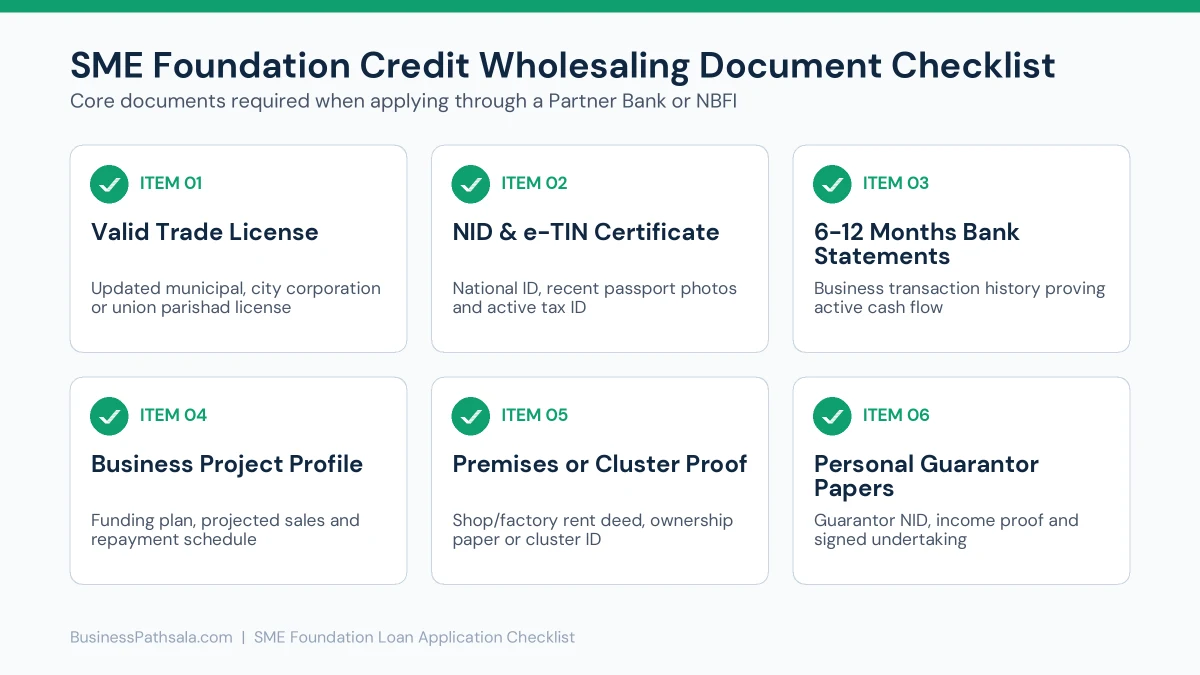
- Valid Business Registration: An updated Trade License from your City Corporation, Pourashava, or Union Parishad. If you run a partnership or private limited company, include the Partnership Deed or RJSC Certificate of Incorporation, MOA, AOA, and Form XII.
- Owner Identity and Tax Documents: Valid National ID (NID) copy, 2 to 4 recent passport-size photographs, an active e-TIN certificate, and your latest income tax return acknowledgement slip (PSR) where applicable.
- Banking and Sales Records: At least 6 to 12 months of business bank account statements. If your workshop receives payments through mobile financial services (bKash or Nagad merchant accounts) or keeps daily cash sales ledgers, bring those records alongside your bank statement to prove real turnover.
- Premises and Utility Proof: A copy of your shop, factory, or warehouse rental agreement, or ownership deed if the premises belong to you or your family, plus recent electricity or gas bills.
- Business Project Profile or Loan Proposal: A straightforward 2-to-5-page summary outlining your products, monthly sales, operating costs, exact use of the requested loan (backed by supplier quotations if buying machinery), and monthly repayment capacity. If you need a ready structure, use our guides on preparing an SME loan project profile in Bangladesh and writing a business plan for a bank loan.
- Cluster or Association Reference: If your business operates inside one of Bangladesh’s 177 SME clusters or belongs to a local trade association, women’s chamber, or BSCIC industrial estate, attach your membership certificate or recommendation letter. Partner banks view cluster verification favorably.
- Personal Guarantor File: NID copies, passport photos, and income or business proof for two financially solvent guarantors (typically one family member and one third-party business or salaried guarantor) for collateral-free facilities.
Step-by-Step: How to Apply for the SME Foundation Credit Wholesaling Program
Follow these seven practical steps to avoid dead ends and improve your chances of securing a subsidized allocation before a funding round closes.
- Check active funding announcements first. Visit smef.gov.bd or contact your local SME cluster association or district chamber of commerce to confirm whether a Credit Wholesaling round is currently open and which Partner Financial Institutions have active MoUs.
- Contact 2 to 3 PFI branches near your business. Speak directly with the SME Relationship Manager or Branch Manager rather than stopping at the front desk. Ask clearly: “Does your bank currently have an active allocation under the SME Foundation Credit Wholesaling Program for my sector, and what is the current customer interest rate and maximum unsecured limit?”
- Verify your CIB status and bank turnover. Before submitting a formal form, make sure you and your guarantors have no overdue credit card balances or forgotten microfinance defaults. If you mostly transact in cash, start routing daily sales through a business bank account immediately so the lender can see consistent inflows.
- Prepare an itemized use-of-funds plan. Banks reject vague requests like “BDT 10 lakh for business expansion.” Break the request down clearly. For example, specify BDT 6 lakh for a semi-automatic packaging machine (with a dated supplier quotation) and BDT 4 lakh for raw material inventory ahead of peak season.
- Submit the loan application at the PFI branch. Complete the partner bank’s official SME loan application form, attach your document folder, and ask for a written acknowledgement or application tracking number. Never pay unofficial brokers or agents who promise guaranteed SME Foundation approval.
- Host the bank’s field verification visit. An SME credit officer will visit your factory, shop, or workshop to inspect inventory, machinery, staff count, and local market reputation, and may interview nearby suppliers or buyers. Keep your sales register and purchase receipts organized for this visit.
- Review the sanction letter before signing. Once approved, read every clause in the written sanction letter: the exact annual interest rate, repayment schedule, monthly EMI, processing fees and VAT, insurance charges, guarantor liabilities, and early-settlement rules. Sign only when the written rate matches the SME Foundation program terms you were quoted.
SME Foundation Credit Wholesaling vs. Bangladesh Bank CMSME Refinance
Bangladeshi entrepreneurs frequently confuse SME Foundation’s Credit Wholesaling Program with Bangladesh Bank’s SMESPD Refinance Schemes. Both channels lower borrowing costs through commercial banks, yet they operate differently and suit slightly different situations.
| Comparison Point | SME Foundation Credit Wholesaling | Bangladesh Bank CMSME Refinance |
|---|---|---|
| Administering Body | SME Foundation (Ministry of Industries) | Bangladesh Bank (SMESPD) |
| Core Target Group | 177 SME clusters, rural and peri-urban cottage, micro and small enterprises, and women entrepreneurs | All eligible CMSMEs nationwide, including startups, agriculture, manufacturing, and women-owned firms |
| Fund Availability | Periodic revolving rounds and MoU-based allocations to selected PFIs (can pause between tranches) | Larger continuous revolving pools (such as Tk 25,000 crore CMSME fund and dedicated 5% women’s window) |
| Typical Interest Ceiling | Single-digit (historically 4% to 9% depending on the specific funding round) | 5% (Small Enterprise Women Refinance) or 7% (Tk 25,000 Cr CMSME Refinance) |
| Where You Apply | Partner Financial Institutions (PFIs) with active SME Foundation MoUs | Any participating scheduled bank or finance company |
If your local bank branch tells you its SME Foundation allocation is temporarily exhausted, ask immediately whether your business qualifies under a Bangladesh Bank refinance window instead. You can also check the Bangladesh Bank SMESPD Circular Portal for current central bank schemes or explore broader Uddokta loan options in Bangladesh.
Common Mistakes and Practical Challenges to Watch Out For
Even strong small businesses lose months during the application process because of avoidable friction points. Knowing these four common hurdles upfront helps you plan realistically.
- Visiting SME Foundation’s Dhaka office expecting a loan counter: Entrepreneurs from outside Dhaka sometimes travel to Agargaon hoping to submit a loan form directly. SME Foundation runs training, cluster support, and policy coordination; it does not issue retail loans over the counter. Always start at a participating bank or NBFI branch in your district.
- Assuming “collateral-free” means “zero verification”: Banks still protect themselves against default when they waive land mortgages. Expect strict scrutiny of your daily sales books, supplier invoices, bank statements, and two financially credible personal guarantors.
- Applying after a funding round has already closed: Because subsidized single-digit tranches are heavily oversubscribed, funds often fill up quickly once an MoU is signed. Building a working relationship with an SME officer at a PFI branch ahead of time ensures you hear about new rounds early.
- Mixing personal and business cash: Depositing business revenue into a personal savings account or keeping everything in cash makes it difficult for a credit analyst to verify your actual monthly profit. Opening a simple business current account six months before applying dramatically strengthens your file.
Frequently Asked Questions
Can I apply directly to the SME Foundation for a business loan?
No. Under the Credit Wholesaling model, SME Foundation lends wholesale funds to selected Partner Financial Institutions (banks and NBFIs). Individual entrepreneurs must apply directly at a participating partner bank or finance company branch.
What is the current interest rate of the SME Foundation Credit Wholesaling Program?
The program provides single-digit subsidized interest rates, which have ranged from 4% (under special government stimulus packages) to between 6% and 9% under regular revolving Credit Wholesaling rounds. Because the exact customer rate is set in each funding round’s MoU, confirm the active rate directly on smef.gov.bd or with a participating bank branch.
How much collateral-free loan can I get under this program?
Across most Credit Wholesaling rounds, eligible cottage, micro, and small entrepreneurs can apply for collateral-free loans ranging from BDT 1 lakh up to BDT 25 lakh, backed by personal guarantees and business asset hypothecation. Larger requests (such as BDT 25 lakh to BDT 50 lakh for machinery or factory expansion) typically require additional security depending on the partner bank’s credit policy.
Do I need to be inside one of the 177 SME clusters to qualify?
Being part of one of Bangladesh’s 177 recognized SME clusters gives your application strong priority, because cluster development is a core mandate of SME Foundation. However, eligible cottage, micro, small, and women-owned enterprises outside formal clusters can also qualify if they operate in priority manufacturing, agro-processing, or service sectors and meet the partner bank’s lending criteria.
Can a brand-new startup apply for an SME Foundation Credit Wholesaling loan?
Most partner banks prefer at least 1 to 2 years of existing business operations with verifiable sales before approving an unsecured Credit Wholesaling loan. If you are a trained first-time founder with less than a year of trading history, ask the bank about SME Foundation’s training-linked entrepreneur support or Bangladesh Bank’s New Entrepreneurs Refinance Scheme.
Official Sources and Further Reading
- SME Foundation Official Portal (smef.gov.bd): Official announcements, active Credit Wholesaling funding rounds, cluster directory, and Partner Financial Institution (PFI) notices.
- Ministry of Industries, Government of Bangladesh: Parent ministry overseeing national SME policy and industrial cluster development.
- Bangladesh Bank SMESPD Circular No. 01 — CMSME Financing Master Circular (17 March 2025): Official definitions of cottage, micro, small, and medium enterprises in Bangladesh.
- Bangladesh Bank SME & Special Programmes Department (SMESPD): Central bank refinance options that complement SME Foundation’s wholesale credit rounds.
- Bangladesh Bank SMESPD Circular Portal: Official index for verifying updated CMSME financing circulars.
Next Steps to Prepare Your Application
Before visiting a bank branch, confirm on the SME Foundation website which Partner Financial Institutions currently hold active Credit Wholesaling allocations in your district. Put your updated Trade License, e-TIN, 6 to 12 months of business bank statements, and an itemized project profile into one clean folder, and line up two solvent personal guarantors. Comparing two or three participating partner banks side by side will help you secure the lowest active single-digit rate and avoid unnecessary commercial markups.
Financial information notice: This article is published for general educational purposes only and does not constitute a loan offer, legal advice, or a guarantee of financing approval. SME Foundation funding tranches, interest rates, loan limits, and partner bank policies change over time. Always verify current terms directly with SME Foundation and your chosen Partner Financial Institution.