Quick answer: A restaurant business loan in Bangladesh is typically processed under the service-sector CMSME lending track of commercial banks and non-bank financial institutions (NBFIs) governed by Bangladesh Bank’s CMSME Master Circular (SMESPD Circular No. 01, 17 March 2025). Eligible dine-in restaurants, cafes, bakeries, catering services, and registered cloud kitchens with at least 1 to 2 years of operating history can apply for unsecured SME term loans (commonly BDT 5 lakh to BDT 50 lakh+ depending on bank turnover), kitchen equipment lease finance, or working-capital overdrafts. Standard commercial hospitality SME rates typically fall between 12% and 15%, while qualifying women-owned or central bank refinance-backed files can access subsidized rates of 5% to 7% when allocations are open. Strict regulatory compliance, including a valid Trade License, Fire Service clearance, BFSA food safety registration, VAT BIN, and a commercial rent deed, is required before disbursement.
Updated 20 November 2026. Commercial bank interest rates, refinance allocations, municipal trade license rules, and Fire Service inspection standards change periodically. Confirm active loan terms and branch checklists directly with your lender before signing a lease or buying kitchen equipment.
Walk down Banani Road 11, Dhanmondi Satmasjid Road, Uttara, or Agrabad in Chattogram, and you can see how fast Bangladesh’s dining and coffee culture has grown. Behind every busy cafe, biryani house, or multi-outlet burger brand is a heavy upfront bill for commercial rent deposits, interior fit-out, exhaust hoods, chillers, ovens, and daily raw ingredients. Yet when restaurant owners approach a Bangladeshi bank for financing, many get surprised by how cautious credit officers are toward hospitality businesses. Because restaurants face high rent overhead, strict fire and food safety inspections, and fluctuating daily footfall, banks underwrite them differently from regular retail shops. Knowing which loan products fit your stage and which permits clear compliance hurdles first makes approval far more realistic.
How Bangladeshi Banks View Restaurant Business Loans
Under Bangladesh Bank’s CMSME classification, restaurants, cafes, fast-food outlets, bakeries, and commercial catering kitchens fall inside the Service Sector (or light food-processing manufacturing if you operate a central bakery or packaged food commissary). That classification matters because Bangladesh Bank encourages scheduled banks to expand service and manufacturing lending rather than relying solely on trading loans. You can check how small and medium thresholds are calculated in our CMSME loan guide for Bangladesh.
Even with supportive central bank definitions, commercial banks treat hospitality as a medium-to-high-risk service category for three practical reasons:
- High failure rate for brand-new outlets: New restaurants often burn through startup cash during the first six months while paying commercial rent and staff salaries before customer traffic stabilizes. Because of this, almost no scheduled bank funds a 100% greenfield first restaurant without heavy property collateral.
- Low resale value of interior decoration: Spending BDT 30 lakh on false ceilings, lighting, custom tables, and wall paneling looks great to diners, yet a bank cannot recover that money if the restaurant closes. Banks prefer financing verifiable cash flow and movable kitchen equipment over interior decor.
- Heightened fire and building-safety scrutiny: Following high-profile commercial building fire incidents in Dhaka, banks and municipal authorities strictly inspect whether a restaurant sits inside a properly zoned commercial space with an active Fire Service license and safe gas storage.
Understanding these three lender concerns upfront helps you structure a proposal that speaks directly to a credit committee’s risk checklist.
Five Financing Options for Restaurants, Cafes, and Cloud Kitchens
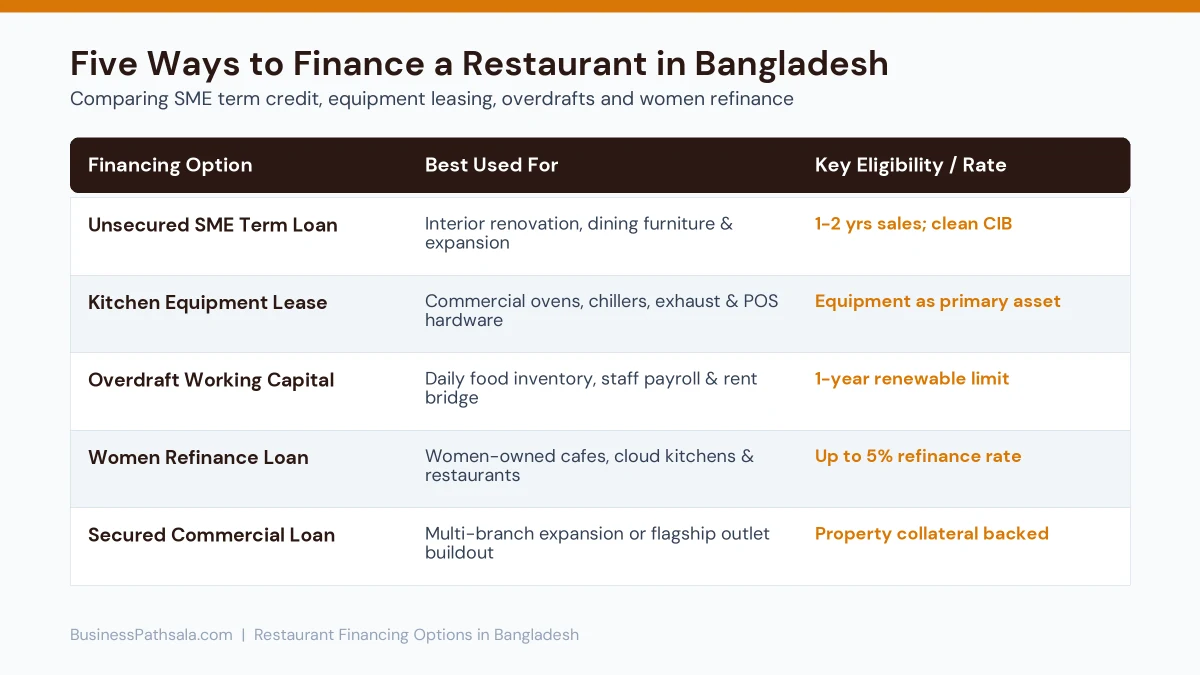
Restaurants rarely need just one lump sum of cash. Expanding to a second branch, replacing aging commercial ovens, and smoothing out Ramadan or seasonal supply bills each call for a different credit structure. Here are the five main financing channels available in Bangladesh.
1. Unsecured SME Term Loan (For Established Outlets)
If your restaurant or cafe has been operating profitably for at least 1.5 to 2 years with consistent bank deposits and POS card settlements, leading private SME banks offer collateral-free term loans typically ranging from BDT 5 lakh to BDT 50 lakh (and higher for multi-branch brands with strong turnover). Owners use these 2-to-4-year EMI loans to remodel dining areas, open a second outlet, upgrade POS billing systems, or cover commercial security deposits. Security usually consists of two solvent personal guarantors, hypothecation of kitchen assets, and undated security cheques.
2. Commercial Kitchen Equipment Lease Finance
Commercial espresso machines, combi ovens, walk-in chillers, industrial deep fryers, central air-conditioning units, and backup generators cost lakhs of Taka. Instead of draining working capital, established restaurants can finance 70% to 80% of vendor-quoted equipment through licensed NBFIs (such as IDLC Finance, IPDC Finance, or LankaBangla Finance) or commercial bank lease desks. Tenures run 2 to 5 years, and the bank pays the equipment vendor directly upon delivery.
3. Working Capital Overdraft (OD) or Cash Credit
Food businesses deal with sharp seasonal swings. Sales jump during Eid, Pohela Boishakh, and winter wedding catering months, then dip during heavy monsoon weeks or pre-exam slowdowns. An annual revolving Overdraft (OD) limit lets you cover bulk meat, poultry, dairy, packaging, and staff payroll during tight weeks without taking a fresh term loan. You pay interest only on the daily balance you actually draw, and banks typically tie the OD ceiling to a percentage of your verified annual bank turnover or a fixed deposit (FDR) lien.
4. Women Entrepreneur Refinance Loans (Up to 5% Rate)
A large and fast-growing share of boutique cafes, artisan bakeries, home-kitchen catering brands, and cloud kitchens in Dhaka, Chattogram, and Sylhet are owned by women. If a woman holds 100% ownership (proprietorship) or at least 51% shares (partnership or private limited company), the restaurant can apply through a bank’s Women Entrepreneurs Dedicated Desk under Bangladesh Bank’s SMESPD Refinance Schemes. Under the dedicated Small Enterprise Refinance Scheme for women, customer interest rates are capped at 5% per year when refinance funds are active, and central bank rules guide lenders to consider collateral-free loans up to BDT 25 lakh against personal guarantees.
5. Secured Multi-Branch Expansion Loans
When a popular local restaurant brand wants to expand from two outlets to five, build a central kitchen commissary, or acquire a commercial floor space, unsecured SME limits are rarely enough. Registered mortgage of residential or commercial property unlocks larger facilities (BDT 50 lakh to BDT 5 crore+) with longer repayment tenures of 3 to 7 years and slightly lower commercial interest rates than unsecured loans.
Interest Rates and Real Repayment Math (BDT 15 Lakh Example)
Because restaurant net profit margins in Bangladesh typically sit between 12% and 20% after food cost (30% to 38%), rent, staff wages, utilities, and delivery-app commissions, your interest rate directly determines whether a loan helps you grow or squeezes monthly cash. You can compare broader commercial pricing across lenders in our guide to SME loan interest rates in Bangladesh.
Below is an illustrative calculation for a BDT 15,00,000 (15 lakh) restaurant renovation and kitchen equipment loan repaid over 36 months (3 years) on a standard monthly reducing-balance schedule:
| Loan Rate Scenario (BDT 15 Lakh, 36 Months) | Approx. Monthly EMI | Total Interest (3 Years) | Total Repayment |
|---|---|---|---|
| 7.0% Annual Rate (CMSME Refinance Window) | BDT 46,316 | BDT 1,67,363 | BDT 16,67,363 |
| 11.5% Annual Rate (Secured / Prime SME Tier) | BDT 49,464 | BDT 2,80,704 | BDT 17,80,704 |
| 13.5% Annual Rate (Standard Commercial SME Rate) | BDT 50,903 | BDT 3,32,506 | BDT 18,32,506 |
| 15.0% Annual Rate (Higher-Risk Unsecured / NBFI) | BDT 51,998 | BDT 3,71,928 | BDT 18,71,928 |
Illustrative math only: These figures assume equal monthly installments (EMI) and exclude processing fees (commonly 0.50% to 1.00% plus 15% VAT), CIB charges, stamp duties, and fire insurance. Confirm exact repayment schedules in your written sanction letter.
Qualifying for a 7% CMSME refinance rate rather than a 13.5% commercial rate on BDT 15 lakh saves approximately BDT 4,587 every month and BDT 1,65,143 in total interest over three years. Before accepting any EMI above BDT 50,000 per month, verify that your restaurant’s slowest off-season month still generates enough net cash flow to cover rent, payroll, supplier bills, and the bank installment with room to spare.
Top Banks and NBFIs Financing Restaurants in Bangladesh
Most major banks in Bangladesh do not advertise a standalone product called a “Restaurant Loan.” Instead, they finance restaurants, cafes, and bakeries through their standard SME Banking and Women SME divisions. Below is how active lender categories compare for food-service borrowers.
| Lender Category | Active Institutions | Strengths for Restaurant Owners | Key Requirement to Expect |
|---|---|---|---|
| Private SME Leaders | BRAC Bank (Anonna / TARA), City Bank (City Alo / SME), Eastern Bank (EBL), Prime Bank, Mutual Trust Bank (MTB) | Strong POS merchant acquiring links, unsecured SME loans up to BDT 50 lakh–1.5 crore for established outlets, active BB refinance desks | Minimum 1 to 2 years of trading history, clean POS and bank turnover, active Fire and BFSA compliance |
| Shariah-Compliant Banks | Islami Bank Bangladesh, Shahjalal Islami Bank, Al-Arafah Islami Bank | Asset-backed HPSM equipment financing and Bai-Muajjal working capital for kitchens and bakeries | Verified supplier quotations, halal/hygiene compliance, and clean CIB records |
| Licensed NBFIs | IDLC Finance, IPDC Finance, LankaBangla Finance | Flexible commercial kitchen equipment leasing and faster doorstep financial evaluation | Slightly higher commercial rates than subsidized bank refinance; strong bank statements required |
| State-Owned Banks | Sonali Bank, Janata Bank, Agrani Bank, Rupali Bank | Lower commercial rates on secured loans and broad district-town reach outside Dhaka | Slower turnaround and stricter immovable land collateral requirements |
Eligibility Criteria: Can a Brand-New Restaurant Get a Bank Loan?
This is the single most common question aspiring cafe and restaurant founders ask, and it deserves a straight answer: getting an unsecured bank loan to open your very first restaurant from scratch is extremely difficult in Bangladesh. Banks want proof that customers actually like your food and that your kitchen controls waste and rent costs.
Here is what lenders typically require before approving a restaurant loan:
- Minimum Business Age: At least 2 years of continuous commercial operation at the same or verifiable locations (reduced to 1 year at several private banks for women-owned restaurants and bakeries).
- New Restaurant Exception: If you are launching a brand-new outlet, banks will generally consider financing only if you already own another profitable business with strong bank statements, or if you pledge registered real estate collateral or an FDR/DPS lien (usually financing 70% to 90% against liquid cash security).
- Verifiable Banking and POS Turnover: Cash-only restaurants struggle to prove revenue. Routing card POS settlements, bKash or Nagad merchant payouts, and delivery-app payouts (Foodpanda, Pathao Food) into one dedicated business bank account gives credit officers verifiable monthly sales data.
- Healthy Lease Remaining: If you ask for a 3-year term loan, banks want to see a registered commercial rent agreement with at least 3 to 5 years remaining so your landlord cannot evict the restaurant mid-loan.
- Clean CIB Record: Neither the owner nor any partner, director, or guarantor may have overdue credit cards or classified loan defaults in Bangladesh Bank’s CIB system.
Mandatory Licenses and Document Checklist for Restaurant Loans
Regulatory permits are the biggest deal-breaker for hospitality loans in Bangladesh. A restaurant operating in a residential building without commercial zoning or Fire Service clearance will almost always be rejected during the bank’s physical site inspection. Organize these six document categories before applying.
- Trade License and Tax Compliance: Updated Trade License from the City Corporation or Pourashava specifically listing restaurant, cafe, or catering activity; e-TIN certificate and latest tax return acknowledgement (PSR); plus VAT/BIN registration and recent monthly VAT returns (Mushak-9.1) under the National Board of Revenue (NBR).
- Fire, Food Safety, and District Permits: Valid Fire License from the Bangladesh Fire Service and Civil Defence, food establishment registration or grading compliance under the Bangladesh Food Safety Authority (BFSA), and applicable Deputy Commissioner (DC) office restaurant registration or Department of Environment clearance for larger kitchens.
- Commercial Lease Agreement: A properly stamped rent deed confirming commercial occupancy, monthly rent, advance deposit paid, and a remaining tenure equal to or longer than your requested loan period.
- Banking, POS, and Delivery-App Proof: Last 12 months of business bank statements, monthly POS merchant settlement summaries, MFS merchant statements, and Foodpanda or Pathao Food payout statements to substantiate daily sales.
- Project Profile and Equipment Quotations: A concise financial plan covering average daily covers, average ticket size, food cost percentage (ideally 30% to 35%), rent-to-sales ratio, staff payroll, and dated vendor quotations for ovens, chillers, or fit-out work. Use our guides on writing a business plan for a bank loan in Bangladesh and building an SME loan project profile.
- Owner and Guarantor Papers: NID copies and passport photos of all owners or directors (plus RJSC MOA/AOA/Form XII for private limited companies), along with NID and income proof of two solvent personal guarantors for unsecured loans, or land title deeds for secured facilities.
Step-by-Step: How to Apply for a Restaurant Business Loan
- Clean up your cash deposits and POS settlements 6 months ahead. Stop paying suppliers straight out of the cash register without banking your sales first. Deposit daily cash collections into your business current account and link your POS terminal and delivery-app payouts to that same bank account.
- Audit your Fire, BFSA, and VAT compliance before contacting a bank. Check that your Fire License is renewed, gas cylinders or lines meet safety standards, and your VAT returns reflect realistic sales rather than minimal placeholder filings.
- Start with the bank that already processes your POS card machine. If BRAC Bank, City Bank, or EBL already provides your restaurant’s card POS terminal and holds your daily settlement account, their SME team already sees your live revenue stream. That existing data often leads to faster approval and higher unsecured limits.
- Itemize your funding request clearly. Split your proposal into hard quotes (for example, BDT 9 lakh for commercial kitchen equipment and BDT 6 lakh for dining renovation and working capital) rather than asking for a vague lump sum.
- Prepare your outlet for an unannounced or scheduled bank visit. Credit officers frequently visit restaurants during lunch or dinner service to observe real customer footfall, kitchen cleanliness, seating capacity, and staff operations. Keep your daily POS Z-reports and purchase registers organized on site.
- Review the written sanction letter carefully. Before signing, verify the exact annual interest rate, whether any Bangladesh Bank refinance rate applies, processing fee and VAT, early settlement penalty, and personal guarantor obligations.
Common Mistakes That Get Restaurant Loan Applications Rejected
- Under-reporting sales on bank statements and VAT returns: Many small restaurants deposit only 25% of their actual cash sales into the bank to minimize visible turnover. When they later apply for a BDT 20 lakh loan, the bank calculates repayment capacity solely on the low bank deposits and rejects or slashes the limit.
- Signing a short 1-year commercial rent deed: Requesting a 3-year loan on a space whose rent agreement expires in 8 months signals immediate closure risk to any credit committee. Negotiate a 3-to-5-year lease with a clear renewal clause before applying.
- Letting rent exceed 12% to 15% of monthly revenue: Prime-location rents in Gulshan, Banani, or Dhanmondi can wipe out a restaurant during slow months. Banks stress-test your fixed rent against conservative off-season sales.
- Operating in non-commercial buildings without Fire clearance: No matter how strong your sales look on Instagram or Foodpanda, banks will decline a file if the building lacks proper commercial occupancy and Fire Service safety compliance.
If you are running an early-stage cloud kitchen or home-based bakery that has not yet crossed the 1-to-2-year commercial bank threshold, explore smaller Uddokta loan options in Bangladesh, women entrepreneur micro-financing, or supplier credit lines to build a formal track record first.
Frequently Asked Questions
Can I get a bank loan to open a brand-new restaurant in Bangladesh?
Getting an unsecured bank loan for a brand-new restaurant with zero operating history is very difficult. Most Bangladeshi banks require 1 to 2 years of existing commercial operations. New founders usually fund their first outlet using personal savings, equity partners, or a loan secured against existing property collateral or an FDR lien, and then use bank SME loans to renovate or open a second branch.
What is the interest rate on a restaurant business loan in Bangladesh?
Standard commercial SME loans for restaurants typically carry annual interest rates between 12% and 15%, depending on the lender and whether collateral is provided. Women-owned restaurants or bakeries that qualify under Bangladesh Bank’s Small Enterprise Refinance Scheme can access rates capped at 5% per year when refinance allocations are active, while broader CMSME refinance windows cap rates around 7%.
Can a cloud kitchen or home-based bakery qualify for a business loan?
Yes, provided the business is formally registered and verifiable. You need a valid Trade License in the owner’s name, an e-TIN, at least 1 year of verifiable sales through a business bank account, MFS merchant account, or delivery-app payout statements (such as Foodpanda or Pathao Food), and clean CIB status. Women-owned home bakeries and catering kitchens have particularly strong access through dedicated bank women’s SME desks.
What licenses are mandatory before applying for a restaurant loan?
Banks typically require an updated restaurant Trade License, e-TIN and latest tax return slip (PSR), VAT/BIN registration, a valid Fire Service License, BFSA food safety registration, and a stamped commercial rent agreement. Larger dine-in restaurants may also be asked for Deputy Commissioner (DC) office restaurant registration and Department of Environment clearance.
How much collateral-free loan can an established restaurant get?
Depending on verified bank turnover, POS sales volume, and profitability, established restaurants with 2+ years of history can qualify for unsecured SME loans ranging from BDT 5 lakh up to BDT 50 lakh (and sometimes higher at top private SME banks) backed by two solvent personal guarantors and kitchen asset hypothecation.
Official Sources and Further Reading
- Bangladesh Bank SMESPD Circular No. 01 — CMSME Financing Master Circular (17 March 2025): Official service-sector SME definitions, loan eligibility guidelines, and priority lending rules.
- Bangladesh Bank SME & Special Programmes Department (SMESPD): Central bank refinance schemes supporting service-sector and women-owned enterprises.
- Bangladesh Food Safety Authority (BFSA): Official food safety registration, hygiene compliance, and restaurant grading standards.
- Bangladesh Fire Service and Civil Defence: Commercial building fire-safety clearance and restaurant Fire License requirements.
- National Board of Revenue (NBR): VAT BIN registration, e-TIN, and Mushak-9.1 return compliance for hospitality businesses.
Preparing Your Restaurant File for Approval
Securing a restaurant business loan in Bangladesh is much easier when your daily sales and safety permits tell a consistent story. Route your cash, POS card, and delivery-app revenue through one business bank account, keep your Fire License, BFSA registration, and VAT filings current, and lock in a multi-year commercial lease before applying. Start by speaking with the SME desk of the bank that already manages your POS machine, then compare its written quote against at least one other private SME bank or NBFI equipment-lease offer.
Financial information notice: This article is provided for general educational purposes only and does not constitute a loan offer, financial advice, or a guarantee of loan approval. Bank interest rates, refinance allocations, collateral rules, and municipal restaurant licensing requirements can change at any time. Always verify active terms directly with Bangladesh Bank, relevant licensing authorities, and your chosen lender.