My first business plan looked great on paper, yet a bank officer rejected it in ten minutes. I had skipped learning how to do market research for a business plan and guessed every sales number.
That painful meeting taught me to collect real buyer proof before writing a single page. Below is the exact six-step routine I use now to turn raw local data into a funding-ready plan.
What Most Guides Leave Out About Market Research
Most online guides push expensive reports while ignoring real buyer conversations. Lenders and investors rarely care about a huge global market chart.
When I built my second plan, I spent two days reading free reports. Still, I had no clue what people in my own town would actually pay.
Everything changed once I walked into local shops and asked buyers five blunt questions. Those quick chats gave me hard numbers that beat any pricey PDF.
My Hard Lesson: Never ask friends if they like your idea. Ask strangers what they already pay for today and what annoys them most.
| Common Advice | My Real-World Test | Better Move |
|---|---|---|
| Buy a $500 industry report | Too broad for local sales | Use free census and local data |
| Poll friends on Facebook | Everyone gave polite fake praise | Talk to 15 paying strangers |
| Claim 1% of global market | Bank manager laughed it off | Count exact buyers in your zip |
| Spend a full month researching | I stalled and lost momentum | Finish core checks in 7 days |
Tools I Actually Use for How to Do Market Research for a Business Plan
You need five free tools and a simple spreadsheet to do strong research. Paid software looks fancy, yet free sources give you 90% of what lenders check.
I wasted money on a monthly SEO tool during my first launch. Now I stick to simple tools that show real search demand and local buyer pain.
- Google Trends: Shows if buyer interest is rising, flat, or seasonal in your area via Google Trends.
- Google Maps Reviews: Reveals every flaw customers hate about your closest rivals.
- Public Census Data: Gives free age, income, and household counts from the U.S. Census Bureau or local bureau.
- Google Forms: Collects fast survey answers and drops them straight into a clean sheet.
- A Plain Notebook: Captures exact buyer words during short calls or shop visits.
| Option I Tried | Best Use Case | My Honest Verdict |
|---|---|---|
| Google Trends | Checking 5-year demand shifts | Free, fast, and essential |
| Google Maps Reviews | Spotting rival weak points | Goldmine for real buyer pain |
| Google Forms | Running 5-question polls | Clean charts in two minutes |
| Paid report databases | Deep enterprise forecasts | Skip it for small plans |
My Step-by-Step Workflow on How to Do Market Research for a Business Plan
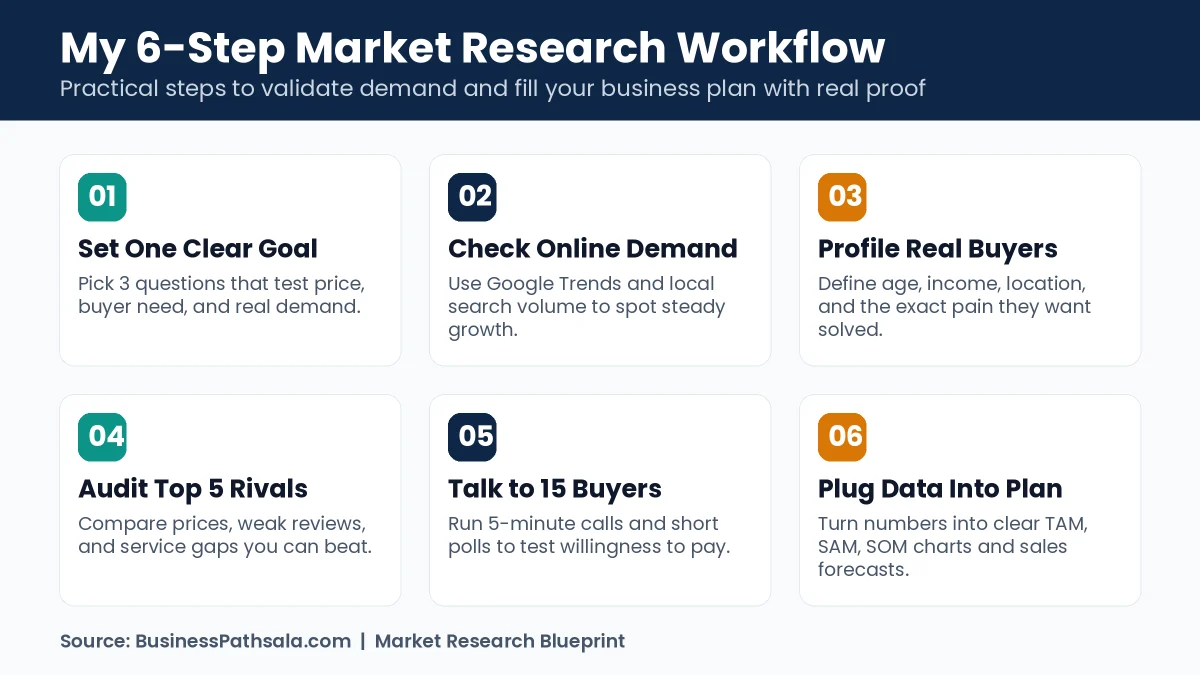
Follow six short steps in order so you collect proof without getting lost. Each step feeds directly into the market section of your step-by-step business plan guide.
Step 1: Set Three Sharp Research Questions
Write down three specific questions before you open a single browser tab. Broad goals like “learn the market” waste hours and produce messy notes.
- Who buys this product at least twice a month right now?
- What exact price makes them hesitate or walk away?
- Which gap in current options annoys them enough to switch?
Step 2: Check Secondary Data and Local Demand
Start with secondary research, which means free data already published by others. The U.S. Small Business Administration suggests pulling public trade and census stats first.
Type your main product into Google Trends and set the range to five years. A flat or rising line proves steady demand instead of a short fad.
Step 3: Build One Real Target Buyer Profile
Describe one real buyer group using age, income, location, and daily habits. Trying to sell to “everyone” kills your budget and weakens your pitch.
Write down the exact trigger that makes this person open their wallet. For example, busy parents buy ready meals at 6 PM after late office shifts.
Step 4: Audit Your Top Five Rivals
List three direct rivals and two indirect rivals serving your exact area. Direct rivals sell the same item, while indirect rivals solve the same need differently.
Read their twenty most recent one-star and three-star reviews on Google Maps. Those complaints hand you your exact edge for your SME marketing strategy.
Step 5: Run Primary Research With 15 Real Buyers
Primary research means gathering fresh answers straight from your own target buyers. I aim for fifteen five-minute chats or fifty short online survey replies.
Ask about past actions instead of future guesses. “How much did you spend last month?” beats “Would you buy this?”
Timing Tip: Offer a small coffee voucher or 10% launch coupon. My survey reply rate jumped from 8% to 34% with one tiny perk.
Step 6: Turn Numbers Into How to Do Market Research for a Business Plan Proof
Convert your notes into three simple sizing numbers: TAM, SAM, and SOM. TAM is the total market, SAM is your reachable area, and SOM is your realistic share.
Banks focus heavily on SOM because it proves your year-one sales math works. If you are preparing a bank loan business plan, show exact local buyer counts and average ticket size.
Shortcuts That Cut My Research Time in Half
Batching similar tasks lets me finish solid research in one focused weekend. You do not need months of study to build a sharp, credible plan.
When I stopped jumping between tabs and worked in timed blocks, my speed doubled. I also use AI business plan tools to sort raw survey notes into clean themes in minutes.
- Copy-paste 50 rival reviews into one doc to spot repeat complaints fast.
- Keep surveys under five questions so busy buyers finish in sixty seconds.
- Record voice notes right after each buyer chat while details stay fresh.
Time-Saver: Never build a custom spreadsheet from scratch. Use one simple four-column sheet: Rival Name, Price, Top Praise, and Top Complaint.
| Step | Time Needed | Key Shortcut |
|---|---|---|
| Demand trend check | 45 minutes | Filter Google Trends by region |
| Top 5 rival audit | 90 minutes | Sort Google reviews by lowest |
| 15 buyer chats | 3 hours | Ask 4 past-habit questions only |
| Market size math | 60 minutes | Multiply local buyers by spend |
Where Things Usually Go Wrong Mid-Process
Most research fails because owners look for praise instead of hard truth. I made that exact mistake twice before learning to spot bias early.
If every person says your idea is “amazing,” your questions are too leading. Reword them so people feel safe telling you why they would not buy.
| Warning Sign | Real Cause | My 2-Minute Fix |
|---|---|---|
| 100% positive feedback | Asking friends or leading questions | Ask strangers about past spend |
| Zero survey replies | Form is way too long | Cut it to 5 quick clicks |
| Wild sales forecasts | Using global TAM not SOM | Base math on local footfall |
| Data feels messy | No clear goal at start | Group notes under 3 questions |
Honesty Check: Always list your sample size in your plan. Lenders trust “42 local buyers surveyed” far more than vague claims.
My Monthly Habit to Keep Research Fresh
Markets shift fast, so I spend thirty minutes each month updating my sheet. A business plan is a living tool, not a folder that gathers dust.
On the first Sunday of each month, I check rival prices and new reviews. That tiny habit spots price drops or new trends months before they hurt sales.
| Check Task | Time Needed | How Often |
|---|---|---|
| Scan top 5 rival reviews | 15 minutes | Once a month |
| Check Google Trends shift | 10 minutes | Once a quarter |
| Chat with 3 recent buyers | 20 minutes | Once a month |
| Update local SOM numbers | 30 minutes | Every 6 months |
FAQs for How to Do Market Research for a Business Plan
How long does market research for a business plan take?
Plan for 5 to 10 focused hours over one week. Spend two hours on free online data and five hours on real buyer interviews.
Can I do market research for a business plan for free?
Yes, you can do it for zero cost using Google Trends, Google Maps reviews, census data, and 15 quick phone calls with buyers.
How many people should I survey for a business plan?
Aim for 15 deep chats or 50 short surveys from real target buyers. Stop asking friends since they rarely give honest feedback.
What is the difference between primary and secondary research?
Primary research is data you collect yourself from calls or polls. Secondary research uses public reports, census stats, and trends.
What market size numbers do lenders expect to see?
Banks want your realistic local share (SOM) more than huge global numbers. Show exact buyer counts, average spend, and local proof.
Start Your First 5-Minute Market Check Today
Learning how to do market research for a business plan is not about complex math. It is about listening closely to real buyers and proving your numbers hold up.
Open Google Maps right now and search for your top three local rivals. Read their ten worst reviews, write down three repeat complaints, and you have already started.