Last updated: · By Afra Monira
Quick answer: Sanchayapatra and Bangladesh Government Treasury Bonds are both government-backed investment instruments, but they suit different needs. Sanchayapatra is a non-tradable savings certificate with scheme-based profit rates and investment limits. Treasury bonds are tradable government securities with auction-determined coupon rates, semiannual payments and a secondary market. For a saver who values a straightforward holding arrangement, Sanchayapatra may be easier to understand. For an investor who may need to sell before maturity or wants to choose among longer tenors, Treasury Bonds deserve a closer look.
This guide compares the two options for individual investors in Bangladesh. It uses the latest information verified for November 2026. Sanchayapatra rates cited below are those retained for July to December 2026. Treasury bond yields change through auctions and market trading, so there is no single rate that applies to every bond or every purchase date.
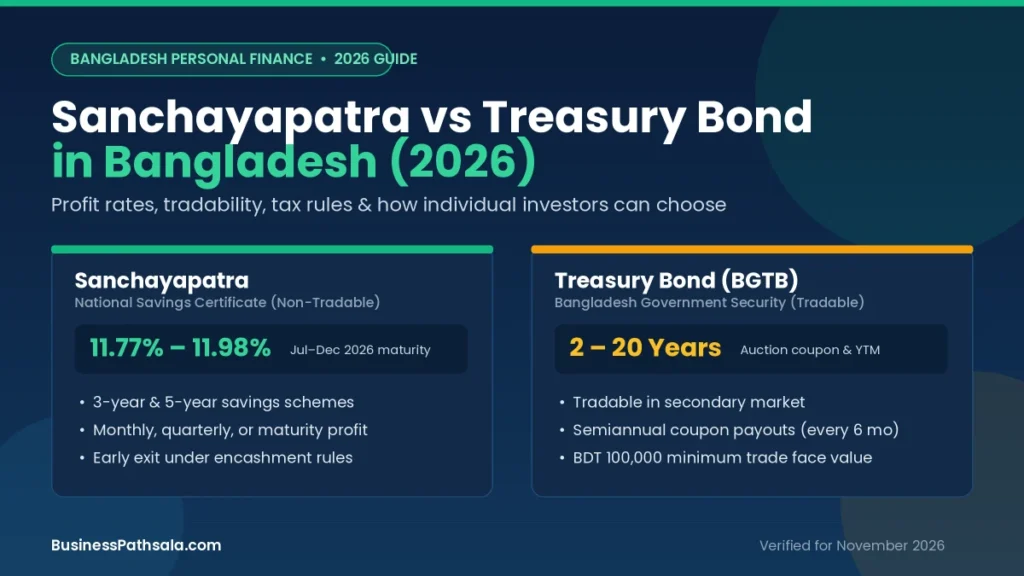
Sanchayapatra vs Treasury Bond in Bangladesh: at a glance
The main difference is how you get your money back before the scheduled maturity date. A Sanchayapatra cannot normally be sold to another investor in the secondary market. You must apply for early encashment under the applicable savings-scheme rules. A Bangladesh Government Treasury Bond (BGTB), on the other hand, can be sold in the secondary market. Its selling price may be higher or lower than the amount you originally paid.
| Feature | Sanchayapatra | Treasury Bond (BGTB) |
|---|---|---|
| Issuer | Government of Bangladesh | Government of Bangladesh |
| Instrument type | National savings certificate | Tradable government security |
| Secondary-market sale | No ordinary secondary-market trading | Yes, through banks, primary dealers and the market infrastructure |
| Return structure | Scheme-based profit rate, subject to the applicable rules | Coupon fixed for the bond; yield and market price depend on auction and market conditions |
| Payment frequency | Depends on the scheme: maturity, monthly or quarterly arrangements may apply | Usually every six months for standard BGTBs |
| Available terms | Common schemes have three- or five-year terms | Common BGTB tenors: 2, 5, 10, 15 and 20 years |
| Minimum investment | Depends on the certificate denomination and scheme | BDT 100,000 face value or multiples of BDT 100,000 in a trade |
| Rate setting | Government-notified savings-scheme rates | Determined through auction; secondary-market yield changes with price |
| Early exit | Encash under scheme rules; the profit rate may be lower | Sell at the prevailing market price; a capital gain or loss is possible |
| Best considered for | Investors who want a savings product with defined scheme rules | Investors who value market tradability, bond tenors and periodic coupon income |
Bangladesh Bank classifies Sanchayapatra as a non-tradable national savings instrument and Treasury Bills and Bangladesh Government Treasury Bonds as tradable government securities. Its government securities FAQ confirms that standard treasury bonds have 2 to 20-year maturities, semiannual coupon payments and secondary-market trading. Bangladesh Bank: Government Securities Market.
What is Sanchayapatra in Bangladesh?
Sanchayapatra is a government savings certificate sold under Bangladesh’s National Savings Scheme. Individuals buy a certificate for a specified term and receive profit according to the scheme and the rules that apply to the purchase. The available schemes include the five-year Bangladesh Sanchayapatra, three-monthly profit-bearing Sanchayapatra, Family Sanchayapatra and Pensioner Sanchayapatra. Eligibility, maximum holding limits and payment arrangements differ by scheme.
People often consider Sanchayapatra when they want to place savings in a government-backed product and can keep the money invested for the required period. The exact choice depends on eligibility and when the investor needs income. A certificate that pays profit periodically may suit someone who wants regular cash flow. A maturity-based certificate may suit a person who can wait until the end of the term.
Sanchayapatra profit rates for July to December 2026
The Ministry of Finance retained the existing national savings rates for July to December 2026. The following figures are the published rates at maturity for the relevant slab. They are annual rates and are not a promise that every investor will receive the same net amount after tax or early encashment.
| Scheme | Total holding up to BDT 750,000 | Total holding above BDT 750,000 |
|---|---|---|
| Five-Year Bangladesh Sanchayapatra | 11.83% | 11.80% |
| Three-Monthly Profit-Bearing Sanchayapatra | 11.82% | 11.77% |
| Family Sanchayapatra | 11.93% | 11.80% |
| Pensioner Sanchayapatra | 11.98% | 11.80% |
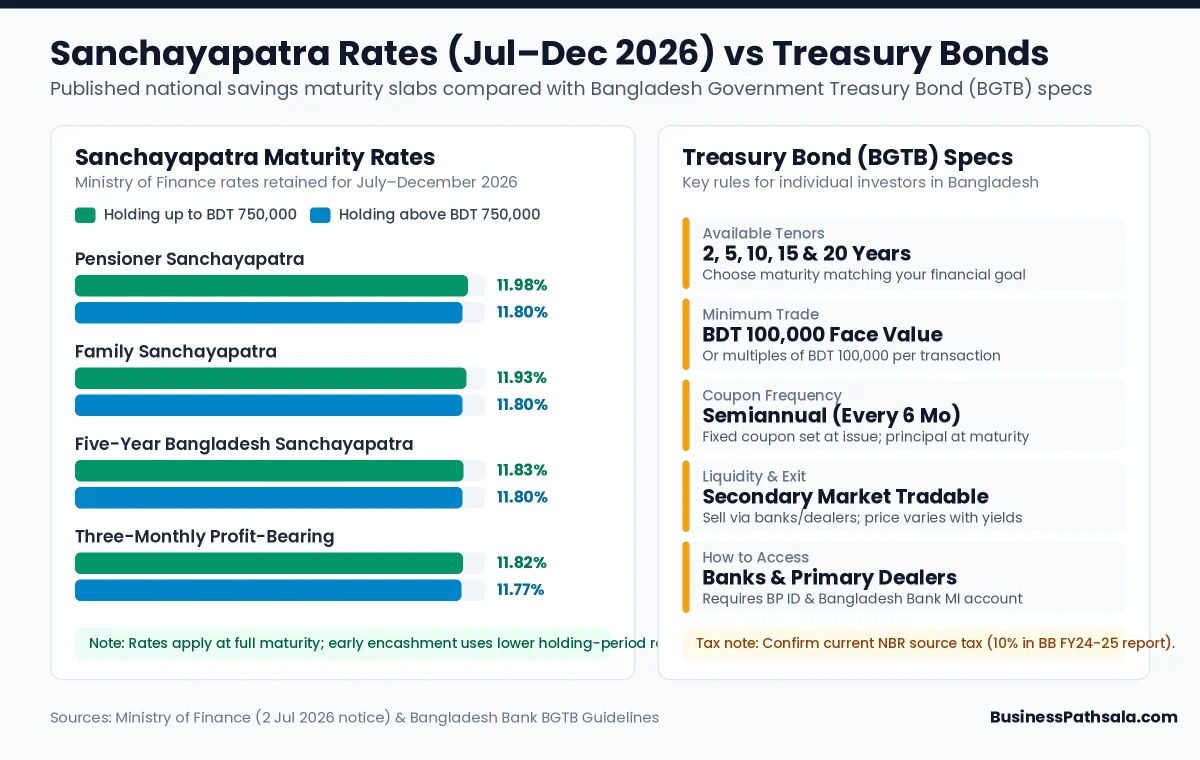
The Ministry’s notice dated 2 July 2026 kept the rates unchanged for the July-December period. The Daily Star reported the same figures from the Finance Ministry notification. Read the National Savings Directorate circular and notification page and the 2 July 2026 rate announcement.
Before buying, confirm which slab applies to your aggregate Sanchayapatra holdings and whether the scheme is available to you. Do not assume that the headline maturity rate is the rate payable if you cash the certificate early. Early encashment uses the applicable holding-period rate and adjustment rules.
Who can buy Sanchayapatra?
Eligibility depends on the certificate. Some schemes are open to adult Bangladeshi citizens who meet the documentation requirements. Family Sanchayapatra and Pensioner Sanchayapatra have specific eligibility conditions. The buyer should check the current official scheme rules before visiting a bank, post office or National Savings office.
Issuing institutions may ask for a National Identity Card, taxpayer identification information, bank account details, photographs and scheme-specific documents. Pensioner applicants may need evidence of retirement benefits. Requirements can change, and the issuing office should confirm the latest checklist.
How do you receive Sanchayapatra profit?
Payment timing depends on the certificate. The three-monthly profit-bearing scheme pays at intervals, while other schemes may provide monthly profit or pay at maturity. The investor should compare the payment schedule with household expenses before choosing a product. The nominal annual profit rate alone does not tell you whether a scheme’s cash flow is convenient.
What is a Bangladesh Government Treasury Bond?
A Bangladesh Government Treasury Bond, commonly called a BGTB or T-bond, is a longer-term government security. When an investor buys one, the investor lends money to the government for the bond’s term. Standard BGTBs currently have tenors of 2, 5, 10, 15 and 20 years. The bond pays a coupon, generally twice a year, and the face value is repaid at maturity.
The coupon rate is set through the issue or auction process and remains fixed for that bond. A bond’s yield for a new buyer can still change because the buyer may purchase it at a price above or below face value in the secondary market. This is why coupon rate and yield to maturity should not be treated as identical figures.
Bangladesh Bank’s Government Securities Market FAQ explains the coupon, maturity and trading features. Its BGTB investment guidelines state that the minimum trade is BDT 100,000 face value or multiples of that amount.
How does a Treasury Bond pay income?
A standard fixed-coupon BGTB pays interest twice each year. For example, a bond with a face value of BDT 500,000 and an annual coupon rate of 10% would have a gross annual coupon of BDT 50,000, normally split into two payments of BDT 25,000. This is an illustration only. It does not represent a current auction rate, and the investor’s net cash received will depend on applicable tax and the bond’s purchase price.
If the investor buys an existing bond at a premium or discount, the effective return can differ from the coupon rate. A secondary-market purchase should therefore be assessed using its price, remaining maturity, coupon dates, accrued interest, transaction costs if any, and yield to maturity.
Can an individual buy Treasury Bonds in Bangladesh?
Yes. Resident individuals can invest in government securities through scheduled banks and primary dealers. Individuals who want to join a primary auction generally submit their bids through a primary dealer. They can also buy or sell BGTBs in the secondary market through participating banks and financial institutions.
The practical first step is to contact your bank’s government securities or investment desk. Ask whether the bank can open or arrange the required Business Partner Identification (BP ID) and securities account in Bangladesh Bank’s Market Infrastructure (MI) Module. Confirm the minimum trade, available bonds, settlement process, coupon dates, tax treatment and any service charges before transferring funds.
Bangladesh Bank provides information about the government securities market, primary and secondary market facilities and its individual-investor FAQ. Only primary dealers can submit bids directly to the auction; individual customers participate through an eligible intermediary.
Five important differences between Sanchayapatra and Treasury Bonds
1. Tradability and access to cash
Sanchayapatra is not listed for normal secondary-market trading. If you need the money before maturity, you have to request encashment under the rules. That may reduce the profit you receive, depending on how long you have held the certificate.
BGTBs can be sold in the secondary market. This gives the investor another way to access cash before maturity. However, the market price changes. If market yields rise after you buy a fixed-coupon bond, its price will generally fall. Selling at that time could mean receiving less than the amount you invested. If market yields fall, the price of an existing bond may rise.
2. Profit rate and yield
Sanchayapatra rates are announced under the national savings rules. The rates shown for July to December 2026 are the published maturity rates for the relevant holding slabs. Treasury bond coupons are set through auction. The yield available to a new investor depends on the bond’s issue terms or secondary-market purchase price.
Comparing a Sanchayapatra maturity rate with a Treasury Bond coupon rate can give a misleading result. A fair comparison should use the expected net return over the same investment period. It should also account for payment timing, purchase price, tax, early exit and reinvestment assumptions.
3. Investment amount and limits
Sanchayapatra schemes have their own investment ceilings and eligibility conditions. The applicable limit can differ between individual schemes and single or joint ownership. Investors should add up their existing holdings before buying more.
The standard BGTB guidelines set a minimum trade of BDT 100,000 face value and multiples of BDT 100,000. This is a minimum trade size, not a statement that every bank has no operational conditions. Ask the intermediary about account, settlement and any customer-level requirements.
4. Payment frequency and cash-flow planning
Sanchayapatra payment frequency depends on the scheme. A three-monthly or monthly payment arrangement may be useful for someone who wants regular income. A maturity-based certificate may suit someone who does not need periodic cash flow.
Standard BGTBs usually pay coupons every six months. The investor receives the coupon on the scheduled dates, while the principal is repaid when the bond matures. If a bond is sold before maturity, the sale proceeds depend on its market price, not simply the face value.
5. Tax and take-home return
Tax is part of the investment calculation. The Bangladesh Government Treasury Bond guidelines refer investors to the current rules issued by the National Board of Revenue. Bangladesh Bank’s FY2024-25 government securities report recorded a change effective from 6 October 2025, stating that source tax on returns from government securities remained 10% for individual investors under the then applicable amendment. Tax laws and administrative treatment can change, so investors should confirm the rate and the final tax liability with their bank or tax adviser before investing.
The Income Tax Act and amendments should be checked for the tax treatment of the specific security and payment. Do not apply a tax rate from an old article or a different type of government instrument to your own transaction. The net amount received may also depend on the investor’s tax status and documentation.
Useful official references include the National Board of Revenue and the Bangladesh Bank Government Securities Report, FY2024-25. Obtain transaction-specific confirmation before calculating after-tax returns.
Which investment may suit different types of investors?
The right choice depends on the purpose of the money, the amount available and the investor’s ability to hold the investment. The following examples are decision guides, not personal financial advice.
You have a smaller amount and want a simple savings product
Check whether an eligible Sanchayapatra scheme accepts your amount and whether you meet its requirements. Compare the applicable rate, profit-payment schedule, holding ceiling and early-encashment terms. If the BDT 100,000 BGTB minimum trade is too large for your available funds, a suitable savings certificate may be easier to access.
You want to receive income every six months
A standard BGTB may fit this payment schedule because it normally pays coupons semiannually. Compare the next coupon date and the bond’s price before buying. Some Sanchayapatra schemes also pay income periodically, so compare their actual schedule with your cash-flow needs.
You may need to sell before maturity
A Treasury Bond offers a secondary-market exit route. That route is useful, but it does not guarantee that you will recover your original investment amount. A rise in market yields can reduce the price of an existing fixed-coupon bond. Keep an emergency fund separate so that you are less likely to sell during an unfavourable market period.
You are planning for a known future expense
Match the investment term with the date when you expect to use the money. For an expense due in a few years, locking the entire amount into a 15- or 20-year bond may be inconvenient. A shorter bond tenor or a suitable savings scheme may be easier to align with the goal. Review what happens if your plans change.
You have reached a Sanchayapatra holding limit
Check the current scheme ceiling and your aggregate holdings. If you have additional funds to invest, a BGTB may be one government-security option to investigate. Its minimum trade and market price risk still apply. Other options, including Treasury Bills or government investment Sukuk, may also be relevant depending on tenor, cash flow and investment preferences.
Illustrative return comparison: how to compare the numbers
Suppose an investor has BDT 500,000. A five-year Bangladesh Sanchayapatra purchased in the July-December 2026 rate period may have a published maturity rate of 11.83% for the first holding slab or 11.80% for the higher slab. The investor should check the applicable slab, eligibility, tax and actual maturity calculation before using those figures in a plan.
Now consider a hypothetical five-year Treasury Bond with a 10% annual coupon and a face value of BDT 500,000. It would pay BDT 50,000 gross coupon income per year, usually as two BDT 25,000 payments. This example is only for understanding the payment mechanics. It is not a current market quote or an offer to invest.
The two examples cannot be compared by subtracting 10% from 11.83%. Sanchayapatra profit is tied to its scheme rules and holding period. A BGTB’s coupon is paid on face value, while the buyer’s yield depends on the price paid and remaining term. Taxes, reinvestment of coupon payments and exit price also affect the final outcome.
A practical checklist before you invest
- Write down the date when you may need the money.
- Keep emergency cash outside long-term investments.
- Check your Sanchayapatra eligibility and total holding against the applicable ceiling.
- For a BGTB, ask for the exact bond identification, face value, clean price, accrued interest, yield to maturity and next coupon date.
- Confirm current tax deductions and any bank or intermediary charges.
- Ask how an early Sanchayapatra encashment is calculated or how a Treasury Bond sale is settled.
- Keep purchase confirmations, tax certificates and payment records.
- Verify current terms with the official issuer or your bank before sending money.
Risks you should understand
Both products carry the credit backing of the Government of Bangladesh, but that does not remove every investment risk. Inflation can reduce the purchasing power of the returns. Tax rules can affect the amount received. The investor may also face reinvestment risk when periodic payments are received and need to be invested again at a different rate.
Treasury Bonds have market-price risk before maturity. If interest rates rise, prices of existing fixed-coupon bonds generally decline. A buyer who sells before maturity may receive less than the original purchase cost. Longer-maturity bonds are usually more sensitive to changes in market yields than shorter-maturity bonds, all else being equal.
Sanchayapatra has a different early-exit trade-off. Since it is not normally sold through a secondary market, the investor must follow the government’s encashment rules. The applicable profit rate may be lower when cashed before full term. This can matter when the investor has an uncertain cash requirement.
Investors should also consider inflation, concentration risk and whether all available funds are being placed into one product. A government-backed instrument may form part of a conservative portfolio, but the investment term should still match the investor’s needs.
How to buy a Treasury Bond in Bangladesh: step by step
Individual investors generally use a scheduled bank or primary dealer to access BGTBs. The process can vary by institution, so ask the bank for its latest forms and service requirements.
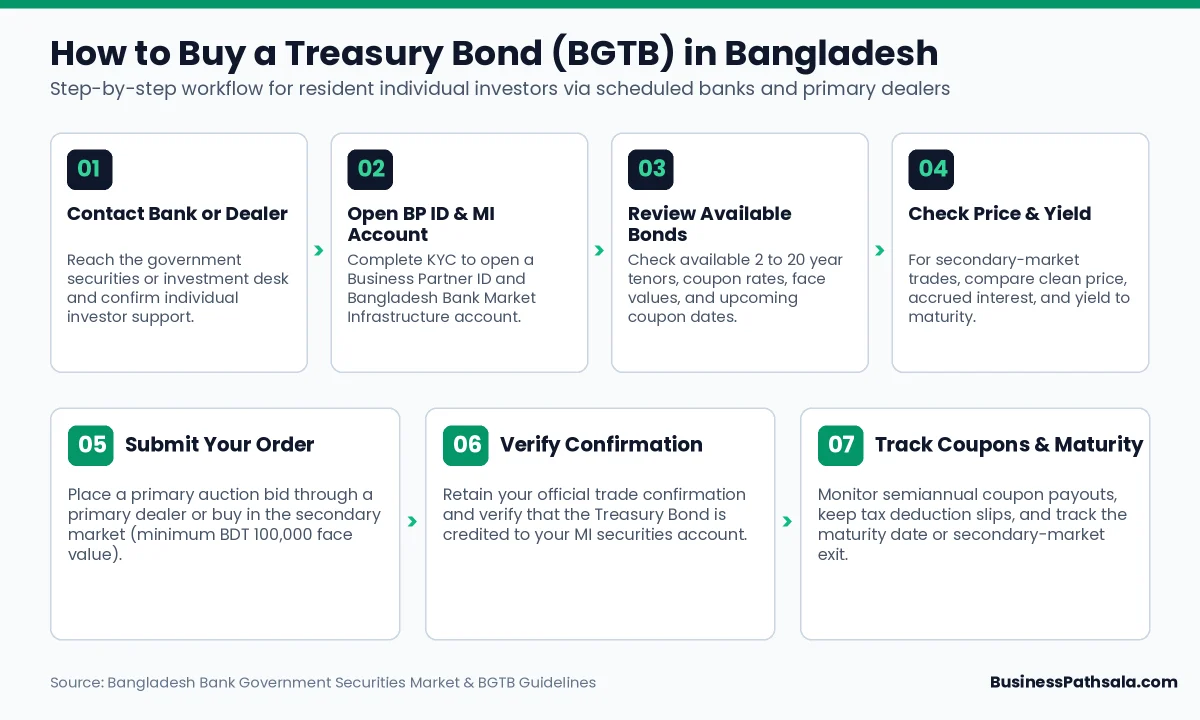
- Contact a participating bank or primary dealer. Ask for the government securities or investment desk and confirm that it serves individual investors.
- Ask about account setup. Confirm the requirements for a BP ID and securities account in Bangladesh Bank’s Market Infrastructure system.
- Review available bonds. Ask for the tenor, coupon rate, face value, issue or maturity date, next coupon date and auction or secondary-market availability.
- Compare the price and yield. For a secondary-market purchase, request the clean price, accrued interest and yield to maturity. Make sure you understand the total settlement amount.
- Submit the order through the bank or dealer. For auction participation, an individual submits a bid through a primary dealer. The order is subject to auction allocation.
- Check the confirmation. Retain the trade confirmation and verify that the security is credited to the relevant account.
- Track coupon payments and maturity. Keep records of coupon receipts, tax deductions and any later sale.
Bangladesh Bank publishes information on government securities, auction notices and market activity. You can also read its brief investment guidelines for BGTBs before contacting a bank.
Frequently asked questions
Is Sanchayapatra safer than Treasury Bonds?
Both are obligations of the Government of Bangladesh. Their main differences for an individual investor concern tradability, payment design, eligibility, investment limits and early exit. A Treasury Bond can lose market value if sold before maturity. Sanchayapatra follows its early-encashment rules and cannot normally be sold in the secondary market.
Can I sell a Treasury Bond before maturity?
Yes. Bangladesh Government Treasury Bonds are tradable in the secondary market through participating banks, financial institutions and other approved market channels. The selling price depends on market conditions and may be below or above the purchase cost.
Can I sell Sanchayapatra to another person?
Sanchayapatra is a non-tradable savings instrument. An investor who needs the money early must apply for encashment under the applicable scheme rules. It is not normally transferred by selling it to another retail investor in a secondary market.
What is the minimum investment in a Bangladesh Treasury Bond?
Bangladesh Bank’s BGTB guideline sets the minimum trade at BDT 100,000 face value or multiples of BDT 100,000. Ask the bank about its operational requirements and whether it has any additional customer-level conditions.
How often does a Treasury Bond pay interest?
Standard Bangladesh Government Treasury Bonds normally pay coupons every six months. The principal is repaid at maturity. Check the exact coupon dates and terms for the bond you are considering.
What are the Sanchayapatra rates in Bangladesh in 2026?
For July to December 2026, the published maturity rates include 11.83% for the five-year Bangladesh Sanchayapatra in the up-to-BDT 750,000 slab and 11.80% above that slab. Other scheme rates differ. The government retained the rates for the second half of 2026. Confirm the applicable scheme, holding slab and early-encashment rules before investing.
Do Treasury Bonds have a fixed interest rate?
A standard fixed-coupon Treasury Bond has a coupon rate set at issue and paid according to its terms. However, the market price and yield available to someone buying or selling the bond later can change. Coupon rate and yield to maturity are different measures.
Can an ordinary person buy government bonds in Bangladesh?
Yes. Resident individuals can invest through scheduled banks and primary dealers. Individuals generally participate in primary auctions through a primary dealer and can also buy or sell securities in the secondary market through participating institutions.
Which is better for monthly income?
It depends on the payment schedule. Some Sanchayapatra schemes offer monthly or quarterly payments, while standard Treasury Bonds generally pay every six months. Compare the specific scheme or bond’s payment dates and net cash flow with your expenses.
Final thoughts
For a Bangladesh investor, Sanchayapatra may be worth considering when scheme eligibility, a published profit structure and a defined savings term match the plan. Treasury Bonds may suit investors who want semiannual coupon income, a choice of longer maturities or the option to sell in the secondary market. That sale option comes with market-price risk.
Before deciding, compare the net return over the same period, payment dates, tax, investment limits and likely early-exit outcome. Ask a participating bank or the National Savings Directorate to confirm current terms. Rates and tax rules can change, and an investment decision should be based on the terms that apply on the purchase date.
Financial information disclaimer: This article is for general educational purposes. It is not personal investment, tax or legal advice. Product availability, rates, eligibility, tax treatment and procedures may change. Verify the current rules with Bangladesh Bank, the National Savings Directorate, the National Board of Revenue or your participating bank before investing.