Last updated: · By Afra Monira
Quick answer: For a Bangladeshi saver choosing where to invest money safely in 2026–2027, the right option depends on when the money may be needed, the amount available, the return after tax, and the risk the investor can accept. A bank FDR is usually easier to open and can suit short- or medium-term savings. Sanchayapatra offers government-set profit rates but has eligibility, investment-limit and early-encashment rules. Bangladesh Government Treasury Bills and Bonds are government securities; they can be tradable, but bond prices can fall before maturity when market yields rise.
This guide compares the three main choices for people in Bangladesh. It uses official information available on 24 November 2026. Rates and rules for 2027 may change, so check the latest notice or bank schedule before investing. No fixed return should be assumed for an investment that has not yet been issued.
Where should you invest money safely in Bangladesh in 2026–2027?
There is no single safest product for every saver. If you may need the money within a few months, keep an accessible emergency reserve and compare short-term FDRs or Treasury Bills. If you can leave a lump sum invested for three to five years and meet the eligibility rules, compare Sanchayapatra with the net return on an FDR. If you have at least Tk 1 lakh, understand bond pricing and want a marketable government security, consider a Treasury Bill or Bangladesh Government Treasury Bond through a participating bank or Primary Dealer.
FDR vs Sanchayapatra vs Treasury Bonds: comparison at a glance
| Feature | Bank FDR | Sanchayapatra | Treasury Bill / Bond |
|---|---|---|---|
| Who issues it? | A bank | Government of Bangladesh | Government of Bangladesh |
| Return | Bank-declared rate for the selected term and amount | Government-notified scheme rate | Discount yield for T-Bills; coupon and market yield for bonds |
| Typical term | Bank-specific, from short terms to several years | Common schemes run for 3 or 5 years | T-Bills: 91, 182 or 364 days; BGTBs: 2, 5, 10, 15 or 20 years |
| Early access | Premature encashment under bank terms, often with reduced interest | Early encashment under scheme rules; lower holding-period profit may apply | Can sell tradable securities, but the market price may be below purchase cost |
| Minimum amount | Set by each bank and product | Depends on scheme and denomination | Bangladesh Bank states Tk 100,000 face value or multiples for BGTB trades |
| Main risk to consider | Bank credit risk, concentration and early-withdrawal terms | Policy changes for new purchases, eligibility and liquidity restrictions | Market-price risk before maturity and access through an intermediary |
| May suit | Savers who want a bank deposit and a defined term | Eligible savers who can follow scheme rules and hold to the planned date | Investors who understand government securities and may need market sale options |
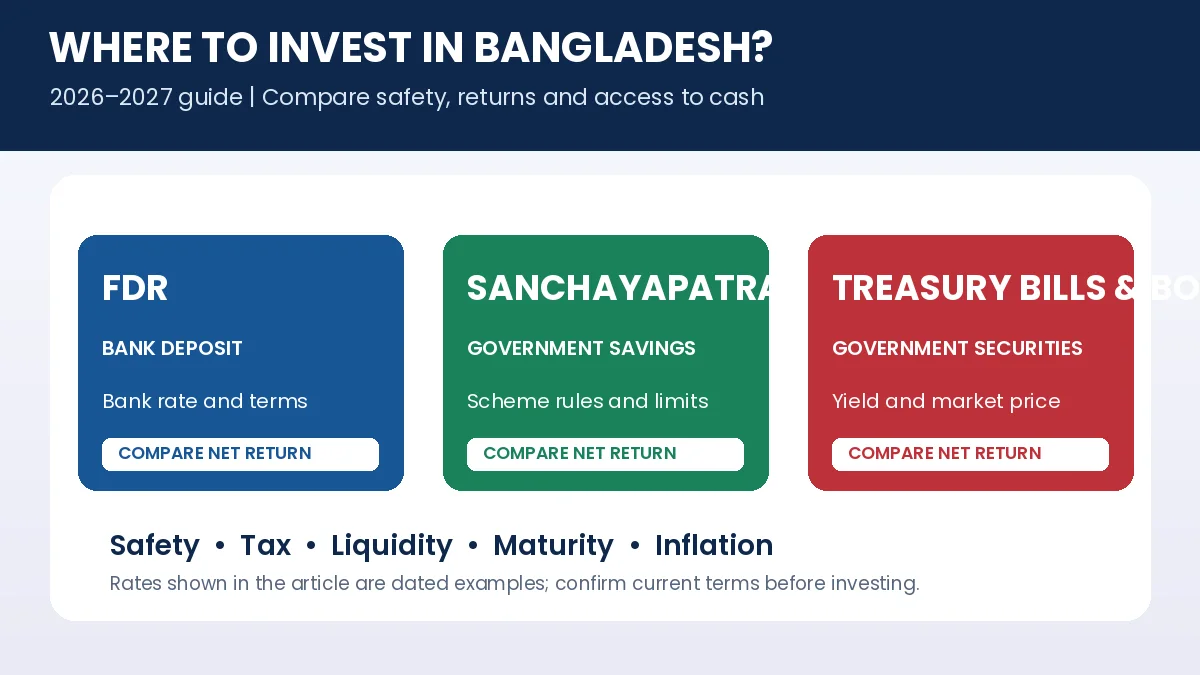
Bangladesh Bank classifies Treasury Bills, Bangladesh Government Treasury Bonds (BGTBs) and Bangladesh Government Investment Sukuk as government securities. The central bank says individuals can invest through participating banks and Primary Dealers. Its FAQ lists 91-, 182- and 364-day Treasury Bills and 2- to 20-year Treasury Bonds. See the Bangladesh Bank Government Securities Market and Government Securities Market FAQ.
1. Bank FDR in Bangladesh: how safe is a fixed deposit?
A Fixed Deposit Receipt (FDR), also called a fixed deposit or term deposit, is a bank deposit kept for an agreed period. You place a lump sum with a bank. The bank pays interest or profit according to the product terms, usually at maturity or at agreed intervals. The rate can depend on the deposit amount, term, customer category and whether the product is conventional or Islamic.
How much interest can an FDR pay in 2026?
FDR rates are bank-specific and can change during the year. As one dated example, National Bank PLC published a deposit-rate schedule effective 1 October 2026 showing 8.25% per year for FDRs of one year and above for deposits up to Tk 10 lakh, with higher slabs for larger deposits. This is one bank’s published schedule, not an average or a promise that the same rate is available at every branch today. Check the bank’s latest deposit rate schedule and compare at least two or three regulated banks before placing a large deposit.
Ask the bank to confirm the gross rate, effective annual yield, interest-payment frequency, tax deducted at source, excise duty or other applicable charges, and the amount you will receive at maturity. If the bank quotes a special rate, ask whether it applies to the full term or can change before renewal.
Advantages of an FDR
- It is widely available through scheduled bank branches and, at some banks, digital channels.
- You can choose a term that is closer to the date when you expect to use the money.
- Minimum deposits and product choices vary, so an FDR may be accessible when a government security’s minimum trade size is too high.
- The bank gives you written terms showing the maturity date and applicable rate.
FDR risks and checks before opening one
An FDR is a claim against the bank that accepts the deposit. The bank’s financial condition therefore matters. Do not select a bank only because it advertises a higher rate. Review the bank’s current financial disclosures, credit rating where available, regulatory notices, service record and ability to meet withdrawals. Avoid concentrating all household savings in one institution.
Bangladesh Bank’s Financial Stability Report 2025, released in 2026, says the Deposit Protection Act 2026 increased deposit protection coverage to Tk 200,000 per depositor per institution. This is a limited protection ceiling, not a guarantee that every taka in a large FDR will be repaid immediately if a bank fails. Check the current law and the bank’s status before relying on deposit protection. Read the Bangladesh Bank Financial Stability Report 2025.
Also read the premature encashment clause. Some banks reduce the interest rate if you close the FDR before maturity. Others may pay no interest for a very short holding period or apply a different rate. Ask for the exact calculation in writing before you sign.
2. Sanchayapatra: government savings certificates
Sanchayapatra is a national savings certificate issued under government savings schemes. The government sets the profit rules and each scheme has its own term, eligible investors, investment ceiling and payment schedule. Common options include the five-year Bangladesh Sanchayapatra, three-monthly profit-bearing Sanchayapatra, Family Sanchayapatra and Pensioner Sanchayapatra.
Sanchayapatra profit rates for July–December 2026
The published five-year Bangladesh Sanchayapatra schedule shows maturity rates of 11.83% for aggregate holdings up to Tk 750,000 and 11.80% above that slab. The rate increases according to the period held if the certificate is encashed before maturity. The official scheme page also states that excess profit already paid may be adjusted against principal when a certificate is encashed early. These rates are the published schedule for the current period; they should not be treated as confirmed 2027 rates.
For the five-year certificate, the official schedule lists 9.74% after one year, 10.21% after two years, 10.72% after three years, 11.26% after four years and 11.83% at maturity for holdings up to Tk 750,000. The corresponding second-slab figures are 9.72%, 10.19%, 10.70%, 11.23% and 11.80%. See the official Five-Year Bangladesh Savings Certificate information.
Who can buy Sanchayapatra?
Eligibility depends on the scheme. Some certificates are available to Bangladeshi citizens generally, while Family and Pensioner schemes have specific conditions. Individual investment ceilings and combined holding limits apply. Before applying, check your existing certificates across issuing institutions and confirm the current limit under your NID and the scheme you want to buy.
Issuing offices may ask for a National Identity Card, bank-account information, nominee details, photographs, tax information and scheme-specific evidence. Requirements can change. Ask the National Savings office or participating bank for its current checklist instead of relying on an old social-media post.
Is Sanchayapatra risk-free?
Sanchayapatra is a government obligation, so its credit backing differs from a commercial bank FDR. It still has practical risks. The investor may need to wait for maturity, early encashment can reduce profit, rules and rates for new purchases can change, and inflation can reduce the purchasing power of the final amount. Eligibility and holding ceilings may also prevent an investor from placing the full amount in a preferred scheme.
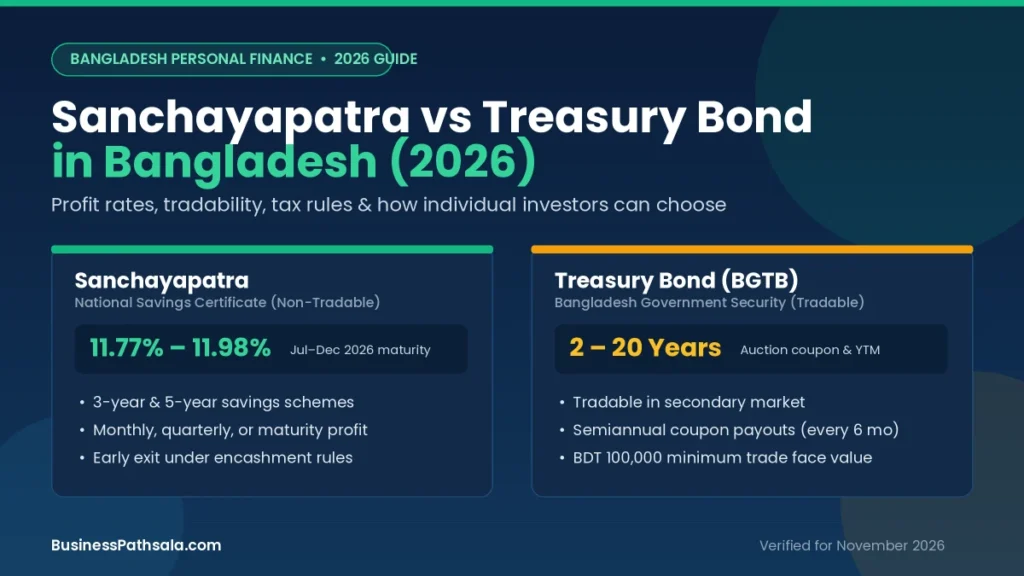
For a deeper comparison of the two government-backed products, read BusinessPathsala’s Sanchayapatra vs Treasury Bond in Bangladesh. For tax-return and purchase-document questions, see Sanchayapatra Without Tax Return Rules 2026.
3. Treasury Bills and Treasury Bonds in Bangladesh
Treasury Bills and Bangladesh Government Treasury Bonds are government securities managed through Bangladesh Bank. Treasury Bills are short-term instruments with 91-, 182- and 364-day maturities. They are generally issued at a discount and redeemed at face value at maturity. Treasury Bonds are longer-term instruments with 2-, 5-, 10-, 15- and 20-year maturities. Standard fixed-coupon bonds pay coupons every six months and repay principal at maturity.
Can an individual invest in Treasury Bonds?
Yes. Individuals can participate through a scheduled bank or Primary Dealer. Bangladesh Bank’s FAQ says individuals can submit bids through Primary Dealers and can also buy or sell government securities in the secondary market through participating institutions. Its published information states a minimum auction bid of Tk 100,000 or multiples of Tk 100,000. Ask your bank whether it can arrange the required Business Partner Identification (BP ID), securities account and settlement process.
Start by contacting the bank’s treasury or government-securities desk. Ask which T-Bills or BGTBs are available, whether the transaction is in the primary or secondary market, the price, yield to maturity, coupon dates, accrued interest, fees, tax deduction and settlement date. For a secondary-market bond, ask for the yield to maturity based on the actual purchase price. A coupon rate by itself does not tell you the return you will earn.
How Treasury Bond price risk works
A fixed-coupon bond’s market price usually moves in the opposite direction to market yields. If market yields rise, an older bond paying a lower coupon becomes less attractive, so its price may fall. If market yields fall, the older bond’s fixed coupon may look more attractive and its price may rise. An investor who holds the bond to maturity and receives all scheduled payments faces a different outcome from someone who sells early. A sale before maturity can produce a capital gain or loss.
Bangladesh Bank says Treasury Bills and Bonds are tradable in the secondary market. Tradability gives a route to sell, but it does not guarantee that a buyer will pay the original purchase price or that a sale will settle instantly at a price you prefer. Ask the intermediary about actual market depth and quoted prices.
See BusinessPathsala’s separate guide to Treasury Bond Interest Rate in Bangladesh 2026 for a focused explanation of yields and tenors.
Which is safer: FDR, Sanchayapatra or Treasury Bonds?
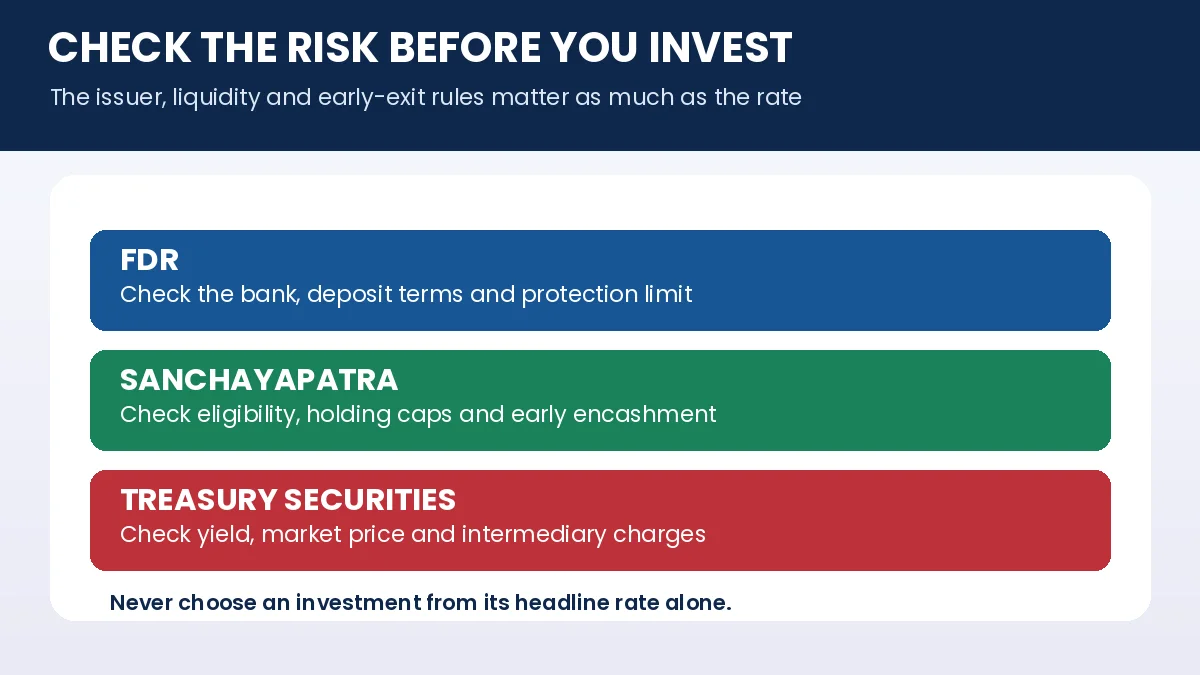
Each product has a different risk source. Sanchayapatra and Treasury securities are obligations of the Government of Bangladesh. An FDR is an obligation of the bank where the deposit is placed and is subject to the bank’s ability to repay. A Treasury Bond can be sold before maturity, but the market price may be lower than the investor’s cost. A Sanchayapatra may have a published rate, but early encashment can reduce the profit and the certificate is not normally traded in a secondary market.
For bank deposits, remember that deposit protection has a statutory limit. Bangladesh Bank’s Financial Stability Report 2025 describes coverage of up to Tk 200,000 per depositor per institution under the Deposit Protection Act 2026. This ceiling is much smaller than the savings of many households. It is sensible to assess the bank itself and spread large deposits where appropriate, while considering account ownership and the legal protection rules.
How to compare actual returns after tax
Compare the amount you expect to receive after tax and charges, over the same time period. Do not compare a five-year Sanchayapatra maturity rate with a one-year FDR rate as if they were identical products. Compare the term, payment timing, reinvestment assumptions and early-exit rules.
Use this simple framework:
- Start with the amount you invest.
- Calculate gross interest or profit using the actual product terms.
- Subtract applicable source tax and known fees or duties.
- Include any reduction for early withdrawal or the market price if you sell a bond.
- Compare the final cash flow with the same period for the other products.
- Consider inflation: a positive nominal return may still mean a lower increase in purchasing power.
Tax treatment can differ by instrument and investor status. The National Board of Revenue publishes tax laws, amendments and guidance. Ask the bank or issuing office for the current source-tax deduction applicable to your transaction, and consult a qualified tax practitioner if the amount is material. Do not copy a tax percentage from an old article or assume that source tax is always the final tax liability. Official starting point: National Board of Revenue.
Where to invest Tk 1 lakh, Tk 5 lakh or Tk 10 lakh?
The amount available changes which products are practical. The examples below are decision frameworks, not instructions to buy a specific security. Confirm current minimums, eligibility and rates before acting.
If you have Tk 1 lakh
First decide whether this is your emergency reserve. If it is, keep it accessible rather than locking it away for years. If you already have a separate emergency fund, compare short-term FDRs and available Treasury Bills. A BGTB trade may start at Tk 100,000 face value, but the actual purchase amount and settlement details must be confirmed with the bank. Sanchayapatra may be an option if the chosen scheme accepts your amount and you meet its conditions.
If you have Tk 5 lakh
Keep a portion accessible for planned expenses. For the balance, compare an FDR term that matches your likely use date with an eligible Sanchayapatra scheme. If you are considering a Treasury Bond, understand the minimum trade and how the price could move before maturity. Do not invest the full Tk 5 lakh in one product if you may need a large part of it quickly.
If you have Tk 10 lakh or more
Consider splitting the money by time horizon and institution. You could keep an emergency reserve in a readily accessible account, place near-term funds in staggered FDR maturities or short Treasury Bills, and allocate longer-term money to a suitable Sanchayapatra or Treasury Bond after checking the rules. Review Sanchayapatra aggregate limits and tax-return requirements before buying. Large FDR balances also make bank selection and the Tk 200,000 deposit-protection ceiling more relevant.
A practical investment allocation method for 2026–2027
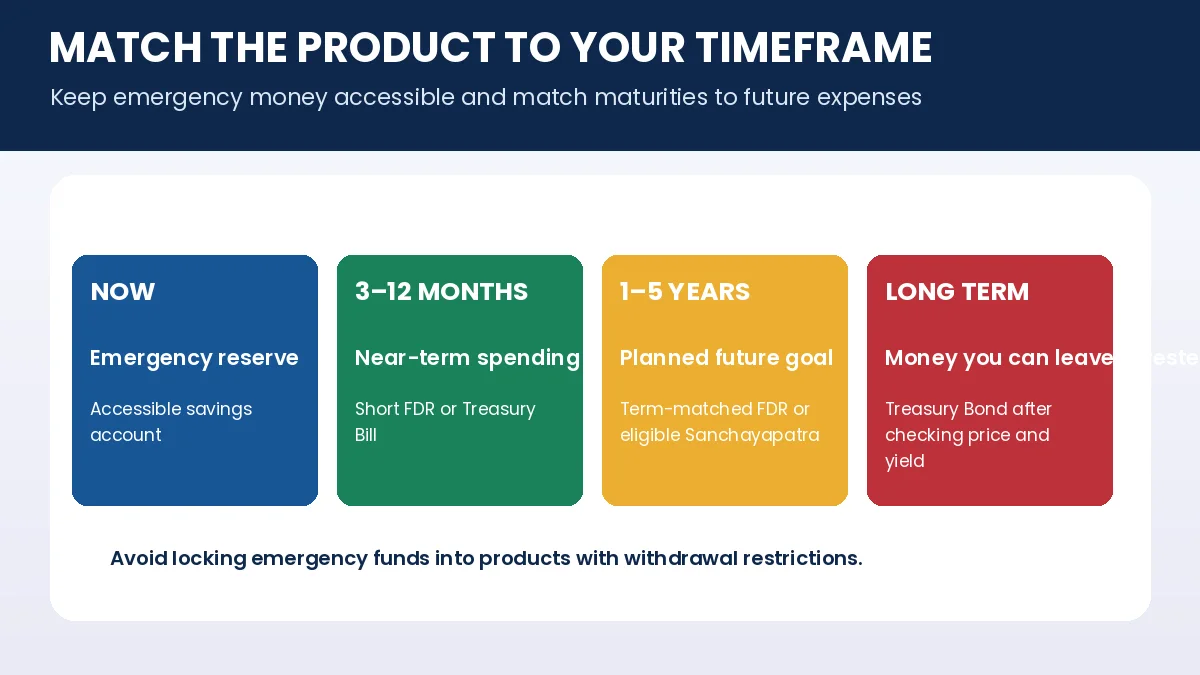
Instead of choosing a product first, divide your savings by the date you may need them. This reduces the chance of selling a long-term investment at a bad time.
| Money purpose | Possible place to keep it | What to check |
|---|---|---|
| Emergency expenses | Accessible bank savings or short notice deposit | Immediate access, bank condition, fees |
| Need within 3–12 months | Short FDR or Treasury Bill | Maturity date, early withdrawal, net yield |
| Need in 1–3 years | FDR ladder or suitable short government securities | Renewal rates, market price if sold early |
| Can hold for 3–5 years | Eligible Sanchayapatra or term-matched FDR | Eligibility, holding limits, tax, early encashment |
| Long-term fixed-income allocation | Suitable Treasury Bond | Yield to maturity, coupon, price risk, maturity |
An FDR ladder means dividing a lump sum into several deposits with different maturity dates. For example, rather than placing all available money into one two-year FDR, an investor could use several smaller deposits with staggered maturities if the bank’s minimums allow it. This can create periodic access to cash and reduce the need to close the entire deposit early. The exact structure should match the household’s expected expenses.
Common mistakes to avoid when investing in Bangladesh
- Chasing the highest rate: Check the institution, product conditions and net return before choosing.
- Ignoring early withdrawal rules: A high maturity rate may be less useful if you need the money next year.
- Confusing coupon with yield: A Treasury Bond’s coupon is not necessarily the yield earned by a buyer who pays a premium or discount.
- Putting all savings in one bank: Review concentration risk and the limited deposit-protection ceiling.
- Ignoring tax: Compare after-tax cash flows, not only gross rates.
- Locking away emergency money: Keep funds for medical, family and urgent expenses accessible.
- Trusting unofficial investment offers: Avoid schemes promising guaranteed unusually high returns or asking you to send money to personal accounts.
- Using old rates for a new purchase: Confirm the current notice, bank schedule or auction result on the day you invest.
How to check an investment before paying
For an FDR, obtain the bank’s official rate sheet and written deposit terms. Confirm the bank account name, deposit receipt, maturity date, renewal instruction and premature encashment calculation. Use the bank’s official branch or digital channel.
For Sanchayapatra, confirm the exact scheme, eligibility, current rate, aggregate holding limit, required documents, nominee rules, payment frequency and tax deduction with an authorized issuing office. Keep the purchase receipt and verify that the certificate appears correctly in the official system.
For a Treasury Bill or Bond, deal through a scheduled bank or Primary Dealer. Ask for the security’s identification, maturity date, face value, purchase price, yield calculation, coupon schedule, tax and transaction costs. Keep the transaction confirmation and payment record. Bangladesh Bank’s BGTB investment guidelines provide further details for investors.
Frequently asked questions
Which is better in Bangladesh, FDR or Sanchayapatra?
An FDR may suit someone who wants a bank deposit with a term that matches a near-term goal. Sanchayapatra may suit an eligible investor who can follow the scheme rules and hold the certificate for the planned period. Compare current after-tax returns, early-withdrawal terms and the strength of the bank before deciding.
Are Treasury Bonds safe for individual investors in Bangladesh?
Bangladesh Government Treasury Bonds are obligations of the Government of Bangladesh. Their main risk for an investor who sells before maturity is market-price risk: the sale price can be lower than the purchase price. Investors should understand yield to maturity, coupon dates and the secondary market before buying.
Can I buy Treasury Bonds with Tk 1 lakh?
Bangladesh Bank’s published FAQ states a minimum auction bid of Tk 100,000 or multiples of Tk 100,000. Individual investors normally participate through a Primary Dealer or scheduled bank. Confirm the current transaction process and any operational requirements with the bank.
What is the current Sanchayapatra rate for 2027?
A 2027 rate should not be assumed until the government issues the relevant notification. The rates discussed in this article are the published July–December 2026 schedule. Check the Department of National Savings or Ministry of Finance for any new notice before purchasing in 2027.
Can I withdraw an FDR before maturity?
Many banks allow premature encashment, but the interest rate may be reduced and some conditions may apply. Ask for a written calculation of the amount payable if you close the FDR on a specific date.
Can I sell a Treasury Bond before maturity?
Bangladesh Bank says Treasury Bills and Bonds are tradable in the secondary market. The price depends on market conditions. You may receive more or less than your original purchase amount, so check the available bid price and estimated proceeds before selling.
How much of my bank deposit is protected in Bangladesh?
Bangladesh Bank’s Financial Stability Report 2025 describes coverage of up to Tk 200,000 per depositor per institution under the Deposit Protection Act 2026. Read the current law and official guidance for the scope, eligibility and claim process. Do not assume a large FDR is fully insured.
Should I invest all my savings in one product?
Usually it is better to match products to different cash-flow needs. Keep emergency money accessible, use short maturities for near-term expenses and consider longer-term products only for money you can leave invested. Diversification across terms and institutions can reduce concentration and liquidity problems.
Final verdict: choosing a safe investment in Bangladesh for 2026–2027
Choose an FDR when you want a bank deposit with a term and maturity date that fit your plans, after checking the bank and its early-withdrawal terms. Consider Sanchayapatra when you qualify for the scheme, understand the investment ceiling and can accept the holding rules. Consider Treasury Bills or Bonds when you want government securities and understand how auction yields, bond prices and secondary-market sales work.
Before investing, write down when you may need the money, compare the net return for that same period, and keep emergency savings outside long-term products. Recheck official rates and tax rules in 2027 because the 2026 schedules do not guarantee future terms.
Financial information disclaimer: This article is for general educational purposes and is not individualized investment, tax or legal advice. Rates, taxes, eligibility, deposit-protection rules and product terms may change. Verify details with Bangladesh Bank, the Department of National Savings, the National Board of Revenue and the relevant bank or Primary Dealer before making a financial decision.