Last updated: · By Afra Monira
Latest update: 23 November 2026. The latest standard-tenor figures displayed in Bangladesh Bank’s Treasury Bond auction table are 8.55% for 2-year bonds, 8.22% for 5-year bonds, 9.32% for 10-year bonds, and 9.38% for both 15-year and 20-year bonds. These figures are market yields, not a promise that every investor buying a bond today will receive that exact return. The yield on a specific bond depends on its coupon, purchase price, remaining maturity and market conditions.
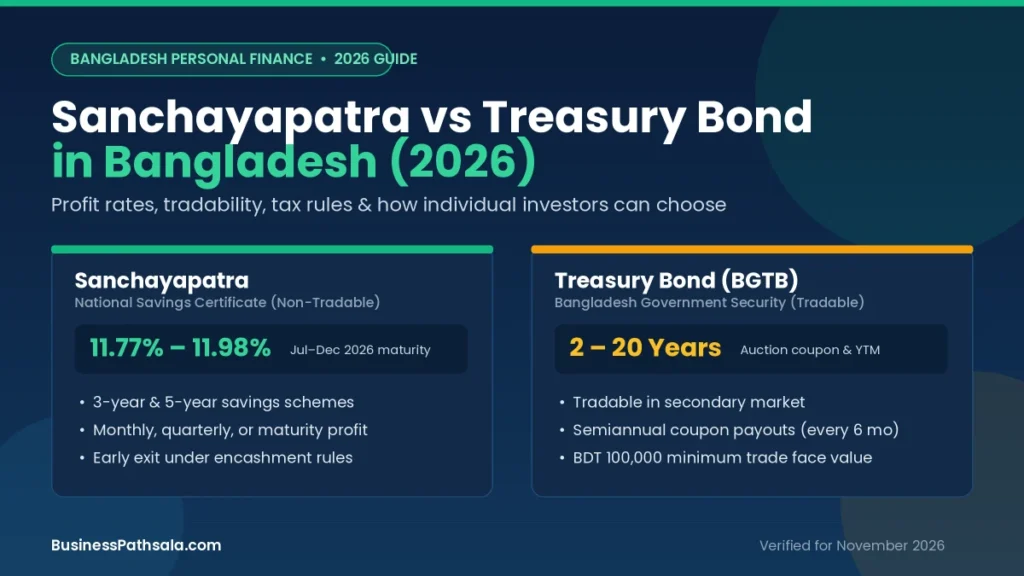
Bangladesh Government Treasury Bonds (BGTBs) are long-term government securities. They pay coupon income on scheduled dates and can be traded before maturity through the secondary market. This guide explains the latest Treasury Bond interest rates in Bangladesh in 2026, the difference between coupon and yield, how individuals can invest, and what to check before buying.
Bangladesh Treasury Bond interest rates in 2026
Bangladesh Bank’s standard-tenor yield table dated 18 November 2026 reports the following rates for government Treasury Bonds. The table uses standard maturities, so the figures are comparable reference yields rather than the coupon rate printed on every existing bond.
| Bond tenor | Standard tenor yield | Bangladesh Bank reference date |
|---|---|---|
| 2 years | 8.55% | 18 November 2026 |
| 5 years | 8.22% | 18 November 2026 |
| 10 years | 9.32% | 18 November 2026 |
| 15 years | 9.38% | 18 November 2026 |
| 20 years | 9.38% | 18 November 2026 |
Source: Bangladesh Bank Treasury Bill/Bond Auctions and Standard Tenor Yield. The latest figures shown on that page when this article was checked were dated 18 November 2026. Check the page again before placing an order because auction results and market yields change.
The latest table also shows the underlying auction records. The 15-year bond re-issue held on 17 November 2026 had a coupon rate of 8.55%, a cut-off yield of 9.33% and a weighted-average yield of 9.21%. The bond had about 10.61 years remaining to maturity. That is a useful example of why coupon rate, cut-off yield and weighted-average yield must be read as different figures.
What do the latest Treasury Bond rates mean?
A Treasury Bond yield is the return implied by the bond’s price, coupon payments and time remaining until maturity, assuming the relevant cash flows are paid as scheduled and the investor holds the bond to maturity. The quoted yield is a useful comparison measure. It is not necessarily the cash coupon rate paid every six months.
The figures above show that the 15-year and 20-year standard yields were both 9.38% on 18 November 2026. The 10-year standard yield was 9.32%, while the 2-year and 5-year yields were lower at 8.55% and 8.22%. This is the shape of the published yield curve on that date. It should not be read as a forecast of future interest rates.
Treasury Bond coupon rate vs cut-off yield vs market yield
Investors often use the words interest rate, coupon rate and yield as if they mean the same thing. They do not. Understanding the distinction helps avoid overestimating the income from a bond or misunderstanding a bank’s quoted rate.
Coupon rate
The coupon rate is the fixed annual rate applied to the bond’s face value. For a standard fixed-coupon bond, the rate stays the same during the bond’s life. The coupon is normally paid in two instalments each year. If a bond has a BDT 100,000 face value and a 9% annual coupon, its gross coupon income is BDT 9,000 a year, normally paid as two BDT 4,500 payments.
Cut-off yield
At an auction, participants submit bids according to the auction rules. The cut-off yield is the yield at which the accepted allocation is determined. The accepted bids can have different prices and yields, so the cut-off yield and weighted-average yield may not be identical.
Yield to maturity
Yield to maturity (YTM) estimates the annualised return from buying a bond at a particular price and holding it until it matures, taking account of coupon payments and the redemption amount. A buyer in the secondary market should pay attention to YTM rather than simply copying the coupon rate shown in the bond description.
Secondary-market yield
When market yields rise, the price of an existing fixed-coupon bond generally falls. When market yields fall, its price generally rises. As a result, two people holding the same bond can have different investment returns if they bought it at different prices. A person who sells before maturity may receive more or less than the purchase cost.
How much income can a Treasury Bond pay?
Coupon income is calculated on the face value, not automatically on the amount a buyer pays in the secondary market. Consider a hypothetical bond with a face value of BDT 500,000 and a coupon rate of 9% a year. Its gross annual coupon is BDT 45,000, normally split into two payments of BDT 22,500.
| Illustrative item | Amount |
|---|---|
| Bond face value | BDT 500,000 |
| Assumed annual coupon rate | 9.00% |
| Gross coupon per year | BDT 45,000 |
| Gross coupon per half-year | BDT 22,500 |
This is a calculation example only. It is not a current bond offer or a statement that a new investor can obtain a 9% coupon. The coupon rate for an actual security must be checked in the issue or re-issue notice. Tax and the bond’s purchase price affect the investor’s net return.
What Treasury Bond maturities are available in Bangladesh?
Bangladesh Bank lists 2-year, 5-year, 10-year, 15-year and 20-year Bangladesh Government Treasury Bonds. The government can also re-issue an existing bond. In a re-issue, the security keeps its original maturity date and coupon terms, so its remaining maturity can be shorter than the bond’s original tenor.
For example, an auction described as a 15-year Treasury Bond may be a re-issue of a bond that has about 10.6 years left. Read the remaining-maturity field and the ISIN carefully. Do not assume that every re-issued 15-year bond gives a new 15-year investment period.
Can an individual invest in Treasury Bonds in Bangladesh?
Yes. Bangladesh Bank says resident individuals can buy government securities through primary dealers or scheduled banks in an auction. Individuals can also buy and sell government securities in the secondary market through primary dealers, banks and non-bank financial institutions.
To participate in an auction, an individual generally works through an eligible bank or primary dealer. The institution arranges the investor’s Business Partner Identification (BP ID) and the necessary access to Bangladesh Bank’s Market Infrastructure (MI) Module. Ask the bank which documents it requires and whether it accepts individual customers for the issue you want.
Minimum investment amount
Bangladesh Bank’s government securities FAQ states that the minimum bid amount for Treasury Bills and Treasury Bonds is BDT 100,000 and multiples of BDT 100,000. This is the face-value bidding denomination. A secondary-market transaction can have a settlement amount that differs from face value because the bond may trade at a premium or discount and accrued interest may be included.
Documents and account arrangements
Document requirements vary by bank. Before visiting, ask the investment desk for its current checklist. It may ask for identity documents, tax information, bank-account details and forms for the securities account or BP ID. Confirm whether the bank charges a service fee and how it will send trade confirmations and coupon payments.
How to buy Bangladesh Treasury Bonds
- Contact a scheduled bank or primary dealer. Ask for the government securities or treasury desk and confirm that individual investors can use the service.
- Set up the required investor records. Ask the institution to arrange the BP ID and access to the Bangladesh Bank Market Infrastructure system.
- Choose the bond. Check the ISIN, coupon, issue date, maturity date, remaining maturity and next coupon date.
- Ask for a full price quotation. For a secondary-market purchase, request the clean price, accrued interest, settlement amount and yield to maturity.
- Submit the order through the institution. Primary auction participation is routed through an eligible primary dealer or bank.
- Check the confirmation. Retain the transaction confirmation and verify that the security is credited to the relevant account.
- Track coupon and maturity dates. Keep the payment records and tax certificates. Review the bond’s market value if you may sell before maturity.
Official guidance is available on the Bangladesh Bank Government Securities Market page and its Government Securities Market FAQ.
How is Treasury Bond interest taxed in Bangladesh?
Tax can change the amount credited to an investor. Section 106 of the published English text of the Income Tax Act, 2023 states that the person responsible for issuing government securities or other securities approved by the Government or Bangladesh Securities and Exchange Commission shall deduct tax at source at 5% on discount, interest or profit when payment is made or credited, whichever occurs earlier.
However, an investor should not treat a short article or a bank’s general product page as a substitute for checking the rules that apply on the actual payment date. The tax law can be amended, and other provisions may affect the amount deducted in particular circumstances. Before investing, ask the bank to confirm the current withholding rate, any applicable higher-rate condition, and how the deduction will be documented for your tax return.
Official reference: National Board of Revenue — Income Tax Act, 2023 (Authentic English Text). See section 106, and check the NBR’s current Finance Acts and amendments.
Are Treasury Bonds risk-free?
Treasury Bonds are obligations of the Government of Bangladesh, so they have sovereign credit backing. That does not mean every investor is guaranteed to earn a fixed return on every purchase price or that the bond’s value cannot fall before maturity.
Market-price risk
A bond sold before maturity may trade below its purchase price. This can happen when market yields rise or when the bond’s price changes for other market reasons. Longer-maturity bonds are generally more sensitive to yield changes than shorter bonds with similar features.
Inflation and reinvestment risk
Inflation reduces the purchasing power of future coupon and principal payments. There is also reinvestment risk: when a coupon is received, the investor may not be able to reinvest it at the same rate.
Liquidity and transaction costs
Treasury Bonds are tradable, but the price and ease of sale depend on the available market and the intermediary. Ask how the bank handles a sale order, how it quotes prices and what charges apply. Do not assume that a sale will always happen immediately at face value.
How to compare two Treasury Bonds before investing
Do not choose a bond only because the coupon rate looks high. Compare the cash you will pay, cash flows you will receive and the date you expect to exit. For a secondary-market bond, ask the bank for these details:
- ISIN and exact maturity date.
- Coupon rate and next coupon payment date.
- Clean price and accrued interest.
- Total settlement amount.
- Yield to maturity and the calculation basis.
- Remaining maturity and any early-sale arrangements.
- Applicable tax deduction and transaction charges.
Compare bonds over the same holding period. A 20-year bond and a 2-year bond do not carry the same market-price risk, even when their quoted yields are close. A higher yield may compensate an investor for a longer commitment or greater exposure to market-rate changes.
Treasury Bond interest rate vs Treasury Bill rate
Treasury Bills and Treasury Bonds are both government securities, but they have different maturities and payment structures. Treasury Bills are short-term instruments, commonly issued for 91, 182 and 364 days. They are sold at a discount and redeemed at face value at maturity. Treasury Bonds have maturities of more than one year and pay coupon income under their terms.
Do not use a Treasury Bill discount yield as if it were a Treasury Bond coupon. The return calculation and payment timing are different. Bangladesh Bank publishes auction information for both instruments on its Treasury page.
Where to check the latest Treasury Bond rates
The Bangladesh Bank Treasury page is the primary source for auction records and standard-tenor yields. Look for the issue date, ISIN, remaining maturity, coupon rate where provided, cut-off yield, weighted-average yield and standard-tenor yield. These fields answer different questions.
Bangladesh Bank also publishes monthly economic indicators. Its October 2026 update reported monthly weighted-average BGTB yields of 8.21% for 2 years, 8.34% for 5 years, 9.18% for 10 years, 9.32% for 15 years and 9.31% for 20 years. These monthly averages differ from the later 18 November standard-tenor auction/yield table because the period and measure are different. Do not combine the two tables as if they were recorded at the same time.
For a current quote, check the Bangladesh Bank Treasury auction page and ask a participating bank or primary dealer for the specific bond’s price and yield. A bank quotation is more useful for an actual purchase than a general tenor rate alone.
Frequently asked questions
What is the Treasury Bond interest rate in Bangladesh in 2026?
Bangladesh Bank’s standard-tenor yields dated 18 November 2026 were 8.55% for 2 years, 8.22% for 5 years, 9.32% for 10 years and 9.38% for 15 and 20 years. These are reference yields, not guaranteed returns for every investor or the coupon rates of every bond.
What is the highest Treasury Bond yield in Bangladesh in the latest table?
The highest standard-tenor yield in Bangladesh Bank’s 18 November 2026 table was 9.38%, shown for both 15-year and 20-year bonds.
What is the minimum amount to buy a Treasury Bond in Bangladesh?
Bangladesh Bank states a minimum bid of BDT 100,000 and multiples of BDT 100,000 for government securities. Ask the bank for the amount payable in a specific secondary-market trade because price and accrued interest can change the settlement amount.
Do Treasury Bonds pay interest every month?
Standard Bangladesh Government Treasury Bonds generally pay coupon income every six months. Check the payment dates for the specific security before buying.
Can I sell a Treasury Bond before maturity?
Yes. BGTBs are tradable in the secondary market through banks and other eligible intermediaries. The selling price may be above or below the amount you paid, so an early sale can result in a capital gain or loss.
Is the coupon rate the same as the yield?
No. The coupon rate is applied to the bond’s face value. Yield takes account of price, coupon cash flows and maturity. A bond bought above or below face value can have a yield that differs from its coupon rate.
Can a salaried person buy Bangladesh Government Treasury Bonds?
Yes. Resident individuals can invest through scheduled banks and primary dealers, subject to the applicable account and transaction requirements. Contact a participating bank’s government securities desk for the current process.
Where can I see official Bangladesh Treasury Bond auction results?
Bangladesh Bank publishes Treasury Bill and Bond auction information on its official Treasury page. Its government securities FAQ explains individual-investor access and the secondary market.
Final points for investors
The latest Bangladesh Bank standard-tenor figures available on 18 November 2026 range from 8.22% for 5-year bonds to 9.38% for 15-year and 20-year bonds. Before buying, identify the exact security and compare its coupon, price, remaining maturity, yield to maturity, tax and transaction costs. The right bond depends on when you may need the money and how much market-price movement you can accept.
Financial information disclaimer: This article is for general educational purposes and is not personal investment, tax or legal advice. Treasury Bond yields, auction schedules, tax rules and bank procedures can change. Verify all current terms with Bangladesh Bank, the National Board of Revenue and your participating bank before investing.
Related reading: Sanchayapatra vs Treasury Bond in Bangladesh for a comparison of the two government-backed investment options.