Last updated: · By Afra Monira
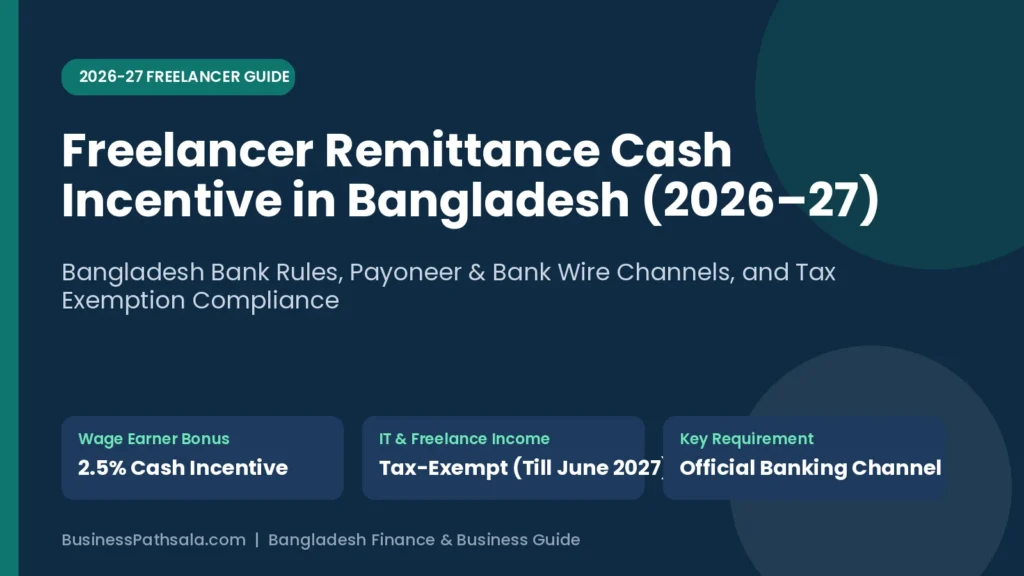
The freelancer remittance cash incentive in Bangladesh is widely misunderstood by remote workers and IT service providers. In short, the 2.5% cash incentive funded by the Bangladesh government applies strictly to inward wage-earner remittances sent by Bangladeshi nationals working abroad, and it excludes commercial business proceeds and individual IT freelancing income. Instead of the 2.5% wage-earner bonus, Bangladeshi freelancers receive a much larger financial benefit under the Finance Act 2026: full income tax exemption on verified freelancing and content creation earnings, alongside IT and IT-enabled services (ITES) relief running through June 30, 2027, when funds arrive through official banking channels.
Confusion around this rule often leads new freelancers to expect an automatic 2.5% top-up on Payoneer, Wise, or Upwork withdrawals, or worse, to use informal transfer channels when no bonus appears. Using informal channels is an expensive mistake because it voids your income tax exemption and exposes your earnings to standard income tax rates. This guide explains how Bangladesh Bank and National Board of Revenue (NBR) rules actually treat freelance remittances in 2026 and 2027, which payout channels keep you compliant, and how registered software exporters access separate export subsidies.
Does the 2.5% Freelancer Remittance Cash Incentive in Bangladesh Apply to You?
No, an individual freelancer living in Bangladesh and working remotely for foreign clients does not qualify for the 2.5% inward wage-earner cash incentive. The Bangladesh government introduced the remittance bonus at 2% in 2019 and raised it to 2.5% in January 2022 to encourage expatriate workers abroad to send family support through licensed banks and mobile financial services rather than informal hundi networks.
According to Bangladesh remittance incentive eligibility rules and Wise’s guide to BDT transfers, the 2.5% bonus is paid to the recipient of a wage-earner transfer from a Bangladeshi citizen employed overseas. Exclusions explicitly cover commercial export proceeds and individual IT freelancing income. Even if your FY 2026-27 national budget kept the 2.5% rate intact for migrant workers, banks filter incoming wire and wallet settlements by purpose code before crediting any government bonus.
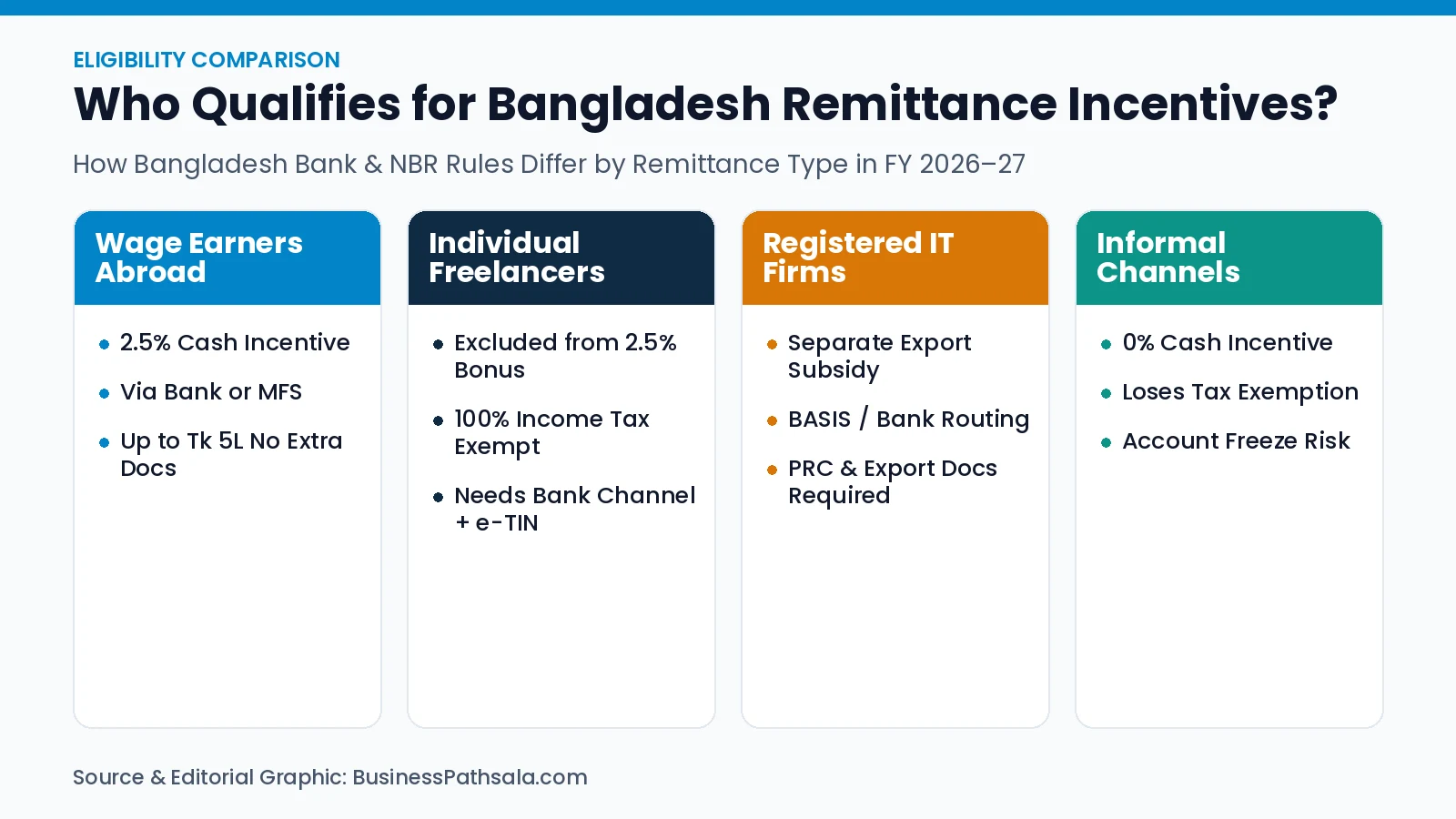
Wage-Earner Bonus vs. Freelancer Tax Exemption vs. IT Export Subsidy
Three separate policies get mixed together in online discussions about the freelancer remittance cash incentive in Bangladesh. Separating them clearly helps you see which benefit applies to your work and how much money you actually save.
| Program Name | Who Qualifies | Benefit Rate | Governing Authority | Key Condition |
|---|---|---|---|---|
| Wage-Earner Remittance Cash Incentive | Bangladeshi nationals working abroad sending money home | 2.5% cash bonus on BDT value | Bangladesh Bank | Must use licensed banks, MTOs, or approved MFS |
| Freelancing & ITES Income Tax Exemption | Resident freelancers, content creators, and ITES providers | 0% income tax (full exemption) | National Board of Revenue (NBR) | Official banking channel plus annual e-Return filing |
| IT / Software Export Cash Subsidy | Registered IT/ITES export companies (often BASIS members) | Subject to periodic FEPD circulars | Bangladesh Bank (FEPD) | Formal export documentation, PRC, and bank routing |
When you compare a 2.5% cash bonus against a full income tax exemption, the tax exemption is worth far more to a mid-to-high-earning freelancer. A Bangladeshi taxpayer earning Tk 15 lakh per year in regular taxable income can face marginal tax slabs up to 20% or 25%. Keeping 100% of your qualifying freelance income tax-free saves several times more than a 2.5% remittance top-up would pay.
Why Some Freelancers Think They Received the 2.5% Bonus
Occasionally, a freelancer withdraws USD through a mobile wallet or local bank partner and sees a higher BDT figure than expected. That extra amount usually comes from one of two sources, neither of which is the government’s wage-earner cash incentive for freelancing.
First, several commercial banks and mobile financial services (MFS) providers run temporary promotional campaigns or offer slightly higher interbank USD conversion rates for inward remittances routed through specific partner networks like Payoneer or Remitly. Second, if a transfer arrives through an aggregator coded as a personal family remittance rather than a commercial B2B service payment, an automated system may briefly apply the 2.5% tag. Relying on misclassified purpose codes is risky because Bangladesh Bank audits and bank compliance checks look for a Proceed Realisation Certificate (PRC) showing freelance service export.
What Freelancers Actually Get in 2026-27: Tax Exemption Rules
Under the Finance Act 2026 and the NBR Income Tax Guide 2026-2027, income earned from freelancing and content creation qualifies for income tax exemption, while the Sixth Schedule exemption for listed IT and IT-enabled services (ITES) runs from July 1, 2024 through June 30, 2027. Services supplied by freelancers are also exempt from Value Added Tax (VAT), and exported services are zero-rated.
To keep that exemption valid, you must satisfy two non-negotiable conditions:
- All freelance earnings, business expenses, and related investments must pass through official banking channels or authorized payment platforms permitted by Bangladesh Bank.
- You must register for an e-TIN and file an annual online return via the NBR e-Return portal declaring your exempt income.
If you skip filing your return or accept payouts through unrecorded peer-to-peer crypto trades or informal cash brokers, the NBR can disqualify your exemption and tax the funds as income from other sources. If you need help preparing your annual filing, follow our walkthrough on income tax return online in Bangladesh.
How to Receive Freelance Remittances Safely in Bangladesh
Choosing the right payout channel protects your tax-exempt status, reduces conversion spread, and gives you bank-verifiable proof of income for loans, visas, and credit cards. Freelancers in Bangladesh typically rely on three compliant routes.
Direct Bank Wire (SWIFT) and ERQ Accounts
Receiving USD directly from overseas clients or agencies into a Bangladeshi commercial bank via SWIFT is the cleanest paper trail available. Your bank issues a Proceed Realisation Certificate (PRC) for each inward remittance, which serves as official proof for NBR tax exemption and bank financing. High-earning freelancers can also open an Exporters’ Retention Quota (ERQ) account at an authorized dealer bank to hold a portion of their foreign currency earnings in USD for legitimate business expenses such as cloud hosting, software subscriptions, or international ad spend.
Payoneer and Licensed Payment Platforms
Marketplaces such as Upwork and Fiverr integrate directly with Payoneer, which settles funds into Bangladeshi bank accounts and bKash wallets through local banking partners. Keep your marketplace withdrawal receipts and bank credit statements together so you can show the full chain from client invoice to local BDT deposit. If Payoneer’s 2% to 3% withdrawal and FX fees cut too deeply into your margins, compare lower-cost options in our review of Payoneer alternatives in Bangladesh.
Dual Currency Cards for Dollar Spending
Once your freelance dollars land in a compliant bank account, you can fund international software tools, domain renewals, and client travel through an endorsed dual-currency debit or credit card. Holding a valid Freelancer ID Card in Bangladesh also helps banks verify your freelance profession when you request higher card limits or ERQ facilities. You can compare bank fees and endorsement rules in our guide to the best dual currency cards in Bangladesh for freelancers.
Separate Export Cash Subsidies for Registered IT Companies
While individual freelancers do not receive the 2.5% wage-earner bonus, Bangladesh Bank periodically issues export subsidy circulars through its Foreign Exchange Policy Department (FEPD) for registered IT, software, and ITES exporting firms. You can check the latest active notices on the Bangladesh Bank circular archive.
To claim an IT export cash subsidy as a business entity, a company generally needs formal business registration (trade license or RJSC incorporation), membership in an approved industry body such as BASIS or BACCO, audited export proceeds backed by bank PRCs, and an application submitted through its authorized dealer bank within the prescribed window. Solo freelancers working under personal bank accounts without a registered export firm do not qualify for corporate export subsidies.
5-Step Compliance Checklist for Bangladeshi Freelancers
Following a consistent banking and tax workflow ensures your foreign remittances stay 100% legal and trouble-free as your income grows.
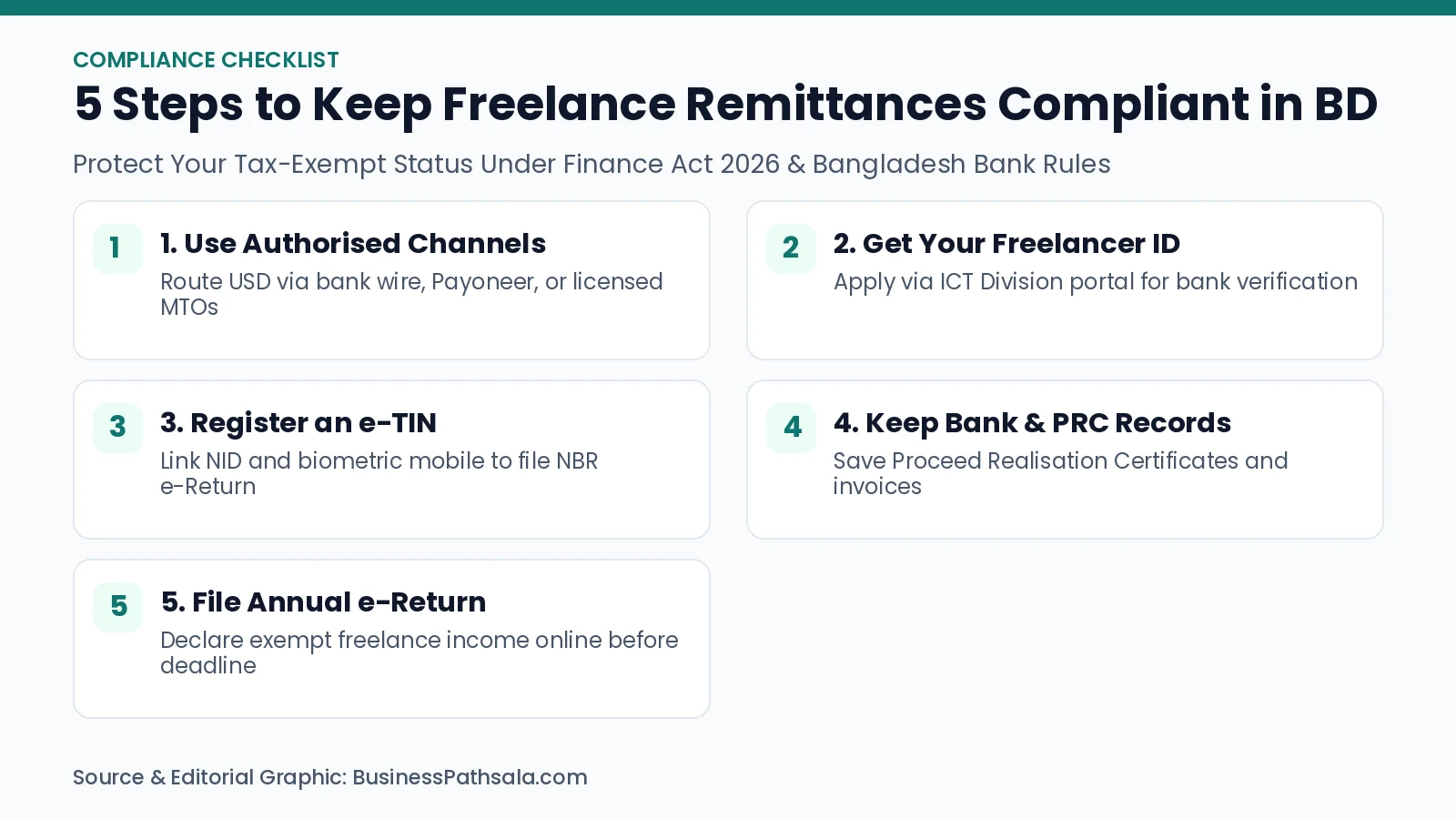
- Route every foreign payment through an authorized dealer bank or a permitted payment platform such as Payoneer, Wise, or bank SWIFT wire.
- Apply for your official Freelancer ID Card through the ICT Division portal so banks and financial institutions can verify your freelance status quickly.
- Register an e-TIN online using your National ID and a biometric-registered mobile number.
- Download and archive your monthly bank statements, client invoices, and Proceed Realisation Certificates (PRCs) in a dedicated cloud folder.
- File your annual NBR e-Return on time and declare your exempt freelance and ITES earnings accurately under the appropriate schedule.
If you are still building your remote income streams or looking for reliable client platforms, explore our broader guide on how to earn money online in Bangladesh.
To minimize conversion losses on every withdrawal, see our detailed cost breakdown comparing Wise vs Payoneer vs bank wire transfer fee in Bangladesh.
Frequently Asked Questions (FAQs)
Do freelancers in Bangladesh get the 2.5% cash incentive on Payoneer withdrawals?
No. Bangladesh Bank’s 2.5% cash incentive applies to wage-earner remittances sent by Bangladeshi citizens employed abroad. Individual IT freelancers living in Bangladesh are excluded from the 2.5% wage-earner bonus, though they benefit from income tax exemption on qualifying bank-routed earnings.
Are Bangladeshi freelancers required to pay income tax on foreign remittances in 2026-27?
Under the Finance Act 2026, income from freelancing and content creation is exempt from income tax, and the IT/ITES exemption runs through June 30, 2027, provided all earnings arrive through official banking channels and you file an annual online return with the NBR.
Can I get an export cash subsidy as a solo freelancer without a company?
No. Formal IT and software export subsidies administered through Bangladesh Bank FEPD circulars are designed for registered exporting companies with industry association membership and audited bank PRCs, not unregistered solo freelancers.
What happens if I receive freelance payments through informal channels like hundi?
Receiving earnings outside official banking channels violates foreign exchange rules, forfeits your NBR tax exemption, and can result in those funds being taxed as unexplained income from other sources.
What documents do I need to prove my freelance remittance is tax-exempt?
Keep your bank statements showing inward foreign remittances, Proceed Realisation Certificates (PRCs) from your bank, marketplace payout receipts (such as Upwork or Fiverr statements), client invoices, and your annual NBR e-Return acknowledgment slip.