Last updated: · By Afra Monira
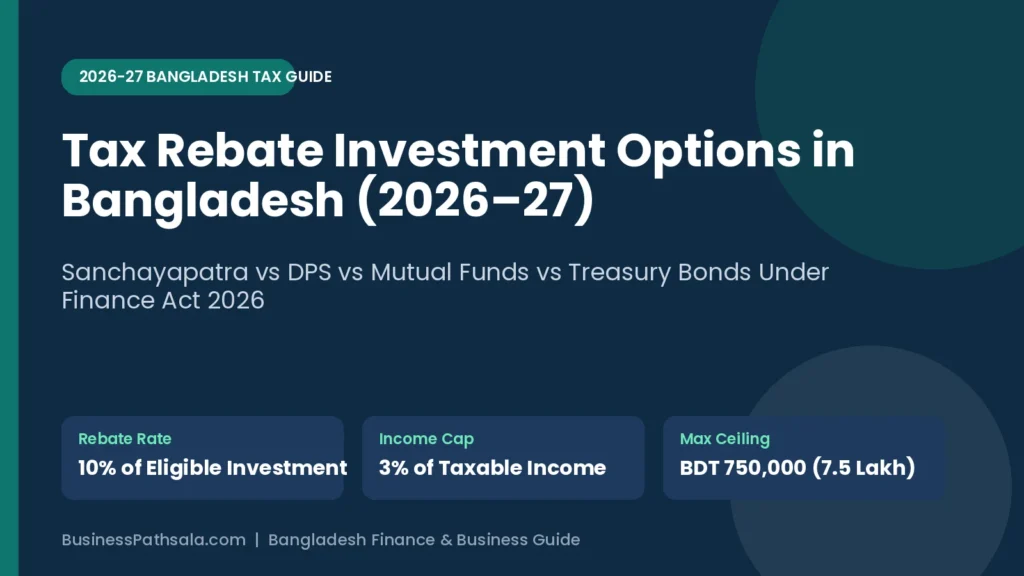
Tax rebate investment options in Bangladesh let resident taxpayers reduce their final income tax bill taka-for-taka by investing in government-approved instruments listed under Part 3 of the Sixth Schedule of the Income Tax Act, 2023. Under the Finance Act 2026 rules for Assessment Year 2026–27, your maximum investment tax rebate is the lowest of 10% of eligible investments, 3% of total taxable income, or BDT 750,000 (Tk 7.5 lakh).
Choosing the right combination of Sanchayapatra, Treasury Bonds, Bank Deposit Pension Schemes (DPS), BSEC-approved mutual funds, listed shares, and life insurance can legally cut your annual tax payable by tens of thousands of taka. However, not every popular savings product qualifies—Fixed Deposit Receipts (FDRs), for example, earn zero tax rebate, and withdrawing certain investments before maturity triggers a full rebate clawback.
This guide breaks down every eligible tax rebate investment option in Bangladesh, compares their annual caps and lock-in rules, walks through real calculation examples for salaried and business taxpayers, and shows you how to claim your rebate cleanly in NBR e-Return.
How the Investment Tax Rebate Works in Bangladesh (2026–27 Rules)
An investment tax rebate is a direct credit subtracted from your calculated gross income tax, not a deduction from your taxable income. If your gross tax liability is Tk 80,000 and you qualify for a Tk 25,000 investment rebate, your net payable tax drops directly to Tk 55,000.
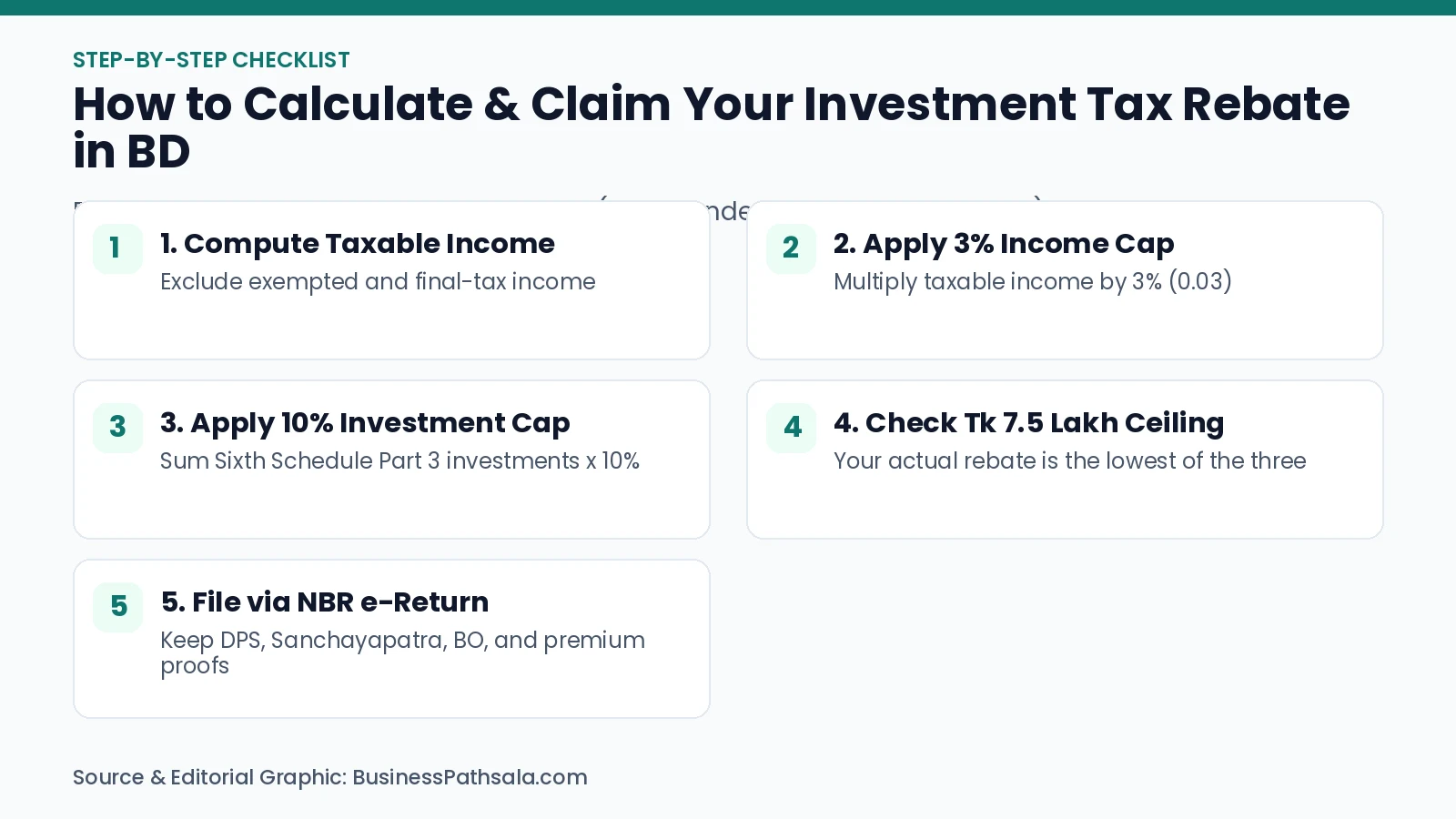
According to the Salient Features of Finance Bill 2026 (KPMG Bangladesh) and PwC Bangladesh Individual Tax Summaries, Section 78 of the Income Tax Act, 2023 calculates your allowable rebate as the lowest of three figures:
- 3% of Total Taxable Income: Calculated on your regular assessed income, excluding tax-exempted income, reduced-rate income, partnership/AoP profit shares, and income subject to final tax settlement.
- 10% of Actual Eligible Investment: Applied to the sum of qualifying investments made between July 1 and June 30 of the relevant income year under Part 3 of the Sixth Schedule (revised from 15% under earlier rules).
- Maximum Ceiling of BDT 750,000 (Tk 7.5 Lakh): No individual taxpayer can claim more than Tk 7.5 lakh in investment tax rebate in a single assessment year (revised from Tk 10 lakh).
Because the 3% income cap and 10% investment rate interact, there is a simple “sweet spot” formula for every taxpayer: Optimal Eligible Investment = 30% of Your Taxable Income. Investing more than 30% of your taxable income in rebate-eligible assets still builds wealth, but it will not generate any extra tax rebate beyond your 3% income ceiling.
All Eligible Tax Rebate Investment Options in Bangladesh Compared
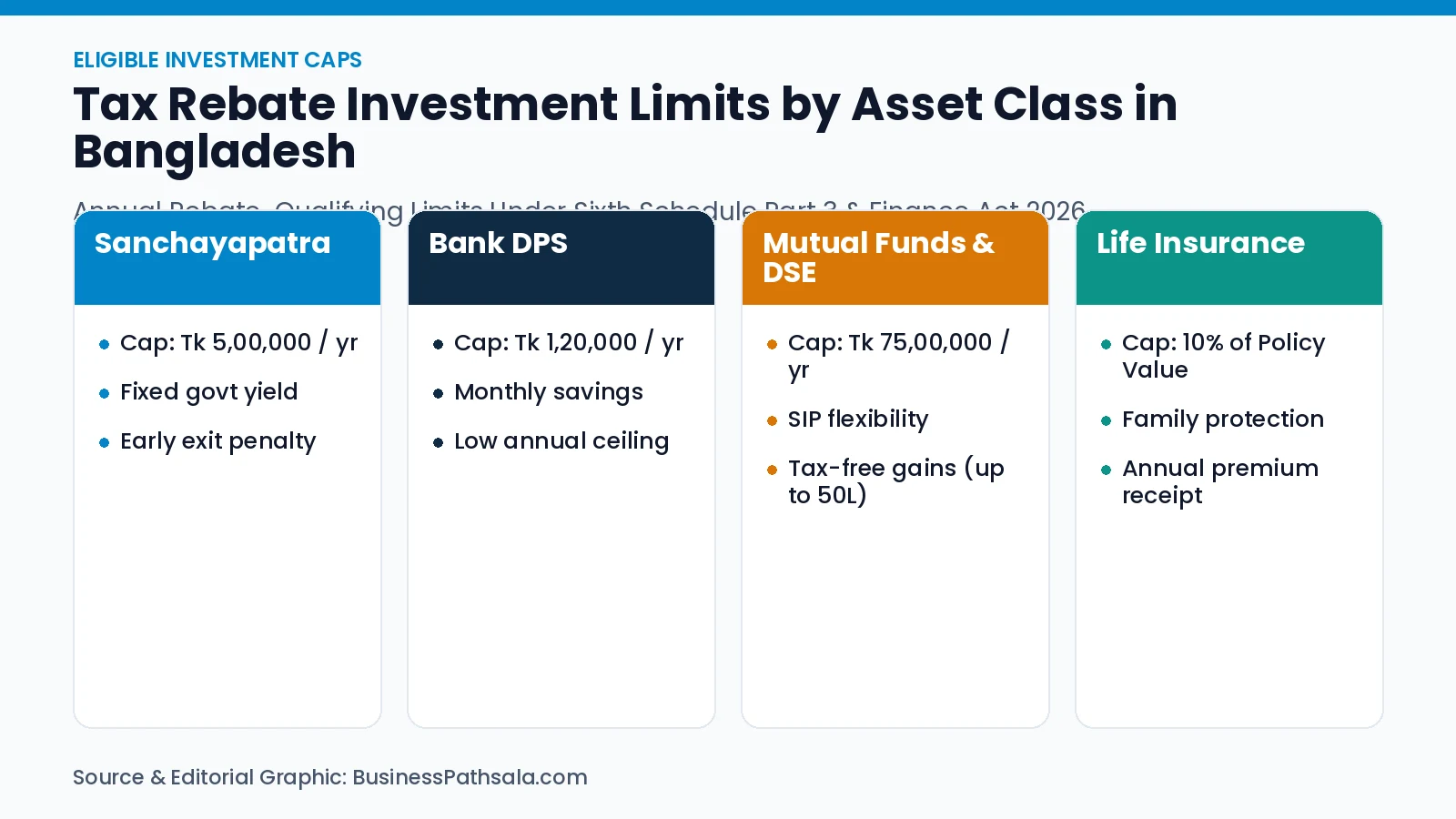
The National Board of Revenue (NBR) restricts the investment tax rebate to specific savings, capital market, and protection instruments. The table below summarizes the seven primary options available to resident Bangladeshi taxpayers and their current annual qualifying limits.
| Investment Option | Annual Rebate-Eligible Cap | Liquidity & Tenure | Best Suited For |
|---|---|---|---|
| Sanchayapatra (Savings Certificates) | Up to BDT 500,000 (Tk 5 Lakh) | 3–5 years; early encashment penalty | Conservative savers wanting fixed govt yields |
| Govt Treasury Bills & Bonds | Up to BDT 7,500,000 (shared securities cap) | 91 days to 20 years; tradable secondary market | High-income earners seeking sovereign safety |
| Bank DPS (Monthly Savings) | Up to BDT 120,000 (Tk 1.2 Lakh) | 3–10 years fixed monthly installments | Salaried beginners building monthly discipline |
| BSEC-Approved Mutual Funds | Up to BDT 7,500,000 (Tk 75 Lakh) | Open-end (SIP/lump sum); hold to avoid clawback | Investors seeking SIP flexibility & tax-free gains |
| DSE/CSE Listed Shares & Securities | Up to BDT 7,500,000 (Tk 75 Lakh) | Market-linked liquidity via BO account | Active equity investors |
| Life Insurance Premium | Up to 10% of actual policy sum assured | Long-term policy schedule | Breadwinners needing family protection |
| Recognized Provident Fund (RPF) | Both employee & employer contributions | Locked until retirement or job exit | Corporate salaried employees |
1. National Savings Certificates (Sanchayapatra)
Sanchayapatra remains Bangladesh’s most popular fixed-income tax-saving instrument, managed by the Department of National Savings. Residents can invest in 5-Year Bangladesh Sanchayapatra, 3-Month Profit-Bearing Sanchayapatra, or Family (Paribar) Sanchayapatra depending on eligibility.
Rebate Limit and Practical Constraints
While individuals can hold higher overall balances across savings certificates, only up to BDT 500,000 (Tk 5 lakh) invested during an income year qualifies for the tax rebate calculation. If your annual taxable income exceeds Tk 16.67 lakh (where 30% is Tk 5 lakh), Sanchayapatra alone cannot fill your entire rebate allowance.
Keep two caveats in mind before buying Sanchayapatra purely for tax savings. First, profit earned on Sanchayapatra is subject to source tax (AIT) deducted by the issuing bank or post office. Second, encashing certificates early reduces your interest rate and can trigger a rebate clawback if held for less than the prescribed period. For a full comparison of yields and lock-in rules, read our breakdown of Sanchayapatra vs Treasury Bond in Bangladesh.
2. Bangladesh Government Treasury Bills & Bonds
Bangladesh Government Treasury Bills (T-Bills: 91-day, 182-day, 364-day) and Treasury Bonds (2-year to 20-year) are sovereign debt instruments auctioned by Bangladesh Bank. Unlike Sanchayapatra, which caps rebate-eligible investment at Tk 5 lakh, approved government securities allow much higher headroom for high-net-worth taxpayers.
If you are unsure how to open a Beneficiary Owner (BO) or bank-level BPID account to participate in auctions, follow our step-by-step guide on how to buy Bangladesh government treasury bills and bonds. Always verify the holding-period requirement with your tax advisor, because selling government securities prematurely before maturity or the minimum statutory lock-in can invalidate the claimed rebate.
3. Bank Deposit Pension Scheme (DPS)
A Deposit Pension Scheme (DPS) at any scheduled bank or licensed non-bank financial institution (NBFI) in Bangladesh is the easiest entry-level rebate option. You deposit a fixed monthly installment—such as Tk 5,000 or Tk 10,000 per month—rather than needing a large lump sum in June.
Why DPS Alone Is Usually Not Enough
Under Part 3 of the Sixth Schedule, bank DPS contributions are capped at BDT 120,000 (Tk 1.2 lakh) per income year—equivalent to Tk 10,000 per month. At a 10% rebate rate, a maxed-out DPS saves you Tk 12,000 in tax. If you earn Tk 10 lakh or Tk 15 lakh per year, you will need a second instrument (such as a mutual fund, Sanchayapatra, or life insurance) to capture the rest of your 3% tax rebate.
To pick an account with competitive profit rates and reliable digital statements for your e-Return filing, check our comparison of the best banks for DPS in Bangladesh.
4. BSEC-Approved Mutual Funds (Open-End & Closed-End)
One of the most significant updates under the Finance Act 2026 is the expansion of the qualifying limit for BSEC-approved mutual funds. Previously capped at Tk 5 lakh per year, mutual fund investments now enjoy a unified qualifying allowance of up to BDT 75 lakh (Tk 7.5 million), matching direct stock market investments.
For salaried professionals and business owners, open-end mutual funds offer two practical advantages over traditional fixed deposits or Sanchayapatra:
- Systematic Investment Plan (SIP) Convenience: You can automate monthly investments of Tk 5,000 to Tk 50,000+ throughout the July–June income year instead of scrambling for cash before June 30.
- Fixed-Income vs. Equity Choice: Risk-averse taxpayers do not have to buy volatile equity funds; fixed-income or balanced mutual funds approved by the Bangladesh Securities and Exchange Commission (BSEC) qualify for the exact same 10% rebate.
Important lock-in warning: Under the proviso of Paragraph 7, Clause Gha of Part 3 of the Sixth Schedule, if you encash or redeem mutual fund units before their prescribed tenure, you become liable to pay back tax equal to the rebate previously claimed.
Investments in shares, debentures, or stocks listed on the Dhaka Stock Exchange (DSE) or Chittagong Stock Exchange (CSE) through a valid BO account qualify for the tax rebate up to the BDT 75 lakh securities ceiling.
Note that your qualifying investment is based on your net investment during the income year (purchases minus sales), not just the gross value of shares bought and sold for short-term trading. If you buy Tk 4 lakh of shares in October and sell Tk 3 lakh in March, only your net retained investment counts toward the rebate. Before committing capital to equities, weigh your risk tolerance using our guide on where to invest money in Bangladesh safely.
6. Life Insurance Premiums
Premiums paid for a life insurance policy covering yourself, your spouse, or your minor children qualify for the investment tax rebate, provided the annual premium claimed does not exceed 10% of the actual sum assured (policy value).
For example, if you hold a life insurance policy with a sum assured of Tk 10,00,000 and pay an annual premium of Tk 85,000, the full Tk 85,000 qualifies because it is under 10% of Tk 10 lakh. However, if your premium is Tk 1,30,000 on a Tk 10 lakh policy, only Tk 1,00,000 counts toward the rebate.
7. Recognized Provident Fund (RPF), Benevolent Fund & Zakat
Many corporate and government employees forget that mandatory payroll deductions already consume part of their 30% investment allowance before they make any voluntary investments:
- Recognized Provident Fund (RPF): Both the employee’s contribution and the employer’s matching contribution to an NBR-recognized provident fund qualify for the investment tax rebate.
- Benevolent Fund & Group Insurance: Mandatory contributions deducted from salary for government or approved institutional benevolent funds and group insurance schemes count in full.
- Zakat Fund & Approved Donations: Contributions to the Government Zakat Fund or NBR-approved charitable institutions (such as Ahsania Mission Cancer Hospital, ICDDR,B, or CRP) also qualify under Part 3 of the Sixth Schedule.
Step-by-Step: How to Calculate Your Exact Tax Rebate (With 3 Examples)
To avoid over-investing or under-claiming, always calculate your rebate ceiling before June 30. Follow the five-step framework below.
Worked Examples for Bangladeshi Taxpayers (AY 2026–27)
| Taxpayer Profile | Annual Taxable Income | 3% of Taxable Income (Cap A) | Optimal Investment (30%) | 10% of Actual Investment (Cap B) | Maximum Allowable Rebate |
|---|---|---|---|---|---|
| Mid-Level Salaried | BDT 8,00,000 | BDT 24,000 | BDT 2,40,000 | BDT 24,000 (e.g., Tk 1.2L DPS + Tk 1.2L Mutual Fund) | BDT 24,000 |
| Senior Manager / SME | BDT 15,00,000 | BDT 45,000 | BDT 4,50,000 | BDT 45,000 (e.g., Tk 1.5L PF + Tk 3L Sanchayapatra) | BDT 45,000 |
| High-Income Executive | BDT 35,00,000 | BDT 1,05,000 | BDT 10,50,000 | BDT 1,05,000 (e.g., Tk 5L Sanchayapatra + Tk 5.5L Mutual Fund) | BDT 1,05,000 |
Notice how in Scenario 1 (Tk 8,00,000 taxable income), a Tk 10,000/month DPS (Tk 1,20,000/year) only covers half of your Tk 2,40,000 optimal allowance. Adding Tk 10,000/month into a BSEC-approved mutual fund SIP or buying Tk 1,20,000 in Sanchayapatra captures the remaining Tk 12,000 in tax savings.
5 Common Tax Rebate Mistakes That Cost Bangladeshi Taxpayers Money
- Assuming Bank FDRs Qualify for a Tax Rebate: Standard Fixed Deposit Receipts (FDRs) at commercial banks do not qualify under Part 3 of the Sixth Schedule. Only approved DPS accounts (up to Tk 1.2 lakh/year) and government securities qualify.
- Missing the June 30 Income-Year Cutoff: Investments made between July 1 and November while preparing your tax return count toward the next income year, not the year you are filing for. Always complete qualifying investments before June 30.
- Ignoring Employer Provident Fund Contributions: If your company deducts 8%–10% of your basic salary into a Recognized Provident Fund (and matches it), add both amounts first before calculating how much extra you need to invest.
- Premature Encashment Clawbacks: Breaking a Sanchayapatra or redeeming mutual fund/unit fund units before the required holding period forces you to repay the tax rebate you claimed in earlier years.
- Investing Without Documentary Proof: During NBR e-Return verification or audit, you must retain bank DPS certificates, Sanchayapatra purchase receipts, BO account year-end statements, or insurance premium receipts.
How to Claim Your Investment Tax Rebate in NBR e-Return
When filing your return on the NBR e-Return portal, navigate to the Rebate section after entering your income details. Select each applicable category (Life Insurance, DPS, Sanchayapatra, Approved Stocks/Mutual Funds, Provident Fund), enter the exact taka amount invested between July 1 and June 30, and verify that the system automatically applies the lowest of 3% of taxable income, 10% of investment, or BDT 750,000.
Keep digital PDFs of all investment certificates—such as your bank’s annual DPS statement, Sanchayapatra registration slip, CDBL/brokerage portfolio statement as of June 30, and insurance premium receipt—organized in one folder for at least six years in case of an NBR audit.
Disclaimer
This article is for educational and informational purposes only and does not constitute formal tax, legal, or investment advice. Bangladesh income tax laws, rebate percentages, and investment caps are subject to annual Finance Act amendments and NBR circulars. Always verify your exact tax liability and instrument eligibility with a qualified Income Tax Practitioner (ITP) or Chartered Accountant before making financial decisions.
Frequently Asked Questions (FAQs)
What is the maximum tax rebate limit in Bangladesh for 2026–27?
Under the Finance Act 2026 amendments to Section 78 of the Income Tax Act, 2023, the maximum investment tax rebate is the lowest of 3% of your total taxable income, 10% of your actual eligible investments, or BDT 750,000 (Tk 7.5 lakh).
Does an FDR (Fixed Deposit Receipt) qualify for an income tax rebate in Bangladesh?
No. Standard commercial bank FDRs are not listed under Part 3 of the Sixth Schedule and do not qualify for an investment tax rebate. Only approved monthly Deposit Pension Schemes (DPS) up to BDT 120,000 per year qualify among bank deposit products.
How much can I invest in a DPS for a tax rebate in Bangladesh?
You can claim a tax rebate on up to BDT 120,000 per income year (Tk 10,000 per month) deposited into an approved bank or NBFI Deposit Pension Scheme (DPS). At a 10% rebate rate, a full Tk 1.2 lakh DPS yields Tk 12,000 in tax savings.
Do mutual funds qualify for a higher tax rebate than Sanchayapatra?
Yes, in terms of annual qualifying allowance. Sanchayapatra is capped at BDT 500,000 (Tk 5 lakh) per year for tax rebate purposes, whereas BSEC-approved mutual funds and listed shares qualify up to BDT 7,500,000 (Tk 75 lakh) under the Finance Act 2026.
Can I invest in July or August and claim a rebate for the previous tax year?
No. To claim a tax rebate for a given income year (July 1 to June 30), the investment must be completed and paid on or before June 30 of that income year.