Last updated: · By Afra Monira
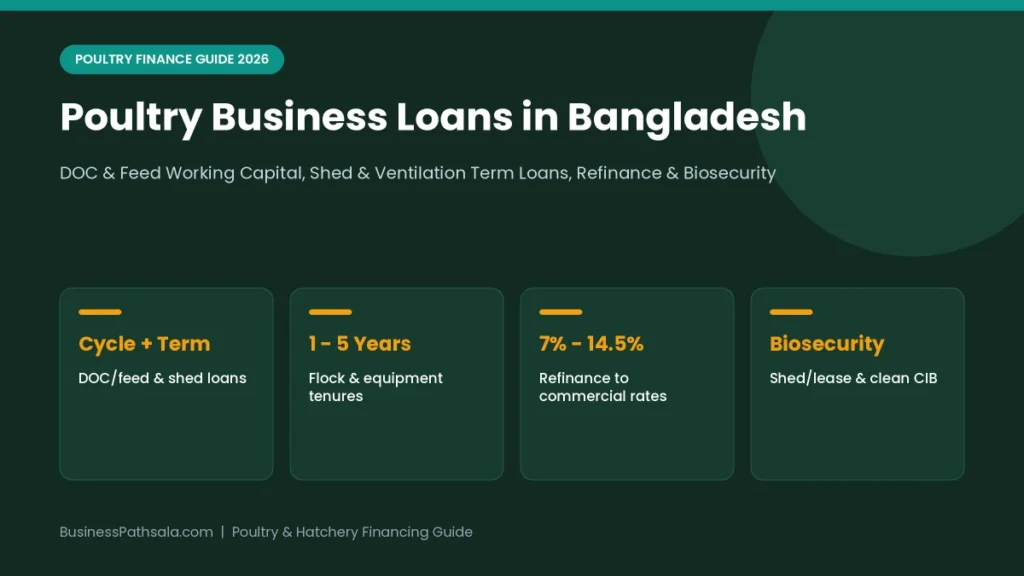
Quick answer: A poultry business loan in Bangladesh is working-capital or batch credit, shed/equipment term financing, or SME/agro credit offered through scheduled commercial banks, specialized agricultural banks, state-owned banks, non-bank financial institutions (NBFIs), and partner microfinance institutions (MFIs) under Bangladesh Bank’s CMSME Master Circular (SMESPD Circular No. 01, 17 March 2025) and central bank SME/agro credit guidelines. Eligible broiler farmers, layer/egg producers, poultry hatcheries, feed dealers/mills, and rural women poultry entrepreneurs can borrow to buy day-old chicks (DOCs), poultry feed, vaccines/medicines, litter, feeders/drinkers, or build/upgrade sheds and ventilation. Standard commercial rates generally sit around 12% to 14.5% depending on credit risk, collateral, and institution type, while qualifying small and medium enterprises or rural/agro borrowers under active central bank refinance or agricultural credit windows can access lower capped rates where eligible. Clean CIB records, verifiable shed/land or lease proof, biosecurity readiness, and realistic batch-to-sale cash flow are essential.
Updated 21 November 2026. Commercial bank interest rates, agricultural/CMSME refinance allocations, poultry/livestock licensing rules, and bank credit policies change periodically. Confirm current interest rates, limits, and document checklists directly with your lender and relevant authorities before applying.
Poultry farming is one of Bangladesh’s fastest-moving agricultural livelihoods—spanning short-cycle broiler batches, continuous egg-laying sheds, hatcheries, and local feed supply across rural and semi-urban districts. Yet poultry owners manage a tight cash rhythm: day-old chicks, starter/grower/layer feed, vaccines, litter, and heating or fan/power costs must be paid week after week, while bird sales or egg collections arrive on batch or periodic cycles. Feed alone accounts for most of a flock’s running cost, and disease, heat stress, or price swings can squeeze margins quickly. Understanding how banks and financial institutions structure poultry loans helps farmers match working capital and shed/equipment credit to real flock economics.
How Banks Evaluate Poultry Businesses in Bangladesh
In Bangladesh, banks evaluate poultry farms, hatcheries, and related enterprises within the frameworks guided by Bangladesh Bank’s CMSME Master Circular and Bangladesh Bank’s SME & Special Programmes Department (SMESPD), alongside agricultural and rural credit channels. Depending on asset investment, headcount, and whether the venture is rural/agro, micro/small, or medium scale, lenders look at both flock viability and repayment discipline. You can see how enterprise tiers fit together in our CMSME loan guide for Bangladesh.
When reviewing a poultry loan proposal, credit officers focus on four practical risk areas:
- Feed cost, batch cycle, and cash flow: Broiler cycles turn over in roughly 4 to 6 weeks while layer flocks run over longer periods with daily/periodic egg sales. Banks check whether your credit facility matches feed outlays and sale proceeds.
- Biosecurity, housing, and disease control: Shed spacing, ventilation, clean water, vaccination, and isolation/biosecurity practices protect flock survival. Lenders look for practical management and real operating experience.
- Shed and land control: Credit officers verify whether you own or hold a valid lease on the farmyard and poultry sheds for a period that supports the loan cycle.
- Clean CIB status: The borrower entity (if applicable) along with all owners, partners, directors, and personal guarantors must hold a clean Credit Information Bureau (CIB) record with no overdue or classified defaults.
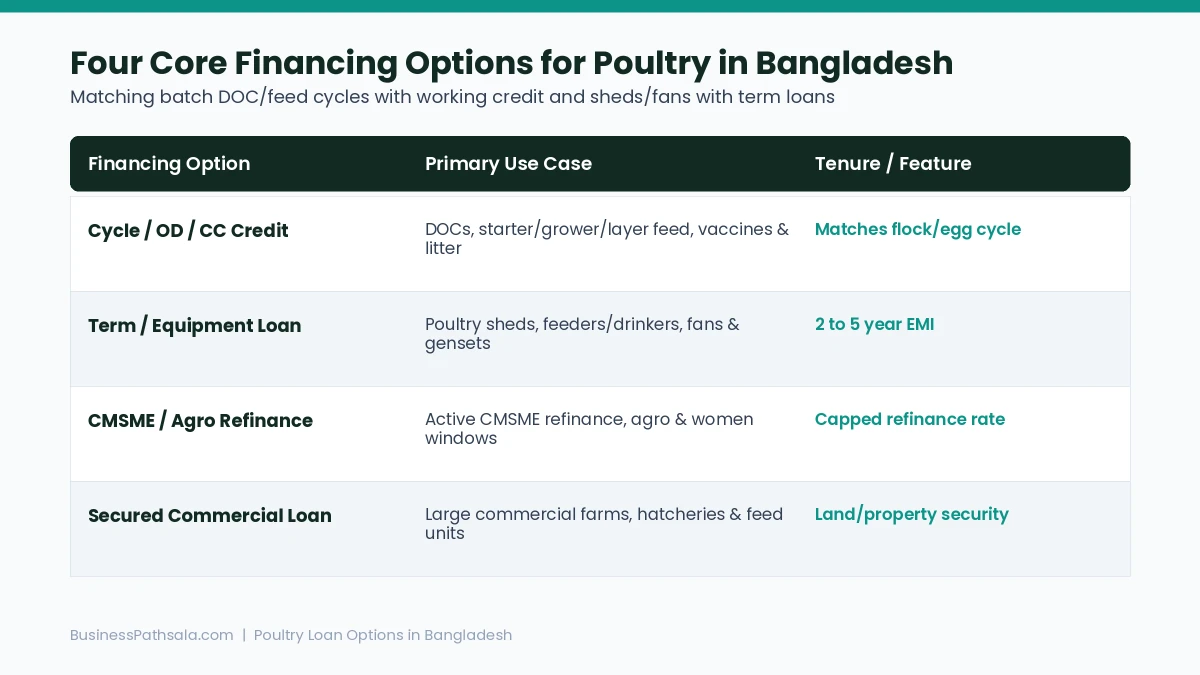
Four Core Financing Options for Poultry in Bangladesh
Funding recurring DOCs and feed is very different from building a poultry shed or installing ventilation and backup power. Pairing working-capital/cycle credit with term loans keeps cash flow aligned with flock cycles.
1. Working Capital, Batch/Cycle Credit, or Revolving Overdraft (OD) / Cash Credit (CC)
For ongoing operational costs—such as day-old chicks, poultry feed, vaccines and supplements, rice-husk/sawdust litter, and electricity/fuel for brooding or cooling—batch/cycle credit or a revolving Overdraft (OD) / Cash Credit (CC Hypo) facility helps bridge cash needs until birds or eggs are sold. Revolving limits (typically reviewed annually) charge interest on the balance used, while cycle/seasonal facilities align repayment with flock or marketing cycles.
2. Term and Equipment Loans (For Sheds, Ventilation, Feeders, and Gensets)
Building well-ventilated poultry sheds, installing automatic/manual feeders and drinkers, exhaust fans or cooling pads, brooders, water pumps, or backup generators requires capital upfront. A term loan spreads repayment over monthly or quarterly installments over roughly 2 to 5 years depending on asset life and bank policy. For related agricultural credit structures, see our agro-processing business loan guide for Bangladesh.
3. Central Bank CMSME / Agro Refinance and Women Support Windows
Eligible small and medium enterprises or agricultural/rural borrowers can ask participating lenders about active central bank refinance allocations (such as CMSME refinance windows where eligible customer rates are capped when active) or agricultural/rural credit programs. Women-owned poultry or small enterprises meeting ownership criteria can also check women-focused refinance and desk support, as discussed in our rural women entrepreneur loan guide for Bangladesh.
4. Secured Commercial or Project Credit (For Larger Farms, Hatcheries, and Feed Units)
Larger commercial broiler or layer complexes, hatcheries, or feed/processing operations seeking higher credit limits generally pledge registered land/property mortgages or liquid security alongside personal/corporate guarantees and asset hypothecation.
Interest Rates and Real Repayment Math (BDT 8 Lakh Example)
Interest rates on poultry loans in Bangladesh depend on whether the facility uses an active central bank refinance or agricultural/priority window or follows standard commercial bank pricing. Outside subsidized refinance windows, commercial SME/business rates generally sit around 12% to 14.5% depending on credit risk, collateral, and lender policy. You can compare broader bank pricing in our guide to SME loan interest rates in Bangladesh.
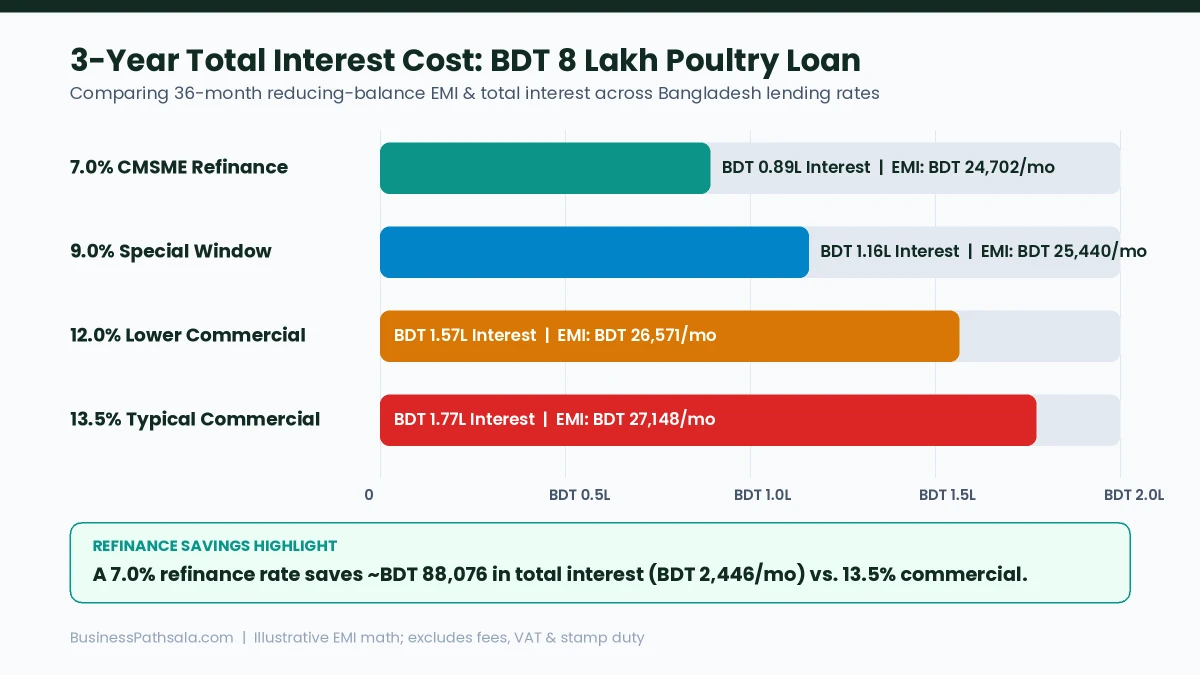
To see how interest rate differences affect monthly installments, consider an illustrative BDT 8,00,000 (8 lakh) poultry shed or equipment loan repaid over 36 months (3 years) on a standard monthly reducing-balance schedule:
| Rate Scenario (BDT 8 Lakh, 36 Months) | Approx. Monthly EMI | Total Interest (3 Years) | Total Repayment |
|---|---|---|---|
| 7.0% Annual Rate (CMSME Refinance Window) | BDT 24,702 | BDT 89,260 | BDT 8,89,260 |
| 9.0% Annual Rate (Concessional / Special Window) | BDT 25,440 | BDT 1,15,832 | BDT 9,15,832 |
| 12.0% Annual Rate (Lower Commercial Tier) | BDT 26,571 | BDT 1,56,572 | BDT 9,56,572 |
| 13.5% Annual Rate (Typical Commercial Rate) | BDT 27,148 | BDT 1,77,336 | BDT 9,77,336 |
Illustrative calculation only: Figures assume equal monthly installments (EMI) without a grace period and exclude processing fees, CIB charges, stamp duties, valuation fees, and VAT. Actual repayment terms appear in your written sanction letter.
On a BDT 8 lakh loan over three years, a 7% refinance rate saves roughly BDT 2,446 per month and BDT 88,076 in total interest compared to a 13.5% commercial rate. Because DOC and feed costs and bird/egg prices can swing across batches, always test monthly repayments against conservative net margins.
Banks and Institutions Financing Poultry in Bangladesh
Poultry farmers and agribusinesses in Bangladesh borrow from specialized agricultural banks, state-owned banks, private commercial banks, and partner microfinance institutions depending on scale, location, and banking history.
| Lender Group | Examples of Active Institutions | Typical Strengths | Best Fit For |
|---|---|---|---|
| Specialized Agro Banks | Bangladesh Krishi Bank (BKB), RAKUB | Extensive rural and upazila branch network serving farm, poultry, and rural livelihoods | Rural broiler/layer farmers, shed operators, and regional agro-borrowers |
| Private SME & Commercial Banks | BRAC Bank, City Bank, Eastern Bank (EBL), Prime Bank, Mutual Trust Bank (MTB), Dhaka Bank | Structured SME evaluation, working-capital/term lines, and active refinance desks where eligible | Commercial/SME poultry farms, hatcheries, and traders with bank turnover and clean records |
| State-Owned Commercial Banks | Sonali Bank, Janata Bank, Agrani Bank, Rupali Bank | Broad district/upazila reach and agricultural/commercial credit lines | Operators with regional banking ties or land/property collateral |
| PKSF Partner NGOs / MFIs | PKSF-supported partner microfinance institutions | Accessible small-ticket loans and rural field follow-up | Small or homestead poultry keepers building track record |
For guidance on preparing your project numbers and loan write-up before visiting a bank branch, see our guide on preparing an SME loan project profile in Bangladesh.
Eligibility Criteria for Poultry Business Loans
Exact underwriting rules vary by lender, loan size, and whether the facility is agro-focused, SME-focused, or collateralized, yet most lenders evaluate poultry applicants against these core points:
- Active Poultry Operation or Viable Plan: Proven experience or a realistic plan for broiler, layer, hatchery, or poultry trading with clear feed, biosecurity, and sales math.
- Operating Track Record: Many commercial banks look for at least 1 to 2 years of active business operation with verifiable sales/bank activity for standard SME loans, while agro/micro windows may serve smaller or newer producers under their own rules.
- Age and Citizenship: Bangladeshi citizen with a valid National ID (NID), typically aged between 21 and 65 years at loan maturity.
- Clean CIB Status: Neither the borrower (or entity) nor any partner, director, or guarantor may have an overdue or classified loan default in the Bangladesh Bank CIB database.
- Premises Control and Guarantees: Proof of owned land/shed or a valid lease agreement covering the loan/flock cycle, plus personal guarantors, asset/stock hypothecation, security cheques, or collateral where required by loan size and bank policy.
Required Documents Checklist for a Poultry Loan
Having your farm/shed papers, batch/sale logs, and identity documents ready speeds up verification. Gather these six document categories where applicable before applying:
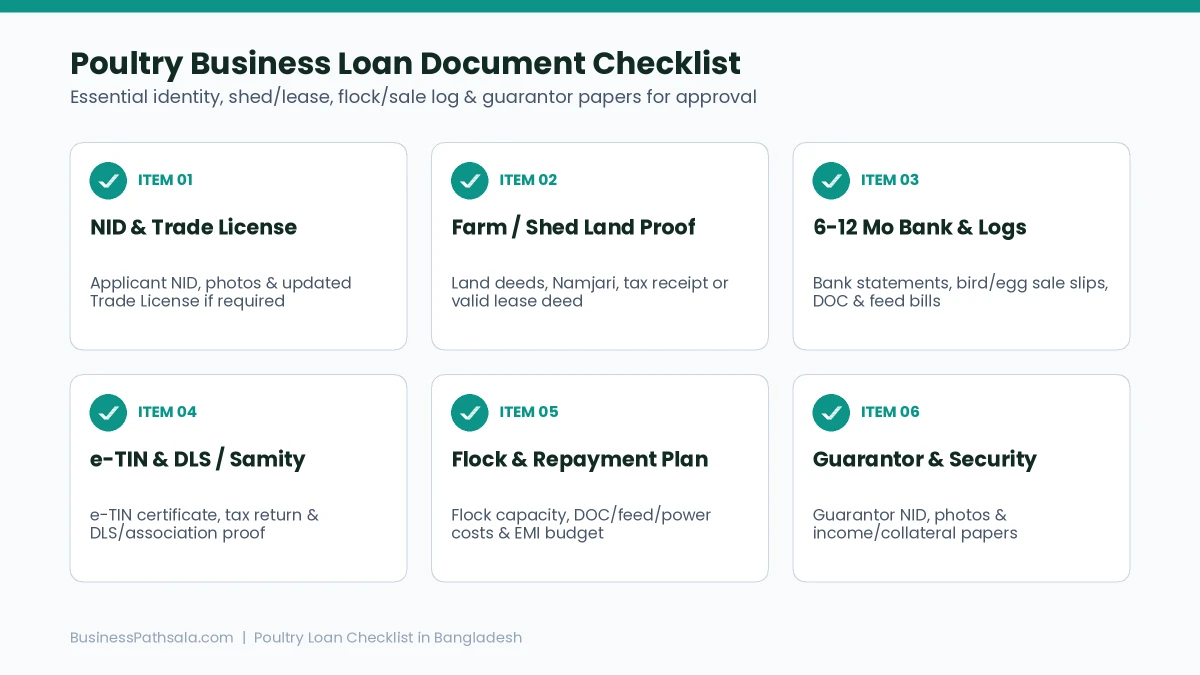
- Identity and Trade Papers: Valid National ID (NID) copy and recent passport-size photographs of the owner/partners/directors, plus an updated Trade License where required by the bank or business type.
- Farm, Shed, or Land Premises Proof: Land ownership deeds, mutation (Namjari), and tax receipts (or a valid farm/shed/land lease agreement) showing location, area, and lease validity.
- Bank Statements and Batch/Sale Records: Last 6 to 12 months of bank statements (where available), supported by broiler/egg sale slips or buyer receipts, DOC/feed/vaccine bills, and mortality/batch logs.
- Tax and Sector/Cluster Registration: e-TIN certificate (and latest income tax return acknowledgement slip where applicable), plus Department of Livestock Services (DLS) or local poultry association/samity registration where relevant.
- Batch and Repayment Plan: A practical summary of flock size/capacity, DOC, feed, vaccine, and power/brooding costs, expected sales proceeds, and monthly/cycle repayment capacity. You can also review our guide on writing a business plan for a bank loan in Bangladesh.
- Guarantor and Security Papers: NID copies, passport photos, and income or business details of personal guarantors (plus collateral/FDR papers if secured).
Step-by-Step: How to Apply for a Poultry Business Loan
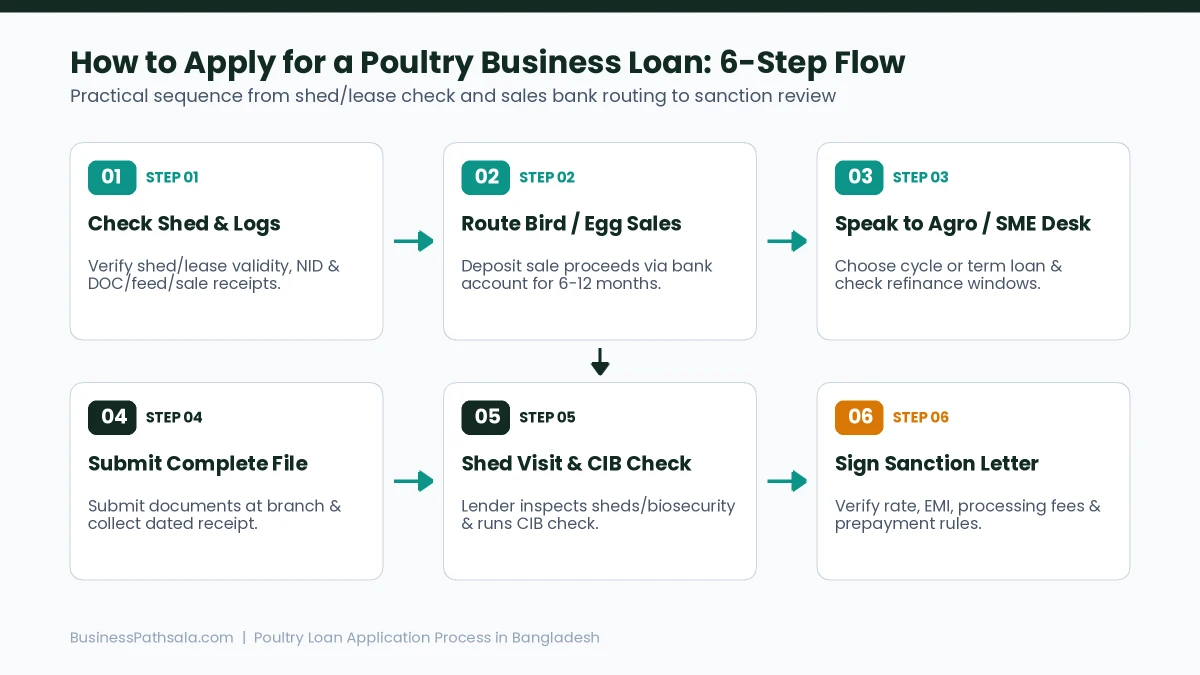
- Check farm/lease validity and organize batch and sale records. Make sure your NID, farm/shed ownership or lease papers, and feed/DOC/egg/bird receipts are clear and up to date.
- Route bird or egg sale proceeds through a bank account. Depositing sales regularly into your bank account over 6 to 12 months helps credit officers verify real income and turnover.
- Speak with the branch SME, Agro, or Women desk (or partner lender). Ask clearly which working-capital/cycle or term/equipment loan fits your poultry farm, whether any refinance or agro window applies, and what exact document checklist they require.
- Submit a complete application and keep an acknowledgement. Hand in your filled form and supporting folder at the branch and collect a dated receipt. Avoid paying unofficial middlemen promising guaranteed approval.
- Support physical farm/shed verification and CIB check. Expect an officer to visit your sheds to inspect housing, ventilation/biosecurity, and records while head office runs CIB screening.
- Verify written terms on the sanction letter before signing. Check the interest rate, EMI or repayment schedule, processing/service charges, guarantor/collateral clauses, and early-settlement rules in writing.
Common Mistakes Poultry Farmers Make When Borrowing
- Keeping all bird or egg sale proceeds outside bank accounts: Unrecorded cash makes income hard to verify and often leads to rejection or a smaller loan offer.
- Applying with a short or informal shed/land lease: If your shed or land lease expires soon, banks may hesitate to approve a multi-year or full-cycle facility.
- Underestimating feed price jumps or disease/heat-stress risk: Always keep a realistic cost buffer rather than assuming peak market prices and zero flock loss.
- Mismatching loan repayment with batch or egg cash flow: Aligning installments and cash flow with realistic sales cycles avoids unnecessary stress.
If you are also exploring broader small-business or rural entrepreneur financing routes in Bangladesh, you can explore our Uddokta loan guide for Bangladesh and our guide to rural women entrepreneur loans in Bangladesh.
Frequently Asked Questions
Can I get a bank loan for a broiler or layer poultry farm in Bangladesh?
Yes. Commercial banks, specialized agricultural banks (such as BKB and RAKUB), state-owned banks, and partner institutions finance broiler, layer, hatchery, and poultry-related enterprises subject to eligibility rules, shed/lease and cash-flow verification, clean CIB status, and lender credit policy.
What is the interest rate on a poultry business loan in Bangladesh?
Standard commercial rates generally sit around 12% to 14.5% depending on the bank, credit risk, and collateral. Eligible small and medium enterprises or qualifying borrowers under active central bank refinance or priority/agro windows can access lower capped rates where allocations are open.
Which loan format is better for poultry: Working Capital/Cycle Credit or Term Loan?
Working-capital, cycle credit, or revolving overdraft/cash-credit lines are better suited for recurring DOCs, feed, vaccines, and batch/egg expenses, while term loans are better suited for multi-year assets such as poultry sheds, ventilation/cooling gear, or farm upgrades.
Do I need to own the farm land to get a poultry loan?
Not always. Many poultry farmers operate on leased land or family/shed premises, provided lease or occupancy papers are valid for a practical period, though owned land/property or formal security may be required for larger or collateralized loans.
How long does poultry loan approval take in Bangladesh?
Timelines vary by lender, loan size, and verification steps. Straightforward branch or microfinance/agro files with complete documents and clean CIB checks can take a couple of weeks to a few weeks, while larger or collateralized files can take longer.
Official Sources and Further Reading
- Bangladesh Bank SMESPD Circular No. 01 — CMSME Financing Master Circular (17 March 2025): Official CMSME definitions, credit guidelines, and lending rules in Bangladesh.
- Bangladesh Bank SME & Special Programmes Department (SMESPD): Central bank refinance windows and SME credit directives.
- Department of Livestock Services (DLS), Bangladesh: Official livestock and poultry health, extension, and sector resources in Bangladesh.
- Bangladesh Krishi Bank (BKB): Agricultural and rural credit programs across Bangladesh.
Final Takeaway
Securing a poultry business loan in Bangladesh comes down to matching DOC, feed, and batch/egg cash cycles with working-capital or cycle credit, funding sheds and ventilation/equipment with term credit, keeping farm/shed papers and sales/feed logs clear, and maintaining a clean CIB record. Compare two or three lenders and verify all terms in writing before signing.
Financial information notice: This article is for general educational purposes only and does not constitute a loan offer, financial advice, or a guarantee of loan approval. Bank interest rates, refinance schemes, collateral rules, and poultry regulations may change over time. Always verify current terms directly with Bangladesh Bank, relevant authorities, and your chosen bank or financial institution.