
Last updated: · By Abrar Hossain
Last updated: 29 November 2026 · Checked against the Fire Prevention and Extinguishing Act 2003, the Environment Conservation Rules 2023 and the 2026 e-fire license rollout
Opening a factory, a warehouse or a mid-sized workshop in Bangladesh takes more than a trade license. Two permits come up again and again: a fire license from the Fire Service and Civil Defence (FSCD), and an environmental clearance certificate (ECC) from the Department of Environment (DoE). This guide to the fire license and environment clearance certificate Bangladesh rules explains who needs each one, what papers to prepare, how the 2026 online systems work, how long each permit lasts, and what happens if you skip them.
Banks, buyers, insurers and utility companies increasingly ask for both. Without them, a loan file can stall, an export buyer’s audit can fail, and an insurance claim after a fire becomes much harder to win.
Quick Answer: Fire License vs ECC at a Glance
Here is the short version of the fire license and environment clearance certificate Bangladesh requirements in 2026.
| Point | Fire license | Environmental clearance certificate (ECC) |
|---|---|---|
| Issuing body | Fire Service and Civil Defence (FSCD) | Department of Environment (DoE) |
| Main law | Fire Prevention and Extinguishing Act 2003 | Environment Conservation Act 1995 and Environment Conservation Rules 2023 |
| Who needs it | Factories, warehouses, workshops, commercial buildings and places storing flammable goods | Industrial units and projects listed in the ECR 2023 schedules |
| How to apply | Online through the FSCD e-fire license system (since May 2026) | Online at ecc.doe.gov.bd |
| Fee | Set in a demand note after inspection | Based on project investment, paid by treasury challan |
| Validity | 1 year | Green 5 years, Yellow 2 years, Orange and Red 1 year |
Part 1: Fire License in Bangladesh
The legal basis
Under Section 4 of the Fire Prevention and Extinguishing Act 2003, nobody may use a building or place as a warehouse or workshop without a license from the Director General of FSCD. The license cannot be transferred (Section 6). If the ownership or the use of the building changes, you need a new one. Section 7 separately requires a fire safety no-objection certificate (NOC) before the design of a multi-storey or commercial building is approved. The Daily Star’s law desk has a plain-language summary of these sections.
Who needs a fire license
- Factories of every kind, including garment, textile, plastic, chemical and food processing units
- Warehouses and godowns
- Workshops and engineering units
- Shopping malls, markets and commercial high-rises
- Hotels, restaurants and community centres
- Hospitals, clinics, schools and other institutions
- Fuel pumps, CNG and LPG stations
- Any place that stores flammable or hazardous material
A small retail shop in a market is often covered under the market building’s arrangements, but check with your local fire station before assuming you are exempt.
2026 change: the e-fire license system
On 30 April 2026, FSCD launched its e-fire license system, and from 1 May 2026 new licenses, renewals and re-evaluations are handled online. According to The Financial Express, manual submission of license applications has been discontinued. Since November 2025, applicants have also been able to download the approved fire safety plan NOC online instead of collecting it in person, as the state news agency BSS reported.
Documents for a fire license
| Document | Notes |
|---|---|
| Trade license | Valid and in the same business name. See our online trade license guide. |
| Owner’s National ID | For a company, the managing director’s NID |
| Building layout plan | Showing exits, stairs and where equipment is installed |
| Ownership papers or rent deed | With a valuation certificate where asked |
| Affidavit on Tk 300 stamp paper | Undertaking on fire safety compliance |
| Fire safety plan approval | For the first license; from the second year a functionality certificate may be asked for |
| Company papers | Certificate of incorporation, memorandum and articles (limited companies) |
| Special NOCs | For example, for plastic or chemical units, or a factory in a residential area |
Step-by-step process
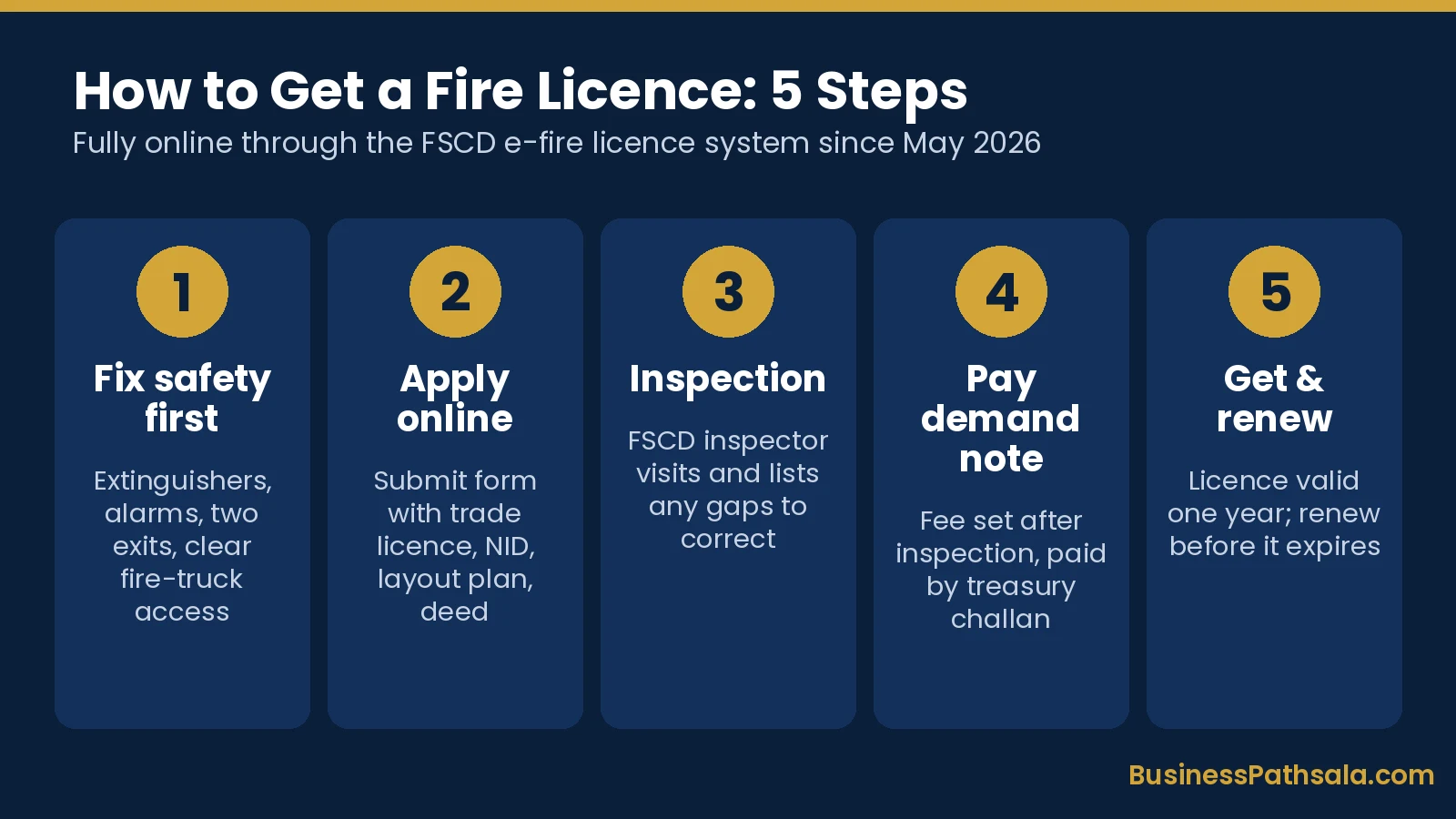
- Get the premises ready first. Install fire extinguishers, hose reels or hydrants, smoke detectors and an alarm. Keep at least two marked exit staircases, a water reservoir, and clear access for a fire truck.
- Apply online through the FSCD e-fire license system and upload your documents.
- Inspection. An FSCD inspector visits the site, checks the safety set-up and lists anything you must fix.
- Pay the demand note. FSCD sets the fee after inspection based on the type of business and the property’s value. Payment goes to the government treasury by challan.
- Receive the license, which is valid for one year, and diarise the renewal date.
Fees and renewal
There is no single published price for every business. The demand note issued after inspection states your fee, so be wary of anyone quoting a “fixed package price” before FSCD has seen your premises. Renewal is yearly: you pay the renewal fee by challan, submit it through the online system, and the inspector may revisit to confirm that your equipment is still in working order.
A recent warning: the Dhanmondi warehouse fire
After an October 2026 fire at an Apex warehouse on Dhanmondi Road 27, the FSCD Director General said the operators had applied for a license months earlier, but it was not issued because they did not have fire safety approval, bdnews24 reported. Applying is not enough. The safety plan has to be approved and the premises have to pass inspection before you are legally covered.
Small and medium factories find this the hardest part. At an April 2026 meeting in Chattogram, BGMEA leaders raised complications in fire safety plan approval and license renewal, and FSCD officials promised to resolve them. Start early, and keep copies of every submission.
Part 2: Environmental Clearance Certificate (ECC)
The legal basis
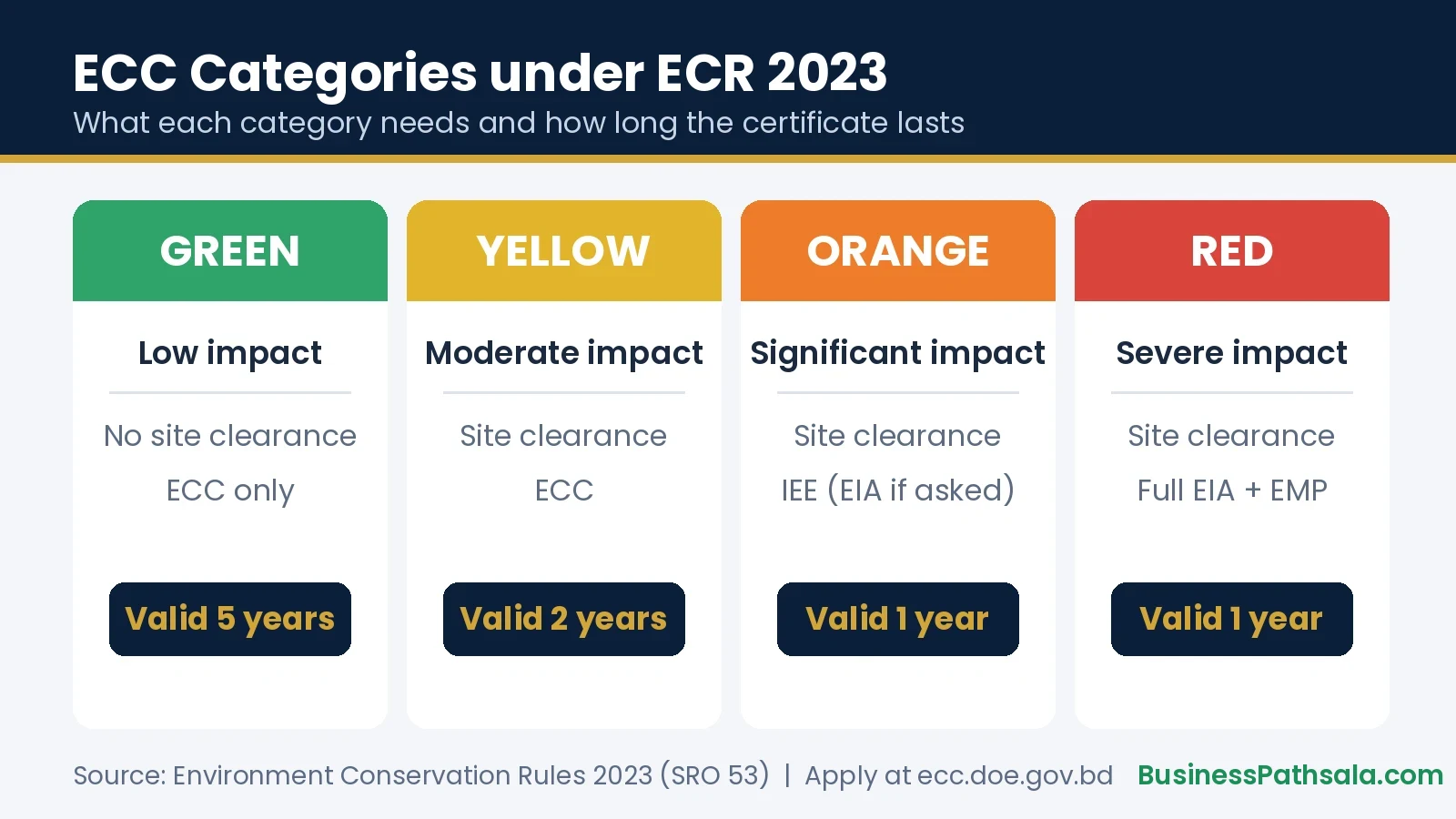
The Environment Conservation Act 1995 requires an ECC before setting up an industrial unit or project listed by the government. The detailed rules are now in the Environment Conservation Rules 2023 (SRO No. 53), issued on 2 March 2023, which replaced the 1997 rules. The old Green, Orange-A, Orange-B and Red system has been replaced by four new categories.
The four ECC categories under ECR 2023
| Category | Impact | Site clearance | Assessment needed | Who issues | ECC validity |
|---|---|---|---|---|---|
| Green | Low | Not needed | None | DoE regional office | 5 years |
| Yellow | Moderate | Required | Pollution control measures | DoE regional office | 2 years |
| Orange | Significant | Required | Initial Environmental Examination (IEE); EIA only if DoE directs | Regional office or headquarters, depending on the schedule serial | 1 year |
| Red | Severe | Required | Full Environmental Impact Assessment (EIA) with ToR approval and public consultation | DoE headquarters | 1 year |
Your category depends on the exact activity listed in Schedule 1 of ECR 2023, not on the size of your business alone. Land development, for example, is Orange for 5 to 25 acres and Red above 25 acres, according to a 2025 review of ECR 2023. Look up your activity before you plan the budget, because a Red project needs months of extra work.
Documents for an ECC
- Online application form and the applicant’s National ID
- Trade license and registration with BIDA, BSCIC or the relevant authority
- Land deed or lease agreement, mouza map with khatian and dag numbers, and a site location map
- No-objection certificate from the local authority
- Project details and investment breakdown
- Process flow diagram and factory layout plan
- Waste management plan, and an effluent treatment plant (ETP) design where wastewater is produced
- IEE report (Orange) or EIA report and Environmental Management Plan (Red)
- Fire license and other sector permits, such as a BSTI license for food units
- Treasury challan for the fee
Step-by-step ECC process
- Find your category in Schedule 1 of ECR 2023.
- Register and apply on the DoE portal at ecc.doe.gov.bd.
- Get site clearance (Yellow, Orange and Red). This confirms that the location is suitable for your activity.
- Submit the IEE or EIA where required. Red projects first need their terms of reference approved, then a public consultation on the draft EIA.
- DoE inspection of the site and, for running units, the ETP and pollution controls.
- Pay the fee by treasury challan. Fees are set in a schedule to the rules according to project investment, plus VAT.
- Receive the ECC and diarise the renewal. Apply for renewal at least 30 days before it expires.
ECR 2023 expects DoE to decide on an ECC within 30 working days of a complete application and to give reasons within 7 working days if it refuses. In practice, Orange and Red projects take longer because of the IEE or EIA stage. If your application is rejected, you can appeal to the Environmental Appellate Authority.
Which Comes First? The Usual Order
The two permits depend on each other, which confuses many first-time founders. For a new factory, the usual order is:
- Trade license and company or BSCIC/BIDA registration
- DoE site clearance (for Yellow, Orange and Red units)
- Fire safety plan NOC from FSCD before construction or fit-out
- Build or fit out the premises, install fire equipment and the ETP
- Fire license after FSCD inspection
- ECC from DoE
- Start production, then renew both on time every cycle
Large investors can process many of these through the BIDA One Stop Service instead of visiting each office separately.
Penalties for Operating Without Them
- No fire license: running a warehouse or workshop without one is an offence under Section 17 of the Fire Prevention and Extinguishing Act 2003, punishable with imprisonment and a fine. FSCD can also seal unsafe premises.
- No ECC: DoE can order electricity, gas and water connections cut, impose environmental compensation, and prosecute under the Environment Conservation Act 1995. Unpaid compensation can lead to other licenses being suspended.
- Insurance and finance: insurers can question a fire claim from unlicensed premises, and banks usually want both permits before releasing an industrial loan.
Why These Permits Matter for Loans and Insurance
Credit officers check permits as part of their environmental and social risk review. If you are preparing a loan file, list both permits in your SME loan project profile, and read our guides to the CMSME loan scheme and manufacturing business loans. For protecting the building and stock once you are running, see our guide to business fire and marine cargo insurance.
Common Mistakes to Avoid
- Renting a building and applying for a fire license before checking that it can meet exit and fire-truck access rules.
- Assuming the landlord’s fire license covers your business. The license is not transferable and is tied to the use of the premises.
- Guessing your ECC category instead of checking Schedule 1 of ECR 2023.
- Letting a Yellow, Orange or Red ECC lapse. Orange and Red certificates must be renewed every year.
- Paying agents who promise a license “without inspection”. Every genuine fire license follows an FSCD inspection.
- Changing the product line or expanding the factory without telling FSCD and DoE.
Frequently Asked Questions
How long is a fire license valid in Bangladesh?
One year. It must be renewed every year through the FSCD online system, and the inspector may revisit before renewing.
Can I apply for a fire license online?
Yes. Since 1 May 2026, new applications, renewals and re-evaluations go through the FSCD e-fire license system, and manual submission has been stopped.
Does every business need an environmental clearance certificate?
No. An ECC is needed for the industrial units and projects listed in the ECR 2023 schedules. Most factories, workshops and processing units are listed. A simple office or retail shop usually is not.
How long is an ECC valid?
Under ECR 2023, a Green category ECC is valid for 5 years, Yellow for 2 years, and Orange and Red for 1 year. Apply for renewal at least 30 days before it expires.
How much does a fire license cost?
There is no single fixed price. FSCD issues a demand note after inspection, based on the type of business and the value of the property, and you pay it by treasury challan.
Final Word
Getting your fire license and environment clearance certificate Bangladesh paperwork right is mostly about order and timing: check your ECC category early, choose premises that can pass a fire inspection, apply online with complete documents, and renew before the deadline. Rules and fees change, so confirm the latest requirements with FSCD, DoE or your local office before you apply.
Disclaimer: This article is general information for business owners, not legal advice. Requirements can differ by location, sector and project size. Always check with FSCD, the Department of Environment or a qualified adviser.
