Last updated: · By Abrar Hossain
Choosing between DPS vs FDR vs Sanchayapatra trips up almost every saver in Bangladesh. Each option promises steady growth, yet they behave very differently once taxes, lock-in periods, and emergencies enter the picture.
A high headline rate means little if you break an account early or pay 15% source tax by mistake. Under the July–December 2026 rate schedules and Finance Act 2026 rules, the gap between these three tools has shifted again.
This guide breaks down how each instrument works in practice using verified 2026 published rates and National Board of Revenue tax rules. You will see which option fits monthly income, emergency cash, or long-term safety.
Core Trade-Offs in DPS vs FDR vs Sanchayapatra
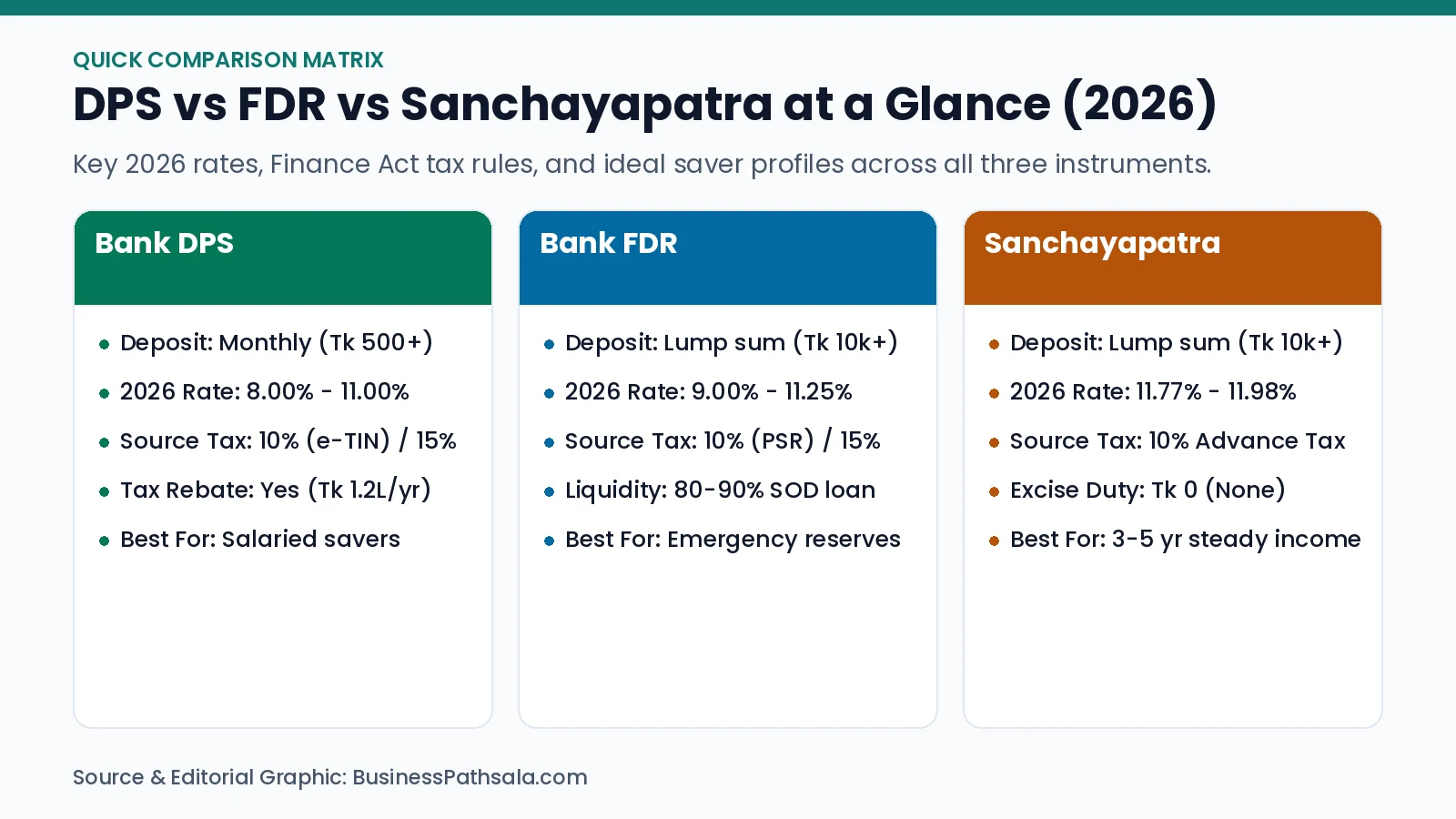
All three options protect your principal while earning fixed returns. Their main differences come down to how you deposit money, how fast you can withdraw it, and how taxes apply.
| Instrument | 2026 Annual Rate | Main Trade-Off |
|---|---|---|
| Bank DPS | 8.00% – 11.00% | Easy monthly start, slower growth early |
| Bank FDR | 9.00% – 11.25% | Fast cash access, lower net yield |
| NBFI FDR (AAA/AA+) | 11.00% – 12.50% | Higher yield, higher institution risk |
| Sanchayapatra | 11.77% – 11.98% | Top safe yield, strict 3–5 year lock |
No single instrument wins on every metric. Understanding how each one handles deposits and penalties makes your choice much clearer.
Why Savers Start With DPS
A Deposit Pension Scheme lets you build a lump sum from monthly salary savings. You do not need a large upfront balance to begin.
Where DPS Shines in Real Life
Most banks let you open a DPS with Tk 250 to Tk 500 per month. Tenures usually run from 1 to 10 years, making it easy to match a future goal.
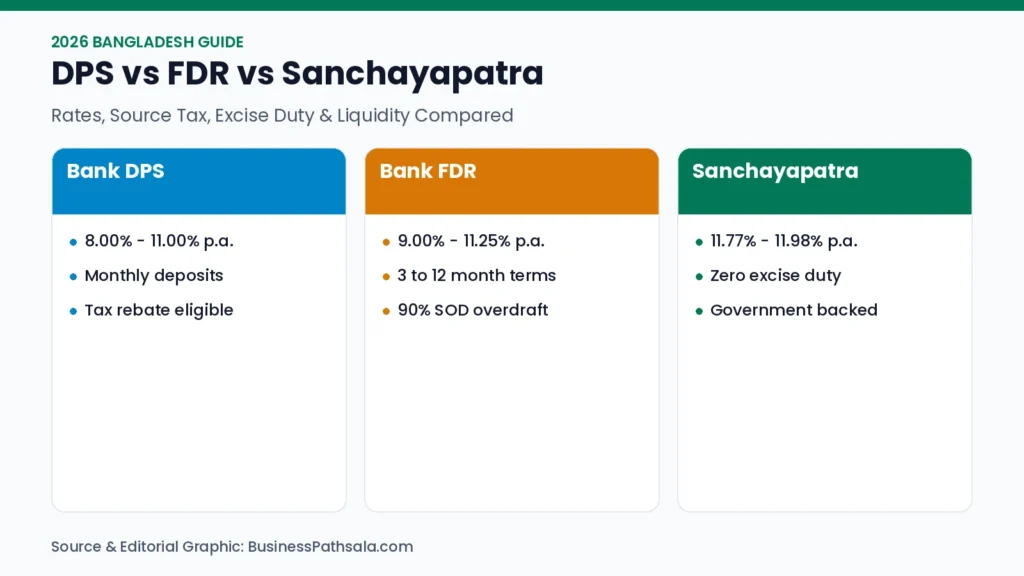
In late 2026, major private banks offer 8.00% to 11.00% per year depending on tenure. Reviewing the best bank for DPS in BD shows that longer 5- to 10-year plans often pay higher rates at select banks, while some banks reward shorter 1- to 3-year terms.
DPS also helps lower your yearly income tax bill. Under Finance Act 2026, DPS deposits up to Tk 1,20,000 per year (Tk 10,000 per month) count as eligible investments for tax rebate calculations.
Where DPS Falls Short
Missing monthly installments can trigger late fees or cut your final interest rate. Breaking a DPS early also drops your return to a basic savings rate.
| Type | Point | Practical Impact |
|---|---|---|
| Pro | Low monthly entry | Start saving from Tk 250–Tk 500 monthly |
| Pro | Tax rebate benefit | Up to Tk 1,20,000 yearly counts for rebate |
| Pro | Forced discipline | Auto-debit builds wealth without effort |
| Con | Bank credit risk | Deposit insurance covers only Tk 2 lakh |
| Con | Excise duty applies | Balances above Tk 4 lakh incur yearly duty |
Once your monthly savings grow into a lump sum, your next decision is where to park that larger balance.
Why Lump-Sum Savers Compare FDR and Sanchayapatra
When you already hold Tk 50,000 or Tk 10 lakh, a DPS is too slow. Fixed deposits and national savings certificates are built specifically for lump-sum capital.
Where FDR Shines and Falls Short
A Fixed Deposit Receipt locks a lump sum in a bank for 1 month to 5 years. Most savers pick 6-month or 12-month tenures to stay flexible.
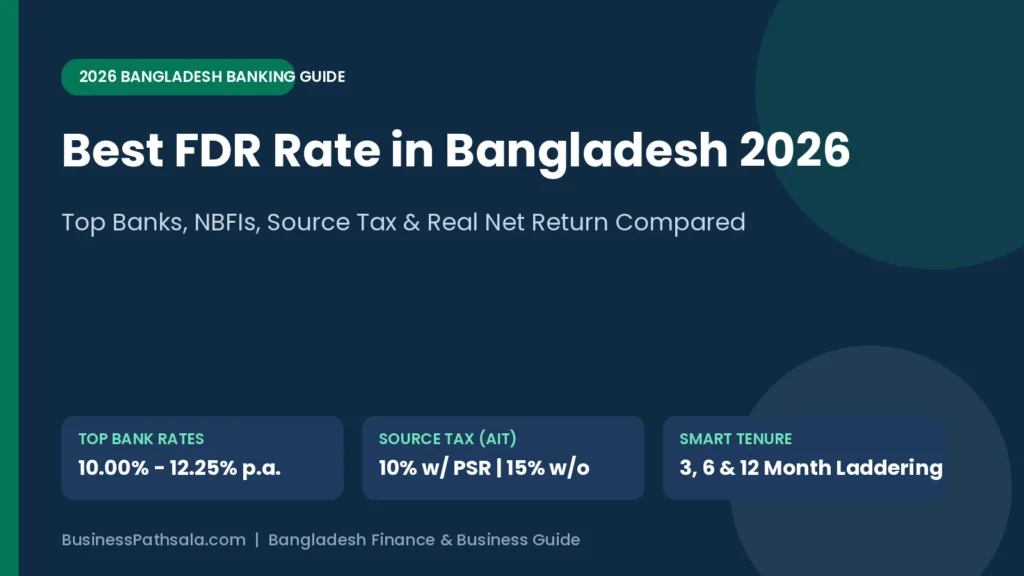
Strong Tier-1 private banks pay roughly 9.00% to 11.25% in 2026, while state-owned banks pay 8.50% to 9.75%. You can check the best FDR rate in Bangladesh 2026 to compare current private bank and AAA-rated NBFI slabs.
The biggest advantage of an FDR is emergency liquidity. Instead of breaking your deposit, you can take a Secured Overdraft (SOD) loan worth 80% to 90% of the balance within a day.
| Type | Point | Practical Impact |
|---|---|---|
| Pro | Short tenures available | Lock cash for 3, 6, or 12 months easily |
| Pro | Instant SOD loan | Borrow 80%–90% without breaking the FDR |
| Pro | No investment cap | Deposit any amount across multiple banks |
| Con | No tax rebate | FDR principal does not lower income tax |
| Con | Excise duty slabs | Duty jumps to Tk 3,000 above Tk 10 lakh |
Where Sanchayapatra Shines and Falls Short
Sanchayapatra is backed directly by the Government of Bangladesh through the National Savings Directorate. That sovereign guarantee removes bank default risk completely.
For July–December 2026, maturity rates reach 11.98% on Pensioner Sanchayapatra and 11.93% on Paribar (Family) Sanchayapatra for holdings up to Tk 7.5 lakh. Standard 5-Year and 3-Monthly schemes pay 11.83% and 11.82% up to Tk 7.5 lakh, and 11.77% to 11.80% above that tier.
You can model exact monthly or quarterly payouts with our Sanchaypatra profit rates and source tax calculator 2026. Unlike bank deposits, Sanchayapatra charges zero annual excise duty.
| Type | Point | Practical Impact |
|---|---|---|
| Pro | 100% sovereign safety | Government guarantee with zero bank risk |
| Pro | Highest safe rates | 11.77%–11.98% beats most Tier-1 banks |
| Pro | Zero excise duty | No yearly balance fee regardless of size |
| Con | Strict holding caps | Tk 50 lakh max per person across schemes |
| Con | Harsh early exit | Cashing early deducts excess paid profit |
Seeing the pros and cons alone is helpful, yet tax rules and cash access usually decide the final winner.
Side-by-Side Breakdown for DPS vs FDR vs Sanchayapatra
Real take-home profit depends on National Board of Revenue rules effective July 1, 2026. Here is how all three compare on tax, liquidity, and saver fit.
Tax Rules and Real Net Return
Every profit payout faces source tax before reaching your bank account. Submitting tax proof makes a major difference on bank deposits.
| Cost Factor | DPS & FDR | Sanchayapatra |
|---|---|---|
| Source Tax (With PSR) | 10% on profit | 10% advance tax on all profit |
| Source Tax (No PSR) | 15% on profit | 10% (PSR required above Tk 10L) |
| Final vs Adjustable Tax | Adjustable in return | Adjustable from FY2026–27 |
| Annual Excise Duty | Tk 0 up to Tk 4 lakh | Tk 0 on all balances |
| Investment Tax Rebate | DPS yes; FDR no | Yes (within NBR ceiling) |
From July 2026, Sanchayapatra source tax is a flat 10% advance tax on all profit. You add the profit to your tax return and adjust the 10% against your total tax liability. Under Finance Act 2026, the bank excise duty exemption limit also rose from Tk 3 lakh to Tk 4 lakh.
After-Tax Return Ratings (based on late-2026 published yields and zero excise duty): Sanchayapatra 9.5/10, Bank DPS 8.0/10 (boosted by tax rebate), Bank FDR 7.5/10.
Liquidity and Emergency Access
Liquidity measures how fast you can turn savings into cash without losing money. Bank deposits hold a clear lead over government certificates here.
If you break a 3-Monthly or Family Sanchayapatra before maturity, your rate drops to the lower early-exit slab. Any extra profit already paid is deducted directly from your principal. With an FDR, you can keep your principal intact by borrowing against it via an SOD loan, or split large funds into 3-month and 6-month receipts.
Practical Rule: Keep 3 to 6 months of living expenses in a liquid Tier-1 bank FDR before locking extra savings into a 3- or 5-year Sanchayapatra.
Liquidity Ratings (based on withdrawal speed, early-exit penalty, and SOD loan access): Bank FDR 9.0/10, Bank DPS 7.0/10, Sanchayapatra 5.5/10.
Who Fits Best With Each
Your cash flow pattern matters more than chasing an extra 0.50% rate. Match your deposit method to your actual timeline.
| Saver Profile | Best Pick | Why It Fits |
|---|---|---|
| Salaried monthly saver | Bank DPS | Small monthly deposits plus tax rebate |
| Emergency fund builder | Tier-1 Bank FDR | Fast access and 80%–90% SOD loan |
| Retiree or homemaker | Paribar / Pensioner Sanchayapatra | Highest safe monthly or quarterly income |
| Tax-conscious earner | DPS + Sanchayapatra | Maximizes eligible 2026 tax rebate |
| High-net-worth investor | FDR + Sanchayapatra | Handles funds above the Tk 50L cap |
To lower your annual tax bill legally, review all tax rebate investment options in Bangladesh under the Finance Act 2026 rules. You can also explore government bonds alongside these three choices in our guide on where to invest money in Bangladesh safely.
Conclusion
Comparing DPS vs FDR vs Sanchayapatra shows that each tool solves a different financial job. Choose a bank DPS if you save monthly from a salary and want a tax rebate, pick a Tier-1 bank FDR for flexible emergency reserves, and use Sanchayapatra when you can lock a lump sum for 3 to 5 years at maximum sovereign safety.
Most Bangladeshi households get the best result by combining them. Start a monthly DPS for habit, hold a 6-month FDR ladder for emergencies, and move long-term surplus cash into Sanchayapatra.
FAQs for DPS vs FDR vs Sanchayapatra
Which gives the highest return in DPS vs FDR vs Sanchayapatra?
Sanchayapatra pays the highest safe return at 11.77% to 11.98% in late 2026, beating most Tier-1 bank FDRs (9.00%–11.25%) and DPS plans (8.00%–11.00%).
How does 2026 source tax differ across DPS, FDR, and Sanchayapatra?
Sanchayapatra deducts 10% advance tax on all profit from July 2026. Bank DPS and FDR cut 10% with PSR or e-TIN proof, or 15% without tax proof.
Do you pay excise duty on DPS, FDR, and Sanchayapatra?
Sanchayapatra carries zero excise duty. Bank DPS and FDR accounts are exempt up to Tk 4 lakh under Finance Act 2026, then charged by balance slab.
Which option is best if you need emergency cash quickly?
Bank FDR wins for fast liquidity because you can take an 80% to 90% SOD loan instantly without breaking the deposit and losing your full profit.
Can you get an income tax rebate from DPS, FDR, or Sanchayapatra?
Only bank DPS (up to Tk 1,20,000 yearly) and Sanchayapatra qualify for investment tax rebates under Finance Act 2026. Standard bank FDRs do not.