Last updated: · By Abrar Hossain
Choosing between DPS vs FDR vs Sanchayapatra is one of the most common money decisions for savers in Bangladesh. Each option promises steady returns, yet they work in very different ways once you factor in deposit style, source tax, and early withdrawal rules.
A high headline rate can be misleading when excise duty or tax cuts into your payout. Comparing all three side by side using 2026 rates and Finance Act 2026 rules makes it much easier to put every taka in the right place.
Core Trade-Offs in DPS vs FDR vs Sanchayapatra
Every savings tool asks you to trade one benefit for another. The table below outlines how 2026 annual rates and key rules stack up across the four main choices.
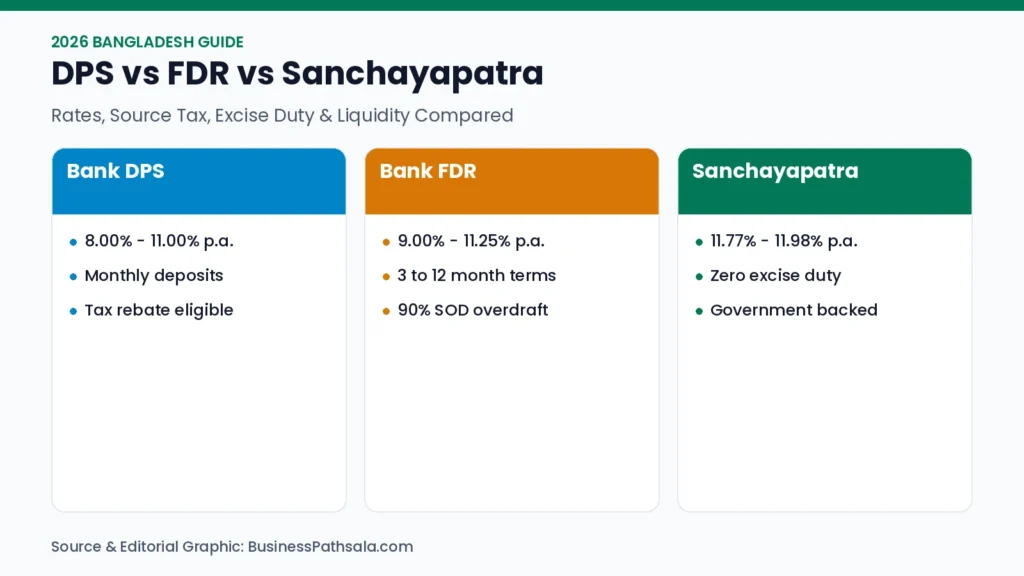
| Savings Option | 2026 Annual Rate | Key Trade-Off |
|---|---|---|
| Bank DPS | 8.00% to 11.00% | Monthly discipline, lower lump growth |
| Bank FDR (Tier-1) | 9.00% to 11.25% | Fast liquidity, excise duty applies |
| 3-Monthly / 5-Year Sanchayapatra | 11.77% to 11.83% | Highest safe yield, 1-year lock-in |
| Paribar / Pensioner Sanchayapatra | 11.80% to 11.98% | Monthly payout, strict eligibility |
Rates alone never tell the full story. Understanding how each instrument behaves day to day helps you avoid costly early penalties.
How Bank DPS Works for Regular Savers
A Deposit Pension Scheme lets you build a lump sum through fixed monthly installments. Most scheduled banks accept deposits starting from Tk 500 or Tk 1,000 per month for one to ten years.
Where Bank DPS Shines
DPS removes the pressure of saving a large lump sum upfront. Standing instructions pull money from your salary account automatically on a set date each month.
Under Bangladesh tax rules, annual DPS deposits up to Tk 1,20,000 qualify as eligible investment for tax rebate. You can also borrow up to 90% of your accumulated balance as a secured overdraft if an emergency hits. For bank-by-bank terms, see our guide on the best bank for DPS in Bangladesh.
Where Bank DPS Falls Short
Missing monthly due dates can trigger late fees or cut your maturity bonus. Breaking the account early also drops your rate to the bank savings level and triggers a tax rebate clawback.
| Type | DPS Feature | Practical Impact |
|---|---|---|
| Pro | Low monthly entry | Start saving from Tk 500 monthly |
| Pro | Tax rebate eligible | Up to Tk 1,20,000 yearly counts |
| Con | Early exit penalty | Drops yield to 2% to 3.5% |
| Con | Excise duty above Tk 4L | Applies once balance crosses limit |
DPS works best when you are still building capital from monthly income. Once you already hold a lump sum, a fixed deposit changes the math completely.
How Bank FDR Works for Lump-Sum Liquidity
A Fixed Deposit Receipt locks a single lump sum in a bank for a chosen term. Tenures typically range from three months to five years, with six-month and one-year terms offering strong flexibility.
Where Bank FDR Shines
FDR is unmatched for short-term flexibility and emergency access. You can open a deposit through a mobile app in minutes and renew or encash it when the term ends.
Strong Tier-1 private banks pay between 9.00% and 11.25% per year in 2026, while state-owned banks pay roughly 8.50% to 9.75%. If you need cash for a short period, an 80% to 90% overdraft loan keeps your maturity profit intact. Check our breakdown of the best FDR rates in Bangladesh for 2026 for current slabs.
Where Bank FDR Falls Short
Bank FDR does not qualify for an annual income tax rebate. You also carry bank credit risk above the Tk 2 lakh deposit insurance cap, so picking a financially strong bank matters.
| Type | FDR Feature | Practical Impact |
|---|---|---|
| Pro | Short 3 to 12 month terms | Matches near-term cash needs |
| Pro | Instant SOD loan option | Borrow 80% to 90% in emergencies |
| Con | No tax rebate benefit | Zero reduction on yearly income tax |
| Con | Bank stability risk | Weak banks may delay payouts |
FDR gives you speed and control over short horizons. If you can leave a lump sum untouched for three to five years, government savings certificates offer stronger protection.
How Sanchayapatra Works for Sovereign Safety
Sanchayapatra refers to National Savings Certificates backed directly by the Government of Bangladesh. For July to December 2026, published maturity rates sit between 11.77% and 11.98% across major schemes.
Where Sanchayapatra Shines
Sanchayapatra combines the highest guaranteed fixed return with sovereign backing. Unlike bank accounts, national savings certificates carry zero annual excise duty and zero hidden maintenance fees.
Eligible groups can also collect steady monthly income through Paribar or Pensioner schemes, while general investors can earn quarterly payouts via the 3-Monthly certificate. Review exact slab math in our Sanchayapatra profit rates and source tax guide.
Where Sanchayapatra Falls Short
Sanchayapatra requires a lump sum upfront and enforces strict purchase limits. Individual holdings are capped at Tk 50 lakh across main schemes, and encashing before one full year pays zero profit.
| Type | Sanchayapatra Feature | Practical Impact |
|---|---|---|
| Pro | Government guarantee | Virtually zero default risk |
| Pro | Zero excise duty | Protects net profit on large sums |
| Con | 1-year profit lock-in | Early exit under 12 months pays 0% |
| Con | No loan facility | Cannot pledge for a bank overdraft |
Each option clearly serves a different stage of wealth building. Comparing their tax rules, liquidity, and net scores side by side makes the final decision much sharper.
Side-by-Side Comparison for DPS vs FDR vs Sanchayapatra
To judge DPS vs FDR vs Sanchayapatra fairly, we look at tax deductions, emergency access, and net returns. Every score below is based on published 2026 rates and Finance Act 2026 rules.
Tax Deductions and Hidden Charges
Source tax and excise duty separate advertised rates from actual cash in hand. Here is how bank products compare against government certificates under 2026 rules.
| Cost Factor | Bank DPS and FDR | Sanchayapatra |
|---|---|---|
| Source tax (with e-TIN / PSR) | 10% on profit | 10% standard (5% if confirmed under Tk 5L) |
| Source tax (without e-TIN / PSR) | 15% on profit | 0% on Pensioner up to Tk 5L |
| Annual excise duty | Tk 0 up to Tk 4L; slab-based above | Tk 0 on all balances |
| Income tax rebate | DPS only (up to Tk 1.2L/year) | Eligible within statutory cap |
| Early break penalty | Savings rate after 3 months | 0% under 1 year; lower slab after |
Tax Efficiency Rating (based on excise duty, source tax, and rebate scope): Sanchayapatra 9/10, Bank DPS 8/10, Bank FDR 6.5/10. Submitting your e-TIN and tax return proof immediately saves 5% on bank profit tax.
Liquidity and Emergency Access
Life rarely waits for a five-year maturity date. How quickly you can unlock cash without losing principal or earned profit matters just as much as interest rate.
Practical Liquidity Rule: Keep three to six months of living expenses in a short-term FDR or savings account before locking multi-year funds into Sanchayapatra.
Liquidity Rating (based on tenure flexibility and overdraft loan access): Bank FDR 9/10, Bank DPS 7.5/10, Sanchayapatra 6/10. Bank overdraft access gives FDR and DPS a major edge during sudden medical or business cash crunches. For wider portfolio balance, review our personal finance planning guide for Bangladesh.
Who Fits Best With Each Option
Matching your cash flow and timeline to the right tool prevents regrets later. Use this quick matrix to pair your goal with the strongest match.
| Saver Profile | Best Choice | Why It Fits |
|---|---|---|
| Salaried monthly saver | Bank DPS | Automates savings and adds tax rebate |
| Emergency fund holder | Tier-1 Bank FDR | Short terms plus 90% overdraft access |
| Retiree or monthly income need | Paribar / Pensioner Sanchayapatra | Highest monthly payout with low tax |
| 3 to 5 year lump-sum goal | 5-Year / 3-Monthly Sanchayapatra | Top sovereign rate and zero excise duty |
| Lump sum above Tk 50 lakh | FDR + Treasury mix | No single-name Sanchayapatra cap |
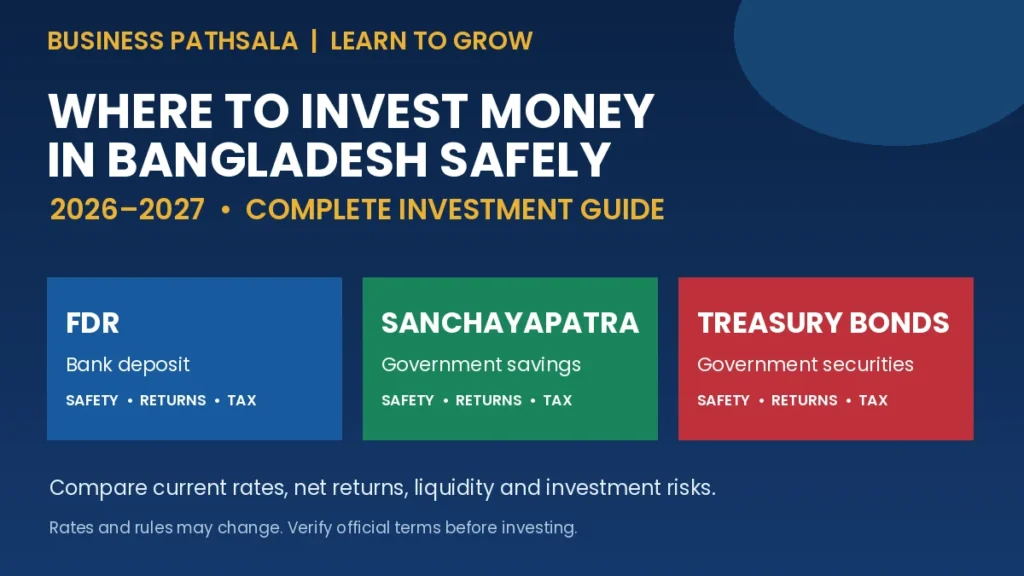
Many households combine all three instead of picking just one. You can also explore Treasury Bonds alongside these options in our guide to safe investments in Bangladesh.
Conclusion
There is no single winner in DPS vs FDR vs Sanchayapatra because each tool solves a different financial job. Choose Bank DPS to build disciplined monthly savings from your income, choose a Tier-1 Bank FDR for emergency reserves and short-term liquidity, and choose Sanchayapatra when you hold a lump sum you can safely lock for three to five years at top government-backed rates.
Before opening any account in 2026, confirm current rate slabs with your bank or national savings office and submit your e-TIN or return proof on day one to protect your net return.
FAQs for DPS vs FDR vs Sanchayapatra
Which gives the highest return in DPS vs FDR vs Sanchayapatra?
Sanchayapatra pays the highest safe yield at 11.77% to 11.98% in 2026, with zero excise duty, ahead of most Tier-1 bank FDR and DPS plans.
Is DPS better than FDR for salaried people?
DPS fits salaried savers better because it builds wealth from small monthly deposits and qualifies for up to Tk 1.2 lakh in annual tax rebate.
Can I take a loan against DPS, FDR, or Sanchayapatra?
Banks let you borrow 80% to 90% against a DPS or FDR via a secured overdraft, while Sanchayapatra does not offer any loan facility.
How does source tax differ across DPS, FDR, and Sanchayapatra?
Bank DPS and FDR deduct 10% tax with e-TIN or PSR and 15% without. Sanchayapatra deducts 10%, or 0% on Pensioner schemes up to Tk 5 lakh.
Which option is safest for emergency money in 2026?
A short-term FDR at a strong Tier-1 bank is best for emergency cash because you can access funds quickly or take an overdraft anytime.