Last updated: · By Afra Monira
Buying sovereign debt in Bangladesh no longer requires institutional connections or a massive portfolio. If you have Tk 1 lakh and a regular bank account, you can learn how to buy Bangladesh Government Treasury Bills and Bonds directly through a local bank or the stock market.
As of late November 2026, Bangladesh Bank auction cut-off yields sit between 8.08% and 8.53% for short-term Treasury Bills and up to 9.60% for 20-year Treasury Bonds. Unlike Sanchaypatra, there is no upper investment ceiling, and unlike bank FDRs, your balance carries zero excise duty.
Treasury Bills vs. Treasury Bonds: quick comparison
Both instruments are backed by the Government of Bangladesh and issued by Bangladesh Bank. The main difference comes down to how long you want to lock in your money and how you receive returns.
| Feature | Treasury Bills (T-Bills) | Treasury Bonds (BGTB) |
|---|---|---|
| Tenor options | 91, 182, and 364 days | 2, 5, 10, 15, and 20 years |
| How returns pay | Bought at a discount; full face value paid at maturity | Fixed coupon paid every 6 months; principal at maturity |
| Minimum amount | Tk 1,00,000 (multiples of Tk 1 lakh) | Tk 1,00,000 (multiples of Tk 1 lakh) |
| Weekly auction day | Usually Sundays | Usually Tuesdays |
| Who can buy | Resident individuals and institutions | Residents and non-residents (via NITA/NFCA) |
| Stock exchange trading | Not traded on DSE/CSE (bank OTC only) | Tradable on DSE/CSE and bank OTC |
You can verify current tenors and auction cut-offs anytime on the official Bangladesh Bank Treasury Auction page. For a deeper look at how coupon rates compare to market yields, see our guide on Treasury Bond interest rates in Bangladesh.
Latest Bangladesh Treasury Bill and Bond yields (November 2026)
Rates change slightly at every weekly auction based on bank liquidity and bids. Below are the actual cut-off yields recorded in Bangladesh Bank’s November 2026 primary auctions.
| Security type | Tenor | Nov 2026 cut-off yield | Auction reference |
|---|---|---|---|
| Treasury Bill | 91 days | 8.08% | 23 Nov 2026 |
| Treasury Bill | 182 days | 8.44% | 23 Nov 2026 |
| Treasury Bill | 364 days | 8.53% | 23 Nov 2026 |
| Treasury Bond | 2 years | 8.55% | 04 Nov 2026 |
| Treasury Bond | 5 years | 8.38% | 11 Nov 2026 |
| Treasury Bond | 10 years | 9.33% | 18 Nov 2026 |
| Treasury Bond | 15 years | 9.57% | 25 Nov 2026 |
| Treasury Bond | 20 years | 9.60% | 25 Nov 2026 |
If you prefer a Shariah-compliant government option with a smaller Tk 10,000 minimum, check our walkthrough on Sukuk bond investment in Bangladesh.
How to buy Bangladesh Government Treasury Bills and Bonds via a bank (BPID)
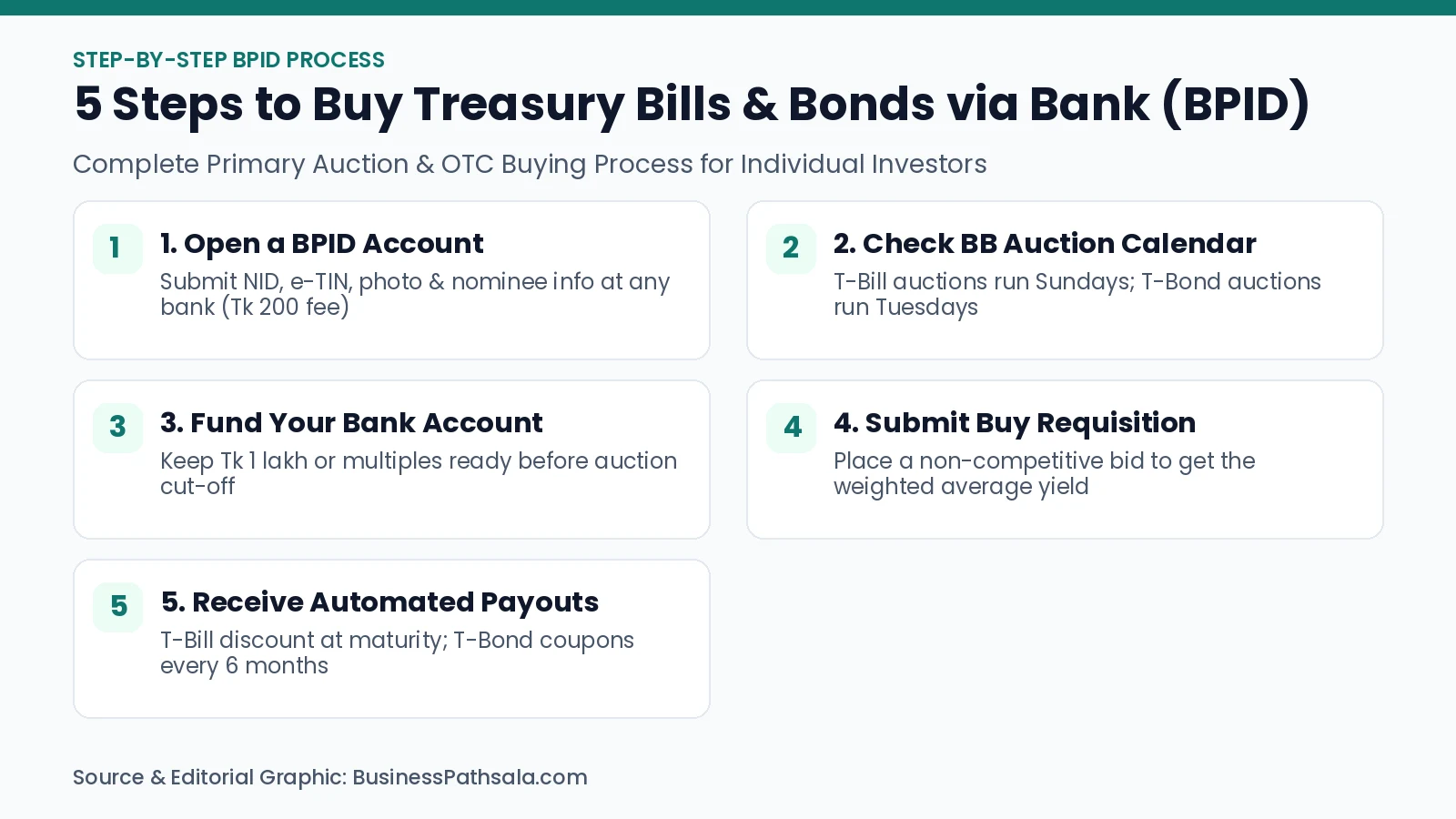
Opening a Business Partner Identification (BPID) account through a scheduled bank is the most flexible method. It lets you participate in weekly Bangladesh Bank primary auctions for both T-Bills and T-Bonds, or buy directly from the bank’s own inventory on any working day.
Step 1: Choose a participating bank or Primary Dealer
Almost every major scheduled bank in Bangladesh operates a Government Securities Investment Window, including City Bank, BRAC Bank, Prime Bank, Bank Asia, EBL, MTB, Midland Bank, and Sonali Bank. Using a bank where you already hold a savings or current account saves time because you will not need to open a separate settlement account.
Step 2: Open your BPID account with Bangladesh Bank
Visit your branch or download the bank’s BPID Opening Form (Annexure-A) and Schedule of Charges. Your bank submits this file to Bangladesh Bank’s Market Infrastructure (MI) Module to generate your unique BPID number. Most banks complete BPID activation within 2 to 5 working days.
Keep these documents ready for an individual BPID application:
- Copy of your valid National ID (NID) or Passport
- Two recent passport-size photographs
- Your 12-digit e-TIN certificate (if you do not have one yet, follow our guide to get an e-TIN certificate online in Bangladesh)
- Active bank account number and routing number for automated payouts
- Nominee’s NID/Passport copy and one passport-size photo
Step 3: Check the weekly auction calendar and fund your account
Bangladesh Bank normally conducts T-Bill auctions on Sundays and T-Bond auctions on Tuesdays. Check the upcoming issue notice on the Bangladesh Bank Government Securities Market portal, then deposit at least Tk 1,00,000 (or any multiple of Tk 1 lakh) plus bank charges into your linked account at least one working day before the auction.
Step 4: Submit your buy order (choose non-competitive bidding)
Fill out the bank’s Government Securities Buy/Transaction Form and email or hand it to the branch or treasury desk before the bank’s internal cut-off time (often 10:00 AM on auction day, or the previous working day).
As an individual investor, select a non-competitive bid on the auction form. Instead of guessing a yield and risking rejection, Bangladesh Bank automatically allocates your bid at the weighted-average yield of the accepted competitive bids.
If you do not want to wait for an auction, ask your bank’s treasury desk for a secondary-market (OTC) quote. Banks frequently sell existing T-Bills and T-Bonds from their inventory with broken or custom remaining maturities—for example, a bond with 3.5 years left.
Step 5: Confirm allotment and track automatic payouts
Once the auction settles (typically T+1 or T+2 working days), your bank debits the purchase price and emails your allotment confirmation showing the ISIN number and maturity date. For T-Bills, you pay a discounted price upfront (for instance, roughly Tk 92,200 for a Tk 1 lakh 364-day bill) and receive the full Tk 1,00,000 at maturity. For T-Bonds, your semi-annual coupon drops directly into your bank account every six months without any follow-up.
How to buy Bangladesh Government Treasury Bonds via DSE/CSE (BO account)
If you already trade shares in Bangladesh, you can buy listed Treasury Bonds directly through the Dhaka Stock Exchange (DSE) or Chittagong Stock Exchange (CSE). Keep in mind that only Treasury Bonds (BGTBs) trade on the stock exchanges—short-term Treasury Bills must still be bought through a bank BPID.
- Use your active BO account: Open a Beneficiary Owner (BO) account with any DSE or CSE brokerage house if you do not have one. You do not need to pay a separate bank BPID opening fee when buying via your BO account.
- Deposit funds with your broker: Transfer at least Tk 1 lakh (plus brokerage commission and any accrued interest) to your BO trading balance.
- Pick a listed BGTB by ISIN and remaining tenor: Ask your broker’s trading desk for active Treasury Bond quotes, checking the remaining maturity, coupon rate, and Yield to Maturity (YTM)—not just the headline coupon.
- Place the buy order on the DSE/CSE board: Your broker executes the trade on the exchange’s debt board. The bond settles into your CDBL BO account, and semi-annual coupons credit automatically to your linked bank account.
Government securities are inexpensive to hold compared to mutual funds or corporate brokerage portfolios. Standard retail fees published by major Bangladeshi commercial banks (such as Prime Bank and Bank Asia) follow this structure:
| Charge type | Individual investor | Corporate / Institutional |
|---|---|---|
| BPID opening fee (one-time) | Tk 200 (incl. VAT) | Tk 500 (incl. VAT) |
| Primary auction fee (per successful bid) | Tk 200 | Tk 500 |
| Secondary market trade fee (OTC) | Tk 100 per trade | Tk 100 per trade |
| Annual BPID maintenance fee | Tk 200 per year | Tk 500 per year |
| Annual tax certificate | 1st copy free; Tk 200 extra | 1st copy free; Tk 500 extra |
On the tax side, banks and Bangladesh Bank deduct 10% Advance Income Tax (AIT) at source from coupon or discount income for individual investors (15% for institutions). Two tax perks make these instruments stand out against fixed deposits:
- Zero excise duty: Unlike bank FDRs or savings accounts, Treasury Bill and Bond holdings are completely exempt from annual government excise duty.
- Income tax rebate: Resident individuals can include eligible BGTB investments when calculating their annual investment tax rebate under Bangladesh’s Income Tax Act.
Still weighing whether to put your savings into T-Bonds, Sanchaypatra, or a bank FDR? Compare the net after-tax math in our guides on Sanchayapatra vs. Treasury Bond in Bangladesh and where to invest money safely in Bangladesh.
Four mistakes new buyers make (and how to avoid them)
- Confusing coupon rate with actual yield: When buying a re-issued or secondary-market bond, the price may sit above or below Tk 100 per unit. Always ask your bank for the Yield to Maturity (YTM) and total settlement cost (clean price plus accrued interest).
- Forgetting price risk on early exit: If you hold a T-Bill or T-Bond to maturity, you get 100% of face value back. If you sell a 10-year or 20-year bond early while interest rates rise, its market price can drop below what you paid.
- Overlooking re-issue remaining maturity: An auction labeled “15-Year T-Bond (Re-issue)” often has only 10 to 12 years left until maturity. Check the remaining maturity column before bidding.
- Missing bank cut-off times: Although Bangladesh Bank auctions run on Sundays and Tuesdays, most retail bank branches require your signed buy form one working day earlier.
Frequently asked questions
What is the minimum amount to buy Bangladesh Treasury Bills or Bonds?
The minimum face value is Tk 1,00,000 (Tk 1 lakh), and you can invest in any multiple of Tk 1 lakh with no upper ceiling. For secondary-market bond purchases, the cash you pay may be slightly above or below Tk 1 lakh depending on market price and accrued interest.
Can I buy Bangladesh Treasury Bills online through a mobile banking app?
Most banks still require a one-time signed BPID opening form at the branch or via verified email. Once your BPID is active, several private banks allow you to email scanned buy/sell requisitions directly to their treasury desk without visiting the branch again.
Can non-resident Bangladeshis (NRBs) buy Treasury Bills and Bonds?
Non-residents can buy Bangladesh Government Treasury Bonds (BGTBs) using funds from a Non-Resident Investor’s Taka Account (NITA) or Foreign Currency Account, and both coupons and principal are repatriable. However, Bangladesh Bank rules restrict short-term Treasury Bills to resident investors only.
Can I encash a Treasury Bill or Bond before maturity?
Yes. You cannot “break” it like a fixed deposit, but you can sell it anytime on the secondary market through your bank’s treasury desk (or via DSE/CSE for listed T-Bonds). Your sale proceeds depend on prevailing market yields on the day you sell.
How much tax is deducted on Treasury Bill and Bond returns in 2026?
Commercial banks currently deduct 10% source tax (AIT) on coupon and discount income for individual investors and 15% for corporate institutions, with zero excise duty. Always confirm the latest withholding rate with your bank before placing a large bid, as NBR Finance Act rules can change.
Next step before your first auction
Call your primary bank’s branch or relationship manager today and ask for their BPID Opening Form and current Schedule of Charges. Getting your BPID activated takes less than a week, and once it is live, you can participate in any Sunday T-Bill or Tuesday T-Bond auction with a single email requisition.
Disclaimer: This article is for informational purposes only and is not personal financial or tax advice. Auction yields, bank service fees, and NBR tax rules change periodically—verify current figures with Bangladesh Bank and your participating bank before investing.