Quick answer: A bank-ready business plan for a startup loan in Bangladesh must do two jobs at once: prove your venture fits Bangladesh Bank’s startup definition (innovation, technology or IP, and scalability) under SMESPD Circular No. 02 (9 July 2025), and show a commercial bank or finance company how monthly operating cash will repay the facility. Size your combined term and working-capital request within your registration-age ceiling (BDT 2 crore under 2 years, BDT 5 crore for 2 to 6 years, or BDT 8 crore for 6 to 12 years), back every cost with vendor quotes, and stress-test your cash flow against the 8% maximum annual customer rate and any requested grace period.
Updated 20 November 2026. Central-bank policies and lender terms can change. Confirm the active circular, lender participation, fund availability, and written sanction offer before making any financing commitment.
Founders in Dhaka, Chattogram, and across Bangladesh often submit investor pitch decks when applying for a bank loan. Credit committees rarely approve loans from a 12-slide pitch deck. Venture investors look for upside and exit multiples; bank credit officers look for policy eligibility, verifiable fund usage, clean credit records, and predictable debt service. Writing a business plan for a startup loan means translating your startup’s growth story into the exact credit language a Bangladeshi bank or non-bank financial institution (NBFI) uses to evaluate risk.
How a Startup Loan Business Plan Differs from a Standard Bank Loan Plan
A traditional shop, wholesaler, or garment subcontractor applies for credit using past tax returns, years of bank statements, and tangible inventory or property. If you are preparing a plan for a regular trading or manufacturing business, our general business plan guide for bank loans in Bangladesh covers that standard CMSME track under Bangladesh Bank’s CMSME Master Circular (17 March 2025).
A startup loan business plan works differently because early-stage ventures rarely have three years of audited profit. Instead of relying solely on historical collateral and turnover, your document must bridge the trust gap between an innovative business model and a conservative credit committee.
| Evaluation Area | Standard SME Bank Loan Plan | Startup Loan Business Plan (Bangladesh) |
|---|---|---|
| Policy framework | CMSME Master Circular (March 2025) and standard commercial credit rules | SMESPD Circular No. 02 (9 July 2025) Startup Financing Master Circular |
| Core eligibility proof | Operating history, trade licence, historical turnover, and bank account activity | Innovation, technology or IP edge, scalability, and registration age (0 to 12 years) |
| Primary financial focus | Historical statements, inventory cycles, and existing debt service | Unit economics, pilot traction, burn rate, cash runway, and post-grace repayment |
| Funding structure | Term loan, cash credit (CC), or overdraft tied to physical assets or stock | Combined term finance and working capital within stage ceilings (BDT 2, 5, or 8 crore) |
| Key risk to address | Seasonal dips, supplier price swings, or late buyer payments | Product-market fit risk, delayed monetization, customer acquisition cost, and tech execution |
Understanding this difference saves weeks of back-and-forth with a branch SME or startup desk. You are not trying to hide that your company is young. You are showing the lender that your assumptions are grounded in real customer demand and conservative cash math.
Understanding Bangladesh Bank Startup Financing Limits Before You Write
Before drafting a single page, align your funding ask with the rules in Bangladesh Bank’s Master Circular on Start-up Financing. Bangladesh Bank operates a BDT 500 crore revolving Startup Fund to refinance participating banks and finance companies, as also contextualized in the Bangladesh Bank Annual Report 2024–2025. You do not apply to Bangladesh Bank directly. You submit your business plan to a scheduled bank or finance company, which evaluates the proposal under its own credit policy and may seek refinance after disbursement.
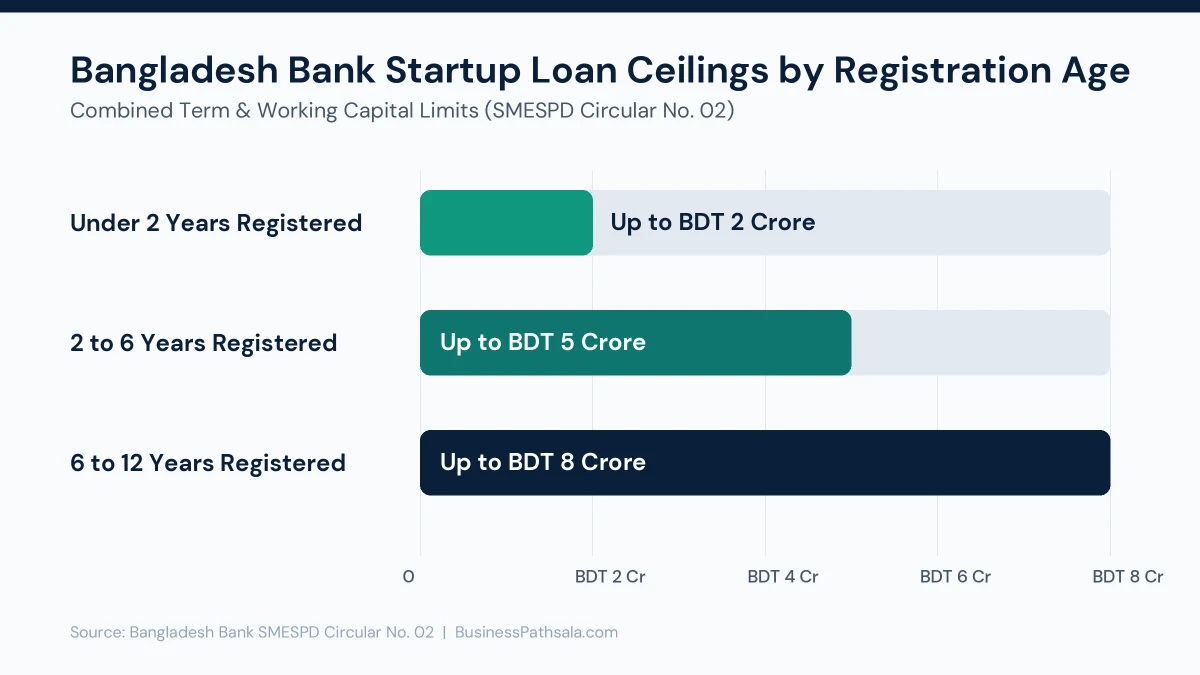
Keep these five policy boundaries visible while building your financial model:
- Registration-age ceilings: Combined term finance and working capital cannot exceed BDT 2 crore for startups registered less than 2 years, BDT 5 crore for 2 to 6 years, and BDT 8 crore for 6 to 12 years. Ventures older than 12 years fall outside this startup window.
- Customer rate ceiling vs. refinance rate: The circular sets a maximum customer-level interest or profit rate of 8% per year (applied quarterly on a compound basis). The 0.50% rate mentioned in the circular is the refinance rate paid by banks to Bangladesh Bank, not the rate charged to founders. Some banks advertise lower product rates when refinance allocations are open—for example, ONE Bank’s Notun Uddyog product page lists 4% per year subject to fund availability and product terms—but you should always model your plan conservatively up to the 8% ceiling until you hold a written sanction letter.
- Tenure and grace period: Term finance can run up to 8 years, including a grace period of 3 months to 2 years depending on the venture’s revenue cycle. Working capital is renewable up to 8 years from first disbursement, after which renewals move to market rates.
- Non-defaulter and age rules: Neither the startup nor any individual founder or director may be a loan defaulter. For IT ventures, the circular notes a minimum entrepreneur age of 21.
- No automatic collateral waiver: The circular does not grant a blanket collateral-free right. Security, personal guarantees, and hypothecation depend on the bank’s internal credit policy.
For a full breakdown of eligibility rules, equity limits, and participating lender checks, read our companion guide on startup loan limits and eligibility in Bangladesh. You should also check the Bangladesh Bank SMESPD circular portal before submission to verify whether any amendment has been issued.
Core Sections of a Startup Loan Business Plan in Bangladesh
A credit analyst should be able to read your business plan in 20 minutes and trace every Taka from your problem statement to your repayment schedule. Most bankable startup loan plans run 12 to 20 pages plus financial spreadsheets and annexures. Organize your document into these eight clear sections.
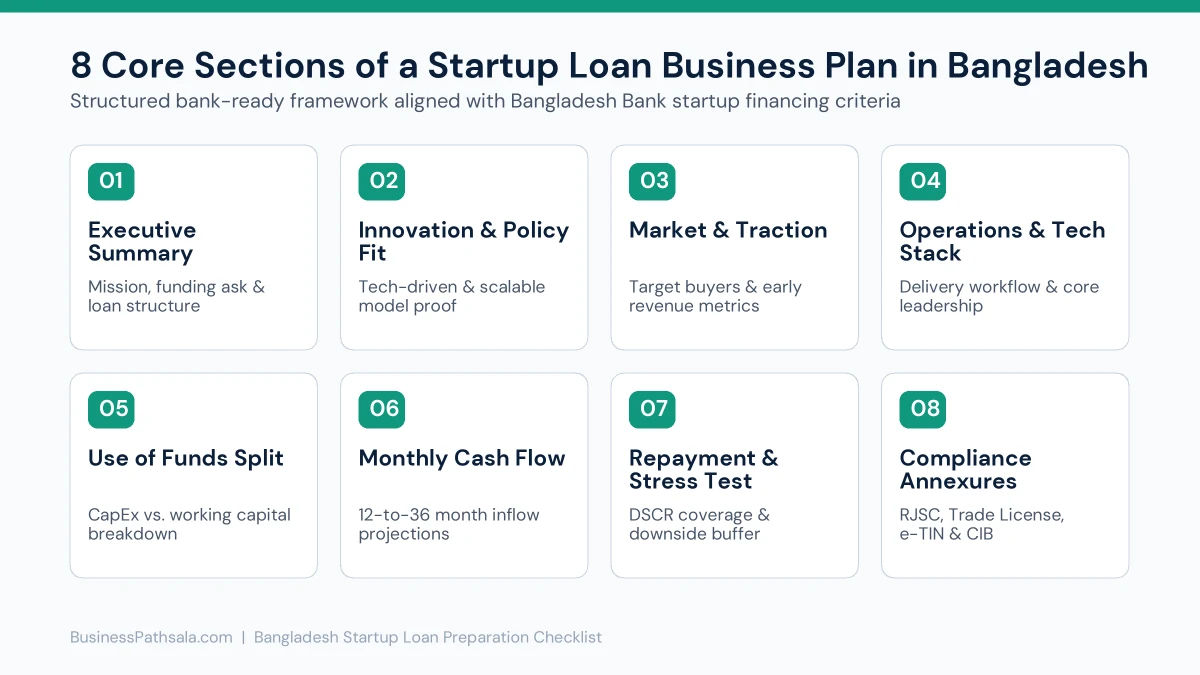
1. Executive Summary and Loan Snapshot
Write the executive summary last, but place it on page one. Keep it to one page and include a quick summary box at the top with your legal entity name, registration date and age bracket, primary sector, exact funding ask (split between term finance and working capital), founder equity contribution, proposed tenure and grace period, and primary repayment source.
Check that every figure on page one matches your loan application form, vendor quotations, and cash-flow sheet. Even a minor mismatch—such as asking for BDT 45 lakh in the summary and BDT 48 lakh in the financial table—creates immediate friction during credit review.
2. Policy Fit: Innovation, Technology, and Scalability Proof
This is the section most founders overlook, and it is the first filter a bank uses to decide whether your file qualifies for the Bangladesh Bank startup refinance window rather than a regular commercial loan. Under SMESPD Circular No. 02, a startup is a technology-based business or industrial venture, or a joint venture, offering an innovative product, service, process, or technology with clear potential to scale.
In plain English, explain three things:
- What is genuinely innovative: Describe the specific bottleneck you solve and how your software, hardware, agro-tech process, logistics model, or intellectual property improves cost, speed, or quality over existing local options.
- Why your venture is not a spin-off: Explicitly state that the entity is an independent startup and not a newly renamed branch or restructured division of an existing large company.
- How it scales beyond one shop: Show how revenue can grow faster than fixed overhead—for example, serving 500 retail pharmacies through a B2B inventory platform rather than opening one physical pharmacy.
If your startup won or was nominated in a recognized startup-hunting programme run by a university, government body, private accelerator, or international organization, include the award certificate or nomination letter here. The circular grants priority to such ventures, though final credit approval still rests with the lender.
3. Market Evidence, Traction, and Competition
Skip generic top-down claims like “Bangladesh has 170 million people, and if we capture 1% we will make crores.” Credit officers ignore top-down guesses. Build your market section from the bottom up using local, verifiable evidence.
Define your exact buyer profile—such as mid-sized apparel buying houses in Uttara, cold-storage operators in Bogura, or urban households in Dhaka and Sylhet paying via bKash, Nagad, or bank transfer. Separate hard traction from early learning:
- Hard evidence: Paid pilot invoices, recurring monthly subscriptions, signed memorandums of understanding (MOUs) with B2B buyers, repeat purchase rates, and verified merchant bank or MFS settlement statements.
- Early validation: Documented customer interviews, waitlist sign-ups, or beta test usage logs, clearly labeled as pre-revenue validation rather than contracted sales.
Map three to five direct and indirect competitors operating in Bangladesh. Compare their pricing, delivery model, and weaknesses honestly. Claiming you have no competitors signals to a banker that you have not studied the local market.
4. Operations, Technology, and Founder Capability
Explain how your product is built, delivered, and supported day to day. If you run a SaaS or e-commerce platform, outline your hosting setup, payment gateway integration, data security, and developer maintenance plan. If you run an agro-tech, manufacturing, or hardware startup, detail your production capacity, raw-material suppliers, quality checks, and regulatory clearances.
Then profile the founding team factually. List each founder’s role, ownership percentage, relevant domain experience, and whether they work full-time in the venture. Banks look closely at founder commitment and key-person risk. If a critical technical or finance role is still vacant, state your hiring timeline and budget rather than pretending the role is filled.
5. Itemized Funding Request and Use-of-Funds Split
Never ask for a round figure like “BDT 1 crore for business growth.” Split your request cleanly into Term Finance (long-lived capital expenditure) and Working Capital (short-term operating cycle needs), and verify that the combined total stays within your registration-age limit. Show your own equity contribution alongside the requested loan so the lender sees you have skin in the game.
| Funding Category | Eligible Startup Uses | Supporting Evidence to Attach |
|---|---|---|
| Term finance (CapEx) | Specialized machinery, IoT or lab hardware, server infrastructure, delivery vehicles, software development milestones | Dated vendor quotations, pro-forma invoices, technical specifications, lease agreement for premises |
| Working capital | Initial raw materials, inventory tied to confirmed orders, cloud hosting, payroll runway during early commercialization, receivables bridge | Supplier price lists, B2B purchase orders, payroll schedule, 12-month operating expense budget |
| Founder equity contribution | Seed capital already spent on MVP development, office deposit, legal registration, or cash held in the company bank account | Company bank statement, paid vendor receipts, RJSC paid-up capital records |
Keep in mind that banks prefer disbursing term finance directly to verified equipment suppliers or against milestone invoices. Structuring your budget this way makes credit approval smoother and reduces disbursement delays.
6. Unit Economics and 24-to-36-Month Monthly Cash-Flow Forecast
Profit on paper does not pay monthly or quarterly bank instalments—cash in the bank account does. Before showing your three-year forecast, lay out your unit economics on a single table: average selling price per unit or subscription, direct cost per unit (COGS), gross margin, customer acquisition cost (CAC), and how many months it takes to recover that acquisition cost.
Next, build a monthly cash-flow sheet for at least 24 to 36 months. Show opening cash balance, cash inflows (separating cash/MFS sales from 30-to-60-day B2B credit collections), cash outflows (direct costs, salaries, rent, marketing, cloud/utilities, VAT/tax obligations), net operating cash flow, scheduled debt service, and closing cash balance.
Clearly label every assumption. For example, state your expected monthly customer churn, B2B payment delay in days, seasonal dips around Eid or monsoon logistics slowdowns, and when new hires join the payroll.
7. Repayment Plan, Grace Period Logic, and Downside Stress Test
Explain exactly when your startup can begin paying principal and interest, and why your requested grace period (anywhere from 3 months to 2 years under the circular) matches your commercialization timeline. Do not forget that a grace period delays principal repayment, but interest or profit still accrues according to the lender’s sanction letter unless explicitly waived.
Illustrative example only: Suppose an early-stage agro-tech startup registered 18 months ago requests BDT 40 lakh in term finance for automated sorting equipment and BDT 10 lakh in working capital (total BDT 50 lakh, well inside the BDT 2 crore early-stage ceiling). The founders model the loan conservatively at the 8% annual ceiling over 5 years, including a 6-month grace period while equipment is installed and B2B buyer contracts ramp up. After the grace period, their illustrative monthly debt service is approximately BDT 1.01 lakh (exact figures depend on the bank’s quarterly compounding and amortization schedule). In their base case, projected monthly net operating cash flow after rent, staff, and taxes is BDT 2.20 lakh—leaving a buffer above 2.0x. In their downside stress test—assuming sales arrive 3 months late and revenue is 25% lower—net operating cash flow drops to BDT 1.35 lakh, which still covers the BDT 1.01 lakh instalment without draining the working-capital reserve. These numbers are created solely to illustrate the stress-testing method and are not a bank quote or approval guarantee.
Including a downside stress test is one of the fastest ways to earn credibility with a bank’s risk team. It proves you have thought through what happens if customer onboarding takes longer than planned.
8. Risk Mitigation and Compliance Annexures
Close the narrative with a concise risk table covering technical delays, supplier price increases, regulatory changes, and key-person dependency, paired with practical mitigations. Then organize your supporting annexures cleanly so the branch officer can verify your file without chasing missing papers.
Documents to Attach to Your Startup Loan Business Plan
Each bank or finance company publishes its own application form and document checklist. Ask the branch startup desk for their current written list before printing originals. Most Bangladeshi lenders request a folder containing the following items where applicable:
- Entity registration papers: Certificate of Incorporation, Memorandum and Articles of Association (MOA/AOA), and Form XII (for private limited companies via RJSC), or Partnership Deed, plus an updated Trade Licence.
- Tax and identity records: Company and founders’ e-TIN certificates, latest income tax return acknowledgements (PSR), VAT/BIN registration if applicable, and NID copies plus passport photographs of all founders/directors.
- Banking and credit records: 6 to 12 months of business bank statements (and MFS merchant settlement summaries if you sell online), plus full disclosure of any existing personal or business loans so the bank’s Credit Information Bureau (CIB) check holds no surprises.
- Startup and innovation proof: Product architecture summary, software screenshots or prototype demo links, patent/copyright/trademark filings (if any), and certificates from recognized accelerators or startup-hunting competitions.
- Financial and commercial evidence: Dated vendor quotations for CapEx items, signed customer contracts or pilot invoices, office lease agreement, and management accounts (or audited statements if your startup is in the 2-to-12-year bracket).
- Security and authorization documents: Board resolution authorizing the loan application, plus guarantor or collateral papers only if requested under the lender’s policy.
Should Your Business Plan Request a Startup Loan, SME Loan, or Equity?
Before submitting your business plan, verify that debt is actually the right tool for your current stage. Taking a loan too early—before you know whether customers will pay for your product—can lock a young company into fixed quarterly repayments it cannot meet.
| Option | Best Fit for Your Business Plan | Key Trade-Off |
|---|---|---|
| Bangladesh Bank Startup Loan (Term / Working Capital) | Innovative, scalable venture with validated demand, clear unit economics, and predictable cash flow after a short grace period | No ownership dilution, capped at 8% max rate under circular, but creates binding repayment obligations and lender credit checks |
| Standard CMSME / SME Loan | Traditional retail, trading, service, or manufacturing business that does not meet the tech/innovation startup criteria | Broader bank availability across branches, but rates and collateral rules follow standard SME loan interest rates in Bangladesh |
| Startup Equity Financing | Pre-revenue or R&D-heavy venture with high growth potential but uncertain near-term monthly cash flow | No fixed monthly loan instalments, but founders dilute ownership and share governance rights |
If your business does not clearly fit the innovation and scalability definition, forcing it into a startup loan template usually leads to rejection. In that case, explore our CMSME loan guide for Bangladesh or compare lenders in our review of the best banks for SME loans in Bangladesh.
Step-by-Step: How to Finalize and Submit Your Plan to a Lender
- Confirm lender participation first. Call or visit the SME/Startup Banking division of 2 to 3 scheduled banks or NBFIs. Ask directly whether they are currently processing applications under SMESPD Circular No. 02, whether refinance funds are active, and whether they have a prescribed project profile format.
- Pre-check founder CIB status. Because a single defaulter among the founders disqualifies the venture under the circular, review all directors’ existing credit cards, personal loans, and past guarantees before submitting.
- Align your ask with quotes and stage limits. Gather fresh vendor quotations (typically valid for 30 to 60 days) and confirm your combined term and working-capital request fits inside your registration-age ceiling.
- Run a cold-read audit on your numbers. Have an accountant or trusted finance peer verify that your executive summary, CapEx table, monthly cash flow, and repayment schedule reconcile to the exact Taka.
- Submit formally and prepare for site verification. Hand in the bound plan, Excel financial model, and annexures through the official branch channel and collect an application receipt. Expect follow-up questions, a physical visit to your office or facility, and a live product demonstration.
- Review the written sanction letter carefully. Before signing, check the sanctioned rate, quarterly compounding terms, grace period interest treatment, processing and legal fees, collateral or guarantor clauses, and early-settlement penalties.
Common Mistakes That Get Startup Loan Business Plans Rejected
- Submitting a VC pitch deck instead of a credit plan: Slides focused on “total addressable market” and “10x valuation” do not answer how monthly instalments will be paid.
- Confusing the 0.50% refinance rate with the borrower rate: Building your financial model at 0.50% interest immediately signals that you have not read the circular carefully. Model conservatively up to 8% unless a bank confirms a lower product rate in writing.
- Asking for the full stage ceiling without justification: Requesting BDT 2 crore simply because your startup is under 2 years old—without vendor quotes or matching revenue capacity—leads to quick rejection or heavy downsizing.
- Ignoring working-capital timing gaps: B2B startups in Bangladesh frequently face 30-to-90-day receivable cycles. Recording a sale in Month 1 when cash arrives in Month 3 hides a cash crunch.
- Hiding founder withdrawals or existing loans: Leaving founder salaries or prior credit facilities out of the cash-flow sheet makes repayment capacity look artificially strong and breaks trust during CIB verification.
- Paying unofficial agents for “guaranteed” approval: No middleman can guarantee approval or unlock Bangladesh Bank funds. Submit directly through a regulated bank or finance company.
Frequently Asked Questions
How long should a business plan for a startup loan in Bangladesh be?
Aim for 12 to 20 concise pages for the main narrative, supported by a 24-to-36-month monthly cash-flow spreadsheet and an organized annexure folder. If your chosen bank provides a fixed project profile template, follow that exact format and attach only the extra evidence needed to explain your innovation and cash flow.
Can a pre-revenue startup get a loan using a strong business plan?
SMESPD Circular No. 02 does not automatically bar early-stage ventures registered under 2 years, and it allows a grace period of 3 months to 2 years on term finance. However, banks still assess repayment risk under their own credit policies. A pre-revenue startup needs strong proof of demand—such as a working prototype, signed B2B pilot letters, founder equity contribution, and a realistic post-grace cash-flow model—to be taken seriously, and approval is never guaranteed.
What interest rate should I use in my startup loan financial projections?
Use the 8% annual customer-level ceiling from Bangladesh Bank’s July 2025 master circular as your conservative planning baseline, noting that it is applied quarterly on a compound basis. If a specific lender later offers a lower written rate (such as 4% under an active refinance product), your actual cash-flow buffer will simply improve.
Do I need a chartered accountant to write my startup loan business plan?
Founders should write the business, product, market, and operational sections themselves because credit officers will interview you on every assumption. For larger requests (especially mid-stage BDT 2–5 crore or large-stage BDT 5–8 crore files), having a qualified accountant review your financial statements, tax compliance, and cash-flow formulas helps catch arithmetic errors and improves credibility.
Is collateral mandatory when submitting a startup loan business plan?
There is no universal rule. Bangladesh Bank’s master circular leaves security and guarantee requirements to the lending bank or finance company’s credit policy. Depending on your loan size, business age, and risk profile, a bank may require hypothecation of equipment or receivables, personal guarantees from directors, or tangible collateral. Confirm security terms in writing before finalizing your application.
Official Sources and Further Reading
- Bangladesh Bank, SMESPD Circular No. 02 — Master Circular on Start-up Financing (9 July 2025): Official startup definition, registration-age ceilings, 8% rate cap, tenure, grace period, and lender refinance rules.
- Bangladesh Bank SMESPD Circular Portal: Official index for checking newer startup or SME financing updates.
- Bangladesh Bank, SMESPD Circular No. 01 — CMSME Financing Master Circular (17 March 2025): Reference framework for standard cottage, micro, small, and medium enterprise loans.
- ONE Bank Notun Uddyog Startup Financing Page: Example of a participating bank’s lender-specific startup loan terms and conditions.
- Bangladesh Bank Annual Report 2024–2025: Institutional overview of central-bank refinance schemes and SME credit support.
Final Takeaway
A strong business plan for a startup loan in Bangladesh is built for credit verification, not hype. Start by confirming that your venture meets Bangladesh Bank’s innovation and scalability criteria and fits within its registration-age ceiling. Back every Taka of your term and working-capital split with vendor quotes, separate hard traction from early assumptions, and prove through a conservative monthly cash-flow stress test that your business can service repayments once the grace period ends. Before submitting, verify the selected bank’s current checklist and funding availability directly with its SME or startup desk.
Financial information notice: This article is provided for general educational purposes only and does not constitute a loan offer, legal or tax advice, or a guarantee of financing approval. Central-bank policies, refinance fund availability, interest rates, collateral rules, and bank document checklists may change. Always verify current terms directly with Bangladesh Bank and your chosen bank or finance company.