
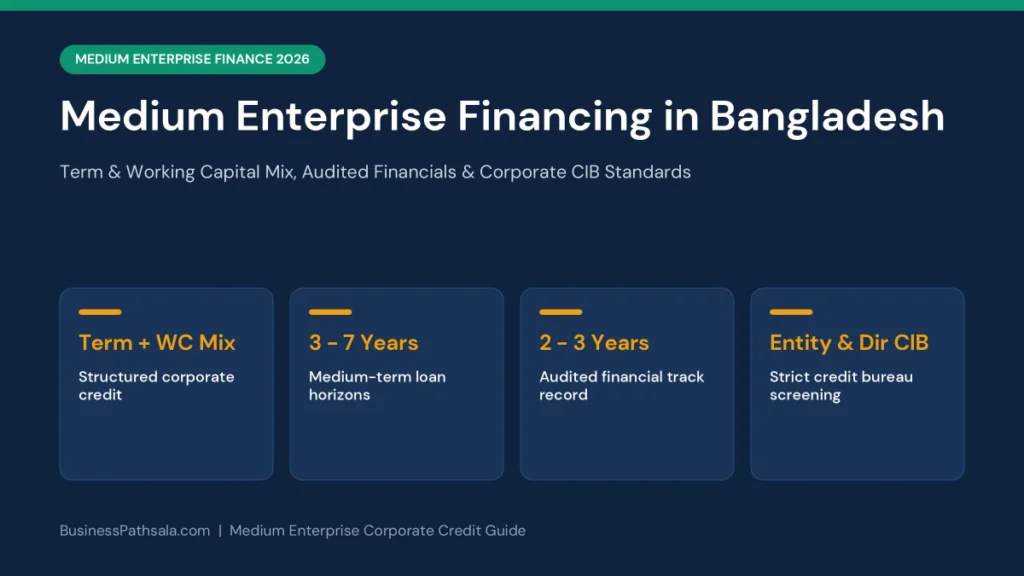
Quick answer: Medium enterprise financing in Bangladesh covers term loans, revolving working-capital facilities (such as Cash Credit, Overdraft, and Import L/C or LTR), and structured credit lines offered by commercial banks, state-owned banks, and non-bank financial institutions (NBFIs) under Bangladesh Bank’s CMSME Master Circular (SMESPD Circular No. 01, 17 March 2025). Eligible medium-sized manufacturers, trading houses, agro-processors, and service businesses with established track records can borrow to expand production lines, open new branches or warehouses, import raw materials, and manage longer receivable cycles. Standard commercial bank rates generally range around 12% to 14.5% depending on credit risk and collateral, while qualifying medium enterprises under active central bank refinance windows (such as the Tk 25,000 crore CMSME refinance scheme when active) can access lower capped rates where eligible. Formal registration, tax/VAT compliance, financial statements, clean CIB records, and clear repayment capacity are central to approval.
Updated 21 November 2026. Central bank refinance allocations, commercial lending rates, collateral rules, and banking regulations change periodically. Confirm current interest rates, limits, and document checklists directly with your bank or NBFI before applying.
Growing from a small business into a medium enterprise in Bangladesh changes how money moves through your company. A business at this stage often has dozens of employees, larger inventory or machinery investments, formal trade or corporate registration, and institutional buyers who pay on credit rather than over the counter. Borrowing a few lakh Taka to restock a single shop no longer solves the real bottlenecks—you may need equipment to raise output, working capital to carry 30-to-90-day receivables, or trade lines to bring in raw materials. Understanding how medium enterprise financing works in Bangladesh helps owners structure growth credit without over-leveraging cash flow.
How Medium Enterprises Are Treated Under Bangladesh Bank’s CMSME Framework
In Bangladesh, medium enterprises sit within the broader CMSME (Cottage, Micro, Small, and Medium Enterprise) classification defined in Bangladesh Bank’s CMSME Master Circular, alongside national industrial classifications. Because banks track CMSME portfolio targets and sector balance across manufacturing, services, and trading, medium enterprises with clean governance and verifiable cash flow often receive dedicated attention from commercial and medium-enterprise banking teams. You can see how enterprise tiers fit together in our CMSME loan guide for Bangladesh.
As a company moves from small to medium scale, credit officers shift from simple shop-level turnover checks toward deeper financial and operational analysis:
- Financial statement quality and consistency: Banks look closely at multi-year financial statements, bank statement inflows, VAT/tax filings, and whether reported revenue matches actual banking activity.
- Debt service coverage and leverage: Lenders check whether your operating cash flow comfortably covers existing and proposed installments after salaries, rent, utilities, and taxes.
- Receivable and inventory cycles: Medium businesses frequently sell to distributors, corporate accounts, or institutional buyers on credit. Banks want to see how fast stock converts into collected cash.
- Clean CIB status across entity and directors: The enterprise itself, along with all partners, directors, and personal guarantors, must maintain a clean Credit Information Bureau (CIB) record with no overdue or classified defaults.
Four Core Financing Facilities for Medium Enterprises
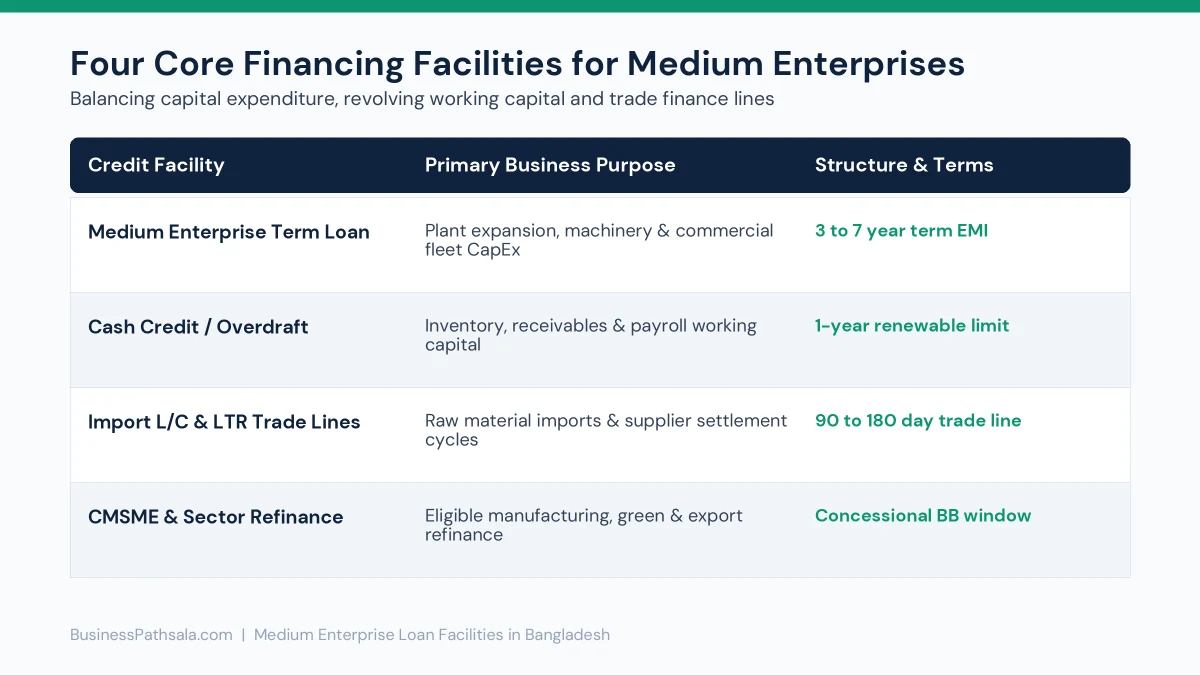
Medium enterprises typically use a blended credit package rather than a single loan. Matching long-term assets with term debt and short-term operations with revolving lines keeps your balance sheet healthy.
1. Medium Enterprise Term Loan (For Expansion, Machinery, and Facilities)
A term loan funds multi-year capital investments such as adding production lines, upgrading equipment, expanding storage or commercial space, or opening new branches. Repayment usually runs across monthly or quarterly installments over roughly 3 to 7 years depending on asset life and bank policy, sometimes with a short installation or setup grace period where justified.
2. Cash Credit (CC Hypothecation) and Overdraft (OD)
Revolving Cash Credit (CC Hypo) and Overdraft (OD) facilities support everyday working capital: holding raw materials or trading stock, paying staff salaries and utility bills, and bridging customer payment delays. Because these limits are typically reviewed annually and interest applies to the balance drawn, they help medium enterprises manage cash peaks and troughs flexibly.
3. Import L/C, Loan Against Trust Receipt (LTR), and Trade Finance
Medium manufacturers and importers that bring in raw materials, components, or capital machinery from abroad use trade facilities such as Import Letters of Credit (L/C) and short-term Loans Against Trust Receipt (LTR). These lines help bridge shipment, customs clearance, production or distribution, and sales collection without freezing all cash upfront.
4. Bangladesh Bank CMSME and Sector Refinance Windows
Participating banks and NBFIs can channel eligible medium-enterprise loans through Bangladesh Bank’s SMESPD Refinance Schemes when allocations are open—such as the Tk 25,000 crore CMSME refinance framework (where eligible customer rates are capped up to 7% per year) or specialized sector/green windows. Women-owned medium enterprises meeting ownership thresholds (at least 51% female ownership in partnerships or companies) can also check women-focused policy and desk support.
Interest Rates and Real Repayment Math (BDT 30 Lakh Example)
Financing rates for medium enterprises in Bangladesh depend on whether the facility qualifies for an active central bank refinance window or follows standard commercial lending. Outside subsidized refinance windows, commercial bank rates generally sit around 12% to 14.5% depending on credit risk, collateral, and market conditions. You can compare broader bank pricing in our guide to SME loan interest rates in Bangladesh.
To see how interest rate differences affect medium-term borrowing, consider an illustrative BDT 30,00,000 (30 lakh) medium enterprise term loan repaid over 60 months (5 years) on a standard monthly reducing-balance schedule:
| Rate Scenario (BDT 30 Lakh, 60 Months) | Approx. Monthly EMI | Total Interest (5 Years) | Total Repayment |
|---|---|---|---|
| 7.0% Annual Rate (CMSME Refinance Window) | BDT 59,404 | BDT 5,64,216 | BDT 35,64,216 |
| 9.0% Annual Rate (Concessional / Special Window) | BDT 62,275 | BDT 7,36,504 | BDT 37,36,504 |
| 12.0% Annual Rate (Lower Commercial Tier) | BDT 66,733 | BDT 10,04,001 | BDT 40,04,001 |
| 13.5% Annual Rate (Typical Commercial Rate) | BDT 69,030 | BDT 11,41,772 | BDT 41,41,772 |
Illustrative calculation only: Figures assume equal monthly installments (EMI) without a grace period and exclude bank processing fees, CIB charges, stamp duties, valuation fees, and VAT. Actual repayment terms appear in your written sanction letter.
On a BDT 30 lakh loan over five years, a 7% refinance rate saves roughly BDT 9,626 per month and BDT 5,77,556 in total interest compared to a 13.5% commercial rate. Because medium-sized commitments run for several years, testing your monthly installment against conservative cash-flow projections is essential before signing.
Banks and Financial Institutions Serving Medium Enterprises
Medium enterprises in Bangladesh borrow from scheduled commercial banks, state-owned banks, and non-bank financial institutions (NBFIs) through their SME/Medium Enterprise, Commercial, and Trade Finance divisions. Comparing institution types helps you pick a lender suited to your transaction size and operational needs.
| Lender Group | Examples of Active Institutions | Typical Strengths | Best Fit For |
|---|---|---|---|
| Private Commercial & SME Banks | BRAC Bank, City Bank, Eastern Bank (EBL), Prime Bank, Mutual Trust Bank (MTB), Dhaka Bank | Dedicated SME/commercial teams, trade finance & L/C capabilities, digital cash management | Medium businesses with 2–3+ years of track record, regular bank turnover, and growth plans |
| Shariah-Compliant Banks | Islami Bank Bangladesh, Shahjalal Islami Bank, Al-Arafah Islami Bank | Islamic asset-backed and trade modes (such as HPSM, Bai-Muajjal, or MPI) | Enterprises seeking Shariah-compliant machinery, inventory, or import financing |
| State-Owned Commercial Banks | Sonali Bank, Janata Bank, Agrani Bank, Rupali Bank | Broad branch and regional reach, multi-year project and commercial lending | Medium enterprises with established collateral, regional operations, or public/institutional links |
| Licensed NBFIs | IDLC Finance, IPDC Finance, LankaBangla Finance | Structured equipment/lease finance, term loans, and commercial credit solutions | Companies funding machinery, commercial equipment, or structured growth projects |
Eligibility Criteria for Medium Enterprise Financing in Bangladesh
While exact thresholds vary across lenders and loan sizes, banks and NBFIs generally evaluate medium enterprise applicants against these core criteria:
- Established Operating Track Record: Lenders typically look for at least 2 to 3 years of active business operation with consistent revenue, customer base, and banking activity.
- Formal Legal Structure: An active Trade License alongside formal partnership deeds or RJSC incorporation documents (Certificate of Incorporation, MOA, AOA, and Form XII) for private limited companies.
- Financial Performance and Cash Flow: Sound profitability, manageable existing debt, and sufficient operating cash flow to service proposed loan installments comfortably.
- Clean CIB Status: The business entity as well as all partners, directors, and personal guarantors must have clean Credit Information Bureau (CIB) records with no overdue or classified defaults.
- Collateral and Guarantees: Medium-sized facilities commonly combine personal/corporate guarantees, hypothecation of inventory or equipment, security cheques, and—for larger limits or term loans—registered property collateral or liquid security depending on bank policy.
Required Documents Checklist for Medium Enterprise Financing
Medium enterprise loan files require thorough documentation so credit analysts can verify both legal standing and financial health. Gather these six document categories where applicable:
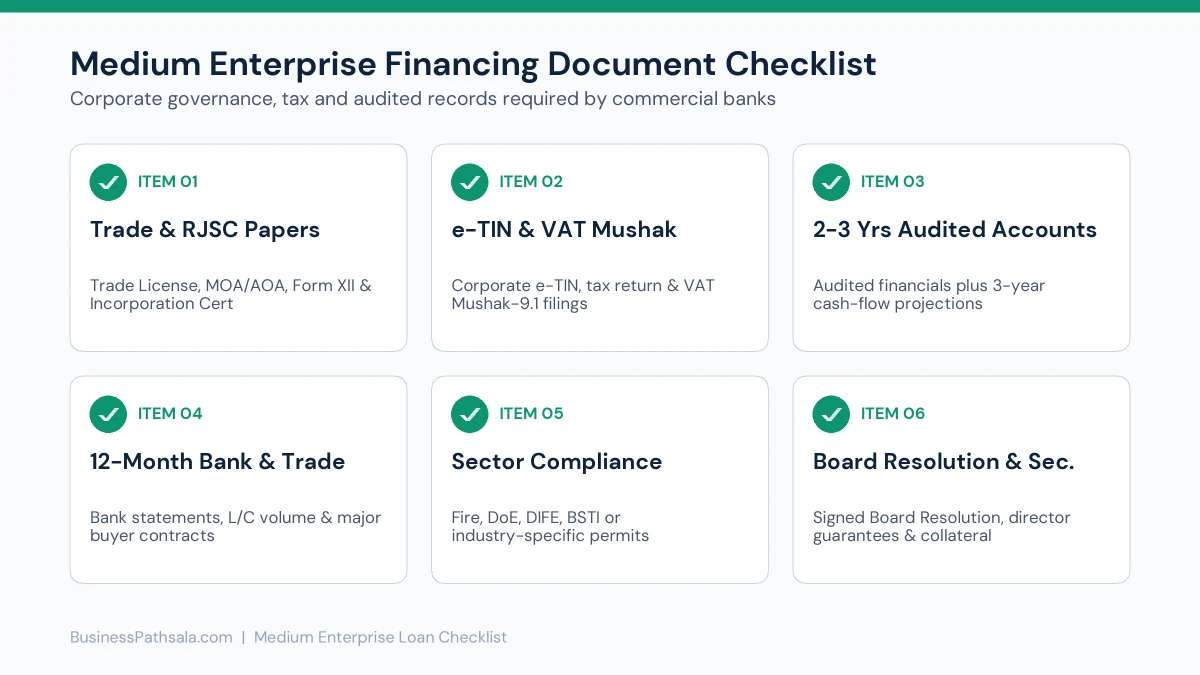
- Entity and Corporate Papers: Updated Trade License; for partnerships, the registered Partnership Deed; for private limited companies, RJSC Certificate of Incorporation, MOA, AOA, and latest Form XII, plus a board resolution authorizing the loan.
- Tax and VAT Records: e-TIN certificates for the entity and directors/partners, latest income tax return acknowledgement slips (PSR), and VAT/BIN registration with recent VAT return filings (such as Mushak-9.1) where applicable.
- Financial Statements and Projections: Last 2 to 3 years of financial statements (audited statements where applicable for companies/larger entities, or management accounts for smaller units) along with a realistic cash-flow and repayment projection. See our guides on writing a business plan for a bank loan in Bangladesh and preparing an SME loan project profile.
- Bank Statements and Trade Records: Last 12 months of business bank statements across active accounts, plus major buyer/supplier contracts, invoices, or L/C and stock schedules.
- Sector and Premises Permits: Commercial rent agreement or property ownership/tax papers, plus applicable operational permits (such as Fire Service license, factory/environmental clearances, or sector-specific approvals).
- Guarantor and Collateral Papers: NID copies, passport photos, and financial/income details of personal guarantors, along with land/property title deeds, mutation (Namjari), and tax receipts if collateral is pledged.
Step-by-Step: How to Apply for Medium Enterprise Financing
- Match your loan facilities to your expansion and working-capital needs. Separate fixed-asset investments (term loans) from daily inventory, receivables, or import cycles (CC/OD/L/C), and prepare clear numbers for each.
- Reconcile your financial statements, VAT/tax filings, and bank statements. Credit officers quickly spot gaps between reported sales, VAT filings, and bank deposits—clean up inconsistencies before submitting.
- Approach 2 to 3 banks or NBFIs with active SME/commercial desks. Compare interest rates, eligible refinance options, collateral requirements, L/C or working-capital terms, and processing timelines.
- Submit a complete application package and collect an acknowledgement. Hand in your application form, project/financial profile, and supporting folder, and keep a dated receipt. Avoid paying unofficial middlemen who promise guaranteed approval.
- Support site inspection, CIB check, and legal/valuation review. Expect credit officers to visit your office, factory, or warehouse, verify stock and receivables, and—where property collateral is involved—conduct legal vetting and valuation.
- Review the written sanction letter carefully before signing. Check the interest rate, repayment schedule, processing fees, VAT, collateral/guarantee obligations, and early-settlement rules in writing.
Common Mistakes Medium Enterprises Make When Borrowing
- Mismatching loan tenure with asset or cash-flow cycles: Using short-term credit for long-term expansion—or tying up cash in slow-moving stock without a buffer—strains liquidity.
- Submitting inconsistent numbers across tax, bank, and financial files: Discrepancies between financial accounts, VAT returns, and bank statements slow down underwriting or reduce sanctioned limits.
- Over-borrowing against optimistic growth projections: Always stress-test repayments against slower sales or longer customer credit periods.
- Signing sanction terms without checking fees and covenants: Review all charges, security conditions, and penalty clauses before accepting.
If you are also comparing broader small-business or entrepreneur financing routes in Bangladesh, you can explore our Uddokta loan guide for Bangladesh.
Frequently Asked Questions
What makes a business a medium enterprise in Bangladesh?
In Bangladesh, medium enterprises sit above small enterprises and below large industries within the CMSME and national industrial classification framework, reflecting larger investment in fixed assets and employee scale across manufacturing, services, or trading. Exact thresholds are defined under Bangladesh Bank’s CMSME Master Circular and industrial policy.
What is the interest rate on medium enterprise financing in Bangladesh?
Standard commercial bank financing for medium enterprises generally sits around 12% to 14.5% depending on credit risk, collateral, and market conditions. Where a medium enterprise qualifies under an active central bank refinance window (such as the Tk 25,000 crore CMSME refinance scheme when active), lower capped rates may apply under scheme terms.
Which loan facilities are most common for medium enterprises?
Medium enterprises commonly combine medium-term loans (for machinery, expansion, or facilities) with revolving working-capital facilities such as Cash Credit (CC), Overdraft (OD), or Import L/C and LTR lines depending on whether they import inputs or sell on credit.
Is collateral required for medium enterprise loans?
Larger medium-enterprise credit lines and term loans frequently require collateral—such as registered land/property mortgages or liquid security—alongside personal/corporate guarantees and asset hypothecation, though exact security requirements depend on the lender’s credit policy, loan size, and borrower strength.
How long does medium enterprise loan approval take in Bangladesh?
Processing times vary by loan size and complexity. Straightforward working-capital or existing-client facilities with complete records and clean CIB checks can take a few weeks, while larger term loans involving site inspections, legal vetting, property valuation, or refinance processing can take longer.
Official Sources and Further Reading
- Bangladesh Bank SMESPD Circular No. 01 — CMSME Financing Master Circular (17 March 2025): Official CMSME definitions, credit guidelines, and lending rules in Bangladesh.
- Bangladesh Bank SME & Special Programmes Department (SMESPD): Central bank refinance schemes and SME credit directives.
- Bangladesh Bank Official Portal (bb.org.bd): Central bank circulars, regulatory updates, and financial sector guidelines.
Final Takeaway
Securing medium enterprise financing in Bangladesh comes down to matching growth assets with term loans and operational cash cycles with revolving or trade lines, backing your application with consistent financial statements, tax/VAT records, and bank turnover, and keeping CIB records clean. Compare two or three lenders and verify all terms in writing before signing.
Financial information notice: This article is for general educational purposes only and does not constitute a loan offer, financial advice, or a guarantee of loan approval. Bank interest rates, refinance schemes, collateral rules, and regulatory requirements may change over time. Always verify current terms directly with Bangladesh Bank and your chosen bank or financial institution.


