Quick answer: A micro enterprise loan in Bangladesh is small-ticket working-capital or equipment financing offered by scheduled commercial banks, specialized and state-owned banks, non-bank financial institutions (NBFIs), and partner microfinance institutions (MFIs) under Bangladesh Bank’s CMSME Master Circular (SMESPD Circular No. 01, 17 March 2025). Eligible small shops, micro-workshops, home-based makers, local service providers, and rural micro-entrepreneurs can borrow to buy inventory, raw materials, or basic tools. Standard commercial SME bank rates generally range around 12% to 14.5%, while qualifying micro or women-owned enterprises under active central bank refinance or SME Foundation windows can access lower subsidized rates (such as up to 5% for eligible women entrepreneurs under dedicated refinance or 7% under broader CMSME/priority refinance when active). Valid identification, trade or business activity proof, clean CIB records, and verifiable sales or bank records are essential.
Updated 21 November 2026. Commercial bank interest rates, refinance fund allocations, micro-enterprise classifications, and lending rules change periodically. Confirm current interest rates, collateral terms, and document checklists directly with your bank branch or partner institution before applying.
Across Bangladesh, micro enterprises form the everyday backbone of local commerce and household income. A neighborhood grocery or stationery stall, a small tailoring or mobile-repair shop, a home-based food or craft maker, or a rural micro-trader often needs modest capital—say BDT 1 lakh to BDT 5 lakh or more depending on turnover—to stock up on goods or buy better tools. Yet micro-entrepreneurs often face a practical hurdle: big corporate loans feel out of reach, while informal borrowing can carry heavy costs. Understanding how micro enterprise loans work across banks, refinance schemes, and partner institutions helps small owners pick a realistic, affordable path.
How Micro Enterprises Are Defined and Evaluated in Bangladesh
In Bangladesh’s banking system, micro enterprises sit within the CMSME framework governed by Bangladesh Bank’s CMSME Master Circular. A micro enterprise generally operates with modest fixed-asset investment and a small workforce across manufacturing, service, or trading activities. You can see how cottage, micro, small, and medium tiers relate in our CMSME loan guide for Bangladesh.
When evaluating a micro enterprise loan request, lenders look closely at four practical factors:
- Steady daily or weekly cash flow: Lenders want to see that your shop, workshop, or service generates regular sales enough to pay monthly installments without starving working capital.
- Bank, MFS, and transaction visibility: Many micro-businesses deal heavily in cash or collect payments through bKash or Nagad. Showing consistent bank deposits, mobile merchant statements, or supplier/buyer receipts makes income verification much easier.
- Clear, practical use of funds: Borrowing for fast-moving stock, essential tools, or minor shop/equipment upgrades makes far more sense to a lender than a vague cash request.
- Clean CIB status: Neither the owner nor any partner or guarantor can have an overdue or classified loan default in the Bangladesh Bank Credit Information Bureau (CIB) system.
Where Micro Enterprises Get Loans in Bangladesh
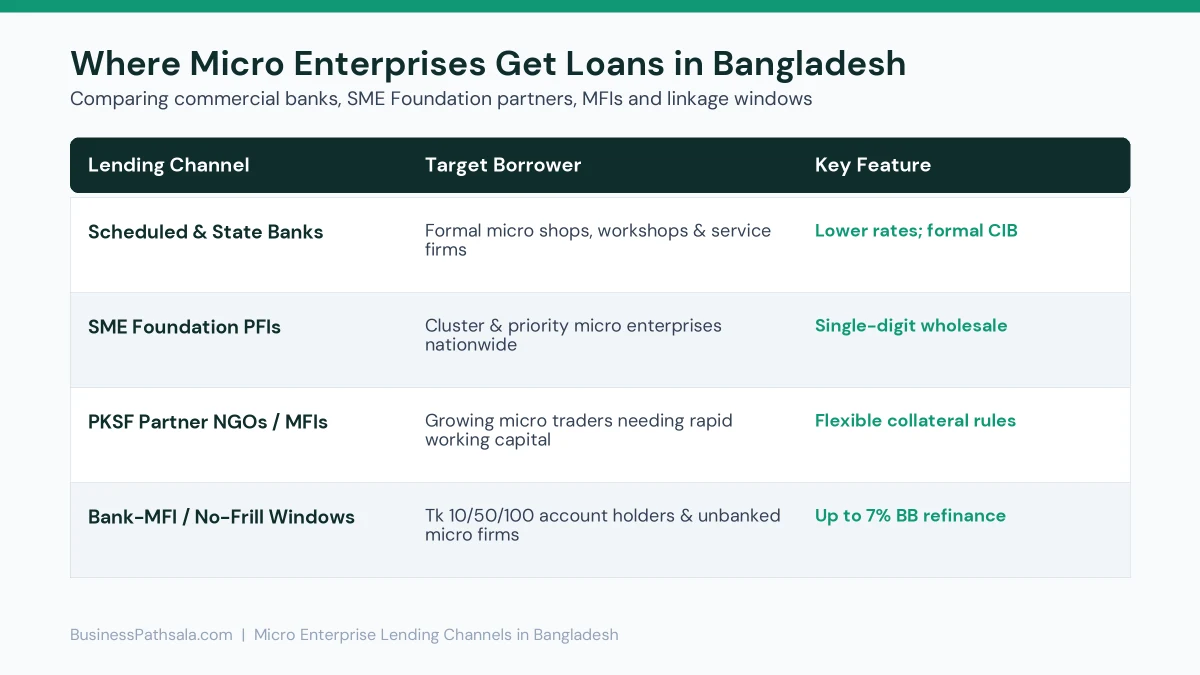
Micro enterprises in Bangladesh borrow through four main channels depending on their size, bank statement history, and location. Choosing the right channel saves time and matches the lender’s underwriting style to your business.
1. Scheduled Commercial Banks, Specialized Banks, and State-Owned Banks
Commercial banks, state-owned banks (such as Sonali, Janata, Agrani, and Rupali), and specialized agricultural banks (such as Bangladesh Krishi Bank and RAKUB) finance micro and small businesses through their Branch SME, SME Banking, and Women SME desks under Bangladesh Bank’s SMESPD Refinance Schemes. If your micro-enterprise has a valid Trade License, bank account activity, and clean CIB status, a bank loan can offer structured repayment terms and access to refinance windows where eligible.
2. SME Foundation Wholesale Credit Channels
The SME Foundation works through Partner Financial Institutions (banks and NBFIs) to channel wholesale funds toward cottage, micro, and small enterprises, including priority clusters and women entrepreneurs. When active rounds are open, partner lenders offer subsidized single-digit rates and smaller collateral-free or guarantee-backed facilities.
3. PKSF Partner NGOs and Microfinance Institutions (MFIs)
Many micro-entrepreneurs—especially rural traders, home-based producers, and small service operators without formal bank statements—access working capital through Palli Karma-Sahayak Foundation (PKSF) partner NGOs and licensed MFIs regulated under the Microcredit Regulatory Authority (MRA). Smaller loan sizes, simpler paperwork, and local field follow-up make MFIs a common starting point before graduating to bank SME credit.
4. Bank-MFI Linkages and Small/No-Frill Account Windows
Bangladesh Bank has long promoted financial inclusion through small/no-frill accounts and bank-MFI linkage arrangements so small and marginalized borrowers can build formal credit history. Women-owned micro-enterprises can also inquire at a bank’s Women Entrepreneurs Dedicated Desk about women-focused refinance support (capped up to 5% per year under the dedicated women’s small-enterprise refinance scheme when active) and collateral-free lending guidance against personal guarantees where applicable.
Interest Rates and Real Repayment Math (BDT 2 Lakh Example)
Borrowing costs for a micro enterprise loan depend on whether the loan is backed by an active central bank refinance or wholesale window or priced as a standard commercial bank loan. Outside subsidized refinance schemes, commercial SME bank rates generally range around 12% to 14.5% depending on risk and security. You can compare broader bank pricing in our guide to SME loan interest rates in Bangladesh.
To see how rate differences affect a smaller micro-business loan, consider an illustrative BDT 2,00,000 (2 lakh) loan repaid over 24 months (2 years) on a standard monthly reducing-balance schedule:
| Rate Scenario (BDT 2 Lakh, 24 Months) | Approx. Monthly EMI | Total Interest (2 Years) | Total Repayment |
|---|---|---|---|
| 5.0% Annual Rate (Women Refinance Ceiling) | BDT 8,774 | BDT 10,583 | BDT 2,10,583 |
| 7.0% Annual Rate (CMSME Refinance Window) | BDT 8,955 | BDT 14,908 | BDT 2,14,908 |
| 9.0% Annual Rate (Concessional / Special Window) | BDT 9,137 | BDT 19,287 | BDT 2,19,287 |
| 13.5% Annual Rate (Typical Commercial SME Rate) | BDT 9,555 | BDT 29,330 | BDT 2,29,330 |
Illustrative calculation only: Figures assume equal monthly installments (EMI) and exclude bank processing fees, CIB charges, stamp duties, or VAT. Actual repayment terms appear in your written sanction letter.
On a BDT 2 lakh loan over two years, a 5% refinance rate saves roughly BDT 781 per month and BDT 18,747 in total interest compared to a 13.5% commercial rate. Even when differences look modest on small amounts, keeping monthly installments manageable protects your daily working cash.
How Micro-Entrepreneurs Graduate From Informal Cash to Bank Credit
Many micro-entrepreneurs in Bangladesh run profitable daily businesses yet get turned down at their first bank visit because their revenue never passes through a bank account. Building a clear bridge between daily sales and formal banking takes just a few steady habits over several months.
Start by opening a dedicated business bank account or linking your bKash or Nagad merchant account to your shop or workshop. Deposit regular cash sales rather than keeping every Taka outside the banking system, pay wholesale suppliers in traceable ways where practical, and keep a simple notebook or ledger of daily sales, supplier bills, and shop rent. Over 6 to 12 months, that clean trail makes it much easier for a branch SME officer to verify your cash flow and consider a larger loan limit.
Eligibility Criteria for Micro Enterprise Loans in Bangladesh
Exact requirements differ across banks, NBFIs, and microfinance institutions, yet most lenders evaluate micro enterprise applicants against these core points:
- Active Micro-Business Operation: You should be actively running a viable micro-enterprise—such as retail trading, a small repair or tailoring workshop, local food/craft production, or a small service—with clear sales activity.
- Operating Track Record: Many banks look for at least 1 year of active business operation (or 1 to 2 years for standard SME loans) with verifiable sales, while microfinance or specialized inclusion windows may serve newer or smaller micro-borrowers under their own rules.
- Age and Citizenship: Bangladeshi citizen with a valid National ID (NID), typically aged between 21 and 65 years at loan maturity.
- Clean CIB Status: Neither the owner nor any partner or guarantor may have an overdue or classified loan default in the Bangladesh Bank CIB database.
- Guarantees and Collateral: Smaller micro and small enterprise facilities frequently use personal guarantors, stock/asset hypothecation, and security cheques rather than land mortgages, whereas larger loans or weaker financial records may require tangible collateral or liquid security.
Required Documents Checklist for a Micro Enterprise Loan
Having basic records organized before visiting a branch helps avoid delays. Gather these six document categories where applicable:
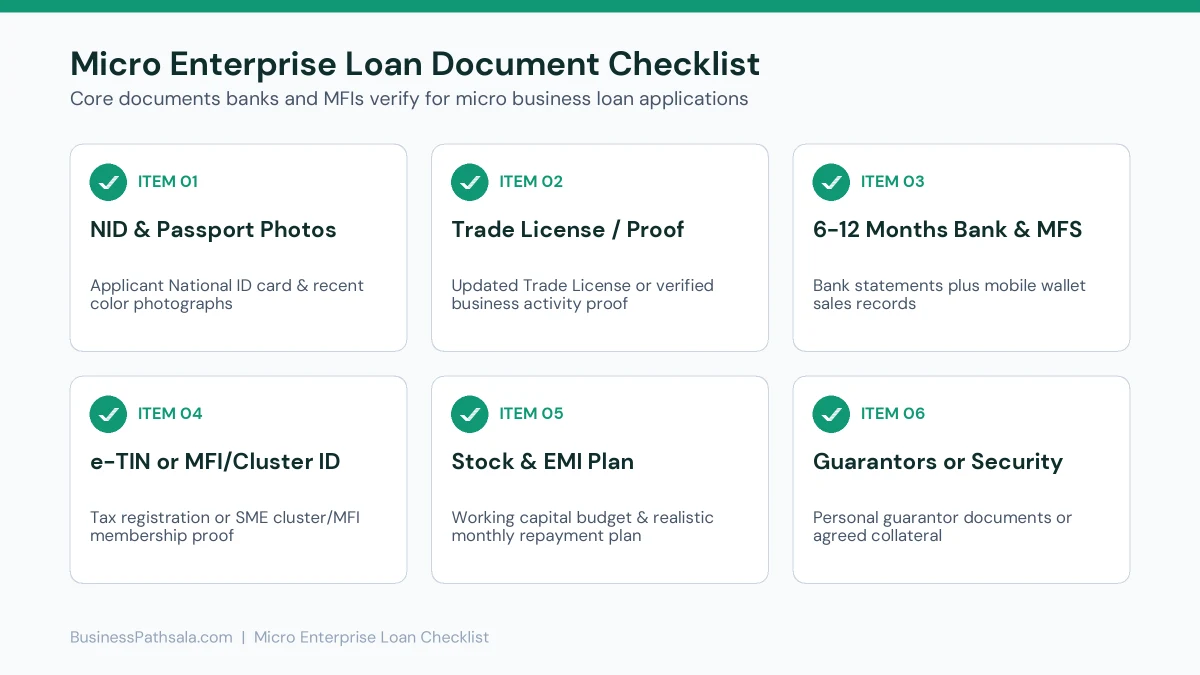
- Identity and Photos: Valid National ID (NID) copy and recent passport-size photographs of the micro-entrepreneur (and guarantors).
- Trade License or Business Activity Proof: Updated Trade License from your City Corporation, Pourashava, or Union Parishad where applicable, along with shop/worksite verification.
- Bank, MFS, and Sales Records: Bank account statement (typically 6 to 12 months if applying to a bank), bKash/Nagad merchant transaction logs, and daily sales or supplier purchase receipts.
- Tax or Institutional Proof: e-TIN certificate (and latest income tax return acknowledgement slip where applicable), or membership/registration details if applying through a cluster or partner institution.
- Simple Stock and Repayment Plan: A clear summary of what inventory, raw materials, or tools you plan to buy, your expected monthly sales and expenses, and how you will pay the monthly installment. See our guides on preparing an SME loan project profile in Bangladesh and writing a business plan for a bank loan.
- Guarantor Papers: NID copies, passport photos, and income or business details of personal guarantors (or collateral/FDR papers if required by the lender).
Step-by-Step: How to Apply for a Micro Enterprise Loan
- Check your NID, trade license, and sales records. Make sure your identification and basic business papers are current and gather whatever bank, MFS, or sales/purchase records you have.
- Route regular sales through a bank or merchant account. Depositing sales regularly into a business bank account over 6 to 12 months makes income verification much smoother at bank SME desks.
- Compare 2 to 3 banks or partner institutions. Ask clearly which micro or small-enterprise loan fits your business, whether any refinance window applies, and what exact document checklist they require.
- Submit your application and collect an acknowledgement. Hand in your filled form and document folder and keep a dated receipt. Never pay unofficial middlemen promising guaranteed approval.
- Complete business verification and CIB check. Expect an officer to visit your shop or workshop to check inventory, equipment, and daily sales while head office runs CIB screening.
- Review written terms on the sanction letter before signing. Check the interest rate, monthly EMI, processing/service fees, guarantor clauses, and early-settlement rules in writing.
Common Mistakes Micro-Entrepreneurs Make
- Keeping all daily cash outside bank or merchant accounts: Unrecorded cash makes monthly income hard to verify and often leads to rejection or a lower loan offer.
- Applying with expired basic documents or missing guarantor details: Incomplete paperwork delays processing right from the start.
- Borrowing for non-business or personal expenses: Using business loan money for personal spending strains cash flow and can hurt future credit eligibility.
- Setting monthly installments too high for slow months: Always test your installment against quieter sales periods, not just busy weeks.
If you are also comparing broader entrepreneur and small-business financing options in Bangladesh, you can explore our Uddokta loan guide for Bangladesh.
Frequently Asked Questions
Can a small micro enterprise get a loan from a bank in Bangladesh?
Yes. Micro enterprises can borrow through commercial, state-owned, or specialized banks under CMSME/micro-enterprise rules if they meet the lender’s track-record, documentation, bank/sales verification, and clean CIB requirements—or start through partner MFIs/NGOs and graduate to bank credit as records grow.
What is the interest rate on a micro enterprise loan in Bangladesh?
Rates vary by lender and funding source. Standard commercial SME bank loans generally range around 12% to 14.5% depending on credit risk and collateral, while eligible women-owned or small/micro borrowers under active central bank refinance or SME Foundation windows can access lower subsidized rates when allocations are open.
Is land collateral required for a micro enterprise loan?
Not always, especially for smaller micro and small enterprise facilities where lenders rely on personal guarantors, asset hypothecation, security cheques, or central bank/SME Foundation support rules. Larger amounts or weaker financial profiles may still require collateral or liquid security.
Can a women micro-entrepreneur get priority for a loan?
Yes. Women-owned micro-enterprises can apply through a bank’s Women Entrepreneurs Dedicated Desk and may qualify for women-focused refinance schemes, collateral-free lending guidance against personal guarantees (where applicable), or SME Foundation wholesale allocations with women priority.
How long does micro enterprise loan approval take?
Timelines depend on the institution and loan size. Microfinance loans or straightforward bank files with complete documents and clean CIB checks can take a couple of weeks to a few weeks, while collateralized or refinance-linked files may take longer.
Official Sources and Further Reading
- Bangladesh Bank SMESPD Circular No. 01 — CMSME Financing Master Circular (17 March 2025): Official CMSME definitions, credit guidelines, and lending rules in Bangladesh.
- Bangladesh Bank SME & Special Programmes Department (SMESPD): Central bank refinance schemes and SME credit directives.
- SME Foundation Official Portal (smef.gov.bd): Cluster support, training, and wholesale credit programs for cottage, micro, and small enterprises.
- Palli Karma-Sahayak Foundation (PKSF): Apex microfinance development institution supporting rural and micro-enterprise credit through partner NGOs.
Final Takeaway
Getting a micro enterprise loan in Bangladesh comes down to matching your loan size and channel to your business stage, keeping clean identification, trade/activity proof, and sales/bank records, maintaining clean CIB status, and sizing monthly installments comfortably for slower months. Compare two or three lenders and confirm all terms in writing before signing.
Financial information notice: This article is for general educational purposes only and does not constitute a loan offer, financial advice, or a guarantee of loan approval. Bank interest rates, refinance schemes, collateral rules, and lending requirements may change over time. Always verify current terms directly with Bangladesh Bank, relevant institutions, and your chosen lender.