
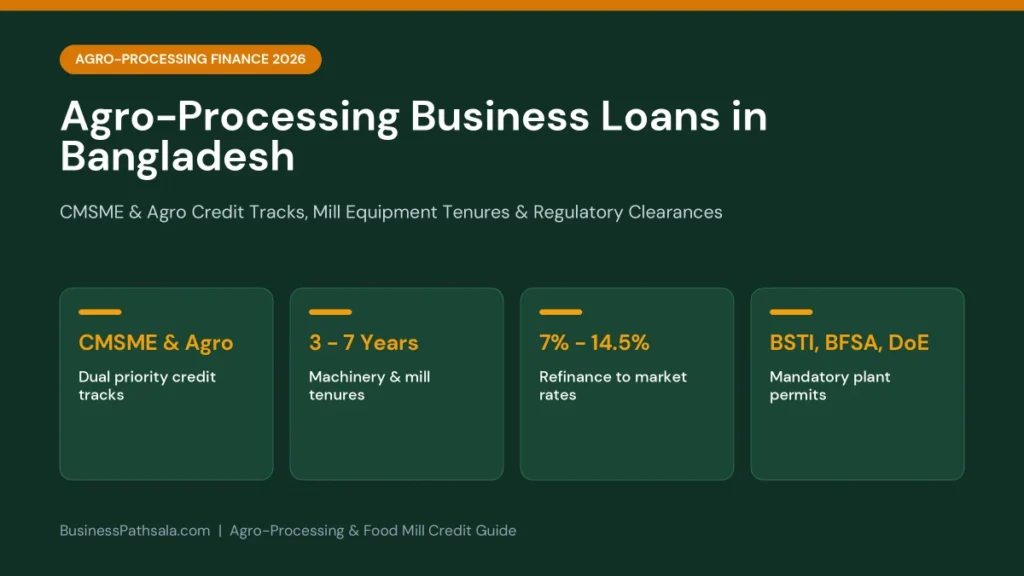
Quick answer: An agro-processing business loan in Bangladesh is term equipment financing or revolving working-capital credit offered by scheduled commercial banks, specialized agricultural banks, state-owned banks, and non-bank financial institutions (NBFIs) under Bangladesh Bank’s CMSME Master Circular (SMESPD Circular No. 01, 17 March 2025) and central bank agro/SME credit guidelines. Eligible rice and grain mills, spice and flour grinders, oilseed crushers, fruit/vegetable processors, dairy and poultry feed units, and cold-storage or packaging operators can borrow for processing machinery, dryers, chillers, and seasonal raw-crop procurement. Standard commercial bank rates generally sit around 12% to 14.5%, while qualifying small and medium processors under active central bank refinance windows (such as the Tk 25,000 crore CMSME refinance scheme when active) can access lower capped rates where eligible. Valid licensing, food/safety and environmental compliance, clean CIB records, and clear seasonal cash-flow planning are essential.
Updated 21 November 2026. Commercial bank interest rates, refinance fund allocations, agricultural/food licensing rules, and bank credit policies change periodically. Confirm current interest rates, limits, and permit checklists directly with your lender and regulatory bodies before applying.
Turning raw farm harvests into packaged, storable, and market-ready food products is one of Bangladesh’s most practical growth opportunities. From paddy and pulse mills in northern and western districts to spice and mustard-oil units, fruit and vegetable processors, dairy/feed grinders, and rural cold-chain operators, agro-processing adds value right near where crops are grown. Yet agro-processors face a distinctive cash rhythm: harvest seasons flood markets with raw crops at lower prices for a few weeks, requiring substantial cash upfront to buy and store inputs, while finished goods sell gradually over the months that follow. Understanding how banks structure loans for agro-processing businesses helps owners match equipment loans and seasonal working capital to real harvest cycles.
How Banks Classify and Evaluate Agro-Processing Businesses
In Bangladesh, banks evaluate agro-processing units within the CMSME framework under Bangladesh Bank’s CMSME Master Circular, alongside agriculture and rural credit policies overseen by Bangladesh Bank’s SME & Special Programmes Department (SMESPD) and agricultural credit channels. Because central bank policy encourages lending to manufacturing and value-adding enterprises rather than pure trading, compliant agro-processors often get constructive attention when they demonstrate steady demand and clear cost control. You can see how cottage, micro, small, and medium tiers fit together in our CMSME loan guide for Bangladesh.
When reviewing an agro-processing loan file, credit officers look closely at four practical risk areas:
- Harvest-price and raw-material swings: Crop prices shift with harvest timing, weather, and supply. Banks check whether your working-capital plan accounts for seasonal buying peaks and price fluctuations.
- Spoilage, moisture, and cold-chain control: Grains, spices, dairy, fruits, and vegetables spoil or lose quality if drying, storage, or temperature control is weak. Lenders want to see proper storage and turnover discipline.
- Bank statement and buyer-settlement visibility: Processors who collect cash and pay farmers or wholesalers without routing transactions through a bank account make turnover harder to verify.
- Clean CIB status: Every owner, partner, director, and guarantor must hold a clean Credit Information Bureau (CIB) record with no overdue or classified loan defaults.
Four Core Financing Facilities for Agro-Processing
Agro-processing businesses rarely rely on a single loan format. Combining multi-year equipment/facility finance with seasonal working capital keeps cash flow steady across harvest and off-peak months.
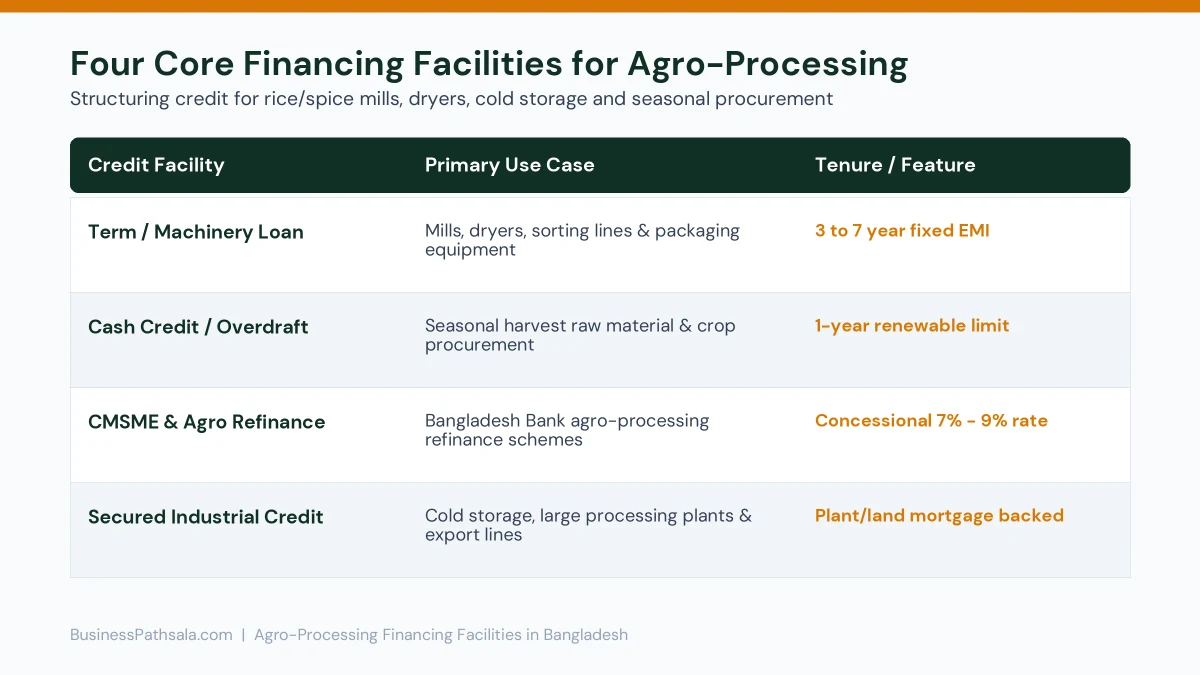
1. Term and Machinery Loans (For Mills, Dryers, Graders, and Cold Chain)
Buying grain mills, color sorters, spice pulverizers, oil expellers, mechanical dryers, packaging lines, or refrigeration/cold-storage equipment requires capital upfront. A term loan spreads repayment over roughly 3 to 7 years depending on asset life and bank policy, sometimes with a grace period while machinery is installed and commissioned. Banks generally finance a share of vendor-quoted equipment or project costs while expecting owner equity contribution. For broader details on industrial and small-factory credit, see our small factory loan guide for Bangladesh.
2. Cash Credit (CC Hypothecation) and Overdraft (OD) for Seasonal Procurement
Revolving Cash Credit (CC Hypo) and Overdraft (OD) limits are widely used for working capital: buying raw crops during harvest windows, paying wages and power/fuel bills, buying packaging materials, and bridging buyer credit cycles. Because these limits are typically reviewed annually and interest applies to the balance drawn, you can draw when procuring stock and pay down as sales collections come in.
3. Central Bank CMSME and Sector Refinance Windows
Eligible small and medium agro-processors can ask participating banks and NBFIs whether active central bank refinance windows—such as the Tk 25,000 crore CMSME refinance scheme (where eligible customer rates are capped up to 7% per year when active) or specialized priority/green windows—apply to their project. Women-owned processing units meeting ownership criteria can also check women-focused refinance and desk support.
4. Secured Industrial and Commercial Credit for Larger Plants
Larger agro-processing plants, regional warehouses, or multi-line food processors seeking higher loan limits typically pledge registered land/building collateral or liquid security alongside hypothecation of machinery and inventory.
Interest Rates and Real Repayment Math (BDT 25 Lakh Example)
Borrowing rates for agro-processing businesses depend on whether a loan qualifies for an active central bank refinance window or sits under standard commercial bank pricing. Outside subsidized refinance schemes, commercial bank rates generally sit around 12% to 14.5% depending on credit risk, collateral, and market conditions. You can compare broader bank pricing in our guide to SME loan interest rates in Bangladesh.
To see how interest rate differences affect an agro-processing equipment loan, consider an illustrative BDT 25,00,000 (25 lakh) term loan repaid over 48 months (4 years) on a standard monthly reducing-balance schedule:
| Rate Scenario (BDT 25 Lakh, 48 Months) | Approx. Monthly EMI | Total Interest (4 Years) | Total Repayment |
|---|---|---|---|
| 7.0% Annual Rate (CMSME Refinance Window) | BDT 59,866 | BDT 3,73,549 | BDT 28,73,549 |
| 9.0% Annual Rate (Concessional / Special Window) | BDT 62,213 | BDT 4,86,205 | BDT 29,86,205 |
| 12.0% Annual Rate (Lower Commercial Tier) | BDT 65,835 | BDT 6,60,060 | BDT 31,60,060 |
| 13.5% Annual Rate (Typical Commercial Rate) | BDT 67,691 | BDT 7,49,159 | BDT 32,49,159 |
Illustrative calculation only: Figures assume equal monthly installments (EMI) without a grace period and exclude bank processing fees, CIB charges, stamp duties, valuation fees, and VAT. Actual repayment terms appear in your written sanction letter.
On a BDT 25 lakh loan over four years, a 7% refinance rate saves roughly BDT 7,825 per month and BDT 3,75,610 in total interest compared to a 13.5% commercial rate. Always test your monthly EMI against slower off-harvest months so equipment payments do not squeeze raw material buying power.
Banks and Institutions Financing Agro-Processing in Bangladesh
Agro-processing businesses borrow from commercial banks, specialized agricultural banks, state-owned banks, and NBFIs through their SME, Agro/Rural, and Commercial banking desks. Comparing lender types helps you match your plant scale and location.
| Lender Group | Examples of Active Institutions | Typical Strengths | Best Fit For |
|---|---|---|---|
| Private SME & Commercial Banks | BRAC Bank, City Bank, Eastern Bank (EBL), Prime Bank, Mutual Trust Bank (MTB), Dhaka Bank | Structured SME cash-flow evaluation, active refinance desks where eligible, and digital banking | Established agro-processors (1–2+ years) with steady bank turnover and clean records |
| Specialized Agro Banks | Bangladesh Krishi Bank (BKB), RAKUB | Wide rural and upazila branch presence near agricultural production zones | Rural milling, crop/spice processing, and agro-enterprise borrowers |
| State-Owned Commercial Banks | Sonali Bank, Janata Bank, Agrani Bank, Rupali Bank | Broad district/upazila network and multi-year project/commercial lending | Processors with collateral, regional footprint, or institutional ties |
| Shariah-Compliant Banks & NBFIs | Islami Bank Bangladesh, Shahjalal Islami Bank, Al-Arafah Islami Bank; IDLC, IPDC, LankaBangla | Islamic trade/asset modes (such as Bai-Muajjal or HPSM) and equipment/lease options | Businesses seeking Shariah-compliant modes or equipment financing |
Eligibility Criteria for Agro-Processing Loans
Exact underwriting rules depend on the bank, loan size, and whether the facility is secured or unsecured, yet most lenders evaluate agro-processing applicants against these core points:
- Operating Track Record: Many commercial banks look for at least 1 to 2 years of active operation with verifiable sales and raw-material handling before approving standard SME loans, while newer or smaller rural ventures may use specialized agricultural/micro windows or collateral/FDR-backed options.
- Age and Citizenship: Bangladeshi citizen with a valid National ID (NID), typically aged between 21 and 65 years at loan maturity.
- Clean CIB Status: Neither the enterprise nor any owner, partner, director, or guarantor may have an overdue or classified loan default in the Bangladesh Bank CIB database.
- Viable Margin and Cash Flow: Clear gross margins after raw crop cost, processing/power/labor expenses, and spoilage allowance, leaving enough net cash flow to cover installments.
- Collateral and Guarantees: Smaller loans for established units may rely on personal guarantors, stock/machinery hypothecation, and security cheques, whereas larger term loans or higher limits generally require registered property collateral or liquid security.
Required Documents and Permits Checklist
Food and agro-processing units face food-safety, environmental, and local licensing checks alongside standard banking paperwork. Gather these six document categories where applicable before applying:
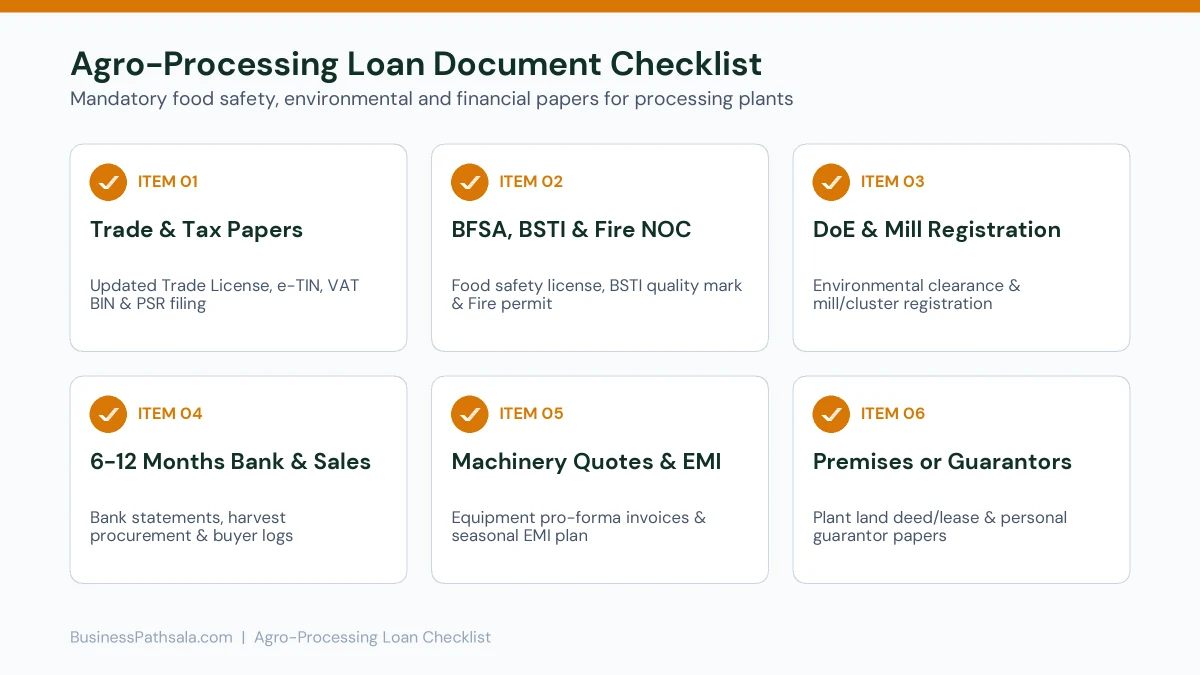
- Trade License and Tax Records: Updated Trade License specifying agro-processing, milling, or food/trading activity; valid NID and passport photos of owner/partners/directors; active e-TIN certificate; latest income tax return acknowledgement (PSR); and VAT/BIN or RJSC/partnership papers where applicable.
- Food Safety, Quality, and Fire Permits: Registration or compliance under the Bangladesh Food Safety Authority (BFSA), product certification from Bangladesh Standards and Testing Institution (BSTI) for regulated packaged foods/oils/spices, and Fire Service license where required.
- Environmental and Mill/Industry Registration: Environmental clearance from the Department of Environment (DoE) where applicable, plus BSCIC, DIFE, or relevant local/sectoral mill registration.
- Bank Statements and Harvest/Sales Records: Last 6 to 12 months of business bank statements, supported by crop purchase bills, wholesale/distributor sales invoices, and basic processing/stock logs.
- Project Profile and Machinery Quotations: A practical summary of your equipment or seasonal procurement budget, dated vendor quotations (for machinery purchases), monthly operating expenses, and repayment plan. Use our guides on preparing an SME loan project profile in Bangladesh and writing a business plan for a bank loan.
- Premises and Guarantor/Security Papers: Mill/plant lease agreement or land ownership/mutation/tax papers, plus NID, photos, and income/business details of guarantors (or collateral documents if secured).
Step-by-Step: How to Apply for an Agro-Processing Loan
- Check licenses, food/safety permits, and equipment quotes. Verify that your Trade License, BFSA/BSTI/DoE/fire papers (as applicable to your product), and vendor quotes are current and accurate.
- Route crop purchases and sales receipts through a bank account. Depositing sales regularly into your business account over 6 to 12 months gives credit officers clear proof of real business volume.
- Speak with the branch SME or Agro/SME desk. Ask which term-loan or working-capital facility fits your processing unit, whether any refinance window is open, and what exact document checklist they require.
- Submit a complete application and keep an acknowledgement. Hand in your filled form and supporting folder at the branch and collect a dated receipt. Avoid paying unofficial middlemen promising guaranteed approval.
- Support physical site verification and CIB check. Expect a bank officer to inspect your mill/plant, storage, equipment, and sales/purchase records while head office runs CIB screening.
- Verify written terms on the sanction letter before signing. Confirm the interest rate, EMI or revolving limit terms, processing fee, VAT, guarantor/collateral clauses, and early-settlement rules in writing.
Common Mistakes Agro-Processors Make When Borrowing
- Keeping all harvest buying and sales outside bank accounts: Unrecorded cash makes turnover hard to verify and often leads to rejection or a smaller loan limit.
- Using short-term cash credit to buy permanent mill machinery: Funding long-term machinery with tight short-term credit can squeeze cash flow before returns arrive.
- Ignoring food-safety or environmental permits until late in the process: Missing BFSA, BSTI, or DoE requirements can delay approval or disbursement.
- Over-borrowing at peak harvest prices without an off-season buffer: Always test repayments against slower sales months and price dips.
If you are also comparing broader small-business or entrepreneur financing routes in Bangladesh, you can explore our Uddokta loan guide for Bangladesh.
Frequently Asked Questions
Can I get a bank loan to start a new agro-processing unit in Bangladesh?
Getting an unsecured bank loan for a brand-new agro-processing business with no operating history is difficult because many banks look for 1 to 2 years of active business track record. New owners often start with personal/partner funds, specialized agricultural/micro windows where eligible, or collateral/FDR-backed loans before qualifying for standard bank SME facilities.
What is the interest rate on an agro-processing loan in Bangladesh?
Standard commercial bank loans for agro-processing generally range around 12% to 14.5% depending on the bank, credit risk, and collateral. Eligible small and medium enterprises under active central bank refinance windows (such as the Tk 25,000 crore CMSME refinance scheme when active) can access lower capped rates under scheme terms.
Which loan format is better for agro-processing: Term Loan or CC/OD?
A term loan is better for processing machinery, dryers, chillers, or facility upgrades repaid over a multi-year EMI schedule, while a revolving Cash Credit (CC) or Overdraft facility is better for seasonal raw-crop procurement, packaging, and ongoing working capital.
Are food safety or environmental licenses required before loan approval?
Banks expect legal operating compliance for the business type, including a valid Trade License and relevant food-safety, quality, or environmental clearances (such as BFSA, BSTI, DoE, or fire permits where applicable to your product and facility).
How long does agro-processing loan approval take in Bangladesh?
Timelines vary by loan size, collateral, and verification steps. Straightforward working-capital or existing-client files with complete records and clean CIB checks can take a few weeks, while larger term loans involving property valuation, legal vetting, or refinance processing can take longer.
Official Sources and Further Reading
- Bangladesh Bank SMESPD Circular No. 01 — CMSME Financing Master Circular (17 March 2025): Official CMSME definitions, credit guidelines, and lending rules in Bangladesh.
- Bangladesh Bank SME & Special Programmes Department (SMESPD): Central bank refinance windows and SME credit directives.
- Bangladesh Food Safety Authority (BFSA): Food safety registration and hygiene compliance standards in Bangladesh.
- Bangladesh Standards and Testing Institution (BSTI): Product quality certification and standards for regulated food and agro items.
- Department of Environment (DoE): Environmental clearance guidelines for industrial and processing facilities.
Final Takeaway
Securing an agro-processing business loan in Bangladesh comes down to matching machinery and facility upgrades with term credit, funding seasonal crop procurement with revolving working capital, keeping trade, food-safety, and environmental compliance in order, and maintaining clean bank statements and CIB records. Compare two or three lenders and verify all terms in writing before signing.
Financial information notice: This article is for general educational purposes only and does not constitute a loan offer, financial advice, or a guarantee of loan approval. Bank interest rates, refinance schemes, collateral rules, and regulatory licensing requirements may change over time. Always verify current terms directly with Bangladesh Bank, relevant regulatory authorities, and your chosen bank or financial institution.


