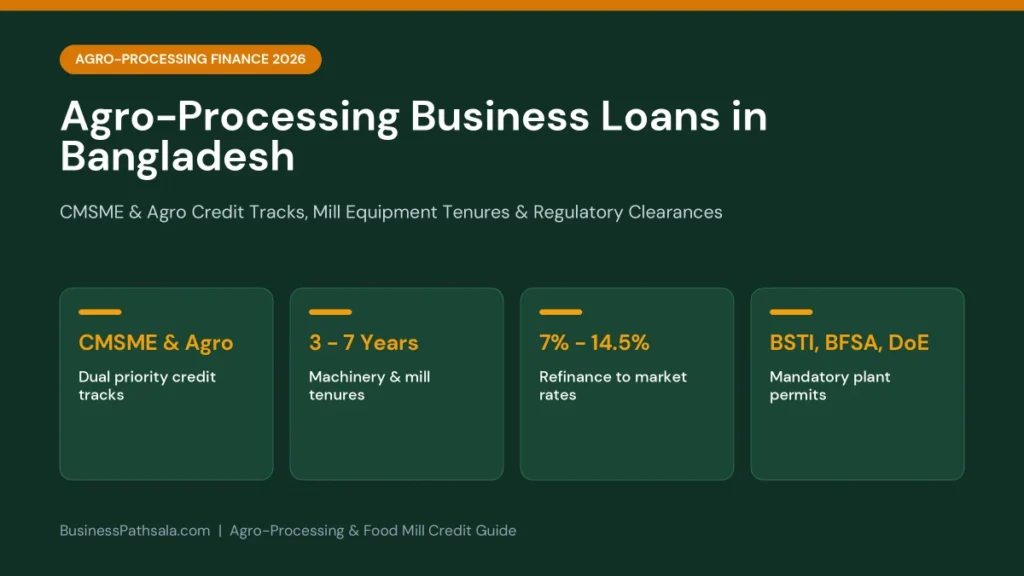
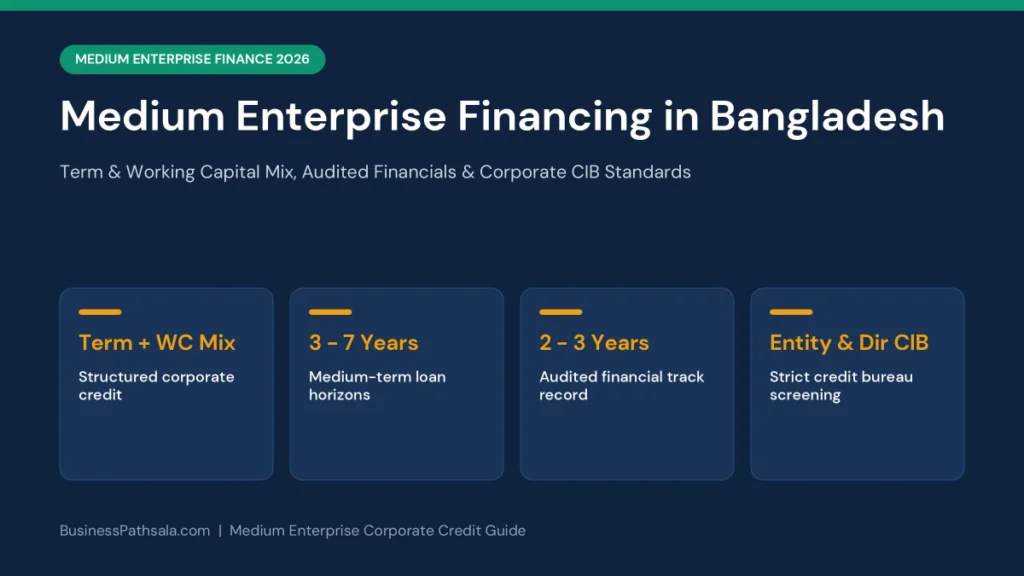
Quick answer: Loans for small factories in Bangladesh are small-enterprise term loans, machinery financing facilities, and revolving working-capital lines (such as Cash Credit or Overdraft) offered by scheduled commercial banks, state-owned banks, and non-bank financial institutions (NBFIs) under Bangladesh Bank’s CMSME Master Circular (SMESPD Circular No. 01, 17 March 2025). Eligible small workshops, light-engineering units, garment/knitting subcontractors, packaging printers, and small food or plastic processors with typically 1 to 2 years of operating history can borrow for equipment upgrades, shed improvements, and raw material stock. Standard commercial SME rates generally range from 12% to 14.5%, while eligible small manufacturers under active central bank refinance or SME Foundation windows can access lower subsidized rates (such as up to 7% under the Tk 25,000 crore CMSME refinance window or single-digit wholesale rounds where active). Valid licensing, safety compliance, clean CIB records, and verifiable production/bank turnover are essential.
Updated 21 November 2026. Commercial bank interest rates, refinance allocations, factory safety licensing rules, and bank credit policies change periodically. Confirm active interest rates, collateral terms, and permit checklists directly with your lender before committing funds.
Across Bangladesh’s industrial belts and district towns—from light-engineering workshops in Bogura and Jashore to printing, packaging, and garment-accessory units in Gazipur, Narayanganj, and Dhaka—small factories keep local supply chains moving. Unlike massive export mills that have dedicated corporate finance teams, a small factory usually runs with a tight crew, hands-on founders, and limited cash reserves. Buying a new lathe, sewing or stitching line, plastic molding machine, or packaging press takes capital upfront, while suppliers and wholesale buyers often create timing gaps between raw material purchases and customer payments. Understanding how banks structure loans for small factories helps you avoid cash strain and pick a facility that fits your workshop’s real numbers.
How Banks Classify and Evaluate Small Factories in Bangladesh
In Bangladesh, banks assess small factories under the CMSME framework set out in Bangladesh Bank’s CMSME Master Circular. Depending on fixed-asset investment and employee headcount, small production units fall under the Cottage, Micro, or Small Enterprise tiers. Because central bank policy encourages scheduled banks to channel a strong share of CMSME credit into manufacturing and service enterprises rather than pure trading, compliant small factories often get constructive attention when they present clear cost and sales proof. You can read how enterprise tiers work in our CMSME loan guide for Bangladesh.
At the same time, credit officers examine small factories through a practical industrial risk lens:
- Machinery productivity and resale value: Specialized machines can be hard to resell quickly if a small plant closes, so lenders look at whether your equipment actually boosts output, reduces unit cost, or serves steady repeat orders.
- Power, safety, and premises compliance: A factory running on unstable power, unsafe wiring, or unverified premises faces operational disruption and regulatory risk that banks factor into credit decisions.
- Bank statement and buyer-order transparency: Workshops that handle most orders in cash without depositing proceeds into a bank account make it harder for a lender to verify true monthly revenue.
- Clean CIB status: Every owner, partner, director, and guarantor must hold a clean Bangladesh Bank Credit Information Bureau (CIB) record with no overdue or classified defaults.
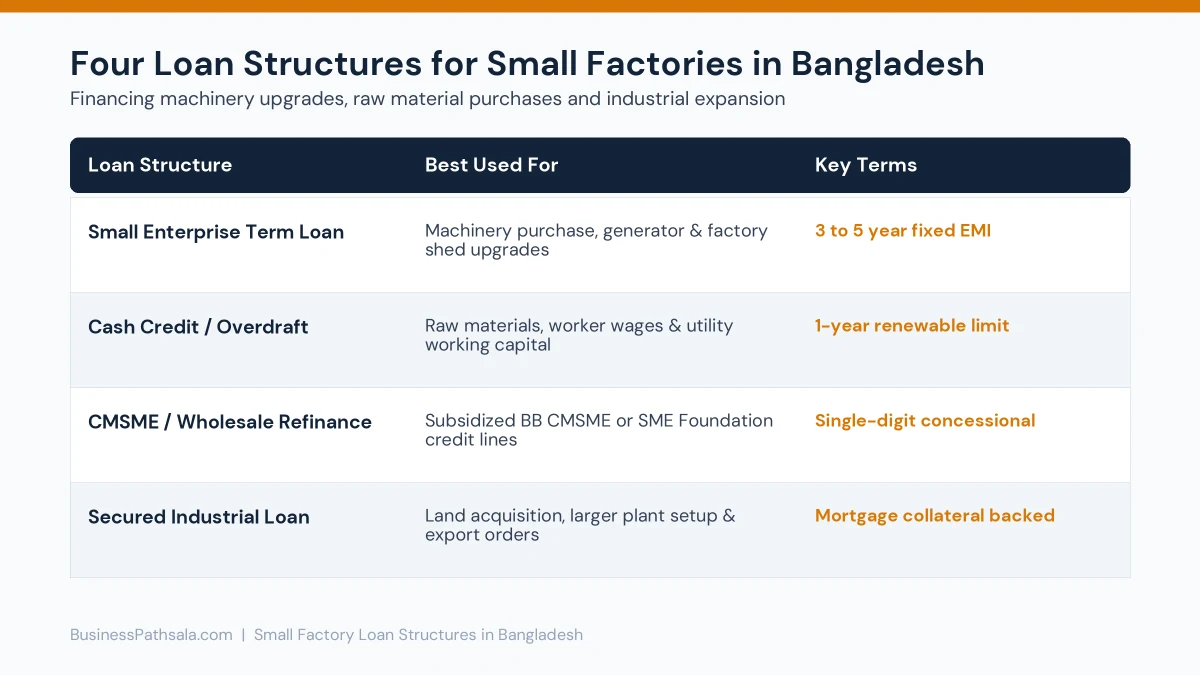
Four Loan Structures Commonly Used by Small Factories
Small factories rarely succeed with a one-size-fits-all loan. Pairing long-term equipment or shed costs with term credit and short-term raw material needs with revolving working capital keeps your cash cycle balanced.
1. Small Enterprise Term Loan (For Machinery and Workshop Upgrades)
When you need to buy new or reconditioned production machines, upgrade electrical wiring or shed roofing, or expand floor space, a term loan repaid in equal monthly installments (EMIs) over roughly 3 to 5 years matches the multi-year life of the asset. Banks typically finance a portion of the verified equipment or project cost (backed by vendor quotations) while expecting the owner to contribute sponsor equity.
2. Cash Credit (CC Hypothecation) or Overdraft (OD) for Raw Materials
A revolving Cash Credit (CC Hypo) or Overdraft (OD) facility helps cover ongoing working capital: buying raw materials in bulk, paying workers and electricity bills, and waiting 30 to 60 days for buyer payments. Because the limit revolves (usually reviewed annually) and interest applies to the balance drawn, you can manage seasonal order spikes without paying interest on unused credit year-round.
3. Central Bank CMSME Refinance and SME Foundation Windows
Before accepting standard commercial pricing, ask participating banks whether your small factory qualifies for an active central bank refinance facility—such as Bangladesh Bank’s SMESPD Refinance Schemes (including the Tk 25,000 crore CMSME refinance framework where eligible customer rates are capped at 7% when active)—or an SME Foundation credit wholesaling round for priority cottage, micro, and small clusters.
4. Secured Industrial Credit for Larger Expansion
If your small factory is scaling up into a larger plant or needs higher credit limits beyond unsecured SME caps, lenders generally require registered property collateral (such as factory land/building or residential/commercial property) or liquid security alongside inventory and equipment hypothecation.
Interest Rates and Real Repayment Math (BDT 20 Lakh Example)
Interest rates for small factory loans in Bangladesh depend on whether your facility uses an active refinance allocation or standard commercial bank lending. Outside subsidized refinance windows, commercial SME loan rates across banks typically sit around 12% to 14.5% depending on credit risk and security. You can compare broader bank pricing in our guide to SME loan interest rates in Bangladesh.
To see how rate differences affect monthly cash flow, look at an illustrative BDT 20,00,000 (20 lakh) small factory term loan repaid over 48 months (4 years) on a standard monthly reducing-balance schedule:
| Rate Scenario (BDT 20 Lakh, 48 Months) | Approx. Monthly EMI | Total Interest (4 Years) | Total Repayment |
|---|---|---|---|
| 7.0% Annual Rate (CMSME Refinance Window) | BDT 47,892 | BDT 2,98,839 | BDT 22,98,839 |
| 9.0% Annual Rate (Concessional / Special Window) | BDT 49,770 | BDT 3,88,964 | BDT 23,88,964 |
| 12.0% Annual Rate (Lower Commercial SME Tier) | BDT 52,668 | BDT 5,28,048 | BDT 25,28,048 |
| 13.5% Annual Rate (Typical Commercial SME Rate) | BDT 54,153 | BDT 5,99,327 | BDT 25,99,327 |
Illustrative calculation only: Figures assume equal monthly installments (EMI) without a grace period and exclude bank processing fees, CIB fees, stamp duties, valuation charges, and VAT. Actual repayment terms appear in your written sanction letter.
On a BDT 20 lakh loan over four years, a 7% refinance rate saves roughly BDT 6,261 per month and BDT 3,00,488 in total interest compared to a 13.5% commercial rate. Always stress-test that monthly EMI against slower production months so machine payments never force you to cut vital raw material stock.
How Production Cycles and Buyer Credit Shape Small Factory Cash Flow
Unlike a retail shop that collects cash at the counter every day, a small factory in Bangladesh often manufactures against custom job orders or supplies wholesale markets, garment accessories, and packaging buyers on 30-to-60-day credit terms. If you buy raw materials today, run production over two weeks, deliver goods on credit, and only collect payment six weeks later, your cash stays tied up long before the invoice is settled.
Matching your loan type to that production cycle prevents avoidable liquidity stress. A revolving Cash Credit or Overdraft facility helps bridge raw material purchases and delayed buyer collections, while a multi-year term loan matches machinery that earns returns gradually over several years rather than in a single sales cycle.
Banks and Financial Institutions Serving Small Factories
Most banks in Bangladesh do not market a standalone product called a “Small Factory Loan.” Instead, they finance small production units through their SME Banking, Branch SME, and Women SME desks. Comparing institution types helps you choose a lender that matches your location and ticket size.
| Lender Group | Examples of Active Institutions | What to Expect | Best Fit For |
|---|---|---|---|
| Private SME-Focused Banks | BRAC Bank, City Bank, Eastern Bank (EBL), Prime Bank, Mutual Trust Bank (MTB), Dhaka Bank | Structured SME appraisal, active refinance desks where eligible, and digital/trade banking | Established small factories (1–2+ years) with steady bank deposits and clean records |
| Shariah-Compliant Banks | Islami Bank Bangladesh, Shahjalal Islami Bank, Al-Arafah Islami Bank | Asset-backed and working-capital modes (such as HPSM or Bai-Muajjal) | Factory owners seeking Shariah-compliant machinery or raw material financing |
| State-Owned Commercial Banks | Sonali Bank, Janata Bank, Agrani Bank, Rupali Bank | Broad branch presence in district and upazila industrial areas | Small factories in regional towns, especially with land collateral or local banking ties |
| Licensed NBFIs | IDLC Finance, IPDC Finance, LankaBangla Finance | Structured SME and equipment/lease support for qualifying businesses | Factories needing equipment or SME credit with strong financial statements |
Eligibility Criteria for Small Factory Loans in Bangladesh
Exact underwriting rules vary by bank and loan amount, yet most lenders evaluate small factories against these core criteria:
- Operating History: Most commercial banks look for at least 1 to 2 years of active factory operation with verifiable production and sales before approving unsecured SME loans. Brand-new factories without prior operating history or collateral face much stricter scrutiny.
- Age and Citizenship: Bangladeshi citizen with a valid National ID (NID), typically aged between 21 and 65 years at loan maturity.
- Clean CIB Status: Neither the owner nor any partner, director, or guarantor may have an overdue or classified default in the Bangladesh Bank CIB database.
- Sponsor Equity and Cash Flow: Lenders expect realistic owner equity in the business and sufficient net cash flow to cover monthly loan installments after rent, power, wages, and taxes.
- Collateral and Guarantees: Smaller SME loans for established workshops may be considered unsecured or partially secured with personal guarantees, hypothecation of machinery/stock, and security cheques, while larger amounts or weaker profiles generally require registered property collateral or liquid security.
Required Documents and Permits Checklist
Missing trade or safety papers is a frequent reason small factory loan applications stall. Organize these six document sets before visiting a bank branch.
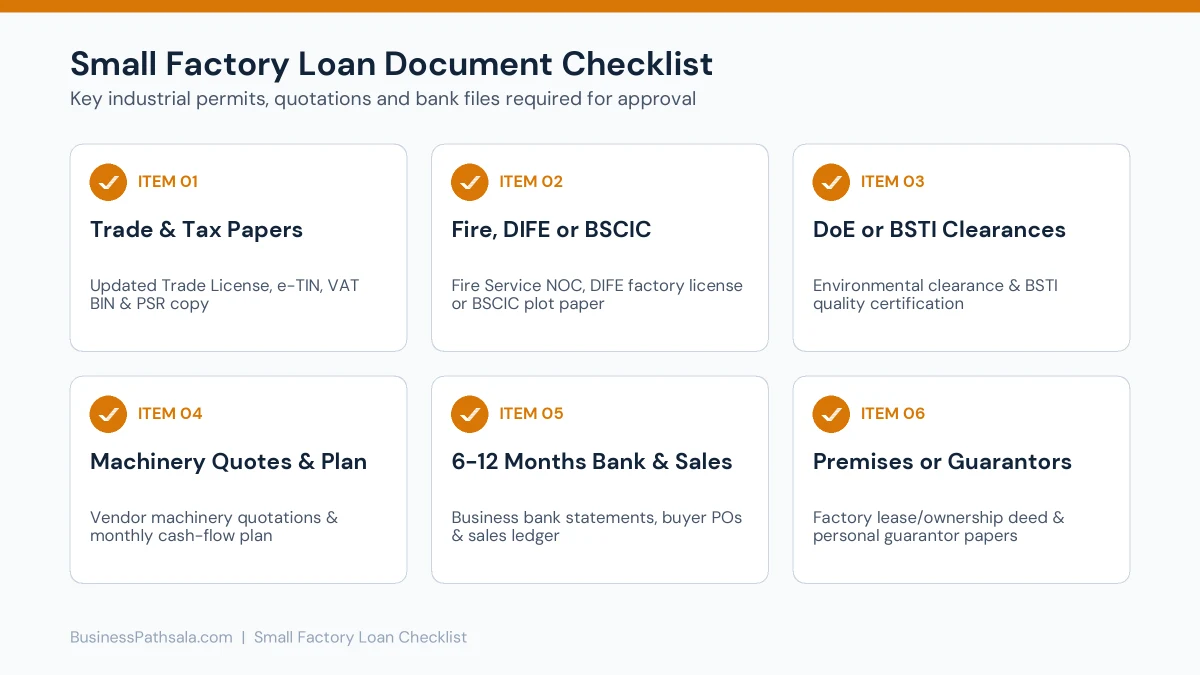
- Trade License and Tax Records: Updated Trade License specifying manufacturing/workshop activity, valid NID and passport photos of owner/partners/directors, active e-TIN certificate, latest income tax return acknowledgement (PSR), and VAT/BIN or RJSC/partnership papers where applicable.
- Factory, Fire, and Sector Permits: Valid Fire Service license, and applicable factory or small-industry registration (such as BSCIC small/cottage registration or DIFE factory compliance depending on factory scale and rules).
- Environmental and Product Clearances: Environmental clearance from the Department of Environment (DoE) or product licensing where required for your manufacturing line.
- Bank Statements and Sales Proof: Last 6 to 12 months of business bank statements, supported by customer invoices/orders, supplier bills, and basic production or sales logs.
- Project Profile and Machinery Quotations: A clear summary of your machinery or raw material budget, vendor quotations (for equipment purchases), monthly operating expenses, and repayment plan. Use our guides on preparing an SME loan project profile in Bangladesh and writing a business plan for a bank loan.
- Premises and Guarantor/Security Papers: Commercial factory lease agreement or property ownership/tax papers, plus NID, photos, and income/business proof of guarantors (or collateral documents if secured).
Step-by-Step: How to Apply for a Small Factory Loan
- Check your licenses, safety clearances, and quotes. Ensure your Trade License, Fire/factory permits, and supplier quotations are current and match your business name and address.
- Route factory receipts and supplier payments through a bank account. Depositing regular sales proceeds into your business account over 6 to 12 months gives credit officers clear proof of operating turnover.
- Speak with the branch SME or Women SME desk. Ask which term-loan or working-capital facility fits a small factory of your size, whether any refinance window is open, and what exact document list they require.
- Submit a complete application and collect an acknowledgement. Hand in your filled form and supporting folder at the branch and keep a dated receipt. Avoid paying unofficial brokers promising guaranteed approval.
- Prepare for physical factory inspection and CIB check. A bank officer will typically visit your factory floor to inspect machinery, stock, safety setup, and records while head office runs CIB screening.
- Verify written terms on the sanction letter before signing. Confirm the interest rate, EMI or revolving limit terms, processing fee, VAT, guarantor/collateral clauses, and early-settlement rules in writing.
Common Mistakes Small Factory Owners Make
- Using short-term working capital to buy permanent machines: Funding fixed machinery with tight short-term credit can squeeze cash flow before the machines generate steady extra profit.
- Keeping production and sales cash completely outside bank accounts: Unrecorded cash makes turnover hard to verify and often lowers approved loan limits.
- Delaying fire or factory safety permits until after applying: Missing safety/regulatory paperwork can stall approval or delay disbursement.
- Overestimating peak-month output when setting EMIs: Always test your monthly repayment against average or slower operating months.
If you are running an early-stage micro workshop or exploring broader small-business financing options in Bangladesh, you can also review our guide to Uddokta loan options in Bangladesh.
Frequently Asked Questions
Can I get a bank loan to start a brand-new small factory in Bangladesh?
Getting an unsecured bank loan for a brand-new factory with no operating track record is difficult because most banks look for 1 to 2 years of active business history. New factory owners typically start with personal/partner equity or collateral/FDR-backed financing, then use bank SME credit once operating history and bank transactions are established.
What is the interest rate on a small factory loan in Bangladesh?
Standard commercial SME loans for small factories generally carry rates around 12% to 14.5% depending on the bank, risk profile, and collateral. Eligible small enterprises under active central bank refinance or SME Foundation windows can access lower subsidized rates (such as up to 7% under the Tk 25,000 crore CMSME refinance scheme where active).
Which loan format is better for a small factory: Term Loan or CC/OD?
A term loan is better suited for machinery, equipment, or workshop improvements repaid over a multi-year EMI schedule, while a revolving Cash Credit (CC) or Overdraft facility is better for ongoing raw material purchases, packaging, and daily working-capital cycles.
Is land collateral always required for a small factory loan?
Not always for smaller SME loans at established workshops. Some banks offer unsecured or partially secured SME facilities backed by personal guarantees, machinery/stock hypothecation, and security cheques, while larger amounts or weaker financial histories generally require tangible collateral or liquid security.
How long does small factory loan approval take in Bangladesh?
With complete documents, clean CIB records, and straightforward verification, small factory SME loans often take around 2 to 5 weeks, though files requiring land mortgage valuation, legal vetting, or refinance processing can take longer.
Official Sources and Further Reading
- Bangladesh Bank SMESPD Circular No. 01 — CMSME Financing Master Circular (17 March 2025): Official CMSME enterprise classifications, credit guidelines, and lending rules in Bangladesh.
- Bangladesh Bank SME & Special Programmes Department (SMESPD): Central bank refinance windows and SME credit directives.
- SME Foundation Official Portal (smef.gov.bd): Cluster support, training, and wholesale credit programs for small enterprises.
- Bangladesh Small and Cottage Industries Corporation (BSCIC): Small and cottage industrial registration and estate support.
- Department of Environment (DoE): Environmental clearance information for industrial and workshop operations.
Final Takeaway
Securing a loan for a small factory in Bangladesh comes down to matching machinery and workshop upgrades with term credit, funding raw materials and buyer cycles with revolving working capital, and keeping your Trade License, safety permits, bank statements, and CIB record clean. Compare two or three banks or NBFIs on active refinance availability and total borrowing costs before signing a sanction letter.
Financial information notice: This article is for general educational purposes only and does not constitute a loan offer, financial advice, or a guarantee of loan approval. Bank interest rates, refinance schemes, collateral rules, and regulatory licensing requirements may change over time. Always verify current terms directly with Bangladesh Bank, relevant regulatory authorities, and your chosen bank or financial institution.