Quick answer: A transport business loan in Bangladesh is vehicle lease or hire-purchase finance, commercial/SME term credit, or revolving working-capital overdraft offered by scheduled commercial banks, state-owned banks, and non-bank financial institutions (NBFIs) under Bangladesh Bank’s CMSME Master Circular (SMESPD Circular No. 01, 17 March 2025) and central bank SME/service lending guidelines. Eligible cargo truck, covered van, pickup, and commercial logistics operators can borrow to acquire vehicles, expand fleets, or cover fuel, trip advances, tyres, and maintenance. Standard commercial rates generally sit around 12% to 14.5% depending on credit risk, collateral, and institution type, while qualifying small and medium enterprises under active central bank refinance windows (such as the Tk 25,000 crore CMSME refinance scheme when active) can access lower capped rates where eligible. Valid Trade License, BRTA vehicle compliance (registration, fitness, tax token, and route permit where applicable), clean CIB records, and verifiable freight/bank cash flow are essential.
Updated 21 November 2026. Commercial bank and NBFI interest rates, down-payment rules, refinance allocations, and BRTA vehicle compliance requirements change periodically. Confirm current terms, vehicle age/condition rules, and document checklists directly with your lender and regulatory authorities before applying.
Moving raw materials from ports and wholesale markets to factories, shops, and cold storages across Bangladesh depends on reliable commercial transport. Whether a business runs cargo trucks, covered delivery vans, pickups, or inter-district logistics fleets, transport sits right at the center of domestic supply chains. Yet buying a vehicle takes substantial upfront capital and down payment, while ongoing trip costs—diesel, highway tolls, driver/helper trip allowances, tyres, lubricants, and routine servicing—arise before corporate or wholesale freight clients pay their invoices. Knowing how banks and NBFIs finance commercial transport in Bangladesh helps operators structure vehicle acquisition and trip cash flow cleanly.
How Lenders Evaluate Transport Businesses in Bangladesh
In Bangladesh’s banking system, commercial transport and logistics operators fall under service-sector or CMSME/commercial lending frameworks guided by Bangladesh Bank’s CMSME Master Circular and Bangladesh Bank’s SME & Special Programmes Department (SMESPD). Because commercial vehicles move across districts and face road, fuel, and maintenance exposure, credit officers look closely at both vehicle asset quality and borrower repayment track record. You can see how enterprise categories and lending rules fit together in our CMSME loan guide for Bangladesh.
When reviewing a transport loan or lease proposal, lenders focus on four practical risk factors:
- Freight demand and contract stability: Lenders look for steady goods movement—such as regular wholesale routes, factory/distributor supply, or ongoing client contracts—rather than idle trucks or speculative fleet expansion.
- Fuel, maintenance, and trip cost discipline: Diesel prices, tyre wear, repairs, and driver trip advances directly affect net operating margin. Banks check whether freight rates comfortably cover operating costs plus monthly installments.
- Vehicle legality and roadworthiness: Proper registration, valid fitness and tax tokens, route permits where required, and clear title or lease/hire-purchase records protect both the operator and the lender.
- Clean CIB status: The business entity as well as all owners, partners, directors, and personal guarantors must hold a clean Credit Information Bureau (CIB) record with no overdue or classified loan defaults.
Four Core Financing Options for Transport Businesses
Acquiring a truck or van is a capital expense, while paying for fuel and trip advances is a working-capital expense. Matching each need to the right credit facility keeps monthly cash flow steady.
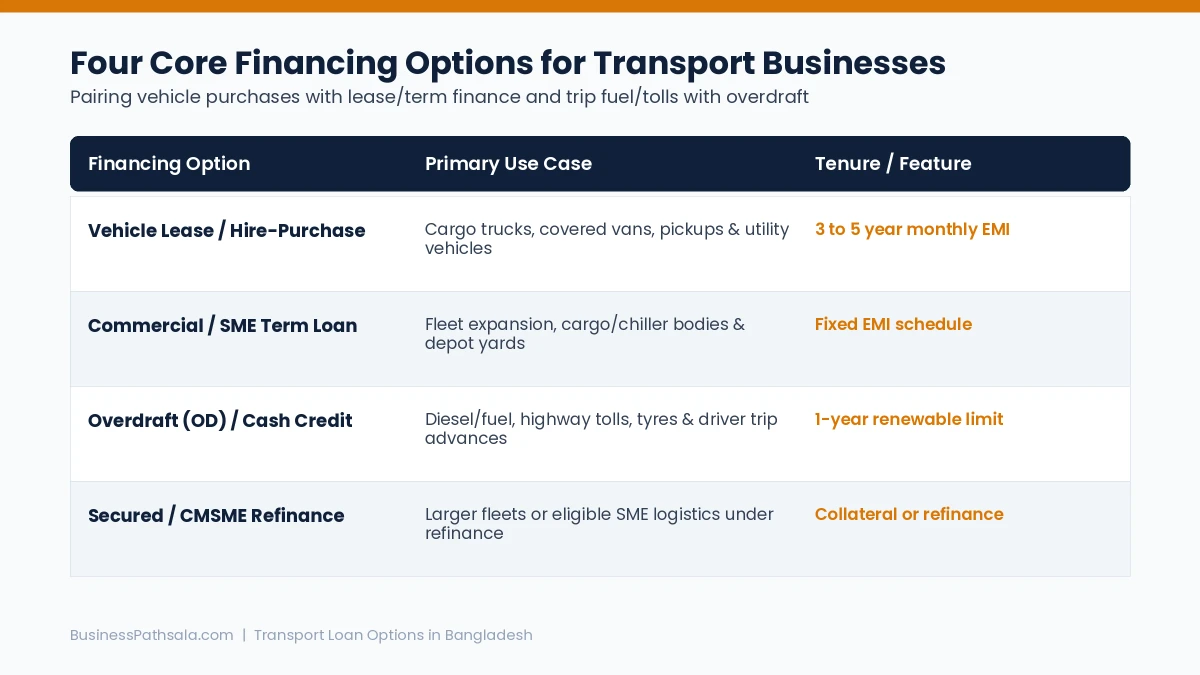
1. Vehicle Lease or Hire-Purchase Finance (For Trucks, Vans, and Pickups)
Non-bank financial institutions (NBFIs) and commercial banks regularly finance commercial vehicles—such as cargo trucks, covered vans, pickups, or specialized utility vehicles—through lease or hire-purchase/term structures. Typically, the buyer provides an upfront equity/down-payment share based on the dealer proforma invoice, and the remaining balance is repaid in equal monthly installments (EMIs) over roughly 3 to 5 years depending on vehicle type, condition, and lender policy.
2. Commercial / SME Term Loans for Fleet and Body/Chiller Upgrades
If you are adding vehicles to an existing transport business, building specialized cargo bodies or refrigeration/chiller units, or setting up a local parking/depot yard, an SME or commercial term loan spreads repayment over a fixed EMI schedule. Established operators with clean banking records can use term credit to scale capacity without draining reserve cash.
3. Overdraft (OD) or Cash Credit (CC) for Fuel and Trip Cash Flow
Freight clients often settle bills weekly or monthly while drivers need fuel, tolls, and trip advances before every run. A revolving Overdraft (OD) or Cash Credit (CC Hypo) facility helps bridge that timing gap. Because interest is charged only on the utilized balance and limits are typically reviewed annually, you can draw for trip and maintenance costs and pay down as freight receipts arrive.
4. Secured Commercial Credit and CMSME Refinance Windows
Larger fleet operators or logistics businesses seeking higher limits often pledge registered property collateral or liquid security alongside vehicle hypothecation/lien. Where a transport or logistics business qualifies as an eligible small or medium enterprise under active central bank refinance allocations (such as the Tk 25,000 crore CMSME refinance scheme when active), participating lenders can check scheme eligibility.
Interest Rates and Real Repayment Math (BDT 12 Lakh Example)
Interest rates on transport loans or leases in Bangladesh depend on whether a facility qualifies for an active central bank refinance window or follows standard commercial lending. Outside subsidized refinance windows, commercial rates generally sit around 12% to 14.5% depending on credit risk, collateral, vehicle type, and institution. You can compare broader bank pricing in our guide to SME loan interest rates in Bangladesh.
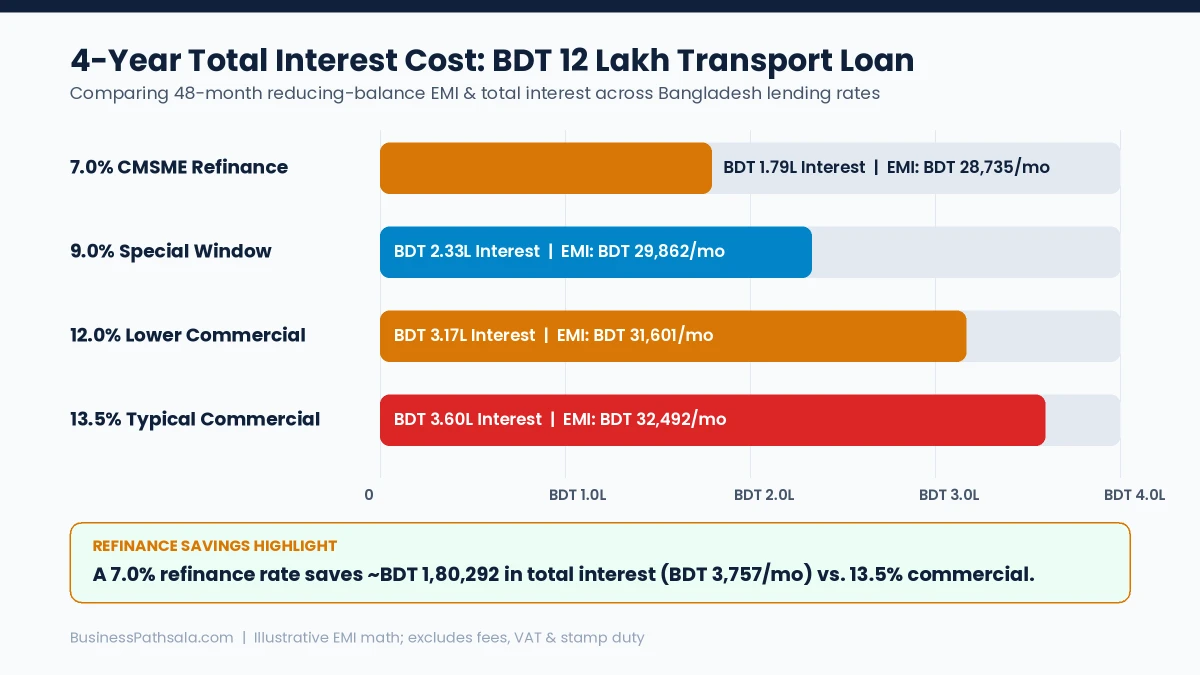
To see how interest rate differences affect monthly loan payments, consider an illustrative BDT 12,00,000 (12 lakh) transport term or vehicle loan repaid over 48 months (4 years) on a standard monthly reducing-balance schedule:
| Rate Scenario (BDT 12 Lakh, 48 Months) | Approx. Monthly EMI | Total Interest (4 Years) | Total Repayment |
|---|---|---|---|
| 7.0% Annual Rate (CMSME Refinance Window) | BDT 28,735 | BDT 1,79,304 | BDT 13,79,304 |
| 9.0% Annual Rate (Concessional / Special Window) | BDT 29,862 | BDT 2,33,378 | BDT 14,33,378 |
| 12.0% Annual Rate (Lower Commercial Tier) | BDT 31,601 | BDT 3,16,829 | BDT 15,16,829 |
| 13.5% Annual Rate (Typical Commercial Rate) | BDT 32,492 | BDT 3,59,596 | BDT 15,59,596 |
Illustrative calculation only: Figures assume equal monthly installments (EMI) without a grace period and exclude processing fees, CIB charges, stamp duties, registration/insurance fees, and VAT. Actual repayment terms appear in your written sanction letter.
On a BDT 12 lakh loan over four years, a 7% refinance rate saves roughly BDT 3,757 per month and BDT 1,80,292 in total interest compared to a 13.5% commercial rate. Because vehicles also require insurance, fitness/tax renewals, and unexpected repairs, always test your monthly EMI against conservative net trip earnings.
Banks and Institutions Financing Transport in Bangladesh
Transport operators in Bangladesh borrow from non-bank financial institutions (NBFIs), private commercial banks, and state-owned banks through their SME, Commercial, and Asset/Lease finance desks. Comparing lender types helps you choose a partner suited to your vehicle count and banking history.
| Lender Group | Examples of Active Institutions | Typical Strengths | Best Fit For |
|---|---|---|---|
| Licensed NBFIs | IDLC Finance, IPDC Finance, LankaBangla Finance | Structured vehicle/equipment leasing and commercial credit solutions | Commercial vehicles, pickups/vans, and equipment with strong cash flow |
| Private SME & Commercial Banks | BRAC Bank, City Bank, Eastern Bank (EBL), Prime Bank, Mutual Trust Bank (MTB), Dhaka Bank | SME/commercial teams, overdraft/working-capital lines, and digital banking | Established operators (1–2+ years) with steady bank deposits and clean records |
| State-Owned Commercial Banks | Sonali Bank, Janata Bank, Agrani Bank, Rupali Bank | Broad branch reach across districts and regional transport hubs | Operators with regional banking ties or collateral security |
| Shariah-Compliant Banks | Islami Bank Bangladesh, Shahjalal Islami Bank, Al-Arafah Islami Bank | Islamic asset-backed and working-capital modes (such as HPSM or Bai-Muajjal) | Operators seeking Shariah-compliant vehicle or working-capital structures |
Eligibility Criteria for Transport Business Loans
Exact underwriting rules depend on the lender, loan amount, vehicle type, and security structure, yet most lenders evaluate transport applicants against these core criteria:
- Operating Track Record: Many banks and NBFIs look for at least 1 to 2 years of active business operation (either in transport/logistics or an established trading/enterprise business expanding into transport) with verifiable cash flow before approving standard facilities.
- Age and Citizenship: Bangladeshi citizen with a valid National ID (NID), typically aged between 21 and 65 years at loan maturity.
- Clean CIB Status: The business entity and all owners, partners, directors, and personal guarantors must have a clean Credit Information Bureau (CIB) record with no overdue or classified defaults.
- Down Payment and Viable Trip Margin: Ability to contribute the required sponsor equity/down payment and generate enough net freight income after fuel, maintenance, drivers, and insurance to pay installments comfortably.
- Collateral, Lien, and Guarantees: Vehicle finance typically involves lender lien/hypothecation on the financed vehicle, comprehensive insurance, personal/corporate guarantees, and security cheques—while larger loans or weaker profiles may require additional collateral or liquid security.
Required Documents Checklist for a Transport Loan
Having your business registration, vehicle papers, and bank records organized speeds up credit review. Gather these six document categories where applicable before applying:
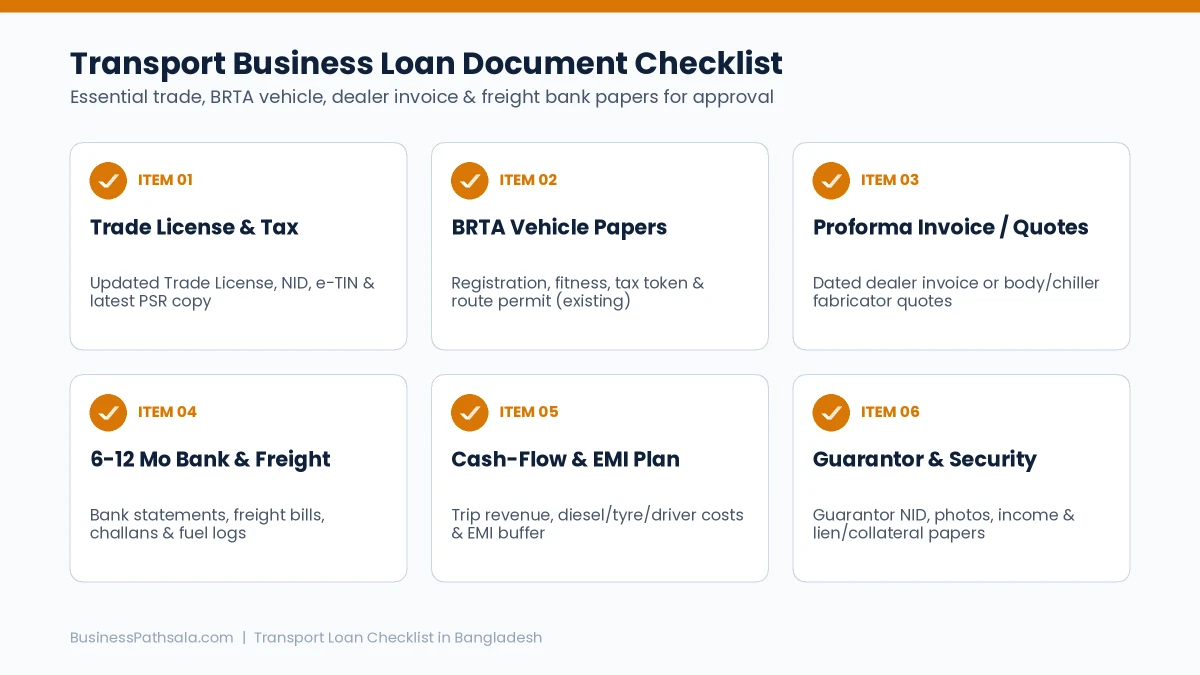
- Trade License and Tax Records: Updated Trade License for transport, logistics, or trading; valid NID and passport photos of owner/partners/directors; active e-TIN certificate; latest income tax return acknowledgement (PSR); and VAT/BIN or RJSC/partnership papers where applicable.
- BRTA Vehicle Compliance Papers: For existing vehicles or fleet refinancing, valid Bangladesh Road Transport Authority (BRTA) registration certificate, fitness certificate, tax token, and route permit where applicable.
- Vehicle Proforma Invoice and Quotes: Dated proforma invoice from an authorized dealer/importer (or body/chiller fabricator quotes), showing vehicle specifications, price, and down-payment breakdown.
- Bank Statements and Freight/Trip Records: Last 6 to 12 months of business bank statements, supported by freight bills/invoices, client challans or transport contracts, and fuel/maintenance logs.
- Cash-Flow and Repayment Plan: A practical estimate of monthly trip revenue, diesel/fuel and repair costs, driver/helper wages, insurance/tax renewals, and monthly EMI repayment capacity. Use our guides on preparing an SME loan project profile in Bangladesh and writing a business plan for a bank loan.
- Guarantor and Security Papers: NID copies, passport photos, and income/business details of personal guarantors (plus collateral/FDR papers if required by the lender).
Step-by-Step: How to Apply for a Transport Business Loan
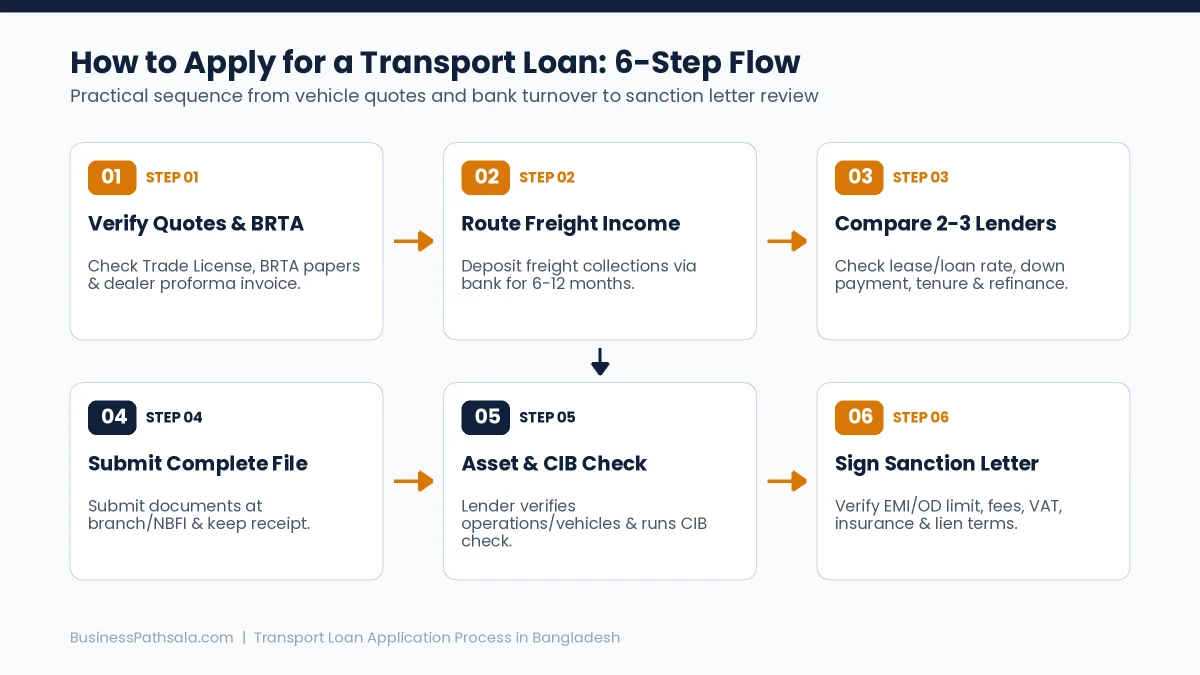
- Confirm vehicle specs, dealer quotes, and compliance papers. Verify that your Trade License, NID, BRTA papers (for existing vehicles), and vendor proforma invoices are accurate and current.
- Route freight collections and operating expenses through a bank account. Depositing freight income regularly into your business bank account over 6 to 12 months gives lenders verifiable cash-flow evidence.
- Compare 2 to 3 banks or NBFIs on lease/loan and working-capital terms. Ask clearly about interest rates, down-payment share, tenure, processing fees, insurance/registration rules, and any eligible refinance options.
- Submit a complete application and keep an acknowledgement. Hand in your filled form and supporting folder at the branch or office and collect a dated receipt. Avoid paying unofficial brokers promising guaranteed approval.
- Complete business/vehicle verification and CIB check. Expect a representative to verify your business operations, existing vehicles or client contracts, and guarantor details while head office runs CIB screening.
- Verify written terms on the sanction letter before signing. Check the interest rate, EMI or overdraft limit terms, processing fee, VAT, vehicle lien/insurance clauses, and early-settlement rules in writing.
Common Mistakes Transport Operators Make When Borrowing
- Keeping all freight cash outside bank accounts: Unrecorded cash makes monthly earnings hard to verify and often leads to rejection or a smaller approved amount.
- Underbudgeting fuel price shifts, tyres, and major repairs: Commercial vehicles face heavy wear and fuel costs; ignoring maintenance reserves can squeeze EMI payments during tough months.
- Overlooking BRTA fitness, tax token, or route permit compliance: Incomplete vehicle documentation creates legal and operational risk that lenders flag during review.
- Signing financing terms without checking fees and insurance/lien rules: Always confirm total cost—including processing charges, VAT, insurance, and prepayment rules—in writing before signing.
If you are also comparing broader small-business or entrepreneur financing routes in Bangladesh, you can explore our Uddokta loan guide for Bangladesh.
Frequently Asked Questions
Can I get a loan to buy a commercial truck or delivery van in Bangladesh?
Yes. Banks and NBFIs finance commercial vehicles such as trucks, covered vans, and pickups through lease, hire-purchase, or term-loan structures, subject to down-payment/equity rules, business and cash-flow verification, vehicle eligibility, and clean CIB checks.
What is the interest rate on a transport business loan in Bangladesh?
Standard commercial rates generally sit around 12% to 14.5% depending on the bank or NBFI, credit risk, collateral, and market conditions. Eligible small and medium enterprises under active central bank refinance windows (such as the Tk 25,000 crore CMSME refinance scheme when active) can access lower capped rates where eligible.
Which loan format is better for transport: Term/Lease Loan or Overdraft?
A term loan or lease/hire-purchase facility is better for buying vehicles or equipment over a multi-year EMI schedule, while a revolving Overdraft (OD) or Cash Credit (CC) facility is better for ongoing fuel, trip advances, tyres, and routine operating cash flow.
Do I need BRTA papers for a transport business loan?
For existing vehicles or fleet-backed financing, lenders check BRTA registration, fitness, tax token, and route permit compliance as applicable, while for new vehicle purchases they review the dealer’s proforma invoice and handle registration/lien requirements under loan or lease terms.
How long does transport loan approval take in Bangladesh?
Timelines vary by lender, loan size, and verification steps. Straightforward files with complete documents, verifiable bank/freight records, and clean CIB checks can take a couple of weeks to a few weeks, while larger or collateralized files can take longer.
Official Sources and Further Reading
- Bangladesh Bank SMESPD Circular No. 01 — CMSME Financing Master Circular (17 March 2025): Official CMSME definitions, credit guidelines, and lending rules in Bangladesh.
- Bangladesh Bank SME & Special Programmes Department (SMESPD): Central bank refinance windows and SME credit directives.
- Bangladesh Road Transport Authority (BRTA): Official vehicle registration, fitness, tax token, and route permit information in Bangladesh.
- Bangladesh Bank Official Portal (bb.org.bd): Central bank circulars, regulatory updates, and financial sector guidelines.
Final Takeaway
Securing a transport business loan in Bangladesh comes down to matching vehicle purchases with lease or term credit, covering fuel and trip cash cycles with revolving overdraft/working capital, keeping Trade License and BRTA compliance in order, and maintaining clean bank statements and CIB records. Compare two or three lenders and verify all terms in writing before signing.
Financial information notice: This article is for general educational purposes only and does not constitute a loan offer, financial advice, or a guarantee of loan approval. Bank and NBFI interest rates, down-payment requirements, refinance schemes, and regulatory rules may change over time. Always verify current terms directly with Bangladesh Bank, relevant authorities, and your chosen lender.