Last updated: · By Afra Monira
Choosing between a sole proprietorship vs private limited company in Bangladesh comes down to three practical trade-offs: personal asset protection, 2026–27 tax math, and whether you plan to raise outside capital. A sole proprietorship requires only a Trade License and a personal e-TIN, making it the fastest and cheapest option for solo Bangladeshi founders testing a small or low-risk business. A private limited company registered with the Registrar of Joint Stock Companies and Firms (RJSC) costs more to set up and requires annual statutory audits, yet it shields your personal assets through limited liability, unlocks equity investment, and lets foreign nationals own shares.
Most online comparisons in Bangladesh stop at textbook legal definitions and leave out actual taka figures. In reality, your entity choice changes your tax bill under the Finance Act 2026, your RJSC stamp duty at incorporation, and how easily banks approve commercial loans. This guide compares both structures side by side with verified 2026–27 tax rates, real government registration fees, a profit break-even table, and a clear checklist for upgrading from a proprietorship to a limited company when you outgrow it.
Sole Proprietorship vs Private Limited Company in Bangladesh: Side-by-Side Comparison
A sole proprietorship and a private limited company operate under completely different legal frameworks. Under Bangladesh law, a proprietorship has no separate legal identity from its owner, whereas a private limited company is incorporated under the Companies Act, 1994 as an independent legal person.
| Factor | Sole Proprietorship | Private Limited Company (Pvt Ltd) |
|---|---|---|
| Governing Law | No dedicated company act; local municipal laws and common law | The Companies Act, 1994 |
| Registration Authority | City Corporation, Pourashava, or Union Parishad (Trade License) | RJSC via eBRS portal plus local Trade License |
| Legal Identity | Same legal person as the owner | Separate legal entity that can own assets and sign contracts |
| Liability | Unlimited personal liability (personal property is exposed) | Limited to unpaid value of shares (unless personal guarantee or fraud applies) |
| Number of Owners | Exactly 1 Bangladeshi citizen | 2 to 50 shareholders (local or foreign) |
| Foreign Ownership | Not permitted for foreign nationals | Up to 100% foreign ownership allowed in most sectors |
| 2026–27 Income Tax Rate | Progressive individual slabs (Tk 3.75 lakh tax-free; up to 25%–30%) | 27.5% standard corporate rate, reduced to 25.0% with full bank-channel compliance |
| Annual Audit Requirement | Not mandatory for standard small proprietorships | Mandatory annual audit by a Chartered Accountant (CA) firm |
| Perpetual Continuity | Ends or disrupts upon death or exit of the owner | Continues regardless of changes in shareholders or directors |
| Closure Process | Cancel Trade License and settle dues | Formal winding-up and liquidation through RJSC |
1. Setup Cost and Registration Timeline in 2026
Starting a sole proprietorship takes just a few days once you have a commercial office address or rent deed. Your primary statutory expense is the annual Trade License fee from your local City Corporation or Pourashava, which usually runs between BDT 3,000 and BDT 15,000 depending on business category and location. You can check the exact steps in our guide to getting an online trade license in Bangladesh. Pair that with a free 12-digit e-TIN certificate, and you can open a proprietorship bank account within a week.
Incorporating a private limited company through RJSC involves five government charges: Name Clearance (Tk 575 including 15% VAT), filing fee (Tk 1,380 including VAT), capital-based registration fee (nil up to Tk 10 lakh authorized capital, Tk 80 per lakh from Tk 10 lakh to Tk 50 lakh, and Tk 130 per lakh above Tk 50 lakh), certified copies, and stamp duty on the Memorandum and Articles of Association (MoA and AoA). For a full fee schedule, see our breakdown of RJSC company registration fees in Bangladesh.
Here is a practical cost tip many founders miss: RJSC stamp duty jumps from Tk 12,000 to Tk 32,000 the moment your authorized capital crosses Tk 40 lakh. Unless a bank, tender, or foreign work permit requires higher capital on day one, registering with Tk 40 lakh or less in authorized capital saves Tk 20,000 upfront, and you can always increase capital later as the company grows.
2. Tax Comparison Under the Finance Act 2026 (With Break-Even Math)
Many entrepreneurs incorporate early because they hear that corporate tax is lower than personal tax, while others avoid incorporation fearing double taxation. Neither assumption holds at every income level. Under the Finance Act 2026 and PwC Bangladesh Corporate Tax Summaries, corporate rates for AY 2026–27 through AY 2030–31 work as follows:
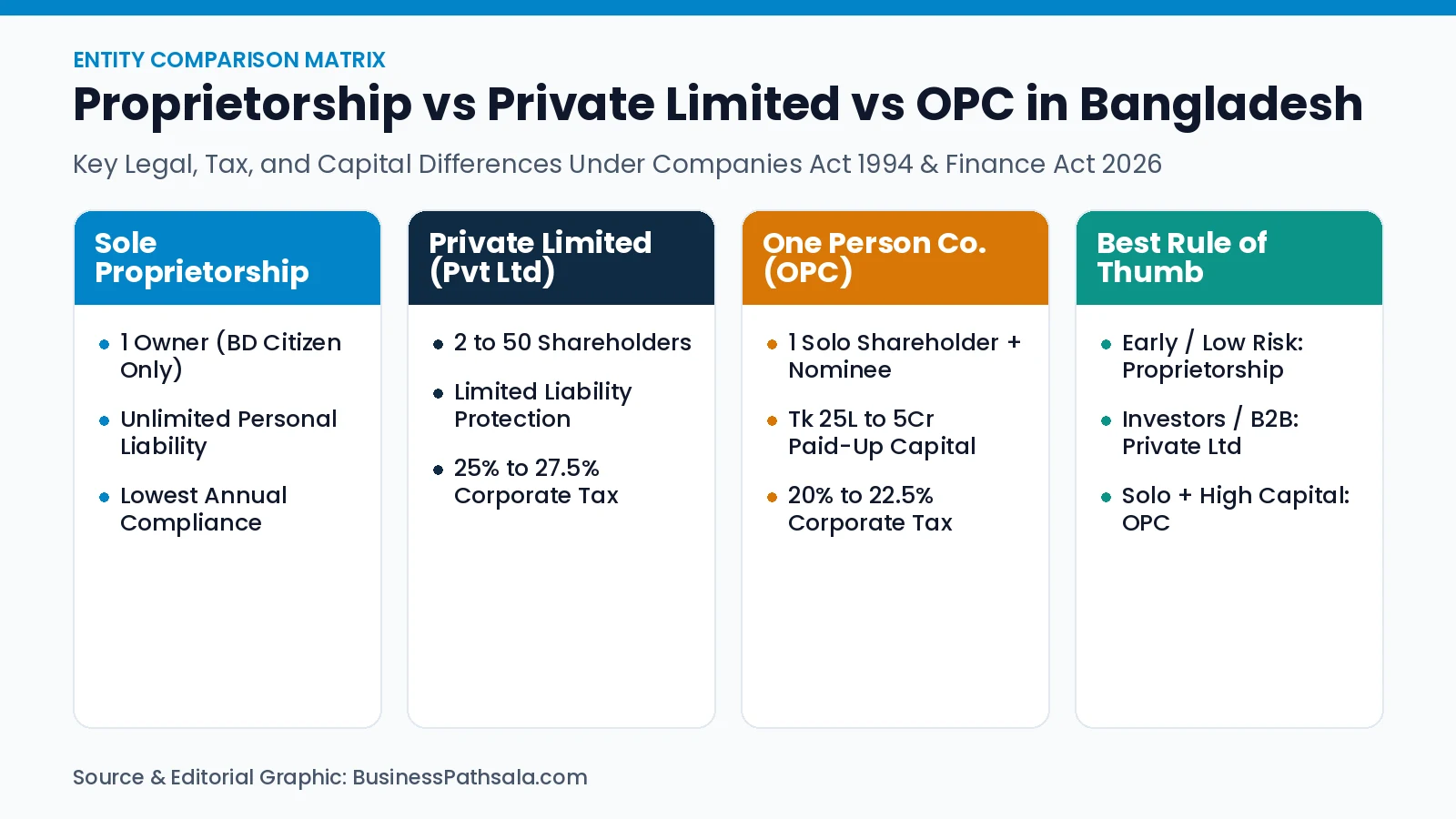
- A non-listed private limited company pays 27.5% corporate income tax. If all receipts and commercial expenditures above Tk 5 lakh (single transaction) or Tk 36 lakh (annual aggregate) move through official bank transfers, the rate drops to 25.0%.
- A One Person Company (OPC) pays 22.5% standard corporate tax, dropping to 20.0% with full bank-channel compliance.
- A sole proprietor’s net business profit is taxed as personal income on progressive slabs, starting with a 0% tax-free threshold of BDT 375,000 for general taxpayers in AY 2026–27 and climbing across slabs to 25%–30% at higher brackets.
Remember two extra tax realities for private limited companies. First, companies pay minimum tax (typically 0.60% of gross receipts for standard sectors) even in a loss-making year. Second, when a company distributes after-tax profit to shareholders as dividends, individual shareholders face dividend withholding tax (15% under Finance Act 2026 rules). However, directors who draw a legitimate monthly salary can deduct that salary as a company expense, reducing corporate taxable profit.
| Annual Net Business Profit | Sole Proprietorship (Personal Slabs, Approx.) | Private Limited Co. (25% Bank-Compliant Rate) | Which Structure Saves More Tax? |
|---|---|---|---|
| BDT 10,00,000 | ~BDT 55,000 to 65,000 (effective ~6%) | BDT 2,50,000 (before director salary deductions) | Sole Proprietorship wins clearly |
| BDT 25,00,000 | ~BDT 3,40,000 to 3,75,000 (effective ~14%–15%) | BDT 6,25,000 (lower if founder draws taxed salary) | Sole Proprietorship still lower overall |
| BDT 60,00,000+ | Marginal slabs hit 25%–30% + potential wealth surcharge | Flat 25.0% on retained earnings for reinvestment | Private Limited wins when reinvesting profits |
The break-even takeaway is straightforward: if your business earns under BDT 20 to 25 lakh in annual profit and you withdraw most of it for household living expenses, a sole proprietorship carries a much lower effective tax rate. Once profits scale past BDT 40 to 50 lakh and you reinvest retained earnings into inventory, equipment, or expansion, a private limited company’s flat 25% bank-compliant rate starts making financial sense. Regardless of structure, any business crossing the turnover threshold or engaging in imports, exports, or tenders must also complete BIN registration online in Bangladesh through the NBR e-VAT portal.
3. Liability Protection and What “Limited Liability” Actually Covers
In a sole proprietorship, there is zero legal wall between your shop or agency and your personal savings, land, or apartment. If a supplier sues over an unpaid contract or a commercial loan defaults, creditors can pursue your personal assets to recover the debt.
A private limited company limits shareholder liability to the unpaid face value of their shares. Still, limited liability is not a blank check. Bangladeshi banks routinely ask managing directors of young private limited companies to sign personal guarantees for SME loans, and directors remain personally accountable for tax evasion, bounced cheques under the Negotiable Instruments Act, or statutory fraud. If you plan to borrow capital from banks, compare eligibility requirements in our CMSME loan Bangladesh guide.
4. Ongoing Annual Compliance and Hidden Costs
Founders frequently budget for RJSC incorporation fees while ignoring recurring annual compliance costs. A sole proprietorship only needs annual Trade License renewal, a personal NBR e-Return filing, and quarterly VAT returns if registered for a BIN. Many proprietors handle these filings themselves or pay a modest annual fee to a local tax practitioner.
A private limited company carries permanent statutory obligations every year, even if revenue is zero:
- Hiring an ICAB-registered Chartered Accountant firm to audit your annual financial statements and generate a Document Verification Code (DVC).
- Holding an Annual General Meeting (AGM) and board meetings, and maintaining statutory registers for directors and shareholders.
- Filing Annual Returns (Schedule X, Form 23B, and audited accounts) with RJSC on time (Tk 200 per document on time; late penalties rise to Tk 500–Tk 700 per year plus court condonation costs if delayed).
- Filing a separate corporate income tax return (usually by January 15 for a July–June fiscal year) in addition to each director’s personal tax return.
Realistically, maintaining a compliant private limited company in Bangladesh costs BDT 40,000 to BDT 1,20,000+ per year in audit, accounting, RJSC filing, and license renewal fees.
5. What About a One Person Company (OPC) for Solo Founders?
If you are a solo Bangladeshi founder who wants limited liability without adding a co-founder just to meet the 2-shareholder rule of a private limited company, Bangladesh’s Companies Act allows you to register a One Person Company (OPC). You need exactly one natural-person shareholder plus one named nominee who takes over in case of death or incapacity.
However, OPCs come with strict statutory thresholds: paid-up capital must stay between BDT 25 lakh and BDT 5 crore, and annual turnover must stay between BDT 1 crore and BDT 50 crore (crossing those limits requires mandatory conversion to a standard private limited company). For solo founders who meet that capital floor, an OPC offers a standout tax advantage at 20.0% to 22.5% corporate tax, lower than a standard private limited company.
How to Convert a Sole Proprietorship to a Private Limited Company in Bangladesh
You do not have to lock yourself into one entity forever. Starting as a sole proprietorship to validate your market and upgrading to a private limited company once revenue, risk, or investor interest grows is a common path in Bangladesh. Note that RJSC does not automatically convert a proprietorship into a company; instead, you incorporate a new private limited company and transfer the business assets and contracts over.
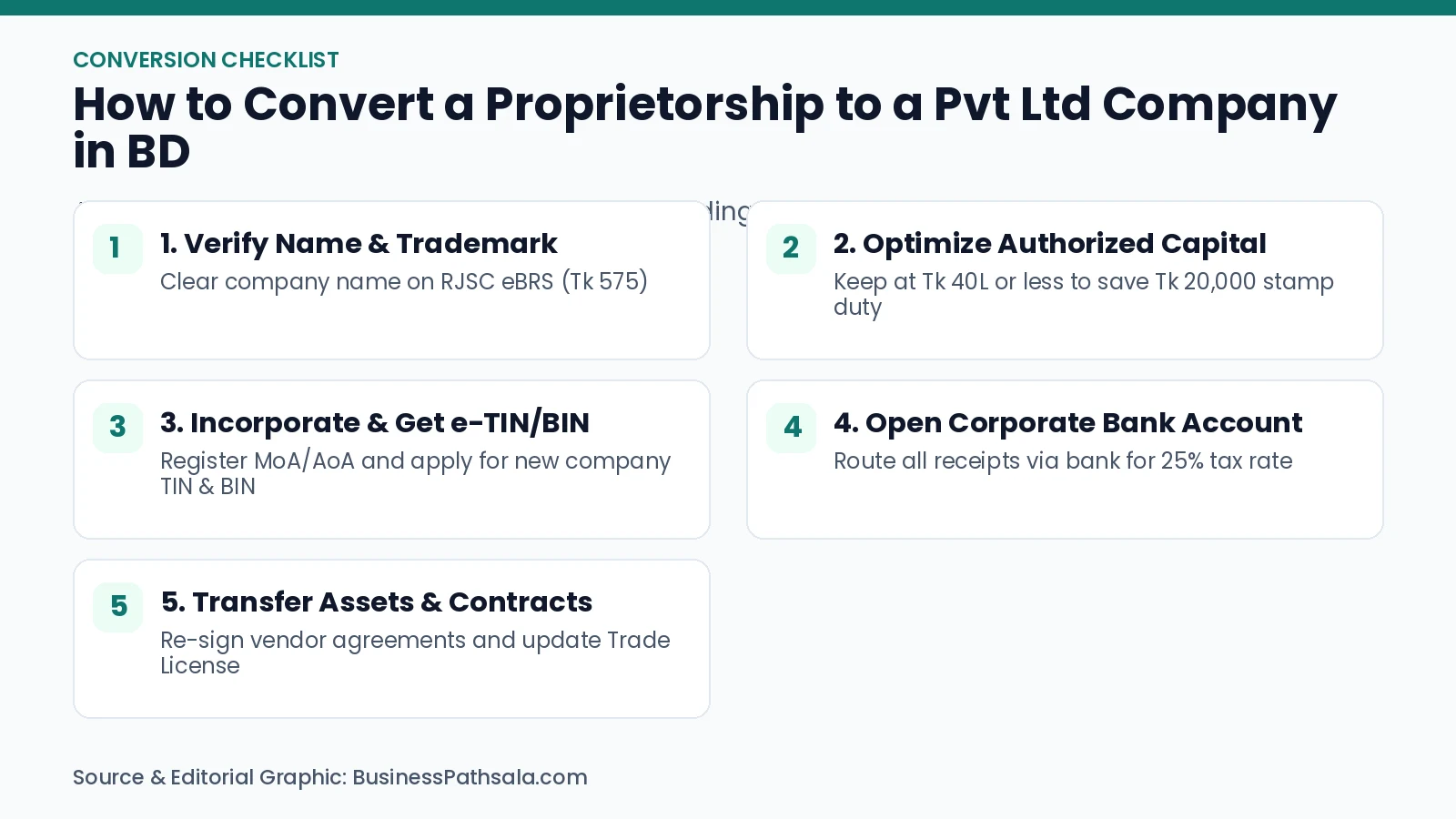
- Run a name search on RJSC eBRS and apply for Name Clearance (Tk 575). Keep in mind that holding a proprietorship Trade License under a brand name does not guarantee RJSC name availability, and RJSC clearance does not replace separate DPDT trademark registration.
- Set your initial authorized capital thoughtfully (Tk 40 lakh or under saves Tk 20,000 in stamp duty) and draft your MoA, AoA, and founder shareholding split clearly.
- Complete RJSC incorporation, then obtain a brand-new Trade License, corporate 12-digit e-TIN, and 13-digit e-BIN under the company’s legal name. Your old proprietorship TIN and BIN cannot be reused by the company.
- Open a corporate bank account, deposit the initial paid-up capital via banking channels, and route all commercial receipts and major expenses through the bank to lock in the 25% corporate tax rate.
- Execute a formal asset transfer agreement to move inventory, equipment, and intellectual property from the proprietorship to the company, re-sign active client and vendor contracts under the new company name, and formally close the old proprietorship licenses to avoid double tax filings.
If you are still mapping out your broader launch steps, licensing sequence, and bank funding plan, read our complete guide on how to start a business in Bangladesh.
Frequently Asked Questions (FAQs)
Which is better in Bangladesh: sole proprietorship or private limited company?
A sole proprietorship is better if you are a solo Bangladeshi founder starting with low capital, low legal risk, and annual profits under BDT 20 to 25 lakh. A private limited company is better if you have co-founders, plan to raise equity funding, work with foreign shareholders, bid on corporate or government tenders, or want limited personal liability as you scale.
Do I need a private limited company to run an e-commerce or Facebook business in Bangladesh?
No. Most early-stage e-commerce and f-commerce stores in Bangladesh operate legally as sole proprietorships using a Trade License, a Digital Business Identification (DBID), and a business bank account or payment gateway. You only need a private limited company when bringing on equity investors, sharing ownership with partners, or scaling into high-liability commercial contracts.
Can a foreigner open a sole proprietorship in Bangladesh?
No. Only Bangladeshi citizens aged 18 or above can register a sole proprietorship. Foreign investors who want to operate in Bangladesh must incorporate a Private Limited Company (up to 100% foreign ownership in most sectors) or set up a BIDA-approved Branch or Liaison Office.
What is the corporate tax rate for a private limited company in Bangladesh in 2026–27?
Under the Finance Act 2026, a standard non-listed private limited company pays 27.5% corporate income tax, which drops to 25.0% if all income receipts and qualifying expenditures (over Tk 5 lakh single or Tk 36 lakh annual) pass through formal banking channels.
Can I keep my old Trade License and BIN after converting to a private limited company?
No. Because a private limited company is a separate legal entity from your sole proprietorship, you must obtain a new Trade License, a new corporate 12-digit e-TIN, and a new 13-digit e-BIN under the company’s registered name, then formally cancel or close the old proprietorship registrations.