

Last updated: · By Sumon Mahmud
An NGO business loan in Bangladesh gives micro-traders, shopkeepers, rural agro-producers, and home-based women entrepreneurs fast access to working capital without the heavy paperwork or land mortgages demanded by commercial banks. Regulated by the Microcredit Regulatory Authority (MRA), more than 700 licensed NGO-MFIs—led by BRAC, ASA, BURO Bangladesh, Shakti Foundation, and TMSS—serve over 41 million account holders across 26,000+ branches nationwide. Under MRA Circular 50, NGO-MFIs cannot charge more than 24% annual interest calculated on a declining balance method, and form plus passbook fees are legally capped at BDT 25.
Speed and doorstep convenience come with a clear trade-off: NGO microenterprise loans cost significantly more than bank SME loans (where average lending rates hover around 14.5%, or 5% under Bangladesh Bank’s women refinance scheme). This guide compares Bangladesh’s largest licensed NGO lenders side by side, breaks down MRA borrower protections, compares real repayment costs against commercial banks, and walks you through applying safely without falling for unlicensed loan scams.
Top NGO Business Loan Providers in Bangladesh (2026 Comparison)
Although over 700 microfinance institutions hold MRA licenses, the top 20 organizations account for roughly 80% of all microenterprise lending in Bangladesh. Each major NGO structures its business loan tiers differently depending on whether you run a small village shop or a growing district-town enterprise.
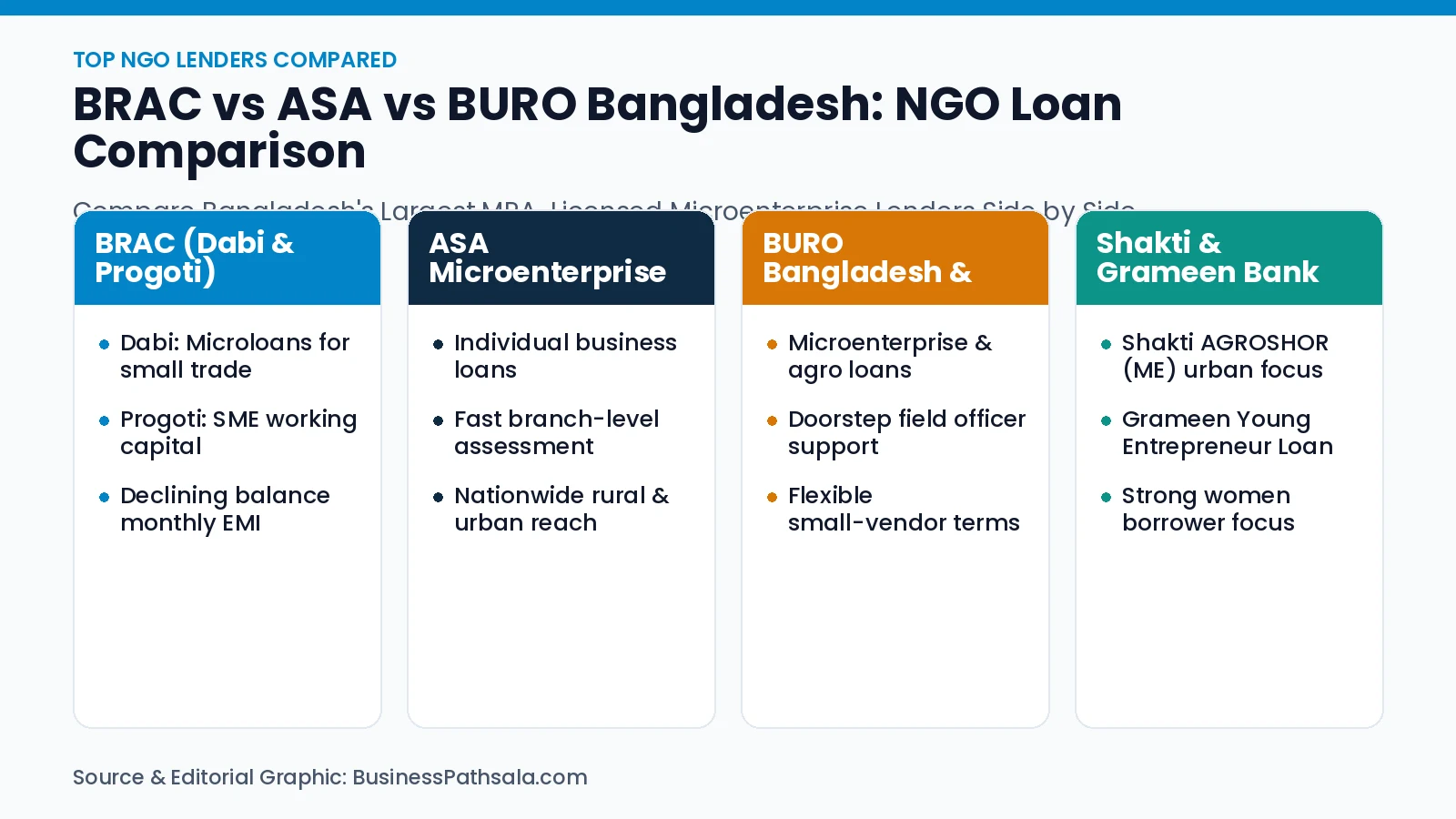
| NGO / MFI | Key Business Loan Product | Target Borrower | Repayment Model | Key Advantage |
|---|---|---|---|---|
| BRAC | Dabi (micro) & Progoti (SME working capital) | Small shops, agro-farms, local manufacturers & women | Monthly or weekly declining-balance installments | Largest branch network & structured Progoti SME scaling |
| ASA | Small Business & Microenterprise Loan | Individual rural and semi-urban traders | Weekly or monthly installments | Fast branch-level decision making and low paperwork |
| BURO Bangladesh | Microenterprise & Agro-Business Loan | Retailers, cottage industries, and seasonal farmers | Flexible weekly/monthly schedules | Strong doorstep field-officer supervision |
| Shakti Foundation | AGROSHOR (ME) Micro-Enterprise Loan | Urban and semi-urban women & micro-entrepreneurs | Structured installment cycles | Tailored for businesses transitioning beyond basic microcredit |
| TMSS | Enterprise-Level Microfinance Loan | Rural micro-entrepreneurs and women-led ventures | Regular installment cycles | Combines credit with technical & livelihood training |
| Grameen Bank | Young Entrepreneur Loan & Microenterprise | Educated youth of Grameen member families & traders | 2-year standard term (extendable by project) | Supports educated youth launching self-employment ventures |
1. BRAC (Dabi and Progoti): Largest Microenterprise Network
BRAC Microfinance operates two flagship business lending tiers. Dabi provides small, collateral-free microloans primarily to women running home-based or micro-trading ventures. Once a business outgrows microcredit, Progoti steps in with larger individual working-capital loans for retail shops, agro-businesses, and small-scale manufacturers. Unlike basic group microloans, larger Progoti facilities typically require a personal guarantor and asset/security verification proportional to the loan size, repaid in equal monthly installments on a declining-balance basis.
2. ASA: Fast Individual Small Business Loans
ASA is known across Bangladesh for its streamlined, decentralized branch model. Rather than routing small loan files through Dhaka headquarters for weeks, ASA branch managers assess local shop inventory, daily sales, and neighborhood reputation on site. This makes ASA popular among grocery owners, tailors, and wholesale traders who need quick seasonal restocking capital before Eid or harvest seasons.
3. BURO Bangladesh, Shakti Foundation, TMSS & Grameen Bank
BURO Bangladesh and TMSS serve thousands of rural and semi-urban entrepreneurs across trading, poultry, dairy, and small manufacturing. In urban and metropolitan centers, Shakti Foundation’s AGROSHOR (ME) scheme specifically bridges the gap for micro-entrepreneurs who are too large for basic group loans yet lack formal bank statements. Meanwhile, Grameen Bank’s Young Entrepreneur Loan offers 2-year project financing to educated youth from Grameen member households who want to build self-employment businesses instead of waiting for salaried jobs.
NGO Business Loan vs. Bank SME Loan: Real Cost Comparison (2026)
Before signing an NGO loan passbook, compare the true annual interest cost against commercial bank SME financing. According to a 2026 Alliance for Financial Inclusion (AFI) analysis of Bangladesh’s microfinance sector, commercial bank lending rates (excluding credit cards) average roughly 14.5%, whereas MRA-regulated MFI service charges are capped at 24% declining balance to cover doorstep field-officer collection costs.
| Comparison Metric | NGO Business Loan (MRA-Licensed MFI) | Commercial Bank SME Loan | Bangladesh Bank Women Refinance |
|---|---|---|---|
| Annual Interest Rate | Up to 24% (declining balance cap) | ~12% to 15.5% (market-linked) | 5% subsidized (up to BDT 25 lakh) |
| Approx. Total Interest on BDT 1,00,000 (12 Mo) | ~BDT 13,400 to 13,500 | ~BDT 7,800 to 8,500 | ~BDT 2,700 to 2,800 |
| Approval Speed | 3 to 7 working days | 10 to 30 working days | 15 to 30 working days |
| Paperwork & Bank History | Minimal (NID, local verification, guarantor) | Trade License, e-TIN, 6–12 mo bank statements | Trade License, NID, clean CIB & guarantor |
| Best Fit | Unbanked / informal micro-vendors needing fast cash | Formal SMEs with bank accounts and steady margins | Women-owned enterprises with valid Trade License |
The math is clear: if you already hold a valid Trade License and route sales through a bank account, applying to one of the collateral-free SME loan banks in Bangladesh or checking Bangladesh Bank women entrepreneur loan schemes can cut your interest bill nearly in half. An NGO business loan makes the most sense when your business is informal, located in a rural area without private bank branches, or needs BDT 50,000 to BDT 3,00,000 within a few days.
Your Legal Rights Under MRA Rules in Bangladesh
Every licensed NGO-MFI must obey strict borrower-protection rules set by the Microcredit Regulatory Authority. Knowing these five rules prevents field-level overcharging:
- 24% Declining Balance Interest Cap: No licensed NGO can legally charge more than 24% per annum on a declining balance (roughly equivalent to ~12%–13.5% flat over 12 months). Flat-rate tricks that double your effective rate are illegal.
- BDT 25 Miscellaneous Fee Cap: Under MRA Circular 23, combined charges for application forms, passbooks, and admission fees cannot exceed BDT 25.
- Minimum 15-Day Grace Period: For 1-year weekly installment loans, MRA rules require at least a 15-day grace period before the first installment and a minimum of 46 installments across the year.
- Minimum 6% Interest on Member Savings: If the NGO requires compulsory weekly savings alongside your loan, they must pay at least 6% annual interest on your deposited savings.
- Official MRA Complaint Hotline: If any licensed MFI violates interest caps or uses abusive recovery tactics, you can report the branch directly to MRA via their national hotline 16133.
5 Rules Before Applying for an NGO Business Loan in Bangladesh
Fake Facebook pages impersonating BRAC, ASA, and BURO Bangladesh regularly scam desperate borrowers by asking for bKash “registration fees” upfront. Follow this five-step checklist to borrow safely.
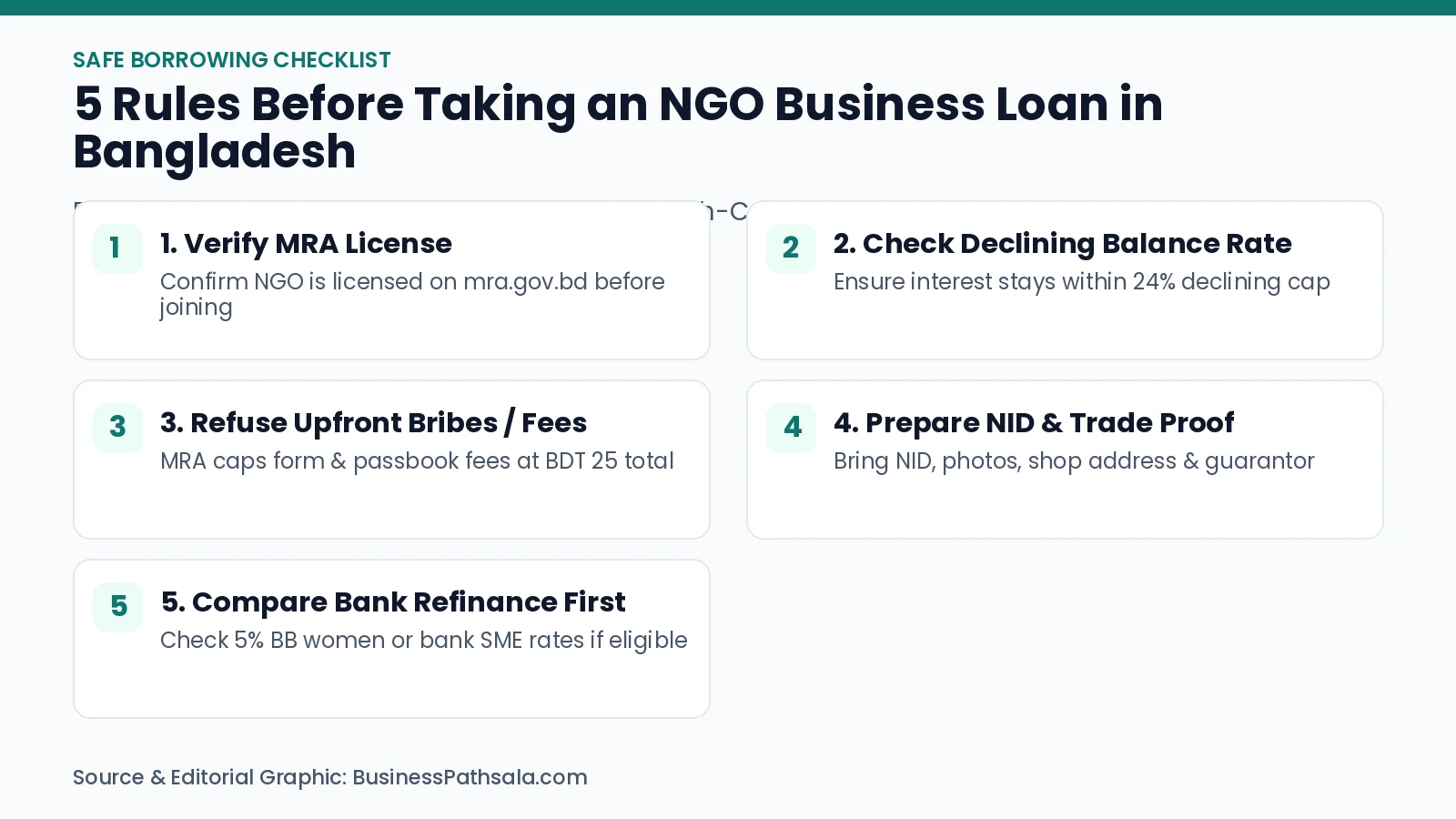
- Verify the NGO’s active MRA license number on mra.gov.bd and visit their physical local branch in person—never send advance “processing fees” to a personal bKash or Nagad number found on Facebook.
- Ask the branch manager for the exact declining-balance interest rate and total taka repayment schedule in writing before signing.
- Avoid taking overlapping loans from two or three NGOs at once; MRA’s new Microfinance Credit Information Bureau (MF-CIB) tracks cross-borrowing, and weekly multi-installment pressure quickly drains working capital.
- Bring clean copies of your National ID (NID), passport photos, shop rental deed or business location proof, and a willing local guarantor (usually a spouse or family member).
- Plan your graduation path: once your business builds 12 months of steady cash flow, open a commercial bank account and transition into lower-cost micro-enterprise bank loans or CMSME loans in Bangladesh, backed by a simple SME loan project profile.
Frequently Asked Questions (FAQs)
Which NGO is best for a business loan in Bangladesh?
BRAC (via Progoti for SMEs and Dabi for micro-traders), ASA, and BURO Bangladesh are the largest MRA-licensed options nationwide. Shakti Foundation (AGROSHOR) is a strong choice for urban women micro-entrepreneurs, while TMSS and Grameen Bank have deep rural coverage.
What is the maximum interest rate an NGO can charge in Bangladesh?
Under Microcredit Regulatory Authority (MRA) Circular 50, licensed NGO-MFIs in Bangladesh cannot charge more than 24% annual interest calculated on a declining balance method.
Can I get an NGO business loan without a Trade License or bank account?
Yes. For smaller microenterprise loans (such as BDT 20,000 to BDT 1,00,000), most licensed NGOs accept your National ID, physical verification of your shop or farm, and a local guarantor without requiring a formal Trade License or 12-month bank statement. Larger Progoti or enterprise loans above several lakh taka usually require a Trade License.
Are online NGO loans on Facebook via bKash real?
No. Licensed NGOs like BRAC, ASA, and BURO Bangladesh require physical branch verification and field-officer visits before disbursing business loans. Any page asking you to send bKash or Nagad money upfront as an “insurance fee” or “file charge” is a scam.
How much processing fee can an NGO legally charge in Bangladesh?
Under MRA Circular 23, total miscellaneous charges—including admission fees, application forms, and passbooks—are capped at BDT 25. Borrowers should refuse to pay unauthorized extra fees.


