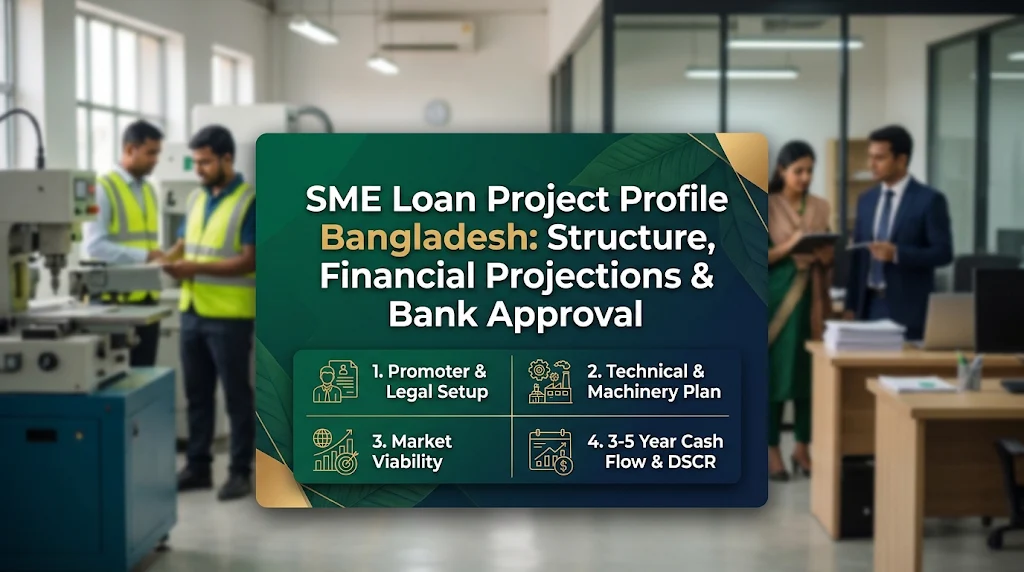
An SME loan project profile in Bangladesh is a technical, commercial, and financial feasibility report that scheduled banks and non-bank financial institutions (NBFIs) use to evaluate whether a cottage, micro, small, or medium enterprise can repay a business loan. When you apply for machinery financing, factory expansion, or a working capital limit, the bank’s Credit Risk Management (CRM) unit checks this file to verify your owner equity share (typically 30% to 40%), 3-to-5-year cash flow projections, Debt Service Coverage Ratio (DSCR of at least 1.50:1), and Internal Rate of Return (IRR above the borrowing cost).
Many applicants buy a pre-filled template from a typing shop near the bank branch. Credit officers spot those copied files within minutes because the machinery prices, power loads, and sales collections contradict the borrower’s bank statements and site inspection.
This guide covers when a Bangladeshi bank requires a formal project profile, how to structure all eight appraisal sections, how to build a 3-year financial model in Bangladeshi Taka (BDT), and how to avoid the calculation errors that delay sanction letters.
What is an SME loan project profile in Bangladesh?
An SME loan project profile is an evidence-backed credit appraisal document prepared for a specific financing request under the Bangladesh Bank SME & Special Programmes Department (SMESPD) framework. Startup pitch decks are written for equity investors looking for valuation growth, whereas a bank project profile is built for credit analysts, relationship managers, and bank engineers who want to see how much cash the business retains after paying suppliers, workers, utilities, and taxes.
In Bangladeshi banking practice, the profile answers four appraisal questions with verifiable documents: management capability (ownership track record and clean CIB report), technical feasibility (factory space, power load, machinery, and labor), commercial viability (raw material sourcing, buyer segments, and cash conversion cycle), and financial sustainability (multi-year schedules proving cash inflows cover installments). If you need to organize your internal strategy first, read our guide on how to write a business plan.
When do Bangladeshi banks require a project profile vs. a simple application form?
Every small borrower does not need a 30-page feasibility study. Under Bangladesh Bank’s standardized CMSME loan application rules, scheduled banks and NBFIs use a simplified Bangla application form (Annex-4) for smaller loans. Once your requested amount, tenor, or technical complexity crosses specific thresholds, the bank asks for a formal project profile alongside Annex-4.
| Financing Scenario | Typical Loan Size (BDT) | What the Bank Requires | Financial Projection Depth |
|---|---|---|---|
| Small trading working capital (Cash Credit or Overdraft) | BDT 2 lakh to BDT 15 lakh | Standardized Bangla form (Annex-4), signed stock list, 12-month bank statement, and basic income-expense sheet | 1-year cash flow and working capital cycle check |
| Unsecured small enterprise loan (such as BRAC Bank SME loans or IDLC SME term loans) | BDT 10 lakh to BDT 50 lakh | Bank credit appraisal sheet, 1-to-3-year management accounts, receivables schedule, and short project summary | 1-to-3-year projected income statement and monthly EMI coverage |
| Machinery purchase, BMRE expansion, or new manufacturing unit | BDT 25 lakh to BDT 5 crore | Complete SME loan project profile with machinery quotations, factory layout, utility load plan, and full financial model | 3-to-5-year income statement, cash flow, balance sheet, DSCR, IRR, NPV, and break-even |
| Medium enterprise industrial project or state-owned bank loan (such as Sonali Bank PLC SME loan) | Above BDT 1 crore (up to BDT 100 crore) | Full bankable feasibility study, civil engineering BOQ, environmental clearance, and sensitivity analysis | 5-to-7-year financial model with multi-scenario stress tests |
| Subsidized refinance schemes (Women 5%, Startup 4%, or Bangladesh Bank CMSME refinance funds) | BDT 5 lakh to BDT 5 crore (scheme-specific) | Scheme-specific profile showing fund utilization, job creation, or import substitution | 3-to-5-year projections aligned with circular tenor and grace period |
For a detailed breakdown of Cottage, Micro, Small, and Medium classification rules under the central bank’s master circular, see our CMSME loan Bangladesh guide.
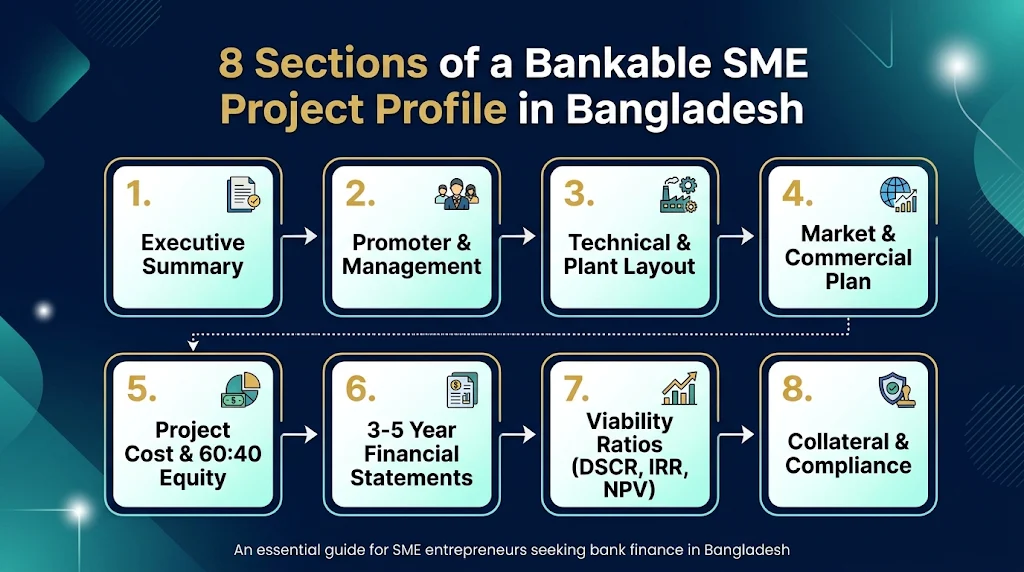
The 8 core sections of a bankable SME project profile in Bangladesh
Whether you draft the file in Excel and Word or work with an accountant, Bangladeshi commercial banks expect the report to follow an eight-part sequence that matches their internal Credit Risk Grading (CRG) scorecard.
1. Executive summary and project at a glance
Place a one-page summary table on the opening page. Branch managers and head-office credit committee members read this table first to check whether the proposal fits their sector policy. Include these exact items:
- Enterprise name, registered office address, and factory, workshop, or godown location.
- Legal form (proprietorship, registered partnership, or private limited company) and trade license number.
- Enterprise category under Bangladesh Bank SMESPD circulars (Micro, Small, or Medium; Manufacturing, Service, or Trading).
- Project purpose (new setup, machinery expansion or BMRE, or working capital enhancement).
- Total project cost split into Fixed Capital (CapEx) and Net Working Capital.
- Means of finance showing Owner’s Equity (BDT and percentage) alongside the Requested Bank Facility (BDT and percentage).
- Facility type (Term Loan, Cash Credit Hypothecation, Overdraft, or Islamic Bai-Muajjal and HPSM), tenor, and grace period.
- Headline viability indicators: average DSCR, project IRR, Net Present Value (NPV), Break-Even Point (BEP), payback period, and jobs created.
2. Promoter background and management appraisal
List each proprietor, partner, or director with their NID, 12-digit e-TIN (see our guide on how to collect an e-TIN certificate online in Bangladesh), education, years of trade experience, shareholding share, personal net worth matching their NBR tax return (IT-10B), and second-line shop manager.
3. Technical feasibility and production plan
For manufacturing, agro-processing, cold storage, or engineering units, the technical section proves your physical setup can produce the forecasted output. State whether the site is owned, leased in a BSCIC estate, or rented commercially, and give the floor area for production, storage, and office space (attaching an engineer’s Bill of Quantities if construction is planned). List every local and imported machine with its specification, origin, unit price, and supplier name, backed by two signed pro-forma quotations. Base installed capacity on 300 working days per year, keeping utilized capacity at 60% to 70% in Year 1, 75% in Year 2, and 80% to 85% in Year 3, followed by kilowatt (kW) power loads and a manpower wage schedule.
4. Market and commercial viability analysis
Skip generic paragraphs about national GDP growth. Credit officers want to know who your buyers are and how your wholesale price compares to two or three named competitors in Dhaka, Chattogram, Bogura, or your local district. Document your raw material sourcing terms as well, noting whether inputs are bought for cash, on 15-to-30-day supplier credit, or via import Letter of Credit (LC), and explain any seasonal demand peaks such as Eid retail or winter harvest cycles.
5. Total project cost and means of finance (Debt-Equity ratio)
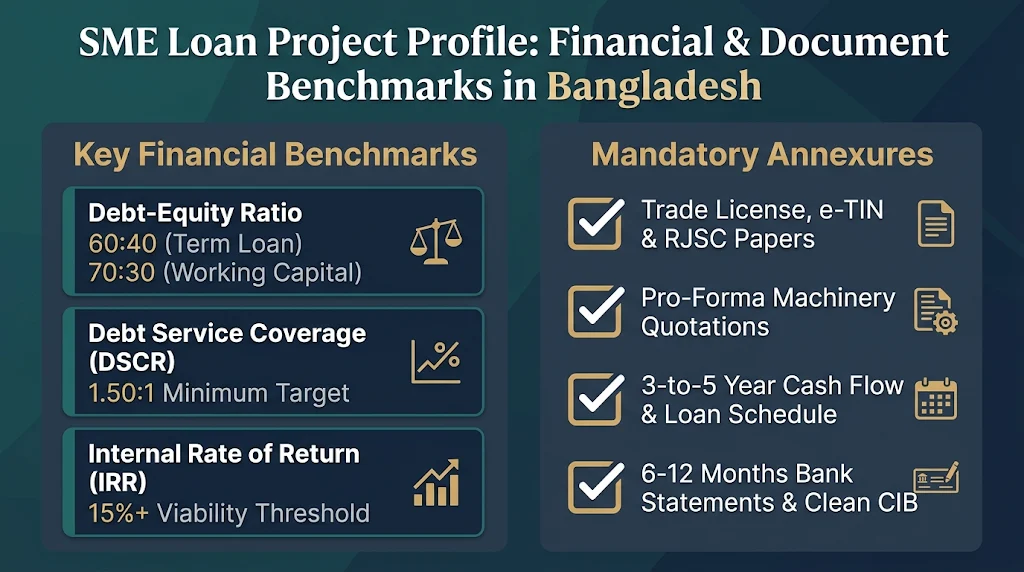
Present a balanced table of Total Project Cost and Means of Finance. Published Sonali Bank PLC SME loan guidelines set a 60:40 debt-to-equity ratio for project loans and 70:30 for working capital, with private banks applying 60:40 to 75:25. Separate owner-funded items (land, advance rent, renovation) from bank-financed machinery or stock.
6. Three-to-five-year financial projections and underlying assumptions
Begin the financial section with a Note on Financial Assumptions listing capacity utilization, annual price and cost escalation (4% to 6%), depreciation rates (10% machinery, 5% buildings, 15% equipment), interest or profit rate, and working capital days, followed by five 3-to-5-year schedules:
- Working capital assessment schedule calculating cash tied up in raw materials (e.g., 30 days), work-in-process (5 days), finished goods (15 days), and receivables (20 days), minus supplier credit.
- Loan amortization schedule showing opening principal, annual interest or profit charges, principal repayments, and closing balances, including any grace period.
- Projected Income Statement detailing gross revenue, Cost of Goods Sold (COGS), gross profit, administrative and selling expenses (SGAE), operating profit (EBIT), bank interest, tax provision, and net profit after tax (NPAT).
- Projected Cash Flow Statement tracking operating inflows, capital expenditures, equity injection, loan disbursement, debt service, and a positive closing cash balance every year.
- Projected Balance Sheet listing Current Assets, net Fixed Assets, Current Liabilities, Long-Term Debt, and Owner’s Equity plus Retained Earnings, balanced to the last Taka.
7. Financial viability ratios and sensitivity analysis
Credit analysts extract five headline ratios from your schedules to score the proposal:
| Financial Metric | Formula Used by Banks | Bangladesh Bank & Lender Benchmark | What It Proves to CRM |
|---|---|---|---|
| Debt Service Coverage Ratio (DSCR) | (Net Profit After Tax + Depreciation + Term Loan Interest) divided by (Term Loan Interest + Principal Installment) | Minimum 1.50:1 (1.75:1 to 2.25:1 preferred) | Shows at least BDT 1.50 to BDT 2.00 of cash generated per BDT 1.00 of installment due. |
| Internal Rate of Return (IRR) | Discount rate at which Net Present Value (NPV) of future net cash flows equals zero | Minimum 15% to 22%+ (above borrowing rate) | Measures annualized percentage return relative to the bank’s lending rate. |
| Net Present Value (NPV) | Present value of projected net cash inflows discounted at cost of capital minus initial outlay | Strictly positive (above BDT 0) at 12% to 15% discount rate | Confirms net economic value in current Taka terms after capital costs. |
| Break-Even Point (BEP) | Fixed Operating Costs divided by (Total Sales minus Variable Costs) | Below 60% to 65% of utilized capacity | Shows how far sales can drop before the unit incurs a loss. |
| Current Ratio | Total Current Assets divided by Total Current Liabilities | Minimum 1.50:1 | Verifies liquidity to pay power bills, wages, and suppliers on time. |
For loans above BDT 50 lakh, include a Sensitivity Analysis table recalculating DSCR and IRR under a 10% raw material cost rise, a 10% revenue drop, and a 2% interest rate increase.
8. Collateral security, environmental clearance, and economic contribution
Close with a schedule of offered securities and permits. List inventory and machinery hypothecation and personal guarantors for unsecured or Credit Guarantee Scheme (CGS) loans, or tabulate the mouza, khatian (CS, SA, RS, BS), dag, deed number, land area, market value, and Forced Sale Value (FSV) for mortgaged loans, alongside Department of Environment (DoE) and Fire Service clearances.
Worked financial example: BDT 50 lakh SME manufacturing project profile
Below is an illustrative model for a packaging workshop applying for BDT 30 lakh (BDT 22 lakh term loan plus BDT 8 lakh working capital) inside a BDT 50 lakh total project cost. Replace these sample numbers with real supplier quotations and current rates from our SME loan interest rate in Bangladesh guide.
Step 1: Total project cost and 60:40 means of finance
| Cost Component | Total Cost (BDT) | Owner’s Equity (40% = BDT 20,00,000) | Bank Loan (60% = BDT 30,00,000) | Verification Evidence Attached |
|---|---|---|---|---|
| Factory shed renovation and electrical wiring | 5,00,000 | 5,00,000 (100%) | 0 | Civil contractor estimate and paid receipts |
| Semi-automatic carton die-cutting and pasting machines | 28,00,000 | 6,00,000 (21.4%) | 22,00,000 (78.6%) | Two supplier pro-forma invoices and catalog |
| Transport, installation, and 3-phase power sub-meter | 2,00,000 | 2,00,000 (100%) | 0 | Electrical contractor quotation |
| Subtotal Fixed Capital (CapEx) | 35,00,000 | 13,00,000 | 22,00,000 (Term Loan) | 62.9% debt and 37.1% equity on CapEx |
| Net Initial Working Capital (45-day paper and receivables cycle) | 15,00,000 | 7,00,000 (46.7%) | 8,00,000 (Working Capital / CC) | Stock valuation sheet and buyer orders |
| Total Project Cost | 50,00,000 | 20,00,000 (40.0%) | 30,00,000 (60.0%) | Matches 60:40 project equity norm |
Step 2: 3-year projected income, cash flow, and DSCR calculation
Here, the BDT 22,00,000 Term Loan carries a 14.0% annual commercial interest rate over 3 years (36 monthly installments of BDT 75,191, or BDT 9,02,292 annual debt service), and the BDT 8,00,000 working capital line costs 14.0% per year (BDT 1,12,000). Capacity utilization is 65% in Year 1, 75% in Year 2, and 85% in Year 3.
| Financial Line Item (in BDT) | Year 1 (65% Capacity) | Year 2 (75% Capacity) | Year 3 (85% Capacity) |
|---|---|---|---|
| Gross Sales Revenue | 96,00,000 | 1,14,00,000 | 1,34,00,000 |
| Less: Raw materials, power, direct labor, and factory overhead (COGS) | 71,50,000 | 84,20,000 | 98,10,000 |
| Less: Depreciation on machinery (10%) and civil works (5%) | 3,05,000 | 3,05,000 | 3,05,000 |
| Gross Profit | 21,45,000 | 26,75,000 | 32,85,000 |
| Less: Administrative, rent, marketing, and transport expenses (SGAE) | 6,20,000 | 6,80,000 | 7,50,000 |
| Operating Profit (EBIT) | 15,25,000 | 19,95,000 | 25,35,000 |
| Less: Term loan interest (14% reducing balance) | 2,68,500 | 1,82,100 | 82,900 |
| Less: Working capital interest (14% on BDT 8 lakh) | 1,12,000 | 1,12,000 | 1,12,000 |
| Net Profit Before Tax (EBT) | 11,44,500 | 17,00,900 | 23,40,100 |
| Less: Estimated income tax provision (15% illustrative SME rate) | 1,71,675 | 2,55,135 | 3,51,015 |
| Net Profit After Tax (NPAT) | 9,72,825 | 14,45,765 | 19,89,085 |
| Cash Accrual for Debt Service (NPAT + Depreciation + Term Interest) | 15,46,325 | 19,32,865 | 23,76,985 |
| Annual Term Loan Debt Service (Principal + Term Interest) | 9,02,292 | 9,02,292 | 9,02,292 |
| Debt Service Coverage Ratio (DSCR) | 1.71 : 1 | 2.14 : 1 | 2.63 : 1 |
Even in Year 1 at 65% capacity, the DSCR is 1.71:1, clearing the 1.50:1 benchmark. If the enterprise qualifies for a 7% Bangladesh Bank refinance scheme or a 5% women entrepreneur refinance facility through a bank listed in our comparison of the best banks for an SME loan in Bangladesh, annual interest drops by more than half and Year 1 DSCR exceeds 2.00:1.
How to customize your project profile by business sector and scheme
Adapt your technical and financial schedules to match your exact sector:
- Manufacturing and agro-processing units must include raw material input-output ratios (with 2% to 5% normal process wastage), machine power loads, BSTI certification for food products, and Department of Environment clearance.
- Trading and wholesale distributors can skip factory layout and machinery depreciation tables, focusing instead on a Working Capital Cycle and Stock Turnover Schedule for their top 15 fast-moving items, supplier credit days, receivables collection days, and godown fire insurance.
- Service sector SMEs (IT firms, diagnostic centers, cold storage, printing, logistics) should emphasize equipment pro-forma invoices, technical staff credentials, corporate client work orders, and monthly utilization across peak and off-peak periods.
- Women entrepreneurs and startups applying for 5% Women Entrepreneur Refinance or 4% Startup Refinance should add a compliance page proving at least 51% female ownership and management, or documenting innovation and training certificates from SME Foundation Bangladesh or BSCIC. See our startup loan Bangladesh guide for new founder criteria.
Complete document checklist to attach as annexures
Based on published bank checklists such as the IDLC SME term loan document checklist, attach these indexed annexures behind your financial schedules:
- Identity and legal papers: NID cards and photographs of all promoters and guarantors; renewed Trade License (see our guide on starting a business in Bangladesh); notarized Partnership Deed; or RJSC Certificate of Incorporation, Memorandum and Articles of Association, Form XII, and Board Resolution.
- Tax and regulatory permits: 12-digit e-TIN certificate, latest tax return acknowledgment receipt (PSR), 13-digit VAT/BIN certificate, and sector licenses (IRC/ERC, Fire License, DoE Clearance, Drug License, or BSCIC registration).
- Banking and financial records: Last 6 to 12 months of business bank statements across all accounts, existing loan sanction letters, and 1 to 3 years of management-signed or CA-audited financial statements.
- Project quotations and site deeds: Two pro-forma invoices per machine, engineer-signed civil BOQ, factory layout drawing, and commercial lease deed valid for the full loan tenor.
- Collateral title chain (for mortgaged loans): Original Title Deed, 25-year Bia Deed chain, CS, SA, RS, and BS Khatians, Mutation Khatian with DCR, up-to-date Land Development Tax (Khajna) receipt, Non-Encumbrance Certificate (NEC), and approved building plan.
Step-by-step: How to prepare your SME project profile in Bangladesh
- Confirm the bank’s format and equity ratio at the branch SME desk before drafting your file.
- Collect at least two verifiable vendor quotations for every machine or vehicle and check commercial utility tariffs.
- Reconcile your Year 0 baseline sales with the past 12 months of deposits in your business bank statements.
- Build the 3-to-5-year Excel model from physical daily output multiplied by 300 working days and 65% to 70% Year 1 capacity utilization.
- Verify that DSCR stays at or above 1.50:1 every year, Total Assets equal Total Liabilities plus Equity, and the project survives a 10% cost increase.
- Write plain, factual technical and market descriptions without promotional claims.
- Audit all names, addresses, and registration numbers across your Trade License, e-TIN, lease deed, and cover page before spiral-binding the file.
Should you write the project profile yourself or hire a consultancy firm in Bangladesh?
For most SME loans up to BDT 50 lakh (and many up to BDT 1 crore), Bangladesh Bank does not require an external consultant’s seal on the project profile; the borrower’s own signature and company stamp on an accurate report are sufficient.
| Preparation Route | Typical Cost in Bangladesh | Best Suited For | Main Risk to Watch |
|---|---|---|---|
| Self-prepared by the owner (with in-house accountant) | BDT 0 (printing and binding only) | Working capital limits and machinery term loans up to BDT 50 lakh to BDT 1 crore | Balance sheet imbalances if you edit rows manually without linked Excel formulas. |
| Local typing shop or template seller | BDT 3,000 to BDT 8,000 | Not recommended for bank credit appraisal | Copied numbers that contradict your bank statement and trigger CRM rejection. |
| Specialized consultancy or CA firm | BDT 15,000 to BDT 60,000+ | Industrial setups, BMRE projects above BDT 1 crore, or multi-bank term loans | Unrealistic sales assumptions that you cannot defend during the bank’s physical site visit. |
7 common mistakes that get SME project profiles rejected by Bangladeshi banks
- Assuming 100% capacity utilization in Year 1 instead of a realistic 60% to 70% ramp-up.
- Projecting Year 1 revenue that contradicts your past 12 months of business bank deposits without signed buyer work orders.
- Requesting a machinery Term Loan without showing how initial 60-day Working Capital will be funded.
- Submitting a Balance Sheet where Total Assets do not equal Total Liabilities plus Owner’s Equity.
- Omitting the 3-to-6-month grace period and Interest During Construction Period (IDCP) for new factory installations.
- Inflating machinery pro-forma invoices to bypass the 60:40 debt-to-equity requirement.
- Paying middlemen who promise guaranteed approval instead of submitting directly at the bank’s SME desk.
Editorial & Financial Disclaimer: This guide is published for educational purposes on BusinessPathsala.com by Afra Munira. It does not constitute formal financial, accounting, or legal advice, and preparing a project profile never guarantees loan approval. Scheduled banks and NBFIs evaluate every application independently under current Bangladesh Bank regulations, internal Credit Risk Management (CRM) policies, and CIB clearance rules.
Frequently asked questions (FAQs)
1. Is a project profile mandatory for every SME loan in Bangladesh?
No. For small working capital or trading loans (typically up to BDT 10 lakh to BDT 15 lakh), banks use Bangladesh Bank’s standardized Bangla application form (Annex-4) along with basic income-expense and stock statements. A formal project profile is required for machinery purchases, new industrial setups, BMRE expansion projects, and larger SME term or working capital facilities.
2. Can I write my own SME loan project profile without a CA firm?
Yes. For most cottage, micro, and small enterprise loans, you can prepare and sign your own project profile as the proprietor or managing director. Banks only require Chartered Accountant-audited financial statements for registered limited companies or larger medium enterprise exposures where statutory audit rules apply.
3. What is the minimum DSCR required by banks in Bangladesh for an SME project loan?
Most Bangladeshi scheduled banks and NBFIs require a minimum Debt Service Coverage Ratio (DSCR) of 1.50:1 across the projected loan period, with an average DSCR between 1.75:1 and 2.25:1 preferred to cushion against raw material price increases or temporary sales slowdowns.
4. What debt-to-equity ratio should I use in an SME project profile in Bangladesh?
A widely accepted benchmark aligned with state-owned and private commercial bank policies (such as Sonali Bank PLC) is 60:40 (60% bank debt, 40% owner equity) for project and term loans, and 70:30 for working capital facilities. Some specialized refinance schemes permit higher debt shares, so confirm the exact ratio with your branch SME officer before finalizing your tables.
5. How many years of financial projections should an SME project profile include?
Your financial projections should cover at least 3 to 5 years, or match the full repayment period of the requested term loan. If you request a 4-year machinery term loan, include 4 to 5 years of projected income statements, cash flows, and balance sheets.
6. Can I submit an SME project profile in Bangla?
Yes. Bangladesh Bank’s standardized CMSME loan application form (Annex-4) is in Bangla, and state-owned banks as well as rural and upazila branches of private banks accept project profiles written in Bangla or English. For larger urban private bank CRM units, English project profiles with Excel financial schedules are standard.
7. Does an Islamic bank require a different project profile format in Bangladesh?
The technical, market, and cash-flow sections remain the same, but an Islamic bank project profile replaces interest-based loan terms with Shariah-compliant investment modes such as Bai-Muajjal, Murabaha, or HPSM (Hire Purchase under Shirkatul Melk). You must also attach clear supplier quotations because the bank purchases the underlying machinery or goods directly.
Conclusion: Your pre-submission checklist
A well-built SME loan project profile in Bangladesh proves whether your expansion can repay 12.5% to 16% commercial debt (or 4% to 9% refinance funds) before you sign a mortgage or guarantee. Keep Year 1 utilization at 65% to 70%, attach vendor quotations, maintain a DSCR above 1.50:1, and match your business bank statements.