Quick answer: A cottage industry loan in Bangladesh is a small-scale working-capital or equipment loan offered by scheduled commercial banks, specialized and state-owned banks, non-bank financial institutions (NBFIs), and partner microfinance channels under Bangladesh Bank’s CMSME Master Circular (SMESPD Circular No. 01, 17 March 2025). Eligible home-based craft makers, handloom and Nakshi Kantha artisans, pottery and cane/bamboo workers, tailoring and embroidery units, and rural food/spice makers can borrow to buy yarn, raw materials, looms, or small tools. Standard commercial SME rates generally range around 12% to 14.5%, while eligible cottage enterprises under active central bank refinance or SME Foundation wholesale programs can access lower subsidized rates (such as up to 5% for qualifying women entrepreneurs under dedicated refinance or 7% under broader CMSME refinance when active). Valid identification, trade or craft registration, clean CIB records, and verifiable sales or bank records are key.
Updated 21 November 2026. Commercial bank interest rates, refinance fund allocations, cottage industry classifications, and lending rules change periodically. Confirm current interest rates, collateral terms, and document checklists directly with your lender or support institution before applying.
Across Bangladesh’s villages, district towns, and artisan hubs—from handloom weavers in Tangail and Sirajganj to Nakshi Kantha makers in Jamalpur, brass and bell-metal artisans in Dhamrai, and home-based craft makers everywhere—cottage industries preserve local skills while creating everyday livelihoods. Unlike large factories with heavy machinery and formal corporate accounting, a cottage business often operates from a home courtyard or small workshop using family labor, traditional tools, and modest capital. Yet buying bulk yarn, clay, cane, fabric, or packaging ahead of festival demand can stretch a small budget fast. Knowing how cottage industry loans work in Bangladesh helps artisans and small makers access affordable credit without getting tangled in unnecessary red tape.
How Cottage Industries Are Defined and Evaluated in Bangladesh
In Bangladesh’s banking and industrial policy, cottage industries sit at the base of the CMSME pyramid under Bangladesh Bank’s CMSME Master Circular and national industrial policy. They are typically home-based or small-scale productive units where the owner and family members (along with a small number of workers) carry out production using modest fixed assets and skill-based or traditional processes. You can see how CMSME categories fit together in our CMSME loan guide for Bangladesh.
Because cottage enterprises are smaller and often less formal than medium-sized factories, credit officers look closely at four practical indicators:
- Genuine production and buyer demand: Lenders look for real craft or goods being produced and sold—whether through local markets, wholesale mahajans/traders, trade fairs, or online/social channels—rather than idle equipment.
- Bank, MFS, and sales record visibility: Many cottage makers sell for cash or collect payments through bKash or Nagad. Showing regular bank deposits, mobile merchant statements, or buyer receipts helps prove repayment ability.
- Cluster or institutional linkage: Being part of a recognized craft cluster, local samity, or training/registration network (such as BSCIC or SME Foundation) often makes verification easier.
- Clean CIB status: Neither the applicant nor any partner or guarantor can have an overdue or classified loan default in the Bangladesh Bank Credit Information Bureau (CIB) database.
Main Financing Channels for Cottage Industries in Bangladesh
Cottage businesses do not all have the same banking history or loan size needs. Choosing the right channel—whether a commercial bank refinance window, an SME Foundation partner lender, a rural bank, or a microfinance linkage—depends on your scale and readiness.

1. Bangladesh Bank CMSME and Women Entrepreneur Refinance Schemes
For cottage businesses that hold formal registration and banking records, participating scheduled banks and NBFIs offer credit under Bangladesh Bank’s SMESPD Refinance Schemes. Women-owned cottage businesses (100% female sole proprietorship or at least 51% female ownership in partnerships/companies) can apply through a bank’s Women Entrepreneurs Dedicated Desk to access women-focused refinance support (capped up to 5% per year under the dedicated women’s small-enterprise refinance scheme when active) and policy protections such as collateral-free consideration against personal guarantees where applicable.
2. SME Foundation Wholesale Credit Support
The SME Foundation channels wholesale funds through Partner Financial Institutions (banks and NBFIs) to support cottage, micro, and small enterprises, with strong attention to Bangladesh’s mapped SME clusters and women entrepreneurs. Rates are set per funding round at subsidized single-digit levels when active, and smaller tickets are designed around collateral-free or guarantee-backed lending.
3. Specialized Agricultural Banks and State-Owned Banks
Rural and regional cottage makers often work closely with Bangladesh Krishi Bank (BKB), Rajshahi Krishi Unnayan Bank (RAKUB, in Rajshahi and Rangpur divisions), or state-owned commercial banks (Sonali, Janata, Agrani, Rupali) that maintain branches in district towns and upazilas. These banks reach areas where private bank branches are sparse.
4. PKSF Partner NGOs and Microfinance Linkages
Very small home-based or micro-cottage makers who do not yet have formal bank statements or large loan needs often start with smaller loans through Palli Karma-Sahayak Foundation (PKSF) partner NGOs/MFIs or bank-MFI linkage programs. Once sales and repayment records grow, entrepreneurs can graduate to bank SME credit.
Interest Rates and Real Repayment Math (BDT 3 Lakh Example)
Borrowing costs for a cottage industry loan depend on whether your loan uses an active central bank refinance or wholesale allocation or follows standard commercial bank pricing. Outside subsidized refinance windows, commercial SME loan rates across banks typically sit around 12% to 14.5% depending on credit risk and collateral. You can compare broader bank pricing in our guide to SME loan interest rates in Bangladesh.
To see how rate differences affect a smaller cottage loan, consider an illustrative BDT 3,00,000 (3 lakh) loan for raw materials or small equipment repaid over 36 months (3 years) on a standard monthly reducing-balance schedule:
| Rate Scenario (BDT 3 Lakh, 36 Months) | Approx. Monthly EMI | Total Interest (3 Years) | Total Repayment |
|---|---|---|---|
| 5.0% Annual Rate (Women Refinance Ceiling) | BDT 8,991 | BDT 23,686 | BDT 3,23,686 |
| 7.0% Annual Rate (CMSME Refinance Window) | BDT 9,263 | BDT 33,473 | BDT 3,33,473 |
| 9.0% Annual Rate (Concessional / Special Window) | BDT 9,540 | BDT 43,437 | BDT 3,43,437 |
| 13.5% Annual Rate (Typical Commercial SME Rate) | BDT 10,181 | BDT 66,501 | BDT 3,66,501 |
Illustrative calculation only: Figures assume equal monthly installments (EMI) and exclude any bank processing fees, CIB fees, stamp duties, or VAT. Actual repayment terms appear in your written sanction letter.
On a BDT 3 lakh loan over three years, a 5% refinance rate saves roughly BDT 1,190 per month and BDT 42,815 in total interest compared to a 13.5% commercial rate. Even on a modest loan size, keeping monthly installments low leaves more cash for yarn, dye, tools, or household buffer during slower months.
How Seasonal Craft Demand Shapes Cottage Cash Flow
Many cottage industries in Bangladesh experience sharp seasonal peaks around Eid-ul-Fitr, Eid-ul-Adha, Pohela Boishakh, Puja, and winter craft fairs, followed by quieter sales stretches during heavy monsoon weeks or off-season months. Artisans often buy raw yarn, dyes, clay, cane, or fabric weeks before peak festivals so finished pieces are ready on time.
Planning your borrowing around those craft cycles helps protect your livelihood. If you use credit to stock up ahead of a major festival, time your production so finished goods sell quickly and build a small cash cushion rather than committing to an installment that strains your budget during slower months.
Eligibility Criteria for Cottage Industry Loans in Bangladesh
Exact requirements vary between banks, NBFIs, and partner microfinance institutions, yet most lenders evaluate cottage applicants against these core points:
- Active Craft or Cottage Operation: You should be actively producing or preparing to launch a viable cottage craft or micro-enterprise—such as handloom weaving, tailoring/embroidery, cane/bamboo work, pottery, leather craft, or traditional food/spice preparation—with a realistic sales plan.
- Age and Citizenship: Bangladeshi citizen with a valid National ID (NID), typically aged between 21 and 65 years at loan maturity.
- Clean CIB Status: Neither the applicant nor any partner or guarantor may have an overdue or classified loan default in the Bangladesh Bank CIB database.
- Business or Craft Proof: Banks generally look for an updated Trade License (and/or BSCIC or cluster/association proof where applicable) plus at least 1 to 2 years of active operation for standard bank SME loans, while smaller micro/training-linked windows may have more flexible entry rules.
- Guarantees and Collateral: Smaller cottage loans are often structured with personal guarantors, asset hypothecation, and security cheques rather than heavy land mortgages, whereas larger loans or weaker financial records may require tangible collateral or liquid security.
Required Documents Checklist for a Cottage Industry Loan
Preparing a clean document folder before visiting a branch helps prevent unnecessary delays. Gather these six document categories where applicable:
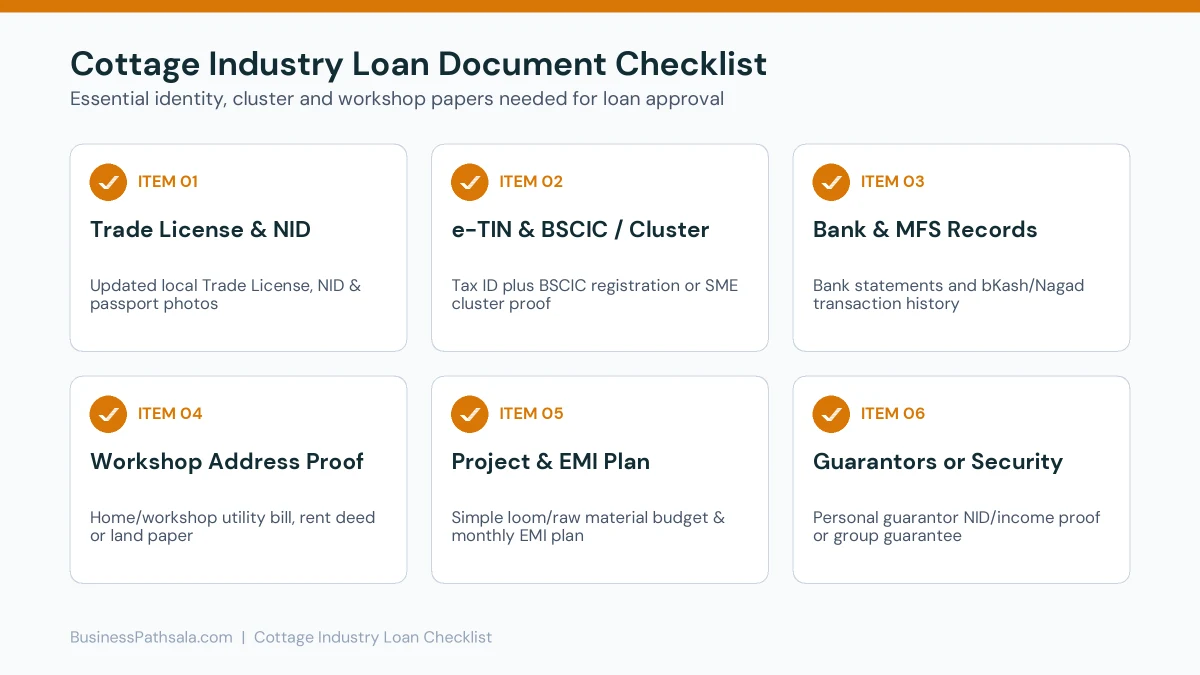
- Trade License and Identity Papers: Valid National ID (NID) copy and passport-size photographs of the owner (and guarantors), plus an updated Trade License from your Union Parishad, Pourashava, or City Corporation where applicable.
- Tax and Craft/Cluster Registration: e-TIN certificate (and tax return acknowledgement slip where applicable), along with registration or membership proof from BSCIC, a local craft/cluster association, or a training institute if available.
- Bank, MFS, and Sales Records: Bank account statement (typically 6 to 12 months if available), bKash/Nagad merchant transaction logs, and supplier purchase or buyer sales receipts.
- Home or Workshop Premises Proof: Address verification for your home workshop or rented/owned work space, such as a rent agreement, electricity/utility bill, or local union/municipal certificate.
- Simple Project Profile or Repayment Plan: A plain-language note showing what raw materials or tools you will buy, expected production and sales, monthly expenses, and how you will pay the monthly installment. See our guides on preparing an SME loan project profile in Bangladesh and writing a business plan for a bank loan.
- Guarantor Papers: NID copies, passport photos, and income or business details of personal guarantors (or collateral/FDR papers if required by the lender).
Step-by-Step: How to Apply for a Cottage Industry Loan
- Gather your ID, trade/craft papers, and sales proof. Check that your NID and Trade License or cluster papers are up to date and assemble whatever bank, MFS, or buyer/supplier records you have.
- Deposit craft sales regularly into a bank or merchant account. Even if you sell locally in cash, routing regular deposits through a bank account helps credit officers verify steady business activity.
- Visit the branch SME or Women SME desk (or partner institution). Ask clearly which cottage/small-enterprise loan or refinance program fits your craft and ticket size, and request their written document checklist.
- Submit your application and collect an acknowledgement. Hand in your completed form and document folder and keep a dated receipt. Avoid paying unofficial middlemen who promise guaranteed loan approval.
- Complete worksite verification and CIB screening. Expect a representative to visit your home or workshop to check your tools, finished goods, and local sales before head office runs CIB checks.
- Review written terms on the sanction letter before signing. Verify the interest rate, monthly EMI, processing/service charges, guarantor terms, and early-settlement rules in writing.
Common Mistakes Cottage Entrepreneurs Make
- Keeping all sales and purchases in unrecorded cash: Without bank or MFS records and basic sales/purchase notes, banks struggle to verify income and may reject or shrink the loan amount.
- Applying with missing or outdated basic papers: An expired Trade License or missing guarantor details can stall a file for weeks.
- Asking for a lump sum without clear raw-material or tool math: Showing exact costs for yarn, clay, tools, or packaging makes your request realistic and easy to assess.
- Setting monthly EMIs too high for seasonal craft sales: Craft demand can dip in off-peak months, so keep your installment comfortable against slower periods.
If you are also exploring broader small-business financing options in Bangladesh, you can review our Uddokta loan guide for Bangladesh.
Frequently Asked Questions
Can a home-based cottage business get a loan in Bangladesh?
Yes. Many cottage enterprises in Bangladesh operate from home or family premises. Eligibility depends on your loan size, verifiable production and sales activity, clean CIB status, identification/trade or craft documentation, and the specific bank, NBFI, or microfinance partner’s credit rules.
What is the interest rate on a cottage industry loan in Bangladesh?
Interest rates vary by funding source. Standard commercial SME bank loans generally sit around 12% to 14.5% depending on credit risk and collateral, while qualifying women entrepreneurs or eligible small/cottage borrowers under active central bank refinance or SME Foundation wholesale windows can access lower subsidized rates when allocations are open.
Is land collateral mandatory for a cottage industry loan?
Not always, especially for smaller loan amounts where lenders rely on personal guarantees, asset hypothecation, security cheques, or central bank/SME Foundation support rules. Larger loans or weaker financial records may still require collateral or liquid security depending on the lender.
Can a women entrepreneur get priority for a cottage industry loan?
Yes. Women-owned cottage businesses can apply through a bank’s Women Entrepreneurs Dedicated Desk and may qualify for women-focused refinance schemes, collateral-free lending guidance against personal guarantees (where applicable), or SME Foundation wholesale allocations with women priority.
How long does it take to get a cottage industry loan?
Timelines vary by institution and loan size. Small loans through microfinance linkages or straightforward branch SME files with complete documents and clean CIB checks can take a couple of weeks to several weeks, while collateralized or refinance-linked files may take longer.
Official Sources and Further Reading
- Bangladesh Bank SMESPD Circular No. 01 — CMSME Financing Master Circular (17 March 2025): Official CMSME definitions, credit guidelines, and lending rules in Bangladesh.
- Bangladesh Bank SME & Special Programmes Department (SMESPD): Central bank refinance schemes and SME credit directives.
- SME Foundation Official Portal (smef.gov.bd): Cluster support, training, and wholesale credit programs for cottage, micro, and small enterprises.
- Bangladesh Small and Cottage Industries Corporation (BSCIC): Small and cottage industrial registration and artisan support in Bangladesh.
- Palli Karma-Sahayak Foundation (PKSF): Apex microfinance development institution supporting rural and cottage livelihood credit through partner NGOs.
Final Takeaway
Getting a cottage industry loan in Bangladesh is smoother when you pair genuine craft or workshop output with clear sales/bank records, clean CIB status, and a realistic raw-material or tool plan. Check active refinance or SME Foundation partner options across two or three lenders, keep monthly installments comfortable for slower months, and verify all terms in writing before signing.
Financial information notice: This article is for general educational purposes only and does not constitute a loan offer, financial advice, or a guarantee of loan approval. Bank interest rates, refinance schemes, collateral rules, and registration requirements may change over time. Always verify current terms directly with Bangladesh Bank, relevant institutions, and your chosen lender.