Starting an agro business in BD in 2026 is one of the most resilient ways to build steady cash flow and long-term asset value in Bangladesh. With over 170 million domestic consumers, 70 million+ metric tons of annual agricultural output, and a USD 7.3 billion packaged food market, demand for fresh, safe, and value-added farm products keeps rising every year.
Yet many first-time founders lose money in their first two cycles because they pick the wrong model for their capital, skip biosecurity, or overlook food-safety licensing. This guide walks you through the highest-margin agribusiness models in Bangladesh, realistic startup budgets in BDT, required licenses, Bangladesh Bank’s 7% agricultural refinancing schemes, and a step-by-step launch plan.
Why Agro Business in BD Is Growing Fast in 2026
Bangladesh combines low production costs, year-round fertile land, and strong government incentives across farming, agro-processing, and exports. According to the Bangladesh Investment Development Authority (BIDA) agribusiness sector profile, Bangladesh ranks 2nd globally in jute, goat milk, and jackfruit production, and 3rd globally in rice and freshwater fish.
Three structural shifts are creating fresh openings for modern entrepreneurs who move beyond traditional subsistence farming:
- Rising urban demand for safe and packaged food: BIDA data shows Bangladesh’s packaged food market is projected to grow at roughly 15.01% annually through 2027, driven by a growing urban middle class seeking hygienic, halal-certified, and ready-to-cook items.
- Strong export momentum and cash incentives: Bangladesh exports over 700 agricultural items to 140+ countries, crossing USD 1.03 billion in FY24 agro-exports. Under Bangladesh Bank’s FEPD-1 Circular No. 17 (valid through June 30, 2027), exporters of locally processed agricultural products and potatoes receive a 10% cash subsidy, alongside 3% for rice and 2% for tea.
- Expanded low-cost farm credit: For FY2026–27, Bangladesh Bank’s Agricultural and Rural Credit Policy raised the national farm credit target to Tk 60,000 crore (a 54% jump from Tk 39,000 crore in FY26) and backed Tk 13,000 crore in agricultural refinancing schemes capped at a 7% customer interest rate.
Key Reality Check: Raw commodity farming often suffers from seasonal price crashes at harvest. The highest and most stable margins in Bangladesh come from combining disciplined production with grading, cold storage, direct urban distribution, or light agro-processing.
Top 8 Profitable Agro Business Ideas in BD (With Startup Costs)
The best agro business in BD depends on three factors: your available land or shed space, your working capital buffer, and how fast you need monthly cash flow. Never commit 100% of your savings to fixed infrastructure; keep at least 35% to 40% liquid for feed, seeds, electricity, and veterinary or crop protection costs.
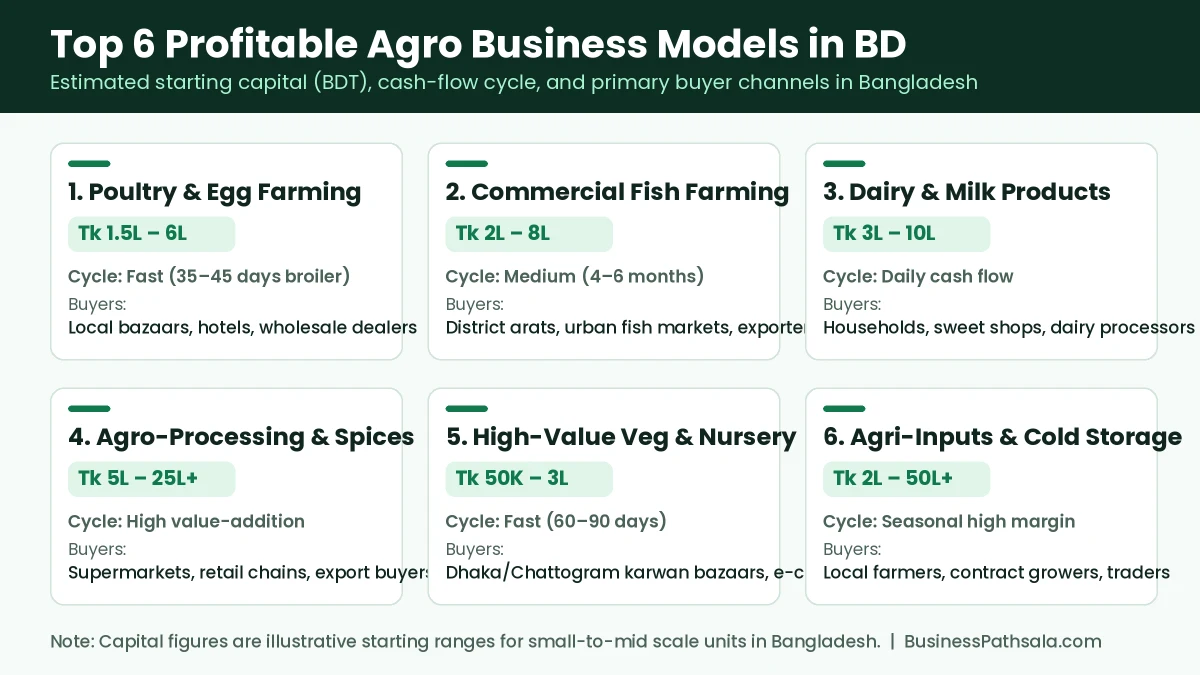
| Agro Business Model | Estimated Startup Cost (BDT) | Revenue Cycle | Primary Target Buyers |
|---|---|---|---|
| Poultry (Broiler / Sonali / Layer) | Tk 1.5 lakh – 6 lakh | 35–45 days (broiler) / daily (eggs) | Local bazaars, hotels, wholesale dealers |
| Commercial Fish Farming (Pond) | Tk 2 lakh – 8 lakh | 4–6 months per harvest | District arats, urban fish markets, exporters |
| Dairy Farming & Milk Products | Tk 3 lakh – 10 lakh | Daily cash flow | Households, sweet shops, dairy processors |
| High-Value Vegetables & Nursery | Tk 50,000 – 3 lakh | 60–90 days | Wholesale arats, supermarkets, F-commerce |
| Cattle Fattening & Goat Rearing | Tk 2 lakh – 8 lakh | 3–6 months (peak before Eid) | Livestock haats, online Qurbani buyers, butchers |
| Agro-Processing & Spice Packaging | Tk 5 lakh – 25 lakh+ | Monthly recurring orders | Grocery chains, supershops, export buyers |
| Agri-Input & Seed Retail Shop | Tk 2 lakh – 7 lakh | Seasonal peak sales | Local farmers, commercial growers |
| Mini Cold Storage & Grading Hub | Tk 15 lakh – 50 lakh+ | Seasonal storage fees | Potato/onion farmers, fruit wholesalers |
Note: Startup cost ranges above are illustrative estimates for small-to-mid-scale units outside prime Dhaka commercial zones. Actual budgets vary significantly depending on whether you own or lease land, shed construction materials, and current feed prices.
1. Commercial Poultry and Egg Farming
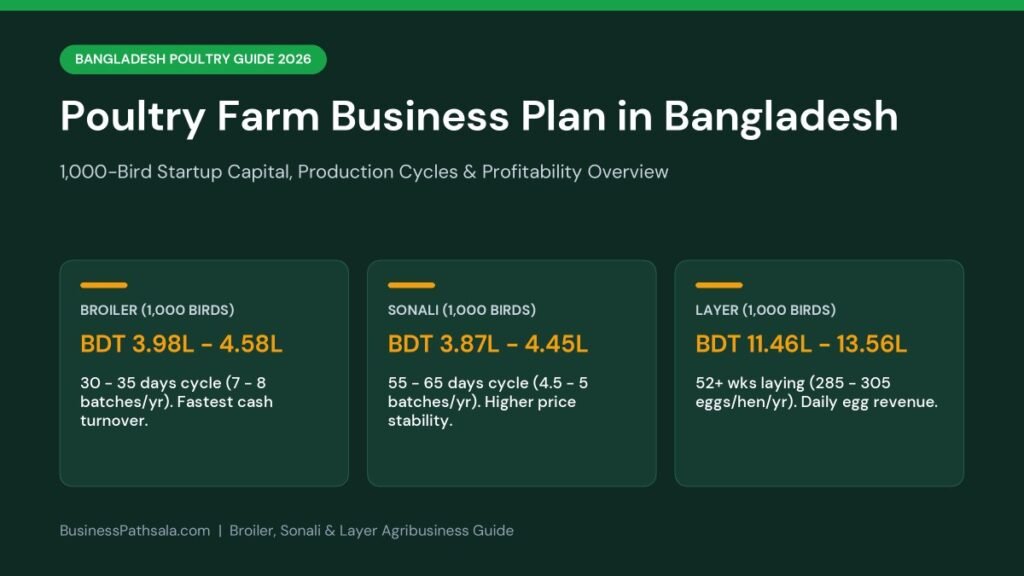
Poultry offers the fastest cash-conversion cycle in Bangladeshi agriculture. Broiler chickens reach market weight in 35 to 42 days, Sonali chickens take roughly 60 to 70 days and command higher per-kilogram prices, and layer farms generate daily cash flow once hens begin laying around week 18 to 20.
Profitability hinges on Feed Conversion Ratio (FCR) and strict vaccination schedules. Before building a shed, review our detailed poultry farm business plan in BD to model chick prices, feed bags, and mortality buffers accurately.
2. Commercial Pond Fish Farming (Aquaculture)
Freshwater aquaculture remains a cornerstone of rural wealth creation across Mymensingh, Bogura, Jashore, and Khulna. Fast-growing species like Pangas, Tilapia, Rui, Katla, and high-value Pabda or Gulsha deliver strong returns when pond water quality, dissolved oxygen, and floating-feed rations are managed scientifically.
If you lease ponds rather than owning them, sign a minimum 3-to-5-year lease agreement so your pond-preparation costs pay off across multiple cycles. Entrepreneurs scaling multiple ponds can explore dedicated fisheries business loans in Bangladesh.
3. Dairy Farming and Value-Added Milk Products
Dairy farming provides predictable daily income, especially when you convert surplus milk into curd (doi), ghee, or chhana. Starting with 3 to 5 crossbred high-yielding cows (such as Holstein Friesian or Sahiwal crosses) allows you to test fodder supply and local milk collection routes without overextending capital.
Growing your own Napier or German grass on leased plots cuts dry-feed bills by 25% to 35%—often the difference between breaking even and earning healthy net profit. For expansion financing, check our guide to dairy farming business loans in Bangladesh.
4. High-Value Vegetable Cultivation and Seedling Nurseries
Growing off-season or high-value crops—such as capsicum, broccoli, cherry tomatoes, strawberries, dragon fruit, or grafted summer tomatoes—earns far higher margins per decimal than standard seasonal crops. Commercial seedling nurseries using coco-peat trays also require modest land (5 to 20 decimals) and sell directly to local farmers at the start of every planting season.
Basic poly-sheds or shade-net houses protect crops from heavy monsoon rain and heat stress. According to BIDA figures, greenhouse setup costs in Bangladesh (roughly EUR 90–150 per square meter) remain among the most competitive in Asia.
5. Agro-Processing, Spices, and Packaged Food
Agro-processing turns perishable, low-margin crops into shelf-stable branded products with 20% to 40% gross margins. Popular SME-friendly items in Bangladesh include pure mustard oil (cold-pressed ghani), turmeric and chili spice powders, puffed rice (muri), pickles (achar), dried fish, honey, and dehydrated vegetables.
Packaged food requires stricter compliance—specifically BSTI certification for regulated items and clean food-grade packaging—but it unlocks supermarkets, corporate gifting, and diaspora export markets. Learn how to fund processing machinery in our agro-processing business loan guide.
6. Cattle Fattening and Black Bengal Goat Rearing
Short-cycle cattle fattening (3 to 6 months before Eid-ul-Adha) is a proven seasonal model when you buy healthy, dewormed bulls early and lock in affordable straw and silage. Year-round Black Bengal goat farming is equally attractive for smaller budgets because goats reproduce quickly and their meat commands premium prices across Bangladesh.
7. Agricultural Input Shop (Seeds, Feed, and Equipment)
If you prefer trading over farm operations, an agricultural input shop serving 3 to 5 surrounding villages avoids weather and disease risk. Selling certified hybrid seeds, balanced poultry/fish feed, vermicompost, sprayers, and irrigation pipes generates steady turnover—provided you secure proper Upazila agricultural licenses for regulated fertilizers or pesticides and keep credit sales strictly controlled.
8. Cold Chain, Sorting, and Mini Storage Services
Post-harvest loss is one of the biggest unsolved problems in Bangladeshi agriculture. Entrepreneurs with higher capital can establish solar-powered mini cold rooms, grading centers, or refrigerated transport to store potatoes, onions, mangoes, or vegetables during harvest gluts and sell when market prices recover. Read our breakdown of cold storage business loans in Bangladesh for project financing details.
Step-by-Step Guide to Starting an Agro Business in BD
Follow a strict six-step launch sequence so your licenses, financing, and buyer contracts align before you spend money on stock. If you are registering a commercial venture for the first time, pair this roadmap with our complete guide to starting a business in Bangladesh.
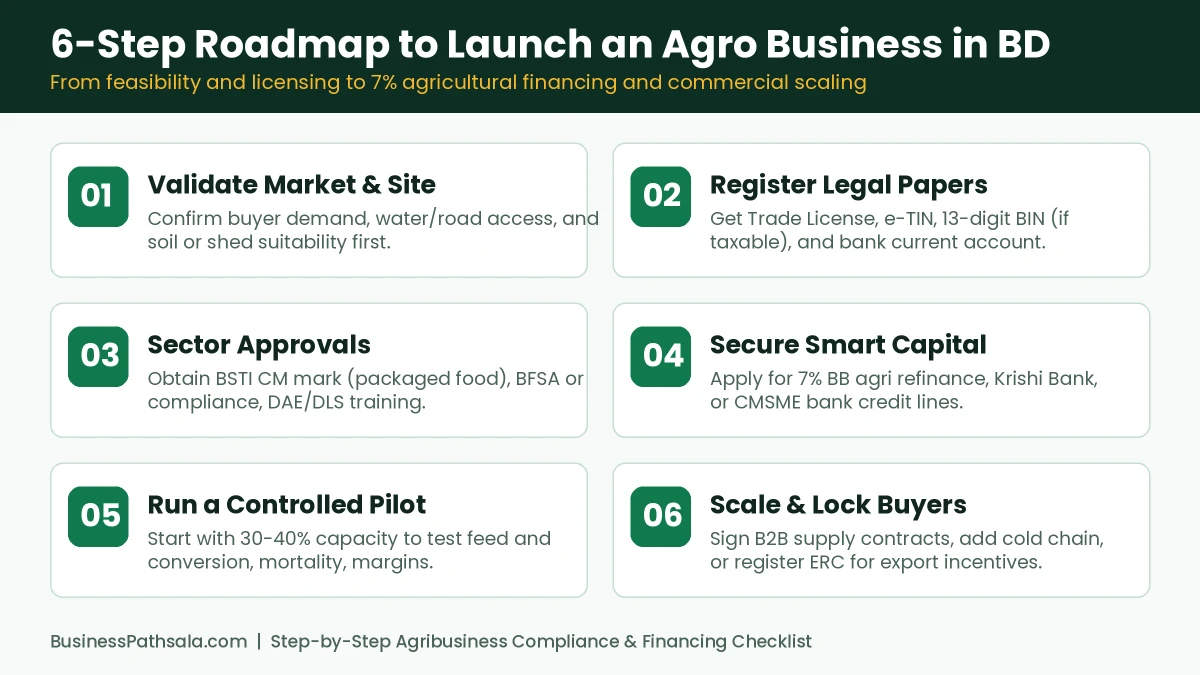
Step 1: Validate Local Demand and Inspect Your Site
Talk to at least five wholesale buyers (aratdars), local retailers, or processors before selecting your product. Ask what grades, weights, or packaging formats they struggle to source consistently, and what price they pay during both peak and off-peak months.
Check four site essentials: flood-free elevation, reliable electricity (plus solar or generator backup for poultry/cold storage), clean groundwater, and truck-accessible roads during monsoon season.
Step 2: Choose Your Legal Structure and Register Core Papers
Small farms can start as a Sole Proprietorship, while agro-processing plants and export ventures should incorporate as a Private Limited Company with RJSC. A Private Limited Company protects your personal assets and qualifies you for BIDA investment incentives and larger corporate credit lines.
- Trade License: Obtain from your local Union Parishad, Pourashava, or City Corporation with the exact agro activity listed. Trade Licenses renew annually on July 1.
- e-TIN Certificate: Register free online with NBR—follow our step-by-step e-TIN certificate guide in BD.
- 13-Digit VAT BIN: Mandatory for processed food manufacturers, importers, and exporters, though many raw basic agricultural commodities remain VAT-exempt under the VAT and Supplementary Duty Act 2012.
- Business Bank Account: Open a dedicated current account in your business name so every sales deposit builds a verifiable cash-flow record for future bank loans.
Step 3: Obtain Sector-Specific Licenses and Quality Approvals
Basic primary farming requires minimal paperwork, whereas packaged food, dairy processing, feed mills, and agro-exports require formal regulatory clearances. Skipping these approvals blocks you from supershops, institutional tenders, and export ports.
| License / Approval | Issuing Authority | Who Needs It |
|---|---|---|
| Trade License | Union Parishad / Pourashava / City Corp | All commercial agro farms, traders, and processors |
| Certification of Marks (CM) License | BSTI | Manufacturers of mandatory packaged foods (spices, oil, juice, honey, etc.) |
| Food Safety Compliance / Registration | BFSA | Food processors, cold storages, and food importers/distributors |
| Environment Clearance (ECC) | Department of Environment (DoE) | Large commercial farms, feed mills, and industrial agro-processing units |
| Export Registration Certificate (ERC) | CCI&E (via OLM Portal) | Agro-exporters shipping fresh produce or processed foods abroad |
| Phytosanitary / Quarantine Certificate | DAE Plant Quarantine Wing | Exporters and importers of seeds, plants, fruits, and vegetables |
For BSTI Certification of Marks (CM), an inspector visits your premises, checks hygiene and testing facilities, and sends product samples to BSTI laboratories in Dhaka, Chattogram, Rajshahi, or Khulna. Official CM application fees start at Tk 1,000 for new applicants (Tk 500 for renewal every three years), alongside a nominal annual license fee (Tk 200) and product-specific marking fees (for example, 0.07% of ex-factory price for fruit items), plus lab testing charges.
Step 4: Build a Realistic Budget and Secure Agricultural Financing
Never rely on informal village moneylenders when regulated bank financing is available at 7% to 13% annual interest. Prepare a clear 12-month cash-flow projection showing fixed setup costs, recurring feed or seed expenses, mortality/spoilage assumptions, and conservative selling prices.
If you plan to apply for bank credit, use our bank loan business plan template for Bangladesh to structure your project profile so credit officers can verify your repayment capacity quickly.
Step 5: Launch a Controlled Pilot Before Going Full Scale
Start at 30% to 40% of your planned farm or factory capacity for the first two production cycles. Running a pilot exposes real-world bottlenecks—such as chick quality, pond ammonia spikes, labor reliability, or transport shrinkage—while your financial exposure is still manageable.
During your pilot, take free technical training from your Upazila Livestock Office (DLS), Upazila Fisheries Office (DoF), or Department of Agricultural Extension (DAE). Their field officers also help with subsidized vaccines, soil testing, and disease diagnosis.
Step 6: Lock In Recurring Buyers and Scale Into Processing or Exports
Once your unit economics are proven, shift away from spot-market selling toward recurring B2B supply contracts. Hotels, restaurants, university hostels, supershops, and urban organic grocery platforms pay reliably when you guarantee consistent quality and on-time delivery.
When you are ready to ship processed foods, vegetables, or specialty crops to Middle Eastern, European, or diaspora markets, follow our export import business setup guide in BD to get your ERC and Authorized Dealer (AD) bank setup in order.
Agro Business Loans, Tax Incentives & Government Support in BD (2026–27)
Bangladesh offers some of its lowest-cost institutional credit and strongest tax incentives specifically to agriculture and agro-processing enterprises. Understanding these official programs can reduce your financing cost by 5 to 7 percentage points compared to standard commercial loans.
| Financing / Incentive Program | Key Terms & Rates (2026–27) | Best Fit For |
|---|---|---|
| Bangladesh Bank Tk 13,000 Cr Agri Refinance Schemes | Customer interest/profit rate capped at 7% (Tk 10,000 cr national + Tk 3,000 cr northern hub) | Crop, livestock, fisheries, and rural agro-enterprises |
| Bangladesh Krishi Bank (BKB) & RAKUB | Specialized agricultural & rural credit aligned with crop seasons | Smallholder & commercial rural farmers nationwide |
| Private Commercial Bank Agri & SME Loans | Declared agriculture rates typically ~11%–13%; CMSME ~13%–15% (varies by bank) | Medium farms, feed dealers, agro-processors needing fast disbursement |
| BIDA Agro-Processing Tax & Duty Incentives | Reduced CIT for 5–10 years (fruit/veg processing until June 2030); capital machinery duty exemptions | Registered agro-processing factories & cold-chain investors |
| Bangladesh Bank Agro Export Cash Subsidy | 10% on processed agro-products & potatoes; 3% rice; 2% tea (valid until June 30, 2027) | ERC-holding agro-exporters shipping through AD banks |
Important Financial Note: Bank lending rates, collateral rules, and refinancing quotas change with new Bangladesh Bank circulars and individual bank policies. Approval is never automatic—lenders assess your CIB credit history, Trade License validity, land lease or ownership deeds, and projected cash flow. Always verify current terms directly with your bank branch before committing capital.
For a deeper breakdown of bank eligibility, collateral thresholds, and application documents, read our dedicated guide on agribusiness and agriculture business loans in Bangladesh.
Sample Unit Economics: What a Small Agro Business Actually Earns
To avoid overestimating profit, always model your numbers using conservative survival rates and off-peak selling prices. Below is an illustrative example of a small 1,000-bird Sonali poultry batch (65-day cycle) in a district outside Dhaka, assuming a leased or existing shed:
| Cost / Revenue Item | Illustrative Estimate (BDT) | Key Assumption |
|---|---|---|
| Day-old chicks (1,000 birds) | Tk 25,000 – 35,000 | Tk 25–35 per chick (seasonal) |
| Balanced commercial feed | Tk 1,35,000 – 1,55,000 | ~2.2–2.4 kg feed per bird to market weight |
| Vaccines, medicine, litter & electricity | Tk 18,000 – 25,000 | Includes brooding heat & biosecurity |
| Total Variable Batch Cost | Tk 1,78,000 – 2,15,000 | Excludes one-time shed construction |
| Marketable Output (94% survival) | ~800 – 850 kg live weight | 940 birds averaging 850–900g |
| Gross Sales (at Tk 270–300/kg farmgate) | Tk 2,16,000 – 2,55,000 | Wholesale farmgate rate fluctuates weekly |
| Illustrative Net Margin per Batch | Tk 25,000 – 45,000 | Before labor/rent; 4–5 batches possible/year |
Notice how sensitive the margin is to two numbers: if mortality rises from 6% to 15% due to poor biosecurity, or if feed is wasted from poorly adjusted feeders, the entire net profit disappears. This same sensitivity applies to fish farming, dairy, and vegetable cultivation—disciplined daily record-keeping is what separates profitable farms from struggling ones.
Common Risks and Mistakes That Sink New Agro Businesses in BD
Most agro startups in Bangladesh fail from preventable operational mistakes rather than lack of market demand. Watch out for these five pitfalls before investing:
- Overbuilding fixed infrastructure: Spending 80% of your capital on a fancy concrete shed or oversized machine leaves no cash for feed or raw materials when prices temporarily dip.
- Ignoring biosecurity and water testing: Allowing visitors into poultry sheds without footbaths, or stocking fish without testing pond pH and ammonia, can wipe out an entire cycle in 72 hours.
- Depending on a single middleman: Selling exclusively to one local aratdar on credit exposes you to bad debt and forced price cuts during harvest peaks.
- Skipping written lease and supplier agreements: Verbal pond or land leases often lead to sudden rent hikes once your farm turns profitable. Always execute a stamped lease deed.
- Launching packaged food without BSTI/BFSA planning: Printing thousands of colorful pouches before checking mandatory BSTI labeling rules leads to wasted packaging and regulatory fines.
Risk-Management Rule: Never buy 100% of your raw materials or sell 100% of your harvest on a single week’s spot price if you can stagger batches. Staggered production smooths out market price swings across the entire year.
Frequently Asked Questions About Agro Business in BD
Which agro business is most profitable in Bangladesh with low investment?
High-value vegetable cultivation, seedling nurseries, and small-scale poultry farming offer the fastest returns under Tk 1 to 3 lakh. Seedlings and off-season vegetables require minimal land and turn over cash within 60 to 90 days.
How can I get a 7% agricultural loan in Bangladesh in 2026?
Apply through a scheduled commercial bank, Bangladesh Krishi Bank, or RAKUB participating in Bangladesh Bank’s Tk 13,000 crore agricultural refinancing schemes. Bring your NID, Trade License or land/lease documents, and a simple farm cash-flow plan.
Do I need a BSTI license to start an agro business in BD?
You do not need BSTI for selling raw crops, live poultry, or fresh fish. However, if you manufacture and sell packaged foods like spice powders, mustard oil, honey, fruit juices, or dairy products under a brand name, BSTI CM certification is mandatory for listed items.
Is agricultural income taxable in Bangladesh?
Primary farming enjoys specific tax exemptions and lower thresholds, while agro-processing companies qualify for reduced Corporate Income Tax rates (such as 5-to-10-year reduced CIT incentives for locally sourced fruit and vegetable processors through June 2030, subject to formal NBR/BIDA compliance). Always file your annual return to keep exemptions valid.
Can I export agricultural products from Bangladesh as a small entrepreneur?
Yes, even a Sole Proprietorship can export agro products after obtaining a Trade License, e-TIN, 13-digit VAT BIN, Chamber/BAPA membership, Export Registration Certificate (ERC), and DAE phytosanitary clearance. Eligible processed agro-exporters can also claim up to a 10% cash subsidy through June 2027.
Final Takeaway: Start Lean, Stay Compliant, and Build Buyer Direct Channels
Building a successful agro business in BD is no longer about guesswork or traditional trial-and-error. With Bangladesh’s domestic food market expanding rapidly, 7% Bangladesh Bank refinancing schemes active, and 10% export cash incentives running through June 2027, disciplined entrepreneurs have a clear advantage.
Your best next step today is simple: pick one model that fits 60% of your available capital, visit your Upazila agricultural or livestock office for technical training, and speak with five real buyers before building a single shed or buying stock. When you are ready to fund your expansion, compare your options in our Bangladesh agriculture business loan guide.
Editorial & Financial Disclaimer: This article is for informational and educational purposes only. Loan interest rates, government subsidies, tax rules, and licensing fees in Bangladesh are subject to change by Bangladesh Bank, NBR, BSTI, and relevant ministries. Always confirm current terms with the respective official authority or bank before making financial commitments.