
Last updated: · By Afra Monira
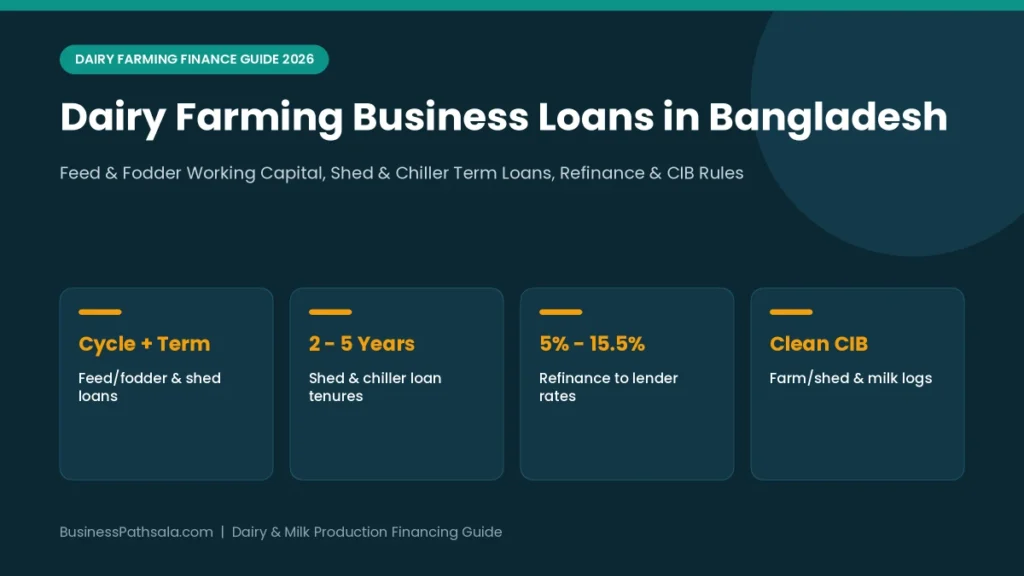
Quick answer: A dairy farming business loan in Bangladesh is working-capital or cycle credit, shed/equipment term financing, or SME/agro credit offered through scheduled commercial banks, specialized agricultural banks, state-owned banks, non-bank financial institutions (NBFIs), and partner microfinance institutions (MFIs) under Bangladesh Bank’s CMSME Master Circular (SMESPD Circular No. 01, 17 March 2025) and central bank SME/agro credit guidelines. Eligible dairy farmers, milk producers, fodder growers, and dairy/chilling entrepreneurs can borrow to buy cattle/calves, concentrate feed, green fodder, veterinary medicines, milking units, milk chillers, or ventilated sheds. Commercial interest rates vary by bank and product—for example, Bangladesh Krishi Bank’s SME page lists 15.00% for term loans and women entrepreneurs and 15.50% for cash/working capital loans, while commercial SME bank rates commonly sit around 12% to 14.5%—whereas qualifying enterprises under active central bank refinance or CMSME windows can access lower capped rates where eligible (such as up to 5% for eligible women entrepreneurs under dedicated women’s small-enterprise refinance when active, 7% under priority/CMSME refinance windows, or up to 9% under Bangladesh Bank’s Tk 5,000 crore CMSME refinancing scheme). Clean CIB records, verifiable farm/shed or lease proof, and realistic milk-to-feed cash flow are essential.
Updated 21 November 2026. Commercial bank interest rates, CMSME/agro refinance allocations, dairy/livestock rules, and bank credit policies change periodically. Confirm current interest rates, limits, and document checklists directly with your lender and relevant authorities before applying.
Dairy farming is one of Bangladesh’s most dependable agricultural and rural livelihoods, supplying daily milk to local households, sweetmeats and tea stalls, milk cooperatives, and dairy processors across districts. Whether a family runs a few crossbred or local cows or an entrepreneur manages a commercial dairy farm with dozens of milking cattle, calves, and fodder land, dairy economics revolve around continuous daily care. Feed, fodder, mineral/veterinary care, clean water, and shed upkeep happen every single day, while milk payments may arrive daily, weekly, or on cooperative billing cycles, and calf growth or herd expansion takes months to pay off. Understanding how banks and financial institutions structure dairy loans helps farmers match working capital and shed/chilling equipment credit to real milk and herd cash flow.
How Banks Evaluate Dairy Farming Businesses in Bangladesh
In Bangladesh, banks evaluate dairy farms and related small/medium enterprises within the frameworks guided by Bangladesh Bank’s CMSME Master Circular and Bangladesh Bank’s SME & Special Programmes Department (SMESPD), alongside agricultural and rural credit channels. Central bank policy continues to emphasize SME and rural/productive credit—for instance, in November 2026 Bangladesh Bank noted plans to set next year’s lending targets around 35% for SMEs, 20% for retail borrowers, and a cap near 45% for corporate lending. Where a farm operates as a small/medium enterprise or agricultural/rural venture, credit officers look at both herd productivity and repayment reliability. You can see how enterprise tiers fit together in our CMSME loan guide for Bangladesh.
When reviewing a dairy farming loan proposal, lenders focus on four practical risk areas:
- Milk yield, feed cost, and daily/cycle cash flow: Concentrates, bran, oilcake, and green fodder make up a major share of daily expense. Banks check whether milk sales reliably cover feed, labor, and loan installments.
- Shed, farm, or fodder land control: Lenders verify whether you own or hold a valid lease on the dairy shed, farmyard, and fodder/grazing space for a period that supports the loan cycle.
- Herd health, mastitis/disease control, and housing: Proper shed ventilation, drainage, clean water, vaccination, and veterinary care protect milk output and calf survival. Credit officers look for practical management and genuine experience.
- Clean CIB status: The borrower entity (if applicable) along with all owners, partners, directors, and personal guarantors must hold a clean Credit Information Bureau (CIB) record with no overdue or classified defaults.
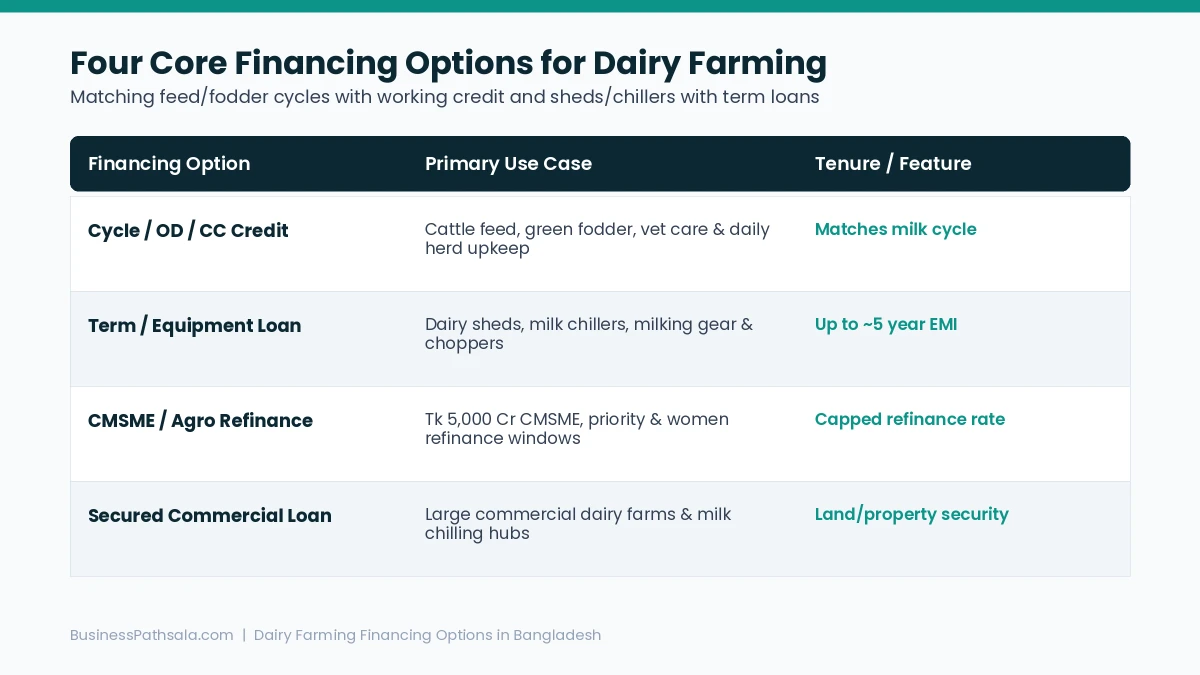
Four Core Financing Options for Dairy Farming in Bangladesh
Funding ongoing feed and fodder is very different from building a dairy shed or buying a milk chiller, milking machine, or fodder chopper. Pairing working-capital/cycle credit with term loans keeps cash flow aligned with herd operations. For broader herd and cattle-fattening credit structures, see our small factory loan guide for Bangladesh.
1. Working Capital, Cycle Credit, or Revolving Overdraft (OD) / Cash Credit (CC)
For recurring expenses—such as balanced cattle feed, green fodder cultivation or purchase, mineral/vitamin supplements, veterinary care, shed labor, and utility bills—cycle credit or a revolving Overdraft (OD) / Cash Credit (CC Hypo) facility helps bridge cash needs across billing cycles. Revolving limits (typically reviewed annually, often up to 1 year for working capital) charge interest on the utilized balance, while cycle/seasonal facilities align repayment with milk or livestock cycles.
2. Term and Equipment Loans (For Sheds, Chillers, Milking Gear, and Choppers)
Constructing airy, well-drained cow sheds, installing milk chillers/cooling tanks, milking machines, chaff cutters/fodder choppers, deep/shallow water pumps, or biogas/manure systems requires capital upfront. A term loan spreads repayment over monthly or quarterly installments (often up to roughly 5 years depending on asset life, scheme rules, and bank policy). For related post-harvest and dairy-processing credit structures, see our agro-processing business loan guide for Bangladesh.
3. Central Bank CMSME / Agro Refinance and Women Support Windows
Eligible small and medium enterprises or agricultural/rural borrowers can ask participating lenders about active central bank refinance allocations—such as Bangladesh Bank’s Tk 5,000 crore CMSME refinancing scheme (where customer lending rates are capped up to 9% per year when active), CMSME/agro refinance windows (such as 7% under priority/agro-processing/new-entrepreneur refinance rules where applicable), or the dedicated small enterprise refinance scheme for women entrepreneurs (capped up to 5% per year when active). Women-owned dairy or small enterprises meeting ownership criteria can also check women-focused refinance and desk support, as discussed in our rural women entrepreneur loan guide for Bangladesh.
4. Secured Commercial or Project Credit (For Larger Dairy Farms and Chilling Hubs)
Larger commercial dairy farms, milk-chilling/collection centers, or integrated fodder-and-dairy units seeking higher credit limits generally pledge registered land/property mortgages or liquid security alongside personal/corporate guarantees and asset hypothecation.
Interest Rates and Real Repayment Math (BDT 10 Lakh Example)
Interest rates on dairy farming loans in Bangladesh depend on whether the facility uses an active central bank refinance or agricultural/priority window or follows standard commercial/specialized bank pricing. Outside subsidized refinance windows, commercial SME/business rates generally sit around 12% to 14.5% depending on credit risk, collateral, and lender policy (with certain specialized/SME products priced around 15%–15.5% depending on institution and terms). You can compare broader bank pricing in our guide to SME loan interest rates in Bangladesh.
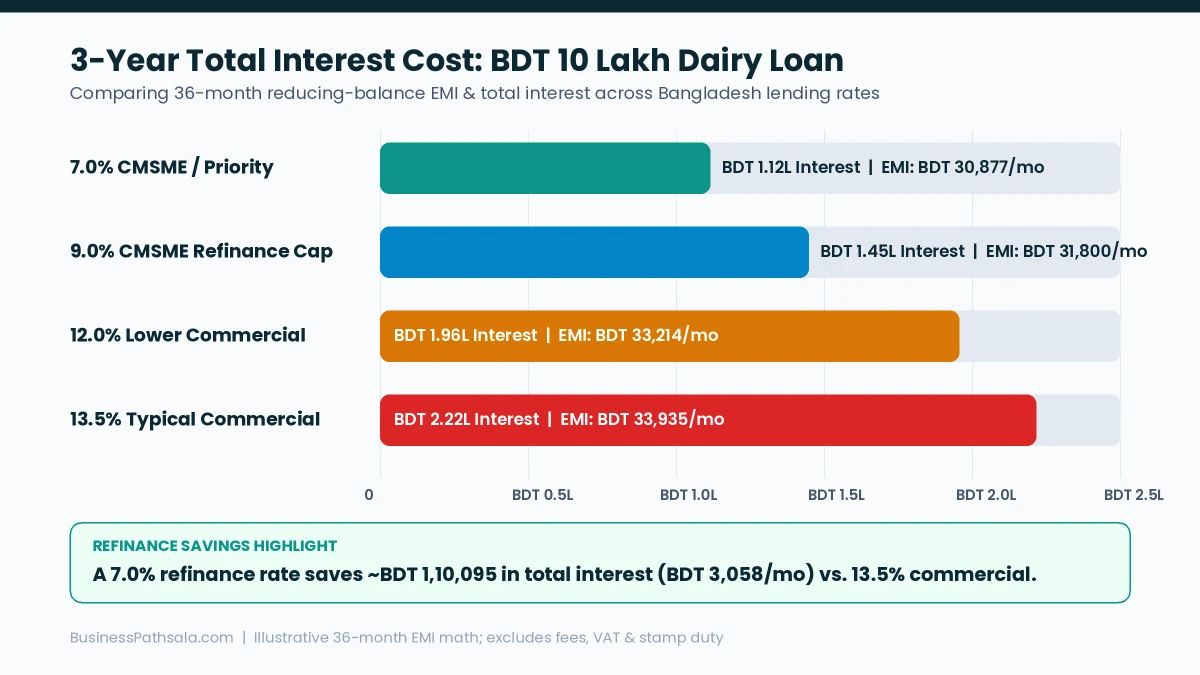
To see how interest rate differences affect monthly installments, consider an illustrative BDT 10,00,000 (10 lakh) dairy shed, chiller, or equipment loan repaid over 36 months (3 years) on a standard monthly reducing-balance schedule:
| Rate Scenario (BDT 10 Lakh, 36 Months) | Approx. Monthly EMI | Total Interest (3 Years) | Total Repayment |
|---|---|---|---|
| 7.0% Annual Rate (CMSME / Priority Refinance) | BDT 30,877 | BDT 1,11,575 | BDT 11,11,575 |
| 9.0% Annual Rate (CMSME Refinance Cap) | BDT 31,800 | BDT 1,44,790 | BDT 11,44,790 |
| 12.0% Annual Rate (Lower Commercial Tier) | BDT 33,214 | BDT 1,95,715 | BDT 11,95,715 |
| 13.5% Annual Rate (Typical Commercial Rate) | BDT 33,935 | BDT 2,21,670 | BDT 12,21,670 |
Illustrative calculation only: Figures assume equal monthly installments (EMI) without a grace period and exclude processing fees, CIB charges, stamp duties, valuation fees, and VAT. Actual repayment terms appear in your written sanction letter.
On a BDT 10 lakh loan over three years, a 7% refinance rate saves roughly BDT 3,058 per month and BDT 1,10,095 in total interest compared to a 13.5% commercial rate. Because feed prices and seasonal milk demand or dry-cow intervals can shift cash flow, always test monthly repayments against conservative net margins.
Banks and Institutions Financing Dairy Farming in Bangladesh
Dairy farmers and agribusinesses in Bangladesh borrow from specialized agricultural banks, state-owned banks, private commercial banks, and partner microfinance institutions depending on herd size, location, and banking history.
| Lender Group | Examples of Active Institutions | Typical Strengths | Best Fit For |
|---|---|---|---|
| Specialized Agro Banks | Bangladesh Krishi Bank (BKB), RAKUB | Extensive rural and upazila branch network serving farm, dairy, and rural livelihoods | Rural dairy farmers, shed operators, and regional agro-borrowers |
| Private SME & Commercial Banks | BRAC Bank, City Bank, Eastern Bank (EBL), Prime Bank, Mutual Trust Bank (MTB), Dhaka Bank | Structured SME evaluation, working-capital/term lines, and active refinance desks where eligible | Commercial/SME dairy farms and chilling units with bank turnover and clean records |
| State-Owned Commercial Banks | Sonali Bank, Janata Bank, Agrani Bank, Rupali Bank | Broad district/upazila reach and agricultural/commercial credit lines | Operators with regional banking ties or land/property collateral |
| PKSF Partner NGOs / MFIs | PKSF-supported partner microfinance institutions | Accessible small-ticket loans and rural field follow-up | Small or homestead dairy keepers building track record |
For guidance on preparing your project numbers and loan write-up before visiting a bank branch, see our guide on preparing an SME loan project profile in Bangladesh.
Eligibility Criteria for Dairy Farming Business Loans
Exact underwriting rules vary by lender, loan size, and whether the facility is agro-focused, SME-focused, or collateralized, yet most lenders evaluate dairy applicants against these core points:
- Active Dairy Operation or Viable Plan: Proven experience or a realistic plan for milk production, cattle/calf rearing, or dairy enterprise with clear feed, care, and milk-sale math.
- Operating Track Record: Many commercial banks look for at least 1 to 2 years of active business operation with verifiable sales/bank activity for standard SME loans, while agro/micro windows may serve smaller or newer producers under their own rules.
- Age and Citizenship: Bangladeshi citizen with a valid National ID (NID), typically aged between 21 and 65 years at loan maturity.
- Clean CIB Status: Neither the borrower (or entity) nor any partner, director, or guarantor may have an overdue or classified loan default in the Bangladesh Bank CIB database.
- Premises Control and Guarantees: Proof of owned land/shed or a valid lease agreement covering the loan/herd cycle, plus personal guarantors, asset/stock hypothecation, security cheques, or collateral where required by loan size and bank policy.
Required Documents Checklist for a Dairy Farming Loan
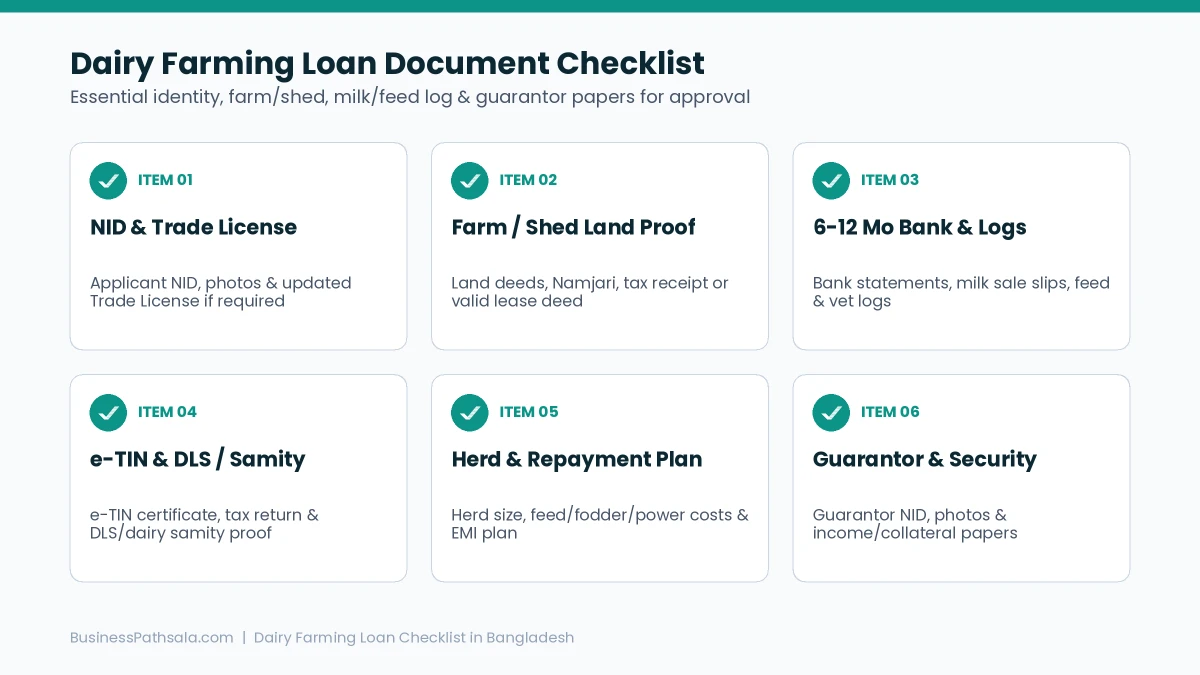
Having your farm/shed papers, milk/feed logs, and identity documents ready speeds up verification. Gather these six document categories where applicable before applying:
- Identity and Trade Papers: Valid National ID (NID) copy and recent passport-size photographs of the owner/partners/directors, plus an updated Trade License where required by the bank or business type.
- Farm, Shed, or Land Premises Proof: Land ownership deeds, mutation (Namjari), and tax receipts (or a valid farm/shed/land lease agreement) showing location, area, and lease validity.
- Bank Statements and Milk/Feed Records: Last 6 to 12 months of bank statements (where available), supported by milk collection/sale slips or buyer receipts, feed/fodder bills, and herd/veterinary logs.
- Tax and Sector/Cluster Registration: e-TIN certificate (and latest income tax return acknowledgement slip where applicable), plus Department of Livestock Services (DLS) or local dairy association/cooperative/samity registration where relevant.
- Herd and Repayment Plan: A practical summary of milking/dry herd size, feed, fodder, veterinary, and cooling/power costs, expected milk/calf sales, and monthly/cycle repayment capacity. You can also review our guide on writing a business plan for a bank loan in Bangladesh.
- Guarantor and Security Papers: NID copies, passport photos, and income or business details of personal guarantors (plus collateral/FDR papers if secured).
Step-by-Step: How to Apply for a Dairy Farming Business Loan
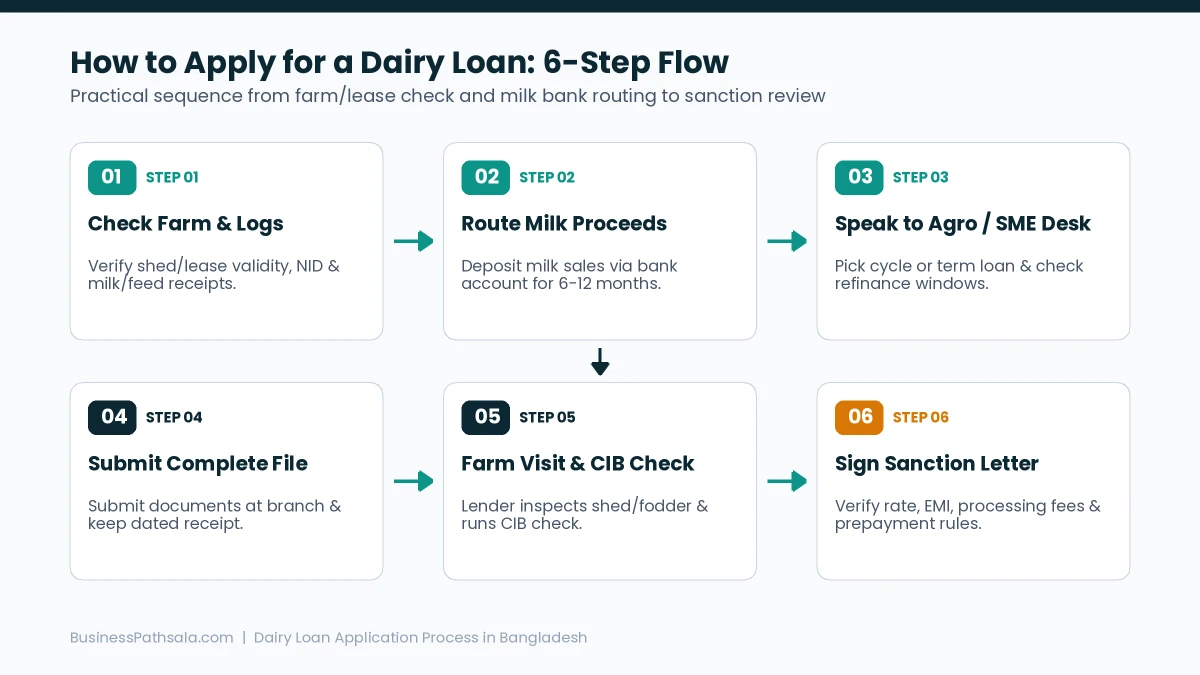
- Check farm/lease validity and organize milk and feed records. Make sure your NID, farm/shed ownership or lease papers, and milk/feed/veterinary receipts are clear and up to date.
- Route milk sale proceeds through a bank account. Depositing milk earnings regularly into your bank account over 6 to 12 months helps credit officers verify real income and turnover.
- Speak with the branch SME, Agro, or Women desk (or partner lender). Ask clearly which working-capital/cycle or term/equipment loan fits your dairy farm, whether any refinance or agro window applies, and what exact document checklist they require.
- Submit a complete application and keep an acknowledgement. Hand in your filled form and supporting folder at the branch and collect a dated receipt. Avoid paying unofficial middlemen promising guaranteed approval.
- Support physical farm/shed verification and CIB check. Expect an officer to visit your farm or shed to inspect housing, feed/fodder setup, and records while head office runs CIB screening.
- Verify written terms on the sanction letter before signing. Check the interest rate, EMI or repayment schedule, processing/service charges, guarantor/collateral clauses, and early-settlement rules in writing.
Common Mistakes Dairy Farmers Make When Borrowing
- Keeping all milk sale proceeds outside bank accounts: Unrecorded cash makes income hard to verify and often leads to rejection or a smaller loan offer.
- Applying with a short or informal shed/land lease: If your farm or shed lease expires soon, banks may hesitate to approve a multi-year or full-cycle facility.
- Underestimating feed price jumps or disease/reproductive delays: Always keep a realistic cost buffer rather than assuming peak milk prices and uninterrupted lactation.
- Mismatching loan repayment with daily/monthly milk cash flow: Aligning installments and cash flow with realistic milk and calf cycles avoids unnecessary stress.
If you are also exploring broader small-business or rural entrepreneur financing routes in Bangladesh, you can explore our Uddokta loan guide for Bangladesh and our guide to rural women entrepreneur loans in Bangladesh.
Frequently Asked Questions
Can I get a bank loan to start or expand a dairy farm in Bangladesh?
Yes. Commercial banks, specialized agricultural banks (such as BKB and RAKUB), state-owned banks, and partner institutions finance dairy farming and related enterprises subject to eligibility rules, farm/shed and cash-flow verification, clean CIB status, and lender credit policy.
What is the interest rate on a dairy farming loan in Bangladesh?
Rates vary by lender, loan type, and scheme eligibility. Standard commercial SME/business rates often sit around 12% to 14.5% (with certain specialized/SME facilities around 15%–15.5% depending on institution terms), while qualifying borrowers under active central bank refinance or priority windows can access lower capped rates where allocations are open.
Which loan format is better for dairy farming: Working Capital/Cycle Credit or Term Loan?
Working-capital, cycle credit, or revolving overdraft/cash-credit lines are better suited for recurring feed, fodder, veterinary, and daily operating expenses, while term loans are better suited for multi-year assets such as dairy sheds, chillers, milking equipment, or farm upgrades.
Do I need to own the farm land to get a dairy loan?
Not always. Many dairy farmers operate on leased land or family/shed premises, provided lease or occupancy papers are valid for a practical period, though owned land/property or formal security may be required for larger or collateralized loans.
How long does dairy farming loan approval take in Bangladesh?
Timelines vary by lender, loan size, and verification steps. Straightforward branch or microfinance/agro files with complete documents and clean CIB checks can take a couple of weeks to a few weeks, while larger or collateralized files can take longer.
Official Sources and Further Reading
- Bangladesh Bank SMESPD Circular No. 01 — CMSME Financing Master Circular (17 March 2025): Official CMSME definitions, credit guidelines, and lending rules in Bangladesh.
- Bangladesh Bank SME & Special Programmes Department (SMESPD): Central bank refinance windows and SME credit directives.
- Department of Livestock Services (DLS), Bangladesh: Official livestock and dairy health, extension, and sector resources in Bangladesh.
- Bangladesh Krishi Bank (BKB): Agricultural and rural credit programs across Bangladesh.
Final Takeaway
Securing a dairy farming business loan in Bangladesh comes down to matching feed, fodder, and milk-collection cycles with working-capital or cycle credit, funding sheds and chillers/equipment with term credit, keeping farm/shed papers and milk/feed logs clear, and maintaining a clean CIB record. Compare two or three lenders and verify all terms in writing before signing.
Financial information notice: This article is for general educational purposes only and does not constitute a loan offer, financial advice, or a guarantee of loan approval. Bank interest rates, refinance schemes, collateral rules, and dairy regulations may change over time. Always verify current terms directly with Bangladesh Bank, relevant authorities, and your chosen bank or financial institution.


