Last updated: · By Abrar Hossain
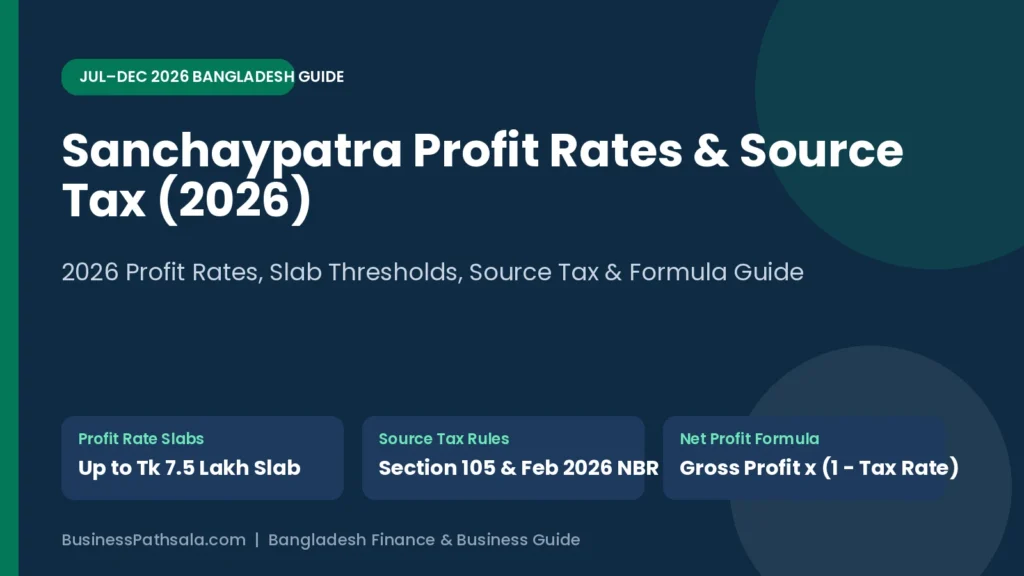
Quick answer: For July–December 2026, Bangladesh’s national savings certificates offer maturity profit rates of 11.80%–11.98% for the main schemes, depending on the certificate and the investor’s total Sanchaypatra holding. The first rate slab generally applies up to Tk 7.5 lakh and the second above Tk 7.5 lakh. Source tax is a separate calculation: Section 105 of the Income Tax Act provides a 10% deduction on savings-certificate profit, with a specific exemption for qualifying Pensioner Sanchaypatra investments up to Tk 5 lakh. A February 2026 NBR clarification also stated a 5% rate for total holdings up to Tk 5 lakh, so investors should confirm which rate the issuing office is applying under the FY 2026–27 rules. This guide explains both the rates and the calculation method.
Last checked: 28 November 2026. This article is for general information, not personal tax or investment advice. The issuing office’s official calculation and the latest NBR instruction take precedence.
Sanchaypatra profit rates in Bangladesh for July–December 2026
The government kept national savings scheme profit rates unchanged for the second half of 2026. The rates that applied during January–June continued from 1 July to 31 December 2026. The following table shows the published annual rates at maturity for the main schemes.
| Scheme | Term | Profit payment | Total holding up to Tk 7.5 lakh | Total holding above Tk 7.5 lakh |
|---|---|---|---|---|
| 5-Year Bangladesh Sanchaypatra | 5 years | At maturity | 11.83% | 11.80% |
| 3-Monthly Profit-Based Sanchaypatra | 3 years | Every 3 months | 11.82% | 11.77% |
| Paribar (Family) Sanchaypatra | 5 years | Monthly | 11.93% | 11.80% |
| Pensioner Sanchaypatra | 5 years | Monthly | 11.98% | 11.80% |
| Post Office Savings Bank Fixed Deposit | 3 years | At maturity | 11.82% | 11.77% |
Important: These are annual rates, not monthly rates. For schemes that pay monthly or quarterly, the annual rate is divided according to the payment schedule. The rate slab is determined by the investor’s accumulated eligible investment, not simply by looking at one certificate in isolation. The official five-year scheme sheet lists the year-by-year rates and confirms that early encashment uses a lower rate. The July–December continuation was reported after the Finance Division’s decision on 2 July 2026. See the July–December 2026 rate update and the official five-year Bangladesh Sanchaypatra information sheet.
How the Tk 7.5 lakh profit-rate slab works
The first and second rate columns are based on the total investment amount recognised under the national savings scheme rules. If the applicable accumulated holding is Tk 7.5 lakh or less, the first-slab rate applies. If the total is above Tk 7.5 lakh, the second-slab rate applies. Do not assume that the first Tk 7.5 lakh earns the higher rate and only the excess earns the lower rate. The published rate table is a slab table; the issuing system determines the applicable rate for the purchase.
Example: Suppose an investor already holds Tk 6 lakh in eligible certificates and wants to buy another Tk 2 lakh. The total would become Tk 8 lakh. The investor should not calculate the new certificate using the up-to-Tk 7.5 lakh column merely because the new purchase is only Tk 2 lakh. The issuing office’s system checks the accumulated holding and applies the relevant slab.
Keep a record of certificates held at different banks or savings offices. Before making a new purchase, ask the issuing office to confirm the combined holding recorded against your NID and the rate that will apply to the proposed certificate.
Sanchaypatra source tax in 2026: 5% or 10%?
This is the part that causes the most confusion. The profit-rate slab and the source-tax rule use different thresholds. The Tk 7.5 lakh threshold in the profit-rate table is not the same as the Tk 5 lakh threshold discussed in the NBR’s February 2026 clarification.
Section 105 of the Income Tax Act, 2023 states a 10% deduction on profit paid from savings certificates. It separately says that no tax is to be deducted from qualifying Pensioner Sanchaypatra profit when the accumulated investment in the pensioner savings instrument does not exceed Tk 5 lakh in an income year. The official English text of the Act is available in the NBR-published Income Tax Act, 2023.
There is also an official NBR clarification dated 3 February 2026. It stated that the source-tax rate is 5% when the accumulated investment in all savings instruments does not exceed Tk 5 lakh, 10% when it exceeds Tk 5 lakh, and 0% for qualifying Pensioner Sanchaypatra holdings up to Tk 5 lakh. The clarification was circulated by the National Savings Directorate and is available in this official government letter on source tax.
For FY 2026–27, the Finance Act, 2026 amended the treatment of tax deducted at source under Section 163. In general, excess tax deducted or paid can be refundable, carried forward or adjusted against tax liabilities, subject to the Act. That means source tax should not automatically be treated as the investor’s final tax bill. Read the Finance Act, 2026 published by NBR and consult a tax professional about your own return.
Practical approach for a calculator: use 10% as the standard planning assumption for ordinary savings-certificate profit under Section 105; use 0% for a qualifying Pensioner Sanchaypatra holding up to Tk 5 lakh. If your total holding is Tk 5 lakh or less and the issuing office confirms that the 3 February 2026 NBR clarification applies to your payment, use 5% for the ordinary scheme instead. Because official materials and post-budget reporting have caused confusion about the interaction of the 5% clarification and the FY 2026–27 advance-tax framework, verify the actual deduction rate with the paying office before relying on a net-profit estimate.
Sanchaypatra profit and source-tax calculator: the formula
You can estimate the amount you will receive by calculating gross profit first, then subtracting source tax. The formula depends on the scheme’s payment frequency.
- Annual gross profit: Investment amount × annual profit rate.
- Monthly gross profit: Annual gross profit ÷ 12.
- Quarterly gross profit: Annual gross profit ÷ 4.
- Source tax: Gross profit for the payment period × applicable tax rate.
- Net profit: Gross profit − source tax.
- Net amount at maturity: Principal + net profit payable at maturity, subject to the scheme rules and any earlier profit payments.
For a simple payment-period estimate, use this calculation:
Net profit = Investment × Annual rate ÷ Number of payments per year × (1 − source-tax rate)
For a monthly scheme, the number of payments is 12. For a quarterly scheme, it is 4. A five-year certificate that pays at maturity needs a separate full-term calculation. The examples below assume the certificate is held for its full term and do not include any early-encashment adjustment.
Example 1: Tk 5 lakh in a 5-year Bangladesh Sanchaypatra
Assume an investor buys a five-year Bangladesh Sanchaypatra when the 11.83% first-slab rate applies and holds it until maturity. For a simplified estimate, the calculation is:
| Investment | Tk 500,000 |
| Annual rate | 11.83% |
| Estimated annual gross profit | Tk 59,150 |
| Estimated gross profit for 5 years | Tk 295,750 |
| Illustrative source tax at 10% | Tk 29,575 |
| Estimated net profit | Tk 266,175 |
| Principal plus estimated net profit | Tk 766,175 |
If the paying office applies the 5% rate under the February 2026 NBR clarification for an eligible total holding up to Tk 5 lakh, the illustrative source tax would be Tk 14,787.50 and net profit would be Tk 280,962.50. This difference is why the tax rate must be confirmed before treating a calculator result as the amount you will receive. The actual maturity calculation may also depend on the certificate’s purchase date, applicable rate schedule, rounding and official processing.
Example 2: Tk 2 lakh in a 3-monthly profit-based certificate
Assume Tk 2 lakh is invested at the 11.82% rate and the certificate remains within the first rate slab. The approximate quarterly gross profit is Tk 5,910 (Tk 200,000 × 11.82% ÷ 4). At a 10% deduction, source tax is Tk 591 and the net quarterly payment is Tk 5,319. If the confirmed tax rate is 5%, the deduction is Tk 295.50 and the net payment is Tk 5,614.50.
This is a useful way to compare the cash flow under two tax assumptions. The 3-monthly scheme pays during the term, so do not multiply a single quarterly payment by the full three years without checking the number of scheduled payments and the exact purchase and maturity dates.
Example 3: Tk 1 lakh in Family Sanchaypatra
The Family Sanchaypatra maturity rate in the first slab is 11.93%. On Tk 1 lakh, the approximate annual gross profit is Tk 11,930. Dividing by 12 gives about Tk 994.17 gross per month.
| Monthly gross profit | Tk 994.17 |
| Source tax at 10% | Tk 99.42 |
| Estimated monthly net profit | Tk 894.75 |
| Source tax at 5%, if confirmed | Tk 49.71 |
| Estimated net at 5% | Tk 944.46 |
Family Sanchaypatra has specific eligibility conditions. Do not assume that every investor can buy it. Confirm the current eligibility and maximum investment with the National Savings Directorate or the issuing office before planning around this monthly income.
Example 4: Tk 1 lakh in Pensioner Sanchaypatra
The first-slab maturity rate for Pensioner Sanchaypatra is 11.98%. On Tk 1 lakh, the approximate annual gross profit is Tk 11,980, or Tk 998.33 per month. If the investor qualifies for the Section 105 exemption and the accumulated pensioner savings investment does not exceed Tk 5 lakh in the relevant income year, no source tax is deducted from that profit. Above the statutory threshold, the 10% deduction may apply.
This exemption is specific to qualifying pensioner savings instruments. It should not be applied automatically to a five-year Bangladesh Sanchaypatra, Family Sanchaypatra or three-monthly profit-based certificate.
Which Sanchaypatra should you choose?
The highest displayed percentage is only one part of the decision. The payment frequency, eligibility, investment ceiling, tax position and the chance that you may need the money early are also important.
Sanchayapatra should fit into a wider savings and investment plan. Review your goals, emergency reserve and other commitments in this guide to personal finance planning in Bangladesh before choosing a certificate.
- Choose the 5-Year Bangladesh Sanchaypatra for a maturity-based goal: It may suit an investor who can leave the principal untouched for five years and prefers to receive the profit at maturity.
- Consider the 3-Monthly Profit-Based Sanchaypatra for quarterly cash flow: It pays profit every three months and has a three-year term. Check the minimum denomination and current purchase rules.
- Consider Family Sanchaypatra if you meet its eligibility rules: It provides monthly profit, but the scheme is restricted to eligible groups and has its own maximum investment limit.
- Consider Pensioner Sanchaypatra if you qualify: It is designed for eligible retired investors and provides monthly profit. Its source-tax exemption up to Tk 5 lakh is subject to the statutory conditions.
If you are comparing government savings certificates with other instruments, read our guide to safe investment options in Bangladesh and our comparison of Sanchaypatra vs Treasury Bonds.
What happens if you encash Sanchaypatra before maturity?
Early encashment can reduce the profit you are entitled to receive. The applicable rate is normally linked to the completed holding period, not the full maturity rate. If you have already received profit at a higher rate than the rate allowed for the completed period, the excess may be adjusted against the amount returned to you.
For example, the official five-year Bangladesh Sanchaypatra sheet lists first-slab rates of 9.74% after the first year, 10.21% after the second year, 10.72% after the third year, 11.26% after the fourth year and 11.83% at the end of the fifth year. The second-slab rates are slightly lower. These are holding-period rates; they are not a promise that a certificate can be redeemed at any time without an adjustment.
Before encashing early, ask the issuing office for a written or system-generated calculation showing the principal returned, the profit rate applied, the profit already paid, the adjustment and the source tax. This is more reliable than estimating the refund from the maturity rate.
Documents and tax-return requirements
Documents vary by scheme, investor type and issuing office. Individual applicants are commonly asked for a National Identity Card, bank-account details, photographs or identity information, nominee details and relevant eligibility documents. Pensioner applicants may need retirement or pension-related proof. Applicants should confirm the exact checklist with the office or bank before visiting.
The requirement to submit proof of income-tax return is a separate issue from source tax on profit. A person may be allowed to buy within the applicable purchase threshold without presenting proof of return submission and still have tax deducted from the profit. For the latest discussion of the Tk 10 lakh PSR threshold, read our Sanchaypatra without tax return rules in 2026. If you need a tax identification number, see our guide to the e-TIN certificate in Bangladesh.
Do not treat the Tk 10 lakh proof-of-return threshold, the Tk 7.5 lakh profit-rate slab and the Tk 5 lakh source-tax references as interchangeable. They answer three different questions: whether return-submission proof is needed, which profit-rate column applies, and how much tax may be deducted.
How to check your actual Sanchaypatra profit
- Write down the exact scheme name and purchase date.
- Confirm the certificate’s original investment amount.
- Ask the issuing office to confirm the total eligible Sanchaypatra holding recorded against your NID.
- Confirm which profit-rate slab applies to the certificate.
- Ask which source-tax rate the office is applying and request the relevant NBR instruction if the rate differs from your expectation.
- For monthly or quarterly schemes, confirm the payment schedule and the date of the next payment.
- For early encashment, request the holding-period rate and adjustment calculation.
- Keep the profit statement and tax-deduction certificate or receipt for your income-tax return.
Frequently asked questions
What is the highest Sanchaypatra profit rate in Bangladesh in 2026?
For July–December 2026, the highest listed maturity rate among the main schemes is 11.98% for Pensioner Sanchaypatra in the first slab, subject to eligibility and the applicable total-investment slab.
Is Sanchaypatra source tax 5% or 10% in 2026?
Section 105 of the Income Tax Act states a 10% deduction on savings-certificate profit, with a 0% exemption for qualifying Pensioner Sanchaypatra investment up to Tk 5 lakh. An NBR clarification dated 3 February 2026 stated that 5% applies when total savings-instrument investment does not exceed Tk 5 lakh and 10% applies above it. Because the FY 2026–27 tax treatment has created confusion, confirm the rate being applied by the paying office before calculating your take-home amount.
Does the Tk 7.5 lakh limit decide source tax?
No. The Tk 7.5 lakh threshold is used in the published profit-rate table. Source tax has a separate legal framework and has been discussed using a Tk 5 lakh threshold. Do not use the profit-rate slab as a substitute for the tax rule.
Is source tax the final tax on Sanchaypatra profit?
Not necessarily. The Finance Act, 2026 amended Section 163 so that excess tax deducted or paid can be refundable, carried forward or adjusted, subject to the law. Whether you can claim an adjustment or refund depends on your tax position and return compliance.
Can I calculate monthly profit by dividing the annual rate by 12?
That gives a useful estimate for a scheme that pays monthly, but the actual payment is determined by the scheme’s rules, purchase date, principal, applicable rate slab, rounding and source-tax deduction. Use the issuing office’s payment statement for the exact amount.
Can I get the full maturity rate if I cash out early?
No. Early encashment normally uses the rate for the completed holding period. If profit already paid is higher than the amount allowed under that rate, the excess may be adjusted against the amount returned.
Where can I verify Sanchaypatra rules?
Use the Bangladesh Bank Sanchaypatra information page, the National Board of Revenue and the Internal Resources Division. For a payment or encashment decision, ask the issuing bank or National Savings office to confirm the current system calculation.
Final thoughts
Bangladesh’s Sanchaypatra rates for July–December 2026 remain unchanged, with maturity rates ranging from 11.77% to 11.98% across the main schemes and investment slabs. To estimate your take-home profit, first identify the correct scheme and rate slab, then calculate the gross payment and apply the source-tax rate confirmed for your circumstances. Keep the Tk 7.5 lakh profit-rate slab, the Tk 5 lakh tax references and the separate proof-of-return threshold distinct. A calculator is useful for planning, but the issuing office’s official statement is the final figure to use.
Financial information notice: Rates, eligibility, tax deductions and investment limits may change through government notifications or legislation. This page is educational and does not replace the applicable certificate terms, NBR guidance or professional tax advice.