Last updated: · By Abrar Hossain
SME loan EMI in Bangladesh depends on the loan amount, annual interest or profit rate, repayment period and the way the lender calculates interest. For a reducing-balance term loan, each monthly instalment (EMI) includes principal and interest on the outstanding balance. Your actual borrowing cost can be higher than the EMI calculation because processing fees, VAT, documentation, CIB, stamp, legal and valuation costs may be payable separately.
This guide explains how to calculate an SME loan EMI, estimate the total repayment, identify charges that may be added before disbursement, and compare written offers from banks. It uses published bank schedules available at the time of review. Fees and product terms can change, so confirm the current schedule with the lender before signing.
Quick answer: how do you calculate an SME loan EMI?
For a standard reducing-balance loan with equal monthly instalments, use the following formula:
EMI = P × r × (1 + r)n ÷ [(1 + r)n − 1]
- P = principal borrowed
- r = monthly interest rate (annual nominal rate divided by 12)
- n = total number of monthly instalments
For example, a hypothetical Tk 10,00,000 loan at 12% annual interest for 36 months has a monthly rate of 1% and an estimated EMI of about Tk 33,214. Total instalments are about Tk 11,95,704, including approximately Tk 1,95,704 interest. This is an illustration, not a quote from a bank. Actual schedules can differ because of day-count conventions, repayment dates, rate changes, grace periods and fees.
What is an SME loan EMI?
EMI means Equated Monthly Instalment. It is a fixed monthly payment used to repay a loan over an agreed period. In a typical reducing-balance loan, the interest portion is higher in the early instalments because the outstanding principal is larger. As principal is repaid, the interest portion usually falls and the principal portion rises.
Some lenders use different repayment structures for working-capital facilities, overdrafts, cash credit, seasonal loans or Islamic financing. An EMI calculator is suitable for a conventional amortising term loan with equal monthly payments. It should not be used as if it were the exact repayment method for every SME facility.
Reducing-balance vs flat-rate interest: why the difference matters
With reducing-balance interest, the lender calculates interest on the principal still outstanding. With flat-rate interest, interest is calculated on the original principal for the full agreed period, even while instalments reduce the balance. The same advertised percentage can therefore produce very different repayment costs.
| Feature | Reducing balance | Flat rate |
|---|---|---|
| Interest base | Outstanding principal | Original principal |
| Interest over time | Normally declines as principal falls | Usually calculated on the original amount |
| Common use | Bank term loans with amortising instalments | Some non-bank, leasing or microfinance products |
| What to compare | EMI, total interest and effective annual cost | Total repayment and effective annual cost |
Do not assume a product is flat-rate or reducing-balance based on the lender’s name. Ask for the repayment schedule and written explanation of the calculation method. If the offer says only “12%”, ask whether that is a nominal annual rate, an effective rate, a flat rate or a variable rate.
Worked SME loan EMI examples in Bangladesh
The following examples use a standard monthly reducing-balance calculation. They exclude all fees, VAT, insurance, legal costs and other charges. Figures are rounded to the nearest taka and are for comparison only.
| Loan amount | Annual rate | Tenure | Estimated monthly EMI | Estimated total interest |
|---|---|---|---|---|
| Tk 5,00,000 | 12% | 24 months | Tk 23,537 | Tk 64,888 |
| Tk 5,00,000 | 12% | 36 months | Tk 16,607 | Tk 97,852 |
| Tk 10,00,000 | 14% | 36 months | Tk 34,178 | Tk 2,30,408 |
| Tk 20,00,000 | 14% | 60 months | Tk 46,535 | Tk 7,92,100 |
These examples show why a lower monthly instalment does not automatically mean a cheaper loan. A longer tenure can reduce the EMI while increasing the total interest. Compare both monthly affordability and total repayment.
How to calculate the EMI step by step
- Confirm the sanctioned principal. Check whether the bank will disburse the full approved amount or deduct charges before crediting the account.
- Confirm the interest rate and method. Ask whether the rate is fixed or variable and whether it applies to the reducing balance.
- Convert the annual rate to a monthly rate. For a nominal annual rate of 12%, divide 12% by 12 to get 1% per month.
- Count the instalments. A three-year monthly repayment has 36 instalments, unless the agreement provides a grace period or a different schedule.
- Calculate the EMI. Use the formula above or a calculator that supports reducing-balance repayment.
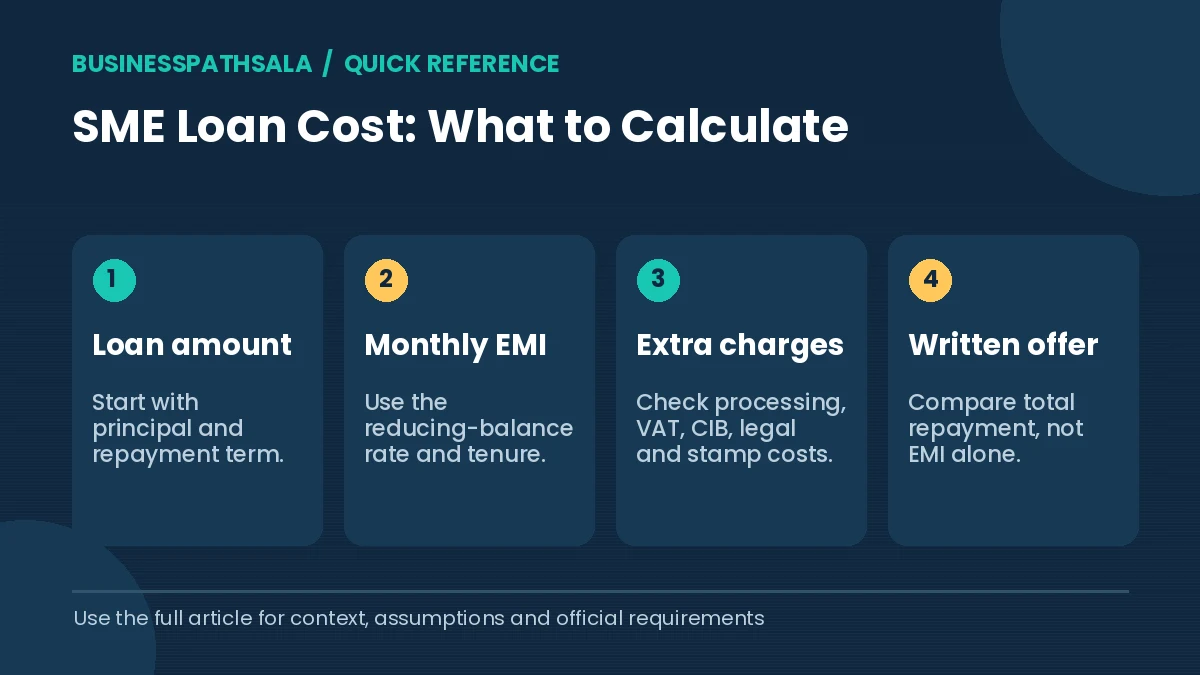
- Add one-time and recurring charges. Include processing fee, applicable VAT, documentation, CIB, stamp, legal, valuation and insurance costs where applicable.
- Compare net cash received with total payments. If charges are deducted at disbursement, you may receive less than the loan principal but still repay instalments calculated on the full principal.
SME loan charges in Bangladesh: what should you check?
“Hidden charges” should mean costs a borrower did not understand or notice before accepting an offer. A fee listed in a bank’s published schedule is not automatically hidden. The practical problem is failing to obtain the schedule, a written cost breakdown and an estimate of third-party expenses before signing.
Bangladesh Bank’s published regulatory summary says banks should display their schedules of charges and should not impose fees or commissions that are undeclared in those schedules. It also describes the restriction on additional service charges beyond the declared interest rate. Read the relevant circular and the bank’s current schedule together; the summary is not a substitute for the latest circular or your facility agreement. Bangladesh Bank: Prudential Regulation for Banks, Selected Issues (April 2024).
1. Loan processing fee
Processing fees are commonly expressed as a percentage, subject to a maximum amount. For example, State Bank of India Bangladesh Operations’ schedule effective 1 May 2026 lists, for working-capital and term loans including CMSME loans, up to 0.50% for loans up to Tk 50 lakh, capped at Tk 15,000, and up to 0.30% above Tk 50 lakh, capped at Tk 20,000. The same schedule lists the loan application fee as nil. This is SBI’s published schedule, not a universal rate for every bank. SBI Bangladesh Schedule of Charges (effective 1 May 2026).
ONE Bank’s schedule effective 15 March 2026 shows a similar cap structure for CMSME loans: up to 0.5% or Tk 15,000, whichever is lower, for loans up to Tk 50 lakh; and up to 0.3% or Tk 20,000, whichever is lower, above Tk 50 lakh. It separately lists documentation, legal and valuation, mortgage, CIB and stamp costs at actual. ONE Bank Schedule of Charges (15 March 2026).
Example: on a Tk 20 lakh facility, 0.50% equals Tk 10,000 before any applicable VAT. Do not multiply a percentage fee by the loan amount without checking the cap and the exact product category.
2. VAT on applicable fees
Some bank schedules state that VAT applies to fees and charges under prevailing NBR rules, subject to exemptions. SBI’s May 2026 schedule states that VAT is applicable on fees at the then-current 15% rate except where waived by NBR. If a fee is Tk 10,000 and 15% VAT applies, the fee plus VAT would be Tk 11,500. Confirm the tax treatment of each item; do not apply 15% automatically to every amount in a loan quotation.
3. Documentation and agreement costs
Documentation charges may cover preparation or handling of loan agreements, demand promissory notes, guarantees, hypothecation documents, lien documents and other papers. Some banks list fixed amounts for particular documents, while others recover actual costs. Ask for an itemised list and receipts or supporting details for costs described as “at actual”.
4. CIB report charge
A lender may recover the cost of a Credit Information Bureau (CIB) search where its schedule allows. BRAC Bank’s published SME lending schedule lists a CIB report charge of Tk 100 plus VAT for each search and states that it is nil for loan amounts up to Tk 10 lakh. This is a bank-specific published example; check the schedule for your own lender and product. BRAC Bank SME Lending and Trade Schedule of Charges.
5. Legal, valuation and mortgage expenses
If the facility is secured by land, a building, machinery or another asset, the bank may require legal review, title verification, valuation, search, mortgage documentation or registration-related work. These expenses depend on the asset, location, professional service provider and documentation. Request an estimate before proceeding. “At actual” should be explained with the expected service and a supporting bill.
6. Stamp duty and other third-party costs
Stamp and statutory costs can arise from the documents required for a facility. The exact amount depends on the instrument and applicable law. Ask the bank to distinguish government duties from the bank’s own service fees and from third-party professional costs. Avoid accepting one unexplained lump sum.
7. Early or partial settlement fee
If you expect to repay early, ask whether the facility allows partial or full settlement and how any fee is calculated. ONE Bank’s March 2026 schedule lists no partial or early settlement fee for cottage, micro and small industry facilities, while it lists 0.50% on the early-settlement amount for certain term-loan or lease EMI facilities outside those segments. BRAC Bank’s published schedule similarly distinguishes medium and large term-loan EMI facilities from micro, cottage and small-segment financing. Product and segment classification matter; get the answer in writing.
8. Penal interest or overdue charge
Ask how overdue instalments are treated, what amount the penal charge applies to and when it starts. A penalty may be calculated on an overdue instalment or another defined amount under the agreement and applicable rules. Do not assume it is simply added to the normal EMI. Ask for a sample overdue calculation.
How much cash will your business actually receive?
Suppose a bank sanctions Tk 20,00,000 and deducts a processing fee of Tk 10,000 plus illustrative VAT of Tk 1,500. If another Tk 8,500 in documented costs is deducted or paid at disbursement, the business may receive Tk 19,80,000 while the repayment schedule is based on the sanctioned principal of Tk 20,00,000. In this illustration, the borrower should compare the net amount received with the total instalments and separately paid charges.
Not every bank deducts all fees from the disbursement. Some require payment separately, some recover costs later, and some costs depend on actual legal or valuation work. The example is a way to organise the quotation, not a prediction of what a bank will charge.
Flat fee vs percentage fee: calculate the cap correctly
Where a schedule says “0.50% or Tk 15,000, whichever is lower”, calculate both amounts and use the lower one, provided that the same product and loan bracket apply. For a Tk 20 lakh loan, 0.50% is Tk 10,000, so the percentage amount is lower than the cap. For a Tk 40 lakh loan, 0.50% is Tk 20,000, but the cap would limit the fee to Tk 15,000. VAT, if applicable, is then considered according to the schedule and tax rules.
For loans above Tk 50 lakh, a schedule may use a lower percentage and a separate cap. Always read the exact wording, including whether the cap applies before VAT or after VAT. If the document is unclear, ask the bank to show the calculation on its quotation.
How to compare two SME loan offers fairly
Use the same loan amount, tenure and repayment assumptions for both offers. Then compare:
- Sanctioned principal and net amount disbursed
- Annual interest or profit rate and whether it can change
- Reducing-balance or flat-rate method
- Monthly instalment and total instalments
- Processing fee, applicable VAT and application fee
- Documentation, CIB, stamp, legal, valuation and mortgage expenses
- Insurance or other third-party costs, if required
- Late-payment and early-settlement terms
- Grace period, repayment start date and any balloon payment
- Whether the bank can revise the rate and how it will notify you
Ask each bank for a sanction letter or indicative offer, a repayment schedule and a complete schedule of charges. Do not compare one bank’s EMI with another bank’s “starting rate” without matching the tenure and repayment method.
Common mistakes when calculating SME loan EMI
- Using the wrong rate type: entering a flat rate into a reducing-balance calculator gives a misleading result.
- Ignoring fees: EMI alone does not show the total borrowing cost.
- Forgetting VAT: applicable VAT can increase the fee payable.
- Assuming every bank charges the same: published schedules and product rules differ.
- Ignoring variable rates: the instalment or repayment period may change if the rate is revised under the agreement.
- Choosing the longest tenure automatically: a smaller EMI can mean more total interest.
- Not checking early repayment terms: a future cash surplus may not save as much as expected if settlement costs apply.
- Not checking the actual disbursement: deductions can mean the business receives less than the sanctioned amount.
Documents to collect before applying for an SME loan
Each lender sets its own document list. Depending on the business and facility, the bank may request a current trade licence, NID and photographs of owners or directors, e-TIN and tax documents, bank statements, financial statements, sales and purchase records, stock details, rent or ownership documents, partnership deed or company documents, project profile, cash-flow forecast, collateral papers and guarantor information. Use the bank’s official checklist rather than assuming this list is complete.
Business owners preparing a financing file can read our SME loan project profile guide for Bangladesh. For a wider overview of loan types and policy routes, see our CMSME loan guide.
Questions to ask the bank before signing
- Is the interest rate fixed or variable for the entire tenure?
- Is interest calculated on a reducing balance, flat basis or another method?
- What is the exact EMI and total repayment amount?
- How much will be credited to my account after deductions?
- Can I receive an itemised list of all fees and applicable VAT?
- Which charges are fixed and which are “at actual”?
- Are there any charges not shown in the published schedule?
- What is the early-settlement fee for my exact SME category?
- How is overdue interest or a penal charge calculated?
- Can I have the full repayment schedule and schedule of charges before signing?
Frequently asked questions
How much is the EMI for a Tk 10 lakh SME loan in Bangladesh?
It depends on the annual rate and tenure. At an illustrative 12% nominal annual rate over 36 months using reducing-balance monthly instalments, the EMI is approximately Tk 33,214 before fees. Ask the lender for its official schedule.
What is the processing fee for an SME loan in Bangladesh?
There is no single fee for every bank and product. Published examples from several banks use up to 0.50% subject to a Tk 15,000 cap for loans up to Tk 50 lakh and up to 0.30% subject to a Tk 20,000 cap above that threshold. Check the current schedule for your bank and facility.
Can a bank charge a loan application fee?
Bangladesh Bank’s schedule-of-charges framework addresses loan application fees, and the SBI Bangladesh and ONE Bank schedules cited in this guide list the loan application fee as nil for the relevant SME/CMSME facilities. Confirm the rule and the exact product before paying.
They may be legitimate third-party costs where the bank’s schedule and facility require them. They should be disclosed and explained before the borrower commits. Ask for an estimate and supporting documents.
Does a lower EMI mean a cheaper SME loan?
No. A longer repayment period can reduce the monthly EMI but increase total interest. Compare total repayment, upfront costs and the net amount received.
Can I repay an SME loan early without a fee?
It depends on the lender, product and enterprise segment. Some published schedules waive early-settlement fees for cottage, micro and small enterprises, while other facilities may have a fee. Check the exact facility terms in writing.
What is the difference between EMI and total borrowing cost?
EMI is the periodic repayment amount. Total borrowing cost includes interest or profit plus applicable fees, VAT, legal and valuation expenses, insurance and other disclosed costs over the life of the facility.
Final checklist: protect your business before taking the loan
Before accepting an SME loan, calculate the EMI using the correct repayment method, obtain the complete written schedule of charges, check VAT on applicable fees, confirm the amount that will actually reach your account and compare total repayment across lenders. Keep a copy of the sanction letter, repayment schedule, receipts and every fee disclosure. If a charge is not explained or does not appear in the bank’s published schedule, ask the bank to clarify it before paying.
For a comparison of lenders and their SME products, read our guide to the best banks for SME loans in Bangladesh. For current rules, use Bangladesh Bank’s official website and the latest circulars, and confirm product-specific terms directly with the lender.
Disclaimer: This article is for general educational purposes and is not a loan offer or personalised financial advice. Interest rates, charges, VAT treatment, eligibility and repayment terms can change. Verify the current documents with the relevant bank before borrowing.