
Last updated: · By Afra Monira
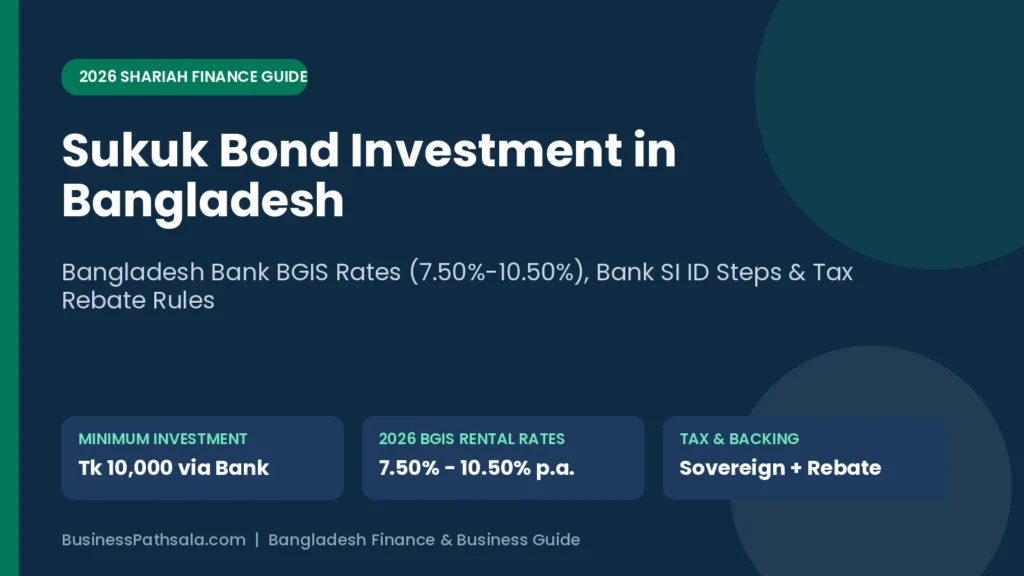
Sukuk bond investment in Bangladesh lets individual investors, businesses, and non-resident Bangladeshis (NRBs) earn Shariah-compliant, asset-backed returns starting from Tk 10,000. In 2026, Bangladesh Government Investment Sukuk (BGIS) issued through Bangladesh Bank offers annualized rental rates between 7.50% and 10.50% across short-term (182-day and 273-day) and long-term (5-year, 7-year, and 10-year) issues, backed by sovereign government assets and eligible for income tax investment rebates.
For years, Bangladeshi savers who wanted to avoid interest-based Sanchaypatra or conventional fixed deposits had only one mainstream halal option: Mudaraba term deposits at Islamic banks. Recent banking-sector stress and bank mergers have made many households rethink keeping large sums in a single commercial bank, where deposit insurance covers only Tk 2,00,000 per depositor. Government Sukuk changes that equation by giving halal-focused investors direct access to sovereign-backed securities with predictable rental schedules.
This guide covers how Sukuk works under Bangladeshi law, the complete list of active Bangladesh Government Investment Sukuk in 2026 (including the upcoming December 1, 2026 short-term auction), worked net-return calculations, step-by-step instructions to open a Sukuk Investor ID (SI ID) through your bank, FY 2026–27 tax and rebate rules, and the very real credit risks separating government Sukuk from corporate Sukuk on the Dhaka Stock Exchange.
What Is a Sukuk Bond and How Does It Work in Bangladesh?
Although people routinely search for “Sukuk bond,” a Sukuk is legally and structurally different from a conventional interest-bearing bond. When you buy a regular Treasury Bond, you lend money to the government and collect interest (coupon payments). When you buy a Sukuk, you purchase undivided beneficial ownership in a real, Shariah-permissible asset or public project—such as rural bridges, primary school buildings, or safe water infrastructure.
In Bangladesh, sovereign Sukuk is issued under the Bangladesh Government Investment Sukuk Guideline 2020 (and subsequent Bangladesh Bank circulars), while private corporate Sukuk is regulated under the Bangladesh Securities and Exchange Commission (Investment Sukuk) Rules, 2019. Nearly all active government Sukuk issues in Bangladesh rely on two Islamic contract structures:
- Ijarah (Lease-Based Sukuk): The government identifies completed or usable public assets and transfers their beneficial ownership to Bangladesh Bank acting as the Special Purpose Vehicle (SPV). Bangladesh Bank issues Sukuk certificates to investors, leases the assets back to the government, and distributes the semi-annual rent to certificate holders. At maturity, the government buys the assets back at face value.
- Istisna’a and Ijarah (Construction + Lease): Used when the project is still under construction, such as building new rural roads or culverts. Investor funds finance construction under an Istisna’a contract, and the completed or partially delivered assets generate Ijarah rental payouts over a 5-year or 7-year tenure.
- Ijarah and Sale (Short-Term BGIS): Introduced in June 2026 for liquidity management, combining short-term asset leasing with a maturity buyback paid as a lump sum after 182 days or 273 days.
Because your return comes from asset rent rather than interest on a cash loan, every BGIS prospectus carries formal certification from Bangladesh Bank’s Shariah Advisory Committee. Non-Muslims can also invest freely—there is no religious restriction on holding Sukuk.

Active Government Sukuk (BGIS) Rates in Bangladesh (2026 Full List)
As of late 2026, Bangladesh Bank has 11 active BGIS issues totaling Tk 53,500 crore outstanding on its official List of Sukuk Outstanding, with a 12th issue—the second Short-Term BGIS worth Tk 3,000 crore—scheduled for auction on December 1, 2026 (Barta24).
Early Sukuk issues from 2021 and 2022 carried low rental rates of 4.65% to 4.75% because market yields were low at the time. By contrast, 2025 and 2026 BGIS issues closely track market benchmarks, paying between 9.25% and 10.50% on 5-to-10-year tenures and 7.50% to 9.36% on short-term issues.
| Sukuk Issue / Project | Tenor | Contract Structure | Issue Date | Maturity Date | Annual Rental Rate | Payout Frequency | Size (Tk Crore) |
|---|---|---|---|---|---|---|---|
| 2nd Short-Term BGIS (Upcoming Auction) | 182 Days | Ijarah | Dec 1, 2026 | Jun 2, 2027 | 7.50% | At Maturity | 3,000 |
| 1st Short-Term BGIS | 273 Days | Ijarah & Sale | Jun 29, 2026 | Mar 29, 2027 | 9.36% | At Maturity | 5,500 |
| 9th BGIS (CAFDRIRP) | 5 Years | Ijarah | Jun 23, 2026 | Jun 23, 2031 | 9.75% | Half-Yearly | 5,600 |
| 8th BGIS (CIBRR-1 Rural Bridges) | 7 Years | Ijarah | May 14, 2026 | May 14, 2033 | 10.40% | Half-Yearly | 5,900 |
| 7th BGIS (IRIDPNFL) | 7 Years | Ijarah | Feb 10, 2026 | Feb 10, 2033 | 9.60% | Half-Yearly | 2,500 |
| Govt Special Sukuk-1 | 10 Years | Ijarah | Jan 14, 2026 | Jan 14, 2036 | 9.75% | Half-Yearly | 10,000 |
| 6th BGIS (RDIRWSP) | 7 Years | Ijarah | May 20, 2025 | May 20, 2032 | 10.50% | Half-Yearly | 2,000 |
| 5th BGIS (CIBRR-2) | 7 Years | Istisna’a & Ijarah | Mar 13, 2025 | Mar 13, 2032 | 9.25% | Half-Yearly | 3,000 |
| 4th BGIS (CDWSP Social Impact) | 5 Years | Istisna’a & Ijarah | Jun 6, 2024 | Jun 6, 2029 | 10.40% | Half-Yearly | 1,000 |
| Safe Water Supply (Extended) | 10 Years | Ijarah | Dec 29, 2020 | Dec 29, 2030 | 9.51% | Half-Yearly | 8,000 |
Note: Two older 5-year issues—Primary Schools Phase 1 (4.65%, maturing Dec 30, 2026) and IRIDP-3 (4.75%, maturing Apr 20, 2027)—remain outstanding for Tk 5,000 crore each, bringing total active outstanding Sukuk before the December 1 auction to Tk 53,500 crore.
If you want to compare these rental yields against conventional government debt before choosing an instrument, check our updated breakdown of Treasury Bond interest rates in Bangladesh for 2026.
How Much Can You Actually Earn? Worked Net Return Examples
Rental rates published in a Bangladesh Bank prospectus are gross annual rates before tax. Under Bangladesh’s Income Tax Act 2023, 10% Tax Deducted at Source (TDS) is deducted from your Sukuk rental payout before it reaches your bank account. There is no separate management fee charged by Bangladesh Bank for holding BGIS directly via a bank SI ID (though individual commercial banks may apply nominal account maintenance or custody charges—always confirm your bank’s schedule of charges first).
The two illustrative examples below show what a Bangladeshi individual actually receives in hand:
Example 1: Tk 5,00,000 in a 7-Year Long-Term BGIS (at 10.40% Annual Rent)
- Gross annual rent: Tk 5,00,000 × 10.40% = Tk 52,000 per year
- Gross half-yearly payout (every 6 months): Tk 26,000
- Less 10% source tax (TDS) per payout: − Tk 2,600
- Net cash credited to your bank every 6 months: Tk 23,400 (Tk 46,800 net per year)
- Principal returned at maturity (Year 7): Tk 5,00,000 in full
- Bonus tax rebate value: Investing Tk 5,00,000 in a government security counts toward your FY 2026–27 investment tax rebate (up to 10% of eligible investment, subject to statutory caps), potentially saving up to Tk 50,000 in annual income tax if your taxable income is high enough.
Example 2: Tk 1,00,000 in the 182-Day Short-Term BGIS (at 7.50% Annualized Rent)
- Gross 182-day lump-sum rent: Tk 1,00,000 × 7.50% × (182 / 365) ≈ Tk 3,740
- Less 10% source tax (TDS): − Tk 374
- Net rent paid at maturity (June 2, 2027): ≈ Tk 3,366
- Total credited to your bank account on maturity: ≈ Tk 1,03,366
Short-term BGIS pays less than 5-to-7-year Sukuk, just as 182-day Treasury Bills pay less than long-term bonds when interest rates begin easing. Its appeal is liquidity: your cash is tied up for only six months instead of five or seven years, making it practical for SMEs parking surplus working capital or households saving for a near-term goal.
Government Sukuk vs. Islamic Bank FDR vs. Sanchaypatra (2026 Comparison)
Savers often hesitate between Government Sukuk, an Islamic bank Mudaraba term deposit (FDR), and National Savings Certificates (Sanchaypatra). Each serves a slightly different goal in a Bangladeshi portfolio.
| Feature | Government Sukuk (BGIS) | Islamic Bank FDR (Mudaraba) | Sanchaypatra (National Savings) |
|---|---|---|---|
| Shariah-Compliant? | Yes (Asset-backed Ijarah / Istisna’a) | Yes (Mudaraba profit-sharing) | No (Interest-based) |
| Issuer & Safety | Government of Bangladesh (Sovereign) | Individual commercial bank (insured up to Tk 2 lakh) | Government of Bangladesh (Sovereign) |
| 2026 Gross Return | 7.50%–10.50% (varies by auction & tenor) | Bank-declared provisional rate (typically 8%–11%, not guaranteed) | 11.77%–11.98% (July–Dec 2026 rates) |
| Minimum Investment | Tk 10,000 (and multiples of Tk 10,000) | Usually Tk 10,000–Tk 50,000 | Tk 10,000 (Poribar) / Tk 1,00,000 (3-Monthly) |
| Maximum Investment Cap | No individual NID cap (subject to auction allotment) | No cap | Tk 50 lakh per NID (Tk 1 crore for pensioners) |
| Early Exit / Liquidity | No premature encashment; must sell in secondary/OTC market | Premature encashment allowed at reduced profit | Premature encashment allowed at lower year-wise rate |
| Tax on Return (TDS) | 10% TDS on rent | 10% (with PSR) or 15% (without PSR) | 5% up to Tk 5 lakh; 10% above Tk 5 lakh |
| Investment Tax Rebate | Yes (counts within Tk 5 lakh govt-securities cap) | No (ordinary FDR does not qualify) | Yes (counts within Tk 5 lakh govt-securities cap) |
For Shariah-conscious investors, Government Sukuk beats an Islamic bank FDR on two critical fronts: sovereign credit safety (zero exposure to a single weak bank) and income tax rebate eligibility. On the other hand, if Shariah compliance is not a personal requirement and your investment is Tk 10 lakh or less, Sanchaypatra currently delivers a higher nominal rate and easier premature encashment—you can review the latest Sanchaypatra without tax return rules for 2026 or compare conventional government options in our guide on Sanchayapatra vs Treasury Bond in Bangladesh.

How to Buy Sukuk in Bangladesh: Step-by-Step Guide for Individuals & NRBs
Individual investors cannot walk into Bangladesh Bank and bid directly on their own. According to Bangladesh Bank’s Government Securities Market FAQ, resident individuals, corporate entities, and NRBs participate through any scheduled commercial bank or financial institution that maintains a current or Al-Wadiah current account with Bangladesh Bank.
Required Documents to Open a Sukuk Investor ID (SI ID / BPID)
Before you can bid in a primary auction or buy Sukuk on the secondary market, your bank must register you on Bangladesh Bank’s Shariah Securities Module (SSM) and issue a Business Partner Identification / Sukuk Investor ID (SI ID). Based on commercial bank wealth-management checklists such as Prime Bank’s Sukuk FAQ, prepare the following:
- Completed Bank Application Form & Standing Instruction (SI): Authorizes your bank to debit investment funds and credit half-yearly rentals directly to your account.
- National ID (NID) or Valid Passport: Original for verification plus photocopy.
- Recent Passport-Size Photograph: Of the applicant.
- e-TIN Certificate: Required by most commercial banks during BPID/SI ID onboarding. If you do not have one yet, follow our walkthrough on how to get an e-TIN certificate online in Bangladesh.
- Nominee Documents: Photocopy of the nominee’s NID, passport, or birth certificate plus passport-size photo.
- Active Bank Account: A resident savings/current account (or an NFCD / NITA account for Non-Resident Bangladeshis and foreign investors).
6 Steps to Invest in a Primary BGIS Auction
- Contact your bank’s Treasury or Islamic Wealth Desk: Visit or call a scheduled bank where you already hold an account (e.g., Islami Bank, Prime Bank, City Bank, BRAC Bank, Eastern Bank, IFIC Bank, or Sonali Bank) and request to open a Sukuk Investor ID (SI ID).
- Submit KYC documents at least 2–3 business days before auction: Banks must verify your documents and generate your SI ID before the auction cut-off. For example, for the December 1, 2026 short-term BGIS auction, Bangladesh Bank advised new investors to complete SI ID registration by November 29, 2026.
- Check the official Bangladesh Bank prospectus: Review the tenure, rental rate, payout schedule, and tradability clause on Bangladesh Bank’s prospectus page before committing funds.
- Fund your bank account: Deposit your investment amount in multiples of Tk 10,000 (minimum Tk 10,000).
- Submit your bid instruction on auction day: Instruct your bank to place your bid online through the Shariah Securities Module (SSM) during the official auction window (typically 10:00 AM to 1:00 PM). Note that if an auction is heavily oversubscribed by Islamic banks, allotments are distributed proportionately based on Bangladesh Bank’s allocation rules.
- Confirm allotment and receive semi-annual rent: Allocated Sukuk units are reflected electronically in your SI ID (usually by 3:00 PM on auction day), and any unallotted funds are released back to your account. All rentals and maturity proceeds arrive automatically in your linked bank account.
Rules for Non-Resident Bangladeshis (NRBs) and Foreign Investors
NRBs and foreign individuals can legally invest in Bangladesh Government Investment Sukuk by routing funds through a Non-Resident Foreign Currency Deposit (NFCD) account or a Non-Resident Investor’s Taka Account (NITA) held with a Bangladeshi bank. Both periodic rental payouts and final maturity principal (net of applicable taxes) are fully repatriable abroad in foreign currency, making BGIS one of the few sovereign Shariah-compliant instruments accessible to the Bangladeshi diaspora.
Government Sukuk vs. Corporate Sukuk: Critical Risks You Must Know
Not all Sukuk in Bangladesh carry the same safety profile. Mixing up a sovereign Bangladesh Government Investment Sukuk (BGIS) with a private corporate Sukuk listed on the Dhaka Stock Exchange (DSE) is one of the costliest mistakes a retail investor can make.
1. Sovereign Credit vs. Corporate Default Risk (The Beximco Lesson): Government Sukuk (BGIS) is backed by the full faith, credit, and sovereign guarantee of the Government of Bangladesh. Private corporate Sukuk, by contrast, depends entirely on the financial health and cash flow of the issuing company. Bangladesh’s flagship corporate issue, Beximco Green Sukuk Al Istisna’a (BEXGSUKUK, face value Tk 100, listed on DSE in 2022), illustrates this risk starkly: as of November 22, 2026, it was trading at Tk 82.50 on the Dhaka Stock Exchange, while BSEC and trustee ICB were weighing a restructuring and maturity extension proposal covering roughly Tk 2,800 crore in outstanding principal. Always treat corporate Sukuk as high-risk credit investments—never as a substitute for sovereign Sukuk.
2. Secondary Market Liquidity Risk: Unlike Sanchaypatra or bank FDRs, Government Sukuk cannot be prematurely encashed with Bangladesh Bank before maturity. While BGIS certificates are tradable in the secondary/over-the-counter (OTC) market through banks, retail trading volume remains relatively thin. If you need to sell a 7-year Sukuk after 18 months, you must find a buyer through your bank’s treasury desk at a negotiated price, which can be below face value if market profit rates have risen since your purchase.
3. Allocation Competition at Auctions: Because Bangladesh’s Shariah-based banks hold large liquidity pools and need Sukuk to meet Statutory Liquidity Ratio (SLR) requirements and access the Islamic Bank Liquidity Facility (IBLF), high-yielding BGIS auctions are often oversubscribed. Individual investors sometimes receive partial allotment rather than 100% of their bid amount.
4. Tax Return Filing for Rebates and Refunds: Under Bangladesh’s FY 2026–27 tax rules (Finance Act 2026), Sukuk rental payouts face 10% TDS at source. To claim the investment tax rebate on your BGIS purchase—or to reconcile excess tax deducted if your total annual income falls below the Tk 3,75,000 tax-free threshold—you must file an annual income tax return. Our step-by-step guide to NBR e-Return online filing for 2026–27 walks through how to report government security investments and claim your rebate.
Frequently Asked Questions (FAQs)
What is the minimum investment amount for Sukuk in Bangladesh?
The minimum investment for Bangladesh Government Investment Sukuk (BGIS) is Tk 10,000, and additional purchases must be in integral multiples of Tk 10,000. On the Dhaka Stock Exchange (DSE), listed corporate Sukuk such as BEXGSUKUK trades with a market lot of 1 unit (face value Tk 100), though corporate Sukuk carries significantly higher credit risk than government Sukuk.
Is Sukuk bond halal in Bangladesh?
Yes. Every Bangladesh Government Investment Sukuk (BGIS) is structured around Shariah-compliant contracts—primarily Ijarah (leasing) and Istisna’a (project construction)—backed by real public assets rather than interest-bearing debt. Each prospectus is reviewed and certified by Bangladesh Bank’s Shariah Advisory Committee prior to issuance.
What is the current profit rate of Bangladesh Government Sukuk in 2026?
Recent 2025–2026 long-term BGIS issues (5-year to 10-year tenures) offer annual rental rates between 9.25% and 10.50%, paid semi-annually. Short-term BGIS issues offer 9.36% (273-day issue from June 2026) and 7.50% (182-day issue scheduled for December 1, 2026), paid as a lump sum at maturity.
Can I withdraw my Sukuk money before maturity?
No, premature encashment with Bangladesh Bank is not allowed for BGIS. However, you can sell your tradable Sukuk units in the secondary market through your scheduled bank’s treasury desk at a negotiated market price (or face value where specified in the prospectus).
Is Sukuk income tax-free in Bangladesh?
No. While your investment in Government Sukuk qualifies for the annual income tax investment rebate (within the Tk 5,00,000 government-securities cap under the Income Tax Act 2023), the periodic rental income you earn is subject to 10% Tax Deducted at Source (TDS).
Can I buy Government Sukuk through a DSE BO account?
Primary BGIS auctions are conducted through Bangladesh Bank’s Shariah Securities Module (SSM) using a bank-issued Sukuk Investor ID (SI ID), not a stockbroker BO account. You must open an SI ID through a scheduled commercial bank to bid in primary auctions or trade BGIS over the counter.
Final Takeaway
Government Sukuk (BGIS) has matured into the strongest Shariah-compliant fixed-income option in Bangladesh. With a Tk 10,000 entry point, sovereign government backing, 7.50%–10.50% rental yields across 2026 issues, and income tax rebate eligibility, it solves both the bank-concentration risk of Islamic FDRs and the interest barrier of Sanchaypatra. Before investing, match the Sukuk tenure to your cash-flow needs—use 182-day or 273-day short-term BGIS for money you may need within a year, reserve 5-to-7-year Ijarah Sukuk for long-term savings, and keep a clear boundary between sovereign BGIS and higher-risk corporate Sukuk.
Financial Information Disclaimer: This article is for informational purposes only and reflects publicly available Bangladesh Bank prospectuses, BSEC regulations, DSE market data, and Income Tax Act 2023 provisions as of November 2026. Sukuk rental rates vary with every auction, and tax rules may change by government notification. Confirm current auction schedules, bank custody fees, and tax treatment with your scheduled bank or a qualified Bangladeshi tax advisor before investing.
