
Last updated: · By Sumon Mahmud
Comparing mutual fund vs FDR vs treasury bond in Bangladesh comes down to what you actually keep after taxes, how soon you might need your cash, and whether you want a 10% investment tax rebate. Under the Finance Act 2026 rules, Bank FDRs offer zero tax rebate and their interest is taxed at your marginal income slab (up to 30%), making them best strictly for 3-to-12-month emergency cash. Bangladesh Government Treasury Bonds (BGTBs) lock in sovereign yields (10-year BGTB yields hovered around 9.20%–10.15% in late 2026) with zero default risk and qualify for the investment tax rebate. BSEC-approved Mutual Funds (especially fixed-income funds) now qualify for up to a BDT 75 lakh tax-rebate allowance, and capital gains on mutual fund units are 100% tax-free up to BDT 50 lakh for individual investors.
Most comparison articles on Bangladeshi finance sites still quote outdated 15% tax rebate formulas, ignore direct Treasury Bonds, or push a single asset manager’s fund. This unbiased 2026 guide compares all three options side by side after Bangladesh Bank’s July 2026 repo rate cut to 9.50%, walks through real after-tax taka returns, and shows how to split your money across them.
Mutual Fund vs FDR vs Treasury Bond in Bangladesh (2026 Comparison)
Before moving a lump sum or starting a monthly savings plan, compare how BSEC-approved mutual funds, commercial bank Fixed Deposit Receipts (FDRs), and government Treasury Bonds perform across risk, tax treatment, and liquidity.
Choosing between these investment products becomes easier when you first understand your financial goals, risk tolerance and overall personal finance strategy.
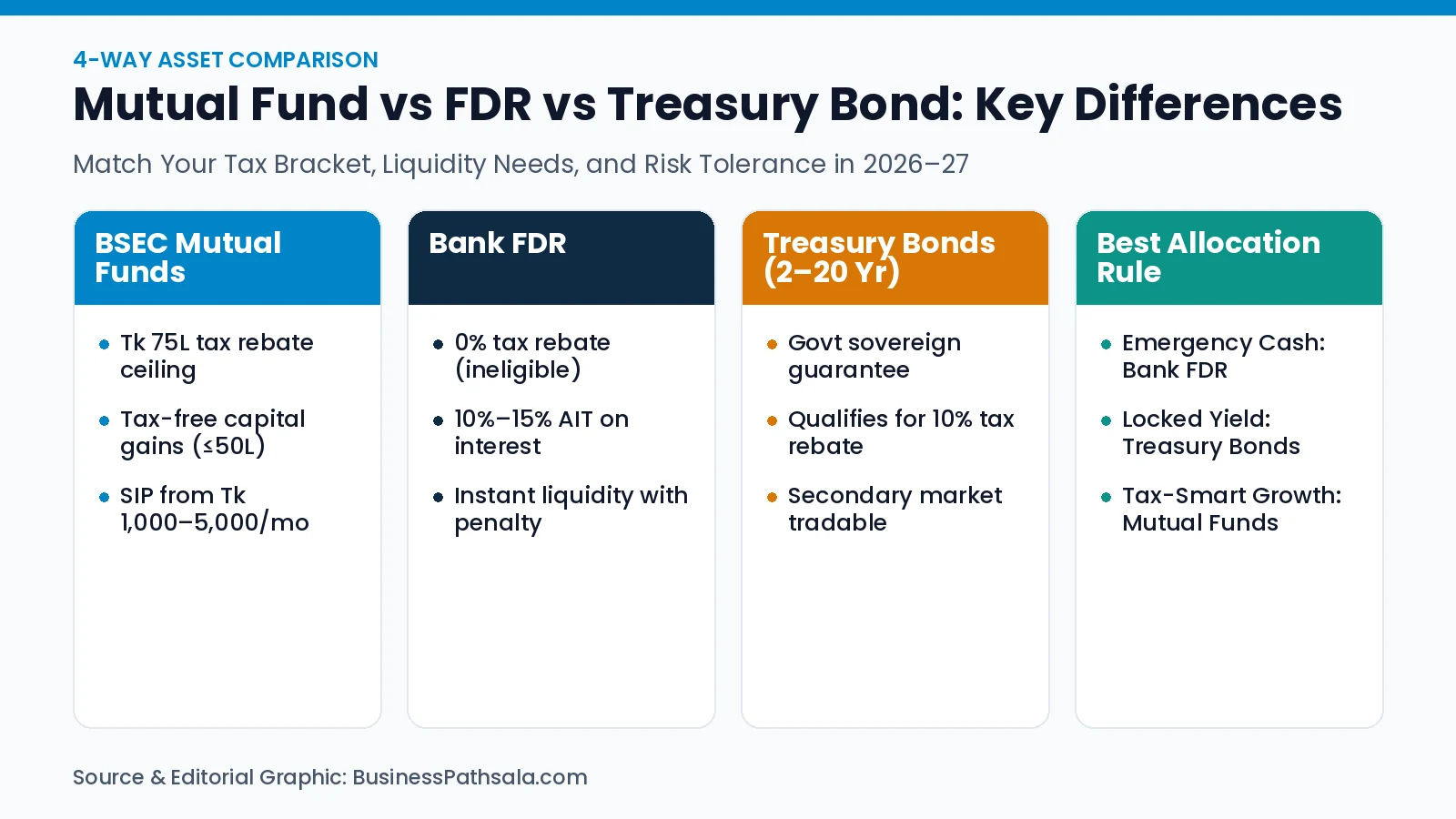
| Feature | BSEC-Approved Mutual Fund | Commercial Bank FDR | Bangladesh Govt Treasury Bond (BGTB) |
|---|---|---|---|
| Capital Safety & Issuer Risk | Market-linked NAV; held by independent custodian & trustee (varies: income vs equity) | Fixed contractual rate; depends on the issuing bank’s financial health | Sovereign guarantee backed by the Government of Bangladesh |
| Tax Rebate Eligibility (2026–27) | Yes — up to BDT 75 lakh annual cap (10% rebate rate) | No (0% tax rebate) | Yes — qualifies under government securities |
| Tax on Returns / Gains | Capital gains tax-free up to BDT 50 lakh/yr; 15% tax on individual dividends | Interest taxed at your marginal income slab (up to 30%) | Coupon interest subject to applicable withholding/income tax |
| Liquidity & Early Exit | Redeemable anytime at NAV (some funds charge 1% exit load for 30–90 days; check rebate lock-in) | Instant encashment anytime (reduces interest rate to savings rate) | Tradable on secondary market via bank/broker (price moves with rates) |
| Minimum Investment / SIP | SIP from BDT 1,000–5,000/month or lump sum | Lump sum (typically BDT 10,000–50,000+) | Auctions typically start at BDT 1,00,000 (or multiples) |
1. Bank FDR: Simple Fixed Return, Heavy Tax Drag
A commercial bank Fixed Deposit Receipt (FDR) pays a contractually agreed interest rate over 3, 6, 12, or 24 months. It is the simplest place to park an emergency reserve or short-term business working capital because you know the exact maturity payout on day one.
However, FDRs carry two major drawbacks in 2026. First, an FDR gives zero investment tax rebate under Part 3 of the Sixth Schedule. Second, following Bangladesh Bank’s July 30, 2026 policy rate cut (lowering the repo rate to 9.50%), commercial banks gradually trim deposit rates on new renewals, while the interest you earn is taxed at your marginal income tax slab (10% to 30% depending on your bracket). Also remember that an FDR is only as safe as the specific bank holding your deposit—an abnormally high FDR rate often signals a bank facing liquidity stress.
2. Bangladesh Government Treasury Bonds (BGTBs): Sovereign Yield + Rate Upside
Bangladesh Government Treasury Bonds (available in 2, 5, 10, 15, and 20-year tenors through Bangladesh Bank’s Government Securities Market) represent direct lending to the sovereign government. According to CEIC long-term yield data, 10-year BGTB yields stood around 9.20% to 10.15% in mid-to-late 2026.
Treasury Bonds hold an important mechanical advantage when central bank policy rates fall: existing bonds issued earlier at higher coupon rates rise in market value on the secondary market. Unlike Sanchayapatra (which caps tax-rebate eligibility at BDT 5 lakh), direct government securities qualify within the higher securities allowance. To learn the exact account setup, read our walkthrough on how to buy Bangladesh government treasury bills and bonds, or compare them with savings certificates in Sanchayapatra vs Treasury Bond in Bangladesh.
3. BSEC-Approved Mutual Funds: The 2026 Tax-Efficiency Winner
Many Bangladeshi savers assume all mutual funds are risky stock-market bets. In reality, comparing an equity growth fund to a bank FDR is an apples-to-oranges comparison. The fair low-risk match is a fixed-income or GSEC mutual fund that invests primarily in government treasury bills, treasury bonds, and high-grade corporate instruments.
Under the Finance Act 2026, mutual funds gained two decisive advantages for salaried and high-bracket investors:
- BDT 75 Lakh Tax Rebate Headroom: Previously capped at BDT 5 lakh per year, BSEC-approved mutual funds now qualify for up to BDT 75 lakh toward your annual 10% investment tax rebate (capped at 3% of taxable income or BDT 7.5 lakh). See all eligible brackets in our tax rebate investment options in Bangladesh guide.
- Tax-Free Capital Gains (Up to BDT 50 Lakh): According to 2026 Bangladesh capital gains tax rules, gains realized by individual investors on mutual fund units are tax-exempt up to BDT 50 lakh per year, whereas individual dividend payouts are taxed at 15% (20% for companies).
Keep two caveats in mind: mutual fund returns are market-linked and not contractually guaranteed like an FDR, and redeeming rebate-claimed units before their statutory holding period triggers a tax-rebate clawback under Part 3 of the Sixth Schedule.
After-Tax Return Math: What BDT 5,00,000 Earns in Each Option
Headline interest rates hide what you actually keep after NBR taxes. Consider an illustrative example of a salaried taxpayer in the 20%–25% marginal tax bracket investing BDT 5,00,000 for 12 months:
| Metric (Illustrative BDT 5,00,000) | Bank FDR (e.g., 9.5% Gross) | 10-Yr Treasury Bond (e.g., 9.5% Coupon) | Fixed-Income Mutual Fund (e.g., 9.5% Growth) |
|---|---|---|---|
| Gross Annual Return | BDT 47,500 | BDT 47,500 | BDT 47,500 (indicative NAV growth) |
| Tax on Return (25% Bracket) | -BDT 11,875 (taxed at slab) | -BDT 11,875 (subject to income tax) | BDT 0 (capital gains exempt up to Tk 50L) |
| Upfront Tax Rebate (10%) | BDT 0 (ineligible) | Up to BDT 50,000 (within 3% income cap) | Up to BDT 50,000 (within 3% income cap) |
| Net After-Tax Return (Excl. Rebate) | BDT 35,625 (~7.13% net) | BDT 35,625 (~7.13% net + sovereign safety) | BDT 47,500 (~9.50% net if realized as capital gain) |
Even before counting the 10% upfront tax rebate, keeping returns as tax-exempt capital gains instead of slab-taxed bank interest preserves thousands of taka every year for taxpayers in the 15% to 30% brackets.
5 Rules to Split Your Money Between Funds, FDRs, and Bonds
Instead of forcing 100% of your savings into one product, match each instrument to its specific financial job.
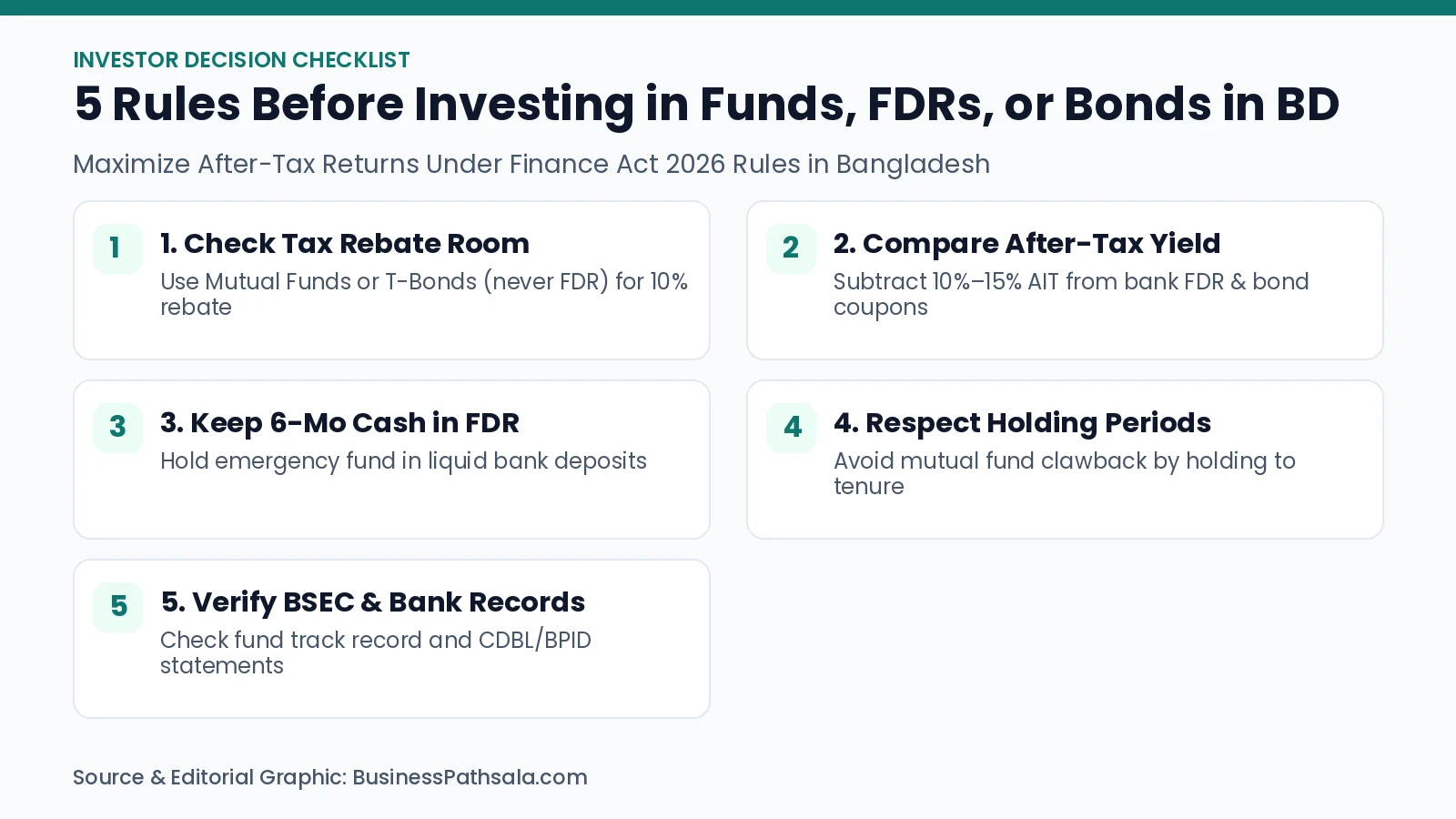
- Keep 3 to 6 months of household expenses in a strong Tier-1 commercial bank FDR or SND account for zero-volatility emergency liquidity.
- Never use a bank FDR to chase a tax rebate; fill your 30% taxable-income rebate allowance using BSEC-approved mutual funds, Treasury Bonds, or monthly Bank DPS accounts (up to BDT 1.2 lakh/year).
- For long-term 5-to-20-year capital preservation with guaranteed sovereign backing, buy Bangladesh Government Treasury Bonds directly through your bank’s BPID or brokerage BO account.
- If you prefer automated monthly investing (SIP) without worrying about BDT 1 lakh auction minimums, choose a reputable fixed-income or balanced open-end mutual fund regulated by BSEC.
- Declare all investments, capital gains, and source-tax (AIT) slips accurately in your annual NBR e-Return, and compare other low-risk options in our where to invest money in Bangladesh safely and Universal Pension Scheme Bangladesh guides.
Frequently Asked Questions (FAQs)
Which gives better after-tax returns in Bangladesh: mutual fund, FDR, or treasury bond?
For taxpayers in the 15% to 30% income tax brackets, fixed-income mutual funds often deliver higher after-tax returns because capital gains up to BDT 50 lakh are tax-free for individuals and investments up to BDT 75 lakh qualify for the 10% tax rebate—whereas bank FDR interest is taxed at your marginal slab and earns no tax rebate.
Is a Bangladesh Government Treasury Bond safer than a bank FDR?
Yes, from a credit-default perspective. Treasury Bonds carry the full sovereign backing of the Government of Bangladesh, whereas a bank FDR depends on the solvency of the individual commercial bank.
Does a bank FDR qualify for an income tax rebate in Bangladesh?
No. Standard bank Fixed Deposit Receipts (FDRs) do not qualify for the investment tax rebate under Part 3 of the Sixth Schedule of the Income Tax Act, 2023. Only approved monthly DPS accounts (up to BDT 1.2 lakh/year), mutual funds, listed shares, Sanchayapatra, and government securities qualify.
Can I lose money in a fixed-income mutual fund compared to an FDR?
Unlike an FDR that guarantees a fixed contractual rate, a mutual fund’s Net Asset Value (NAV) fluctuates with the market prices of the bonds and securities inside the fund. Fixed-income funds investing in short-term Treasury Bills carry much lower volatility than equity mutual funds, though returns remain market-linked.
What is the tax rate on mutual fund dividends vs capital gains in Bangladesh?
Under Finance Act 2026 rules, capital gains realized by individual investors on BSEC-approved mutual fund units are tax-exempt up to BDT 50 lakh per year (15% above that), while cash dividends paid to individuals are taxed at 15% at source (20% for corporate investors).


